SATURDAY POETRY SERIES PRESENTS: ANYA SILVER

FRENCH TOAST
By Anya Silver

Pain perdu: lost bread. Thick slices sunk in milk,
fringed with crisp lace of browned egg and scattered sugar.
Like spongiest challah, dipped in foaming cream
and frothy egg, richness drenching every yeasted
crevice and bubble, that’s how sodden with luck
I felt when we fell in love. Now, at forty,
I remember that “lost bread” means bread that’s gone
stale, leftover heels and crusts, too dry for simple
jam and butter. Still, week-old bread makes the best
French toast, soaks up milk as greedily as I turn
toward you under goose down after ten years
of marriage, craving, still, that sweet white immersion.


Today’s poem was previously published in The Ninety-Third Name of God (LSU Press, 2010), and appears here today with permission from the poet.


Anya Silver’s book of poetry, The Ninety-Third Name of God, was published by LSU press. She teaches at Mercer University and lives in Macon, Georgia with her husband and son.

Editor’s Note: I am not usually one for love poems. This week the love of my life proposed, and—in my nerdy, poetry-loving way—I scoured the internet for a love poem worthy of commemorating the event. My search dragged me through the stick of syrupy pieces, insulted me with poems of the butterflies-and-rainbows variety, and meandered through poems of antiquity that incited sleep instead of expressing in a visceral way this moment of elated love. And then I read “French Toast.”

I find myself unequipped to elaborate on why today’s poem is an example of expert craftsmanship. Unequipped because Anya Silver is a master of words, and my own seem slack in comparison.

As I read today’s poem aloud, I savor the feel of the words in my mouth. Words that mimic the sweetness of the dish they describe. A dish that is not a food, but a metaphor. A metaphor that is so successful, so unexpected, that it nearly redefines the idea of metaphor itself. At the very least, it becomes the standard against which metaphor should be held, and it sets the bar incredibly high.

All that, and it is a love poem! And not a poem inspired by the fleeting passion of new love, but a poem that speaks to what it is to make a life with someone. To love and desire someone as sincerely ten years into a committed relationship as you did when you first felt “sodden with luck” for falling in love.

This is a poem of optimism. A poem that inspires me to love my man fiercely for the rest of my life. This is the poem to express my heart’s desires for our impending union. I thank Anya Silver for this gift, and I dedicate today’s poem to Matt Teitelman, my soon-to-be husband and the love of my life. May our love be like french toast forever.

Want to see more by and about Anya Silver?
Buy The Ninety-Third Name of God on Amazon
Listen to “French Toast on The Writer’s Almanac with Garrison Keillor (Listen at 3:05)
Anya Silver Featured as Image Journal’s Artist of the Month: October 2010

SATURDAY POETRY SERIES PRESENTS: ERIN LYNDAL MARTIN

AT BUCKFAST ABBEY: AFTER THE BEE BURNINGS
By Erin Lyndal Martin

I know they were here.
Their vertigo twists around
the wind.      It is my sickness too.

I play blind, smooth over tree trunks with my palms.
I smell the soot of brimstone, the dangling of a hive.

Daylight hard as leaves.   I smell the smoke.
Skeps still burn like witches.

              They used to harvest honey by burning up the hive.
              Bee bodies and a single rhubarb leaf
              kindled the flame for beekeepers
              to mine with bare hands.

                            The rest of the comb
              they melted down cell by soggy cell
until the wax was useful light.

                            And honeybees, they say,
              were the first tears
                            cried on the cross.

              ~

              Ghost bees shiver,
                            here a leg stuck in resin,
              here a wing in the grit of pollen.

                            I can feel their flight
              trying to make these woods
                            warm again.

              I’m asking for the bees back.
              If it’s in your power,

make the stark and sketchy treetops
              look less like junkie tourniquets
and more like apologies.

                                           Make the trees say they’re sorry
                                                   they kept growing
                            after thirty thousand hearts
                                           were burned.

                                           If it’s in your power, make me say
                                                   I’m sorry too.

              ~

                                           There’s still the scent of smoke
              in the air, maybe from a bonfire,
                            maybe not, and beneath it is the
              sticky hum of amber, and somewhere
                                           beneath that is me—notebook,
                                                   cigarette lighter, plastic bag.

              I can hear the vespers next door.
              The living are praying,

                            but I need the ash
              and the burned-out bees,
              the brimstone to be wise.

                          I want to ink out
              the taste of charred honey
                                           so I can be glad when there is no fire.

                                           Learn this lesson for me.   Tell me what
                            not to do, how to keep without taking,

                                           how to do better,
              here, now, my hair in my eyes,
                                           a pencil in my hair.


(Today’s poem previously appeared in Diode, and appears here today with permission from the poet.)


Erin Lyndal Martin is a poet, fiction writer, and music journalist. Her work has recently appeared in Guernica, InDigest, and Crowd. She is associate fiction editor for H_ngm_n and runs the music website Euterpe’s Notebook.

Editor’s Note: I have had today’s poem in my arsenal for a few weeks now, but something told me to save it for today. I write today’s entry from my own Abbey, St. John’s Abbey at St. John’s University in Collegeville, MN. I am at the end of a week-long writer’s residency titled “Believing in Writing” at The Collegeville Institute, a workshop centered around writer’s contemplating faith. There could not be a better moment for today’s poem to be featured.

I have had the pleasure of featuring Erin Lyndal Martin’s writing before on this series. When I came across today’s poem in Diode, I was so vividly struck by its story, by its imagery, that I knew I needed to seek the writer out and ask permission to share this startling, beautiful piece. As I searched for the poem’s author I thought, “Erin Lyndal Martin… I know that name… I have loved her work before.”

It never ceases to amaze me how the heart yearns for the same beauty time and again. How I can search the Internet for poetry week after week, month after month, year after year, and then, completely out of context, fall in love with the same poet time and again. So it was with Ms. Martin, a poet whose work I love no matter where in time or space our paths cross. It is as much a pleasure to share her poetry with you today as it was to have her steal away my breath when I read today’s poem.

I dedicate today’s post to Michael Dennis Browne, our fearless leader on this past week’s journey, and to my fellow workshop participants, a group of people whose thoughts and words on faith have reshaped my view of the world.

Want to see more by and about Erin Lyndal Martin?
The Offending Adam
The Diagram
The Collagist

SATURDAY POETRY SERIES PRESENTS: JOHN REPP

Photo by Katherine Knupp


THE LETTER
By John Repp

In the letter,
             she says she doesn’t

want to end
             the letter so I’ll

never stop reading
             this scrap light

as ash in the pit
             where I’ve sworn

for thirty years to burn it


Today’s poem originally appeared in diode and appears here today with permission from the poet.


John Repp is a widely published poet, fiction writer, essayist, and book critic. Since 1978, he has taught writing and literature at various colleges, universities, schools, and social service agencies. A native of southern New Jersey, he has lived for many years in northwestern Pennsylvania with his wife, the visual artist Katherine Knupp, and their son, Dylan.

Editor’s Note: Today’s poem contains the joy of the unsaid. It enables the reader to invent a world—a relationship—from a few fragments of speech. There is so much joy in the power of the small poem, and in language that teases, that alludes to something larger than it shares and enables us to choose our own adventure.

Want to see more by John Repp?
John Repp’s Official Website
Buy John Repp’s Books

Rolling Stone

Rolling Stone

by Steve Davenport

Takes a flood to turn a bottom, make hell
of the houses on stilts and the ones squat
as toads hugging shore dirt. Tree-float and sop’s
the least of it. Takes more than a boat line
to drag a failing body from that noise,
the sucking into the long pull. River’s

anything but solidity of things,
no riprap of rocky words for footing.
River brings flow, flood, and alluvium.
Bottom was never saved by a song. Levee’s what

a river makes of it.

***

Steve Davenport is the author of Uncontainable Noise, which won Pavement Saw Press’s 2006 Transcontinental Poetry Prize. His New American Press chapbook Murder on Gasoline Lake is listed as Notable in Best American Essays 2007, and a story of his, published in The Southern Review, received a Special Mention in Pushcart Prize Anthology 2011. His second book of poems, Overpass, is published by Arsenic Lobster/Misty Publications. The above poem is reprinted from this book by permission of the author.

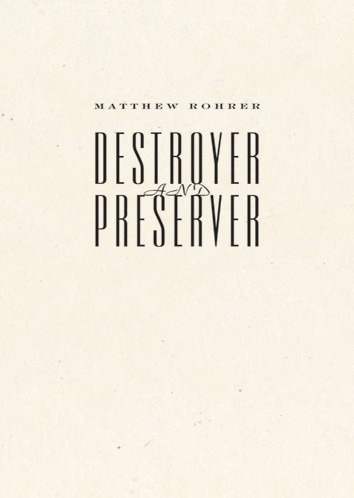
Review of Destroyer and Preserver by Matthew Rohrer

Review of Destroyer and Preserver by Matthew Rohrer

by Letitia Trent

I had a professor during my undergraduate years (one those old-fashioned liberal arts professors who believed that intimately knowing Milton’s Satan or Shakespeare’s Lear was a prerequisite for being a fully-functioning citizen of earth) that defined a great book as a book that shows you what it means to be human. He meant the great, big (and, unfortunately, primarily European or American) books, like War and Peace or Middlemarch, in which an enormous cast of characters weave in and out of each other’s lives, figuring out what it means to be a citizen, part of a family, a soldier, an artist, a lover, or a parent. I appreciate these kinds of books, too, books that are willing to explicitly wrestle with questions about how a person should be in the world and do not fear the explicitly political or philosophical. I don’t know how anyone writes books like this anymore. As Matthew Rohrer writes in the first poem from his book Destroyer and Preserver:

The oldest songs are
breaking apart
like a puzzle in a basement

What kind of writer has the gall to tell people how to live now, when there are no fixed certainties and no unassailable truths? This is not an original question, but one that I find myself bumping into over and over again as I read contemporary literature and poetry that dares to directly touch on the political as Destroyer and Preserver does. While I’ve read many contemporary poetry books that comment on the paranoia and rise of some fervid, defensive American identity that happened post 9-11 (Christian Hawkey’s Citizen Of comes to mind in particular), I don’t see many poets writing in what comes close to straightforward confessional lyric touching the issue of politics aside from Rohrer. Sometimes, when writing about war from the distance of a relatively safe place, the lyric, personal “I” can seem limited, small, stupid, unable to fully grasp anything important from the perspective comfort. Perhaps this is why many poets who are fairly privileged (I know that I am one of them) and who have never seen battle try not to tackle something as large as “the war”.

Destroyer and Preserver tries to show us something about what it means to be a middle-class, materially comfortable human in this particular time in the United States, one in which foreign wars and news of slaughter in countries in which we are linked by politics and war filter in and out of our consciousness through reports from Twitter feeds and Facebook updates, seeming both incredibly important and completely divorced from our everyday lives. I specify that the book is about middle-class life because it differs from many other overtly political books from the standpoint it takes: the speaker is comfortable, white, male, and a father. This is not a book that howls from the edges or speaks as a witness to political and social turmoil. I don’t mention this to belittle the book, but to make it clear from what perspective the book addresses the political. In Carolyn Forche’s introduction to The Poetry of Witness, she writes about the privilege of being a North American in the 20th and 21st centuries: “Wars for us (provided we are not combatants) are fought elsewhere, in other countries. The cities bombed are other people’s cities. The houses destroyed are other people’s houses.” This space is where Destroyer and Preserver comes from.

Part of the book is about the dance between enjoying the privilege we have as North Americans to live our lives relatively unscathed by war and the responsibility to acknowledge that our privileged lives are partly built on the backs of the suffering of other people. Rohrer’s book differs from those big books about morality in that it’s a product of its time, and therefore the poems don’t tell us anything definitive about how to balance joy and responsibility: the subject is not knowing, of feeling guilty for running away to poetry or family life or dreams (the book is full of dreams), and of being politically engaged but not politically engaged enough to leave what is comfortable behind. The speaker in these poems spends his days taking care of small children, recovering from hangovers, and walking around a city as news of what’s happening in the Middle East filters in and out of the central consciousness of the poems. For example, in the poem “Casualties,” the poet’s small son asks “are soldiers good or bad?”, and the speaker meets his son’s confusion with his own:

I see his face, his eyes
right in front of mine.
We are drowning together

in the hold of the ship.
He looks just like me.

The poem leaves us with an image of the plane, having just dropped a bomb on the house and desert, gliding through the sky and being returned to the United States, “to be washed and put away”. Throughout the book, images of war are and desperation are washed and put away and then continually taken out again to be examined, as with the speaker of “Poets With History/Poems Without History”:

… and the melting icebergs crumple

like the prisoners shot in the side

I move through the days remarkably sinuously

and spinning inside

I washed the dishes two or three times a day

with hot water on and on

like a dream behind the yellow gloves

from which I too cannot awaken

though my son is done with school

and holds my hand on the walk home

the feeling of falling backwards

into the bed at night fills me

each time

with sweet content

all the people rounded up in camps

have a look in their eyes

that can’t reach us now

Rohrer is at his best when the speaker of the poems sees this point of tension between a comfortable life and the knowledge that so many other people are not able to have that comfort: the poems are electric when the speaker is both conflicted and ultimately a failure at keeping the high moral ground. They falter, though, when the speaker seems to imply a particular stance is the “good” one: in “For Which I Love You,” the speaker congratulates a lover for a fairly standard, simplistic affirmation against “hate” which reads a little bit like self-congratulation for having the “right” political point of view.

It would be unfair to say that this is only a political book: several short, lyric poems punctuate the book, ranging from records of sad, contradictory moments to poems that seem like sheer celebrations of everyday life, such as “The Smell of Frying Fish.” It’s the context of these poems that makes them political: images of war surface throughout the book in poems that at first seem to be about something completely outside of war, and so these moments of domestic bliss mean something more: is the speaker giving in to forgetfulness or resisting despair by living in the moment (as cliché as that can’t help but sound) by fully embracing the given world around him?

Rohrer’s poems are largely dreamy, personal lyrics that roll from matter-of-fact observation to gentle surrealism, creating poems that seem casually tossed-off yet completely controlled within one lyric event, world, or emotional/narrative moment. You could call it domestic surrealism, but Rohrer’s observations are more about finding the literal strange in the familiar than in creating strangeness. Still yet, reading the book felt too easy: the poems are easy to read and pleasing because Rohrer is good at this kind of poetry and knows what he is doing. I couldn’t help but feel that Rohrer was coasting and that these poems are a slightly toned-down, less boisterous versions of ground he’d already covered in his first book, A Hummock in the Malookas, and his subsequent books. Only in the long poems of the book (“Believe” and “The Terrorists”) does Rohrer seem to stretch beyond his familiar gently joking, gently serious tone.

I can’t say that Destroyer and Preserver left me with anything definitive about how to be a conscientious person in a complex world, but it left me with a useful confusion and the realization of how often I, too, retreat into what’s comfortable in order to forget my own great fortune. I’m not the soldier who crumples, the face behind the cage, or the person whose home has been bulldozed. I have the privilege of forgetfulness, and I exercise it far too often.

***

Letitia Trent‘s work has appeared in the Denver Quarterly, The Black Warrior Review, Fence, and Folio, among others. Her chapbooks are Splice (Blue Hour Press) and The Medical Diaries (Scantily Clad Press). Her first full-length poetry collection, One Perfect Bird, was published by Sundress Press in early 2012. She was the 2010 winner of the Alumni Flash Writing Award from the Ohio State University’s The Journal and has been awarded fellowships from The Vermont Studio Center and the MacDowell Colony.

SATURDAY POETRY SERIES PRESENTS: TERRI KIRBY ERICKSON

DEPRESSION
By Terri Kirby Erickson

Her knees nearly buckle with the weight of a new star,
but oh the sweet relief when one of them falls or when
the sun pulls up its rays like rope ladders because light,
even light is too heavy for her to carry now. And look

at her loose grip on the baby’s stroller, as if any minute
she might let go. Other mothers’ eyes follow their children,
glisten like the wet clay of a newly fashioned Madonna,
but her expression never changes. She sees nothing but

the dull, brown jar where she spends her days alone, its
walls slick and impossible to climb, the lid screwed shut—
feels nothing but cold glass against her back, the tightening
in her chest when she tries to breathe what little air is left.


Today’s poem originally appeared in Tryst, is included in the poet’s latest collection of poetry, In the Palms of Angels (Press 53), and appears here today with permission from the poet.


Terri Kirby Erickson is the award-winning author of three collections of poetry, including her latest book, In the Palms of Angels (Press 53), winner of a 2012 Nautilus Silver Award in Poetry and the Gold Medal for Poetry in the 2012 Next Generation Indie Book Awards. Her work has appeared or is forthcoming in the 2013 Poet’s Market, Ted Kooser’s American Life in Poetry, JAMA, The Christian Science Monitor, storySouth, and many other publications. She lives in North Carolina.

Editor’s Note: Terri Kirby Erickson has a way with direct, straightforward narrative poetry. You are at once within the scene she is painting, carried along by her skill with the lyric and the image, amidst a palpable world where you feel you could actually pluck the fruit from the trees of her invention. Today’s poem captures the inner workings of a sometimes secret condition, yet Erickson’s words bridge the shame gap by giving rise to empathy in the reader.

Want to see more by Terri Kirby Erickson?
Terri Kirby Erickson’s Official Website
Press 53 Author Page
Buy In the Palms of Angels on Amazon
Buy Telling Tales of Dusk on Amazon
Buy Thread Count on Amazon

SATURDAY POETRY SERIES PRESENTS: JOHN PAUL DAVIS

MYSELF, WITH THE NIGHT ON MY FACE
By John Paul Davis

For an angel went down at a certain season into the pool, and troubled the water: whosoever then first after the troubling of the water stepped in was made whole of whatsoever disease he had.    – The Gospel of John 5:4

If I had known more grace. Heartwinter,
& all the locks frozen over. The songs
I should have been able to sing. I no
longer want to know the answers
to any of the questions. My body
less reliable now that I’m older,
& the doctor tells me I’m fit
for my age. Healthy, but not whole.
Like how I have forgotten
how to pray, the muscle that yearns
for God gone slack in my mind
after all these years. I have stopped
expecting the world to deliver magic
to me, yet it continues. Like the clouds
over Brooklyn the morning after I face
the difficult thing & deliver the bad news,
the perfect play they make with the light.
Like being awakened after midnight
by the memory of the song,
only when I listen in the bedroom’s cavedark,
the music is sweeter
than I had recalled, it is a deeper
taste. The music inside the music.
I tell you, I have been granted
the more costly victory. Like love, again.
Like a lame man on crutches to the water
expecting to beg for the day’s provisions
& what waits for him terrifies
him most: unseen,
fingers armed with heartbreak,
about to trouble the pool, the angel.


Today’s poem appears here today with permission from the poet.


John Paul Davis writes poems. Learn more about him here: www.johnpauldavis.org.

Editor’s Note: John Paul Davis is a badass wordsmith with a real knack for blank verse, which is no easy craft to master. I have had the pleasure of seeing Mr. Davis read several times at NYC’s louderArts, and am often moved—if not breathtaken—by his poetry. Today’s selection confronts the human condition as Davis often does, with words that aim straight for the soul of the reader and do not fail to find their target. From the micro of the inner workings of one man to the macro of humanity’s relationship with God, Davis is the poet taking one small step for man and one giant leap for mankind: “Like how I have forgotten / how to pray, the muscle that yearns / for God gone slack in my mind / after all these years.”

Want to see more by John Paul Davis?
John Paul Davis Official Website

Basket

Basket

by Angie DeCola

Once held a pile
of biscuits. Since then sits
still in the corner, a tabby
watching marbles roll
and sound across the floor.

Next to the table now not on it,
basket’s useless as ripped pages
of a tablet, an unchewed chiclet,
a glass of sweet muscat when the meal
needs something dry and viscous.
Basket’s as mistaken as a misread cue card—
muskrat instead of whisker, mascara for mosquito.

Basket feels as much a quitter
as the secondhand guitar—two unused
props in their corners, gritty and tired
on the grained pine planks.

Basket needs purpose—to fall like Niagara, to topple
the notion of blending the way Fallingwater house does.
Basket wants to go back to the prairie, to belong
there with the prairie dogs, who might be prey
for cliques of birds and cats but still
prove themselves daily, digging hole after hole,
rising out of them to scan the grasses and,
in the nick of time, going under again.

Basket doesn’t know what it’s here for.

***

Angie DeCola’s poems have most recently appeared in Crazyhorse and Copper Nickel. Assistant poetry editor at storySouth, mother, and freelance pastry chef, Angie currently resides in the tiniest little town she’s ever lived in, in southern Michigan. Her poem “Basket” was first published, in a slightly different version, in The Greensboro Review, and is in the process of reinventing itself as a children’s picture book.

SATURDAY POETRY SERIES PRESENTS: WILLIAM REICHARD

PALIMPSEST
By William Reichard

The dead call to say they’re not dead, or they are, but in any case, would I please stop writing about them? All of my old lovers call to say they prefer their privacy, so maybe I should stop writing about them. My brothers and my sisters call, then my mother, then my partner, all to ask, would I please stop writing about them? All right. But what then? This morning I sat in an office surrounded by a sea of papers. They all had to be put in order. So I put them in order, in neat little piles, then larger groups, then into the folders and the files where they belong. This is what I’m good at when I’m not writing about the lives of those I love, have loved, may love; when I’m not borrowing heavily from the lessons they’ve learned through pleasure and pain. This afternoon I stopped for the things we need to keep our house running: cleansers, cat food, laundry detergent. I pick them up week by week, we use them up week by week and then I go and get more. This is what I’m good at when I’m not remembering the fields of my youth, the evenly spaced rows of green and black, plant and soil, the odd sunflowers that sprang up because hungry birds carried the seeds from feeder to nest and dropped a few along the way; the sudden tall yellowness of such flowers in the cultivated order of things. This is what I’m good at when I’m not recalling a former love, the bend of his back, shoulders sculpted by afternoon light. This evening I made dinner, something not too good but edible. This is what I do when I’m not reliving the scenes of a childhood I remember more from stories than experience. I feed things: my partner, my cats, the strays in the garage. This is what I’m good at: taking care of people and things that need taking care of. This, when I’m not thinking of my parents, their lives intersecting at just the wrong time in order to make each of us, my brothers and sisters and me. When I’m not dwelling on this then I’m washing the dishes, washing the clothes, taking out the garbage. This is what I’m good for: running my little life, when I’m not locked away in my room, trying to write about all of the things I’m told I shouldn’t, yet must, and do.


Today’s poem originally appeared in Midway Journal, and appears here today with permission from the poet.


William Reichard is the author of four collections of poetry, including Sin Eater (2010) and This Brightness (2007), both published by Mid-List Press. He is the editor of the anthology American Tensions: Literature of Identity and the Search for Social Justice (New Village Press, 2011). He lives in Saint Paul, MN.


Editor’s Note: Today’s poem contemplates what it is to be a writer, and William Reichard obviously gets it. If you are being asked to stop writing about the ones you know and love, you are probably doing something right. If you are not writing, there is plenty to do to comprise a life—chores, errands—but what kind of a life is it when you are merely surviving, as opposed to living? Amidst the clarity and logic of today’s prose Reichard breaks into beautiful lyric imagery. In so doing, he lets the reader know what always lies beneath the surface—even of the mundane—when one is a writer.


Want to see more by William Reichard?
William Reichard’s Official Website
Mid-List Press
New Village Press
Knox Writers House
Interview in Literary Magpie

SATURDAY POETRY SERIES PRESENTS: REGIE CABICO

IT’S NOT SO MUCH HIS KISS I RECALL AS HIS VOICE
By Regie Cabico

A shy pebble rippling water. Each phrase
a school of startled ginger fish shimmering
through the telephone line. I’d like to invite
you to my place & immediately I became
a frightened puppy in a tropical rain forest.
Only to my surprise, I was in Brooklyn
reading Lorca in his living room, calmly
sipping tea. He played me Joni Mitchell
crooning the lines he loved & even tried
to sing the high notes. His falsetto cracking
midair as we both laughed. That’s when he
rested a photo album on his lap & pulled
a picture of himself, a young boy swimming
in a Buenos Aires blue reflecting pool. I wanted
to lick the nape of his neck instead said, You’ll
have to teach me how to swim. I’m afraid
of water. That’s when he placed his lips
to mine, our most perfect palates open as we
pulled away to catch our breath.. You have
to be relaxed otherwise you’ll drown. I kiss
him again feeling ribs beneath sweatshirt,
our hearts racing the way a diver freefalls
plunging in a sea of pearls


Today’s poem appears here today with permission from the poet.


Regie Cabico is one of the country’s leading innovators and pioneers of poetry and spoken word having won 3 top prizes in the National Poetry Slams as well as the Nuyorican Poets Cafe Grand Slam. Bust Magazine ranked him in the 100 Men We Love & The Kenyon Review called him the Lady Gaga of Poetry. He received 3 NY Innovative Theater Award nominations and won a 2006 Best Performance Art Production award for his work on Too Much Light Makes The Baby Go Blind. Other theater credits include the Hip Hop Theater Festival, The Humana Theater Festival & Dixon Place. He has appeared on two seasons of HBO’s Def Poetry Jam and NPR’s Snap Judgement. His work is published in over 40 anthologies including Aloud: Voices from the Nuyorican Poets Café, Spoken Word Revolution & The Outlaw Bible of American Poetry. He has taught at Urban Word NYC, Poets House, Kundiman, Split This Rock and has been on the faculty of Banff Arts Center’s Spoken Word Program. Mr. Cabico received the Writers for Writers Award for his work with at-risk youth from Poets and Writers. He is former NYU Artist in Residence for Asian Pacific American Studies. He performs throughout the UK and North America & resides in Washington, DC.


Editor’s Note: I had the pleasure of seeing Regie Cabico perform recently at NYC’s louderARTS weekly reading series. He gave one of the most engaging, entertaining, and raw performances I’ve seen—poetry or otherwise. Mr. Cabico rolls up his sleeves and delves into the theater of the real, exploring queer themes and other matters of the human condition, as thoughtful and honest in his humor and wit as with his tenderness. A true performance artist in his own right, Regie Cabico’s words are as riveting on the page as they are displayed before a riveted crowd, his peacock feathers on full display. After his performance, the drowning of today’s poem stayed with me for days. When asked if he had any books for sale he replied, “Nothing for sale online but my body.” The Lady Gaga of poetry indeed, and then some.

For a real treat, watch Regie Cabico perform today’s poem live.


Want to see more by Regie Cabico?
Inspired Word Performance on Youtube
Three poems at EOAGH: A Journal of the Arts
watch Regie Cabico perform “Capturing Fire” live