Sue Blaustein: “A Song for Biofilms”

A Song for Biofilms

Wild yeasts and spores – meshed
with whatever minerals and mites

they passively snagged –
formed a mat of slime and grew

in the bar sinks at Johnny’s.
Almost a half-inch thick

when I first met it,
the mat hid the seamed bottoms

of old-style cylindrical sink compartments.
I stared at it. What next?

How high could it grow, how deep
could it get, left to circumstance?

Leaving things to circumstance wasn’t an option.
My job was intervention, so I wrote an order:

Clean and maintain the bar sinks. Slime buildup noted.
A Song for Biofilms Part II
(Science Fiction)


Intervention.
Prevention. Not imagination,
not invention...

and yet, picture it – a tangled, spongy horde!
The organisms and their household goods –

slimy here, dusty there –
clear the top of the sinks
cross drainboards
drop to the floor. Or
they climb! Drainboard to bar top and onward...
Picture yourself opening the door, finding that the letter carrier
who sat there afternoons watching Court TV has been engulfed!
The Microbiome
(Last Word)


Matter on us, in us – in and on
everything.
A lot of it’s alive!
Is there anyone/anything who isn’t
a substrate?
If we shed every last thing
we’re substrates for (we can’t) how tiny would we be?
Anything left?
And yes, who’s “we” anyhow?

About the Author: Sue Blaustein retired from the Milwaukee Health Department in 2016. She published her first book – In the Field, Autobiography of an Inspector – in 2018 and a chapbook The Beer Line in 2022. She blogs for Milwaukee’s Ex Fabula, and serves as an interviewer/writer for the Veteran’s Administration’s “My Life My Story” program. Find more information at www.sueblaustein.com.

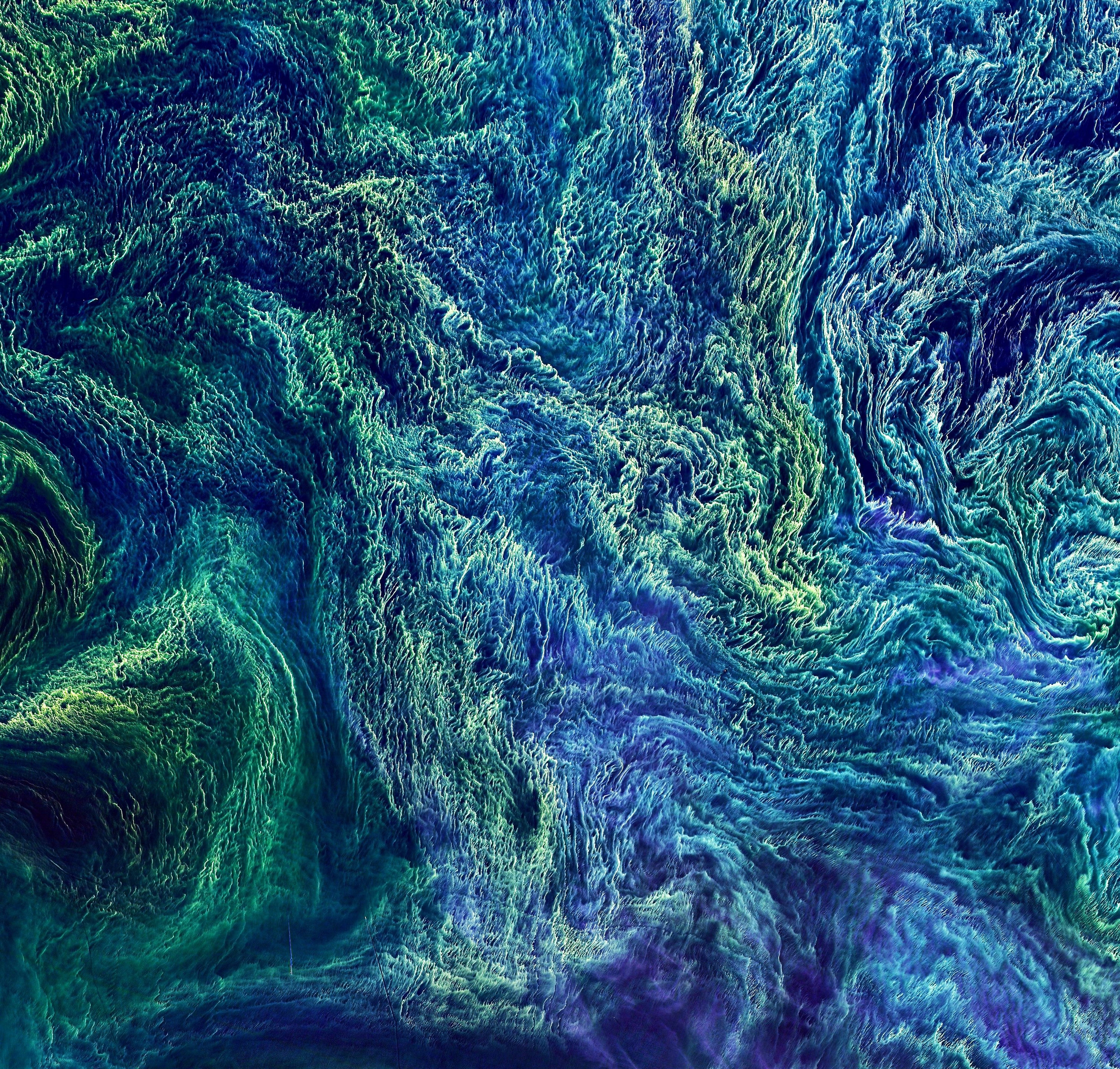
Image Credit: NASA Earth Observatory/USGS “On Aug. 11, 2015, a NASA satellite captured this false-color image of a large bloom of cyanobacteria (Nodularia) swirling in the Baltic Sea.” (2015) Public domain image courtesy of Wikimedia.

Richard Stimac: “Desire”

Desire
You’d think something like a river is a fixed thing.
Maps, no matter how old, keep rivers in the same place.
Names change. Boundaries move, or dissolve.
Arrows mark migrations and invasions.
The river, given erosions and sediment, stays the course.

Like children, or cats, fixity is what adults desire.
All things change, with time. This is a truism.
But some things change so slowly, so easily unnoted,
we assume them permanent and build our imagination around them.
To think things can be otherwise is to be a god.

That was the first sin, in the Land Between the Rivers.
The Serpent implanted an image in Eve: “What if?”
Eden could be different than it was. Paradise lost with options.
Wisdom is knowing all that is need not be all there can be.
After the Fall, we could no longer accept we simply are. Like the river,

that once enclosed Paradise, and now slowly dies in its way
to the delta, we turn against ourselves. We are not enough.
Or so I feel. Like the river never rests in its mindless meander,
through my works, my days, wants and grasps, kisses, goodbyes,
I long to be a fixed thing, without movement, without will and thirst,

to be a standing body of water, a lake, a pond, a flippant backyard pool.
But that’s not true. It’s the sea I fear, the end of course, when all the sediment
collected over a continent dissolves into salt water. There the river ends.
The maps lose their contour. Far at sea, we lose our landmarks.
Lost, we drift, and lift our heads to the stars, secure in their heavens.

About the Author: Richard Stimac has published a poetry book Bricolage (Spartan Press), over forty poems in Michigan Quarterly Review, Faultline, and december, and others, nearly two-dozen flash fiction in Blue Mountain, Good Life, Typescript, and several scripts. He is a fiction reader for The Maine Review.

Image Credit: George Catlin River Bluffs With White Wolves In The Foreground, Upper Missouri (1832) Public domain image courtesy of Artvee

Cheryl A. Rice: “Crow Will Never Carry A Star Across the Sky”

Crow Will Never Carry A Star Across the Sky
-for MJ

“It’s not my job to carry a
self-sufficient body from dawn to dawn.
I’ve got enough on my mind,
what with gathering foodstuffs to tide me over,
making a nest sturdy enough to withstand
kith and kin, raw eggs, new babies.
Stars live lives beyond all that,
provide the only possible light
in that seamless backdrop.

It’s not a matter of choice, no choice about it at all.
Check with Blue Jay, busy bullying inbred Sparrows,
or Cardinal, flitting like a match head from bush to bush,
playing the family man so well you can almost see a
station wagon full of chicks behind him.
Goldfinch, Red-Headed Stranger,
elusive Bluebird of Happiness—
maybe one of them has time
to cart a star around there like some aged queen.

I’ve got my own agenda,
make my own rounds without help
from a creature subject to laws of gravity.
Leave me be. I’ve got a Douglass fir to investigate.
Something is shining on that uppermost branch that calls to me,
seems to be spelling my name in semaphoric signs.”

About the Author: Twice a Best of the Net nominee, Cheryl A. Rice’s books include Dressing for the Unbearable (Flying Monkey Press), Until the Words Came (Post Traumatic Press), and Love’s Compass (Kung Fu Treachery Press). Her monthly column, The Flying Monkey, can be found at https://hvwg.org/, while her occasional blog, Flying Monkey Productions, is at http://flyingmonkeyprods.blogspot.com. Rice can be reached at dorothyy62@yahoo.com.

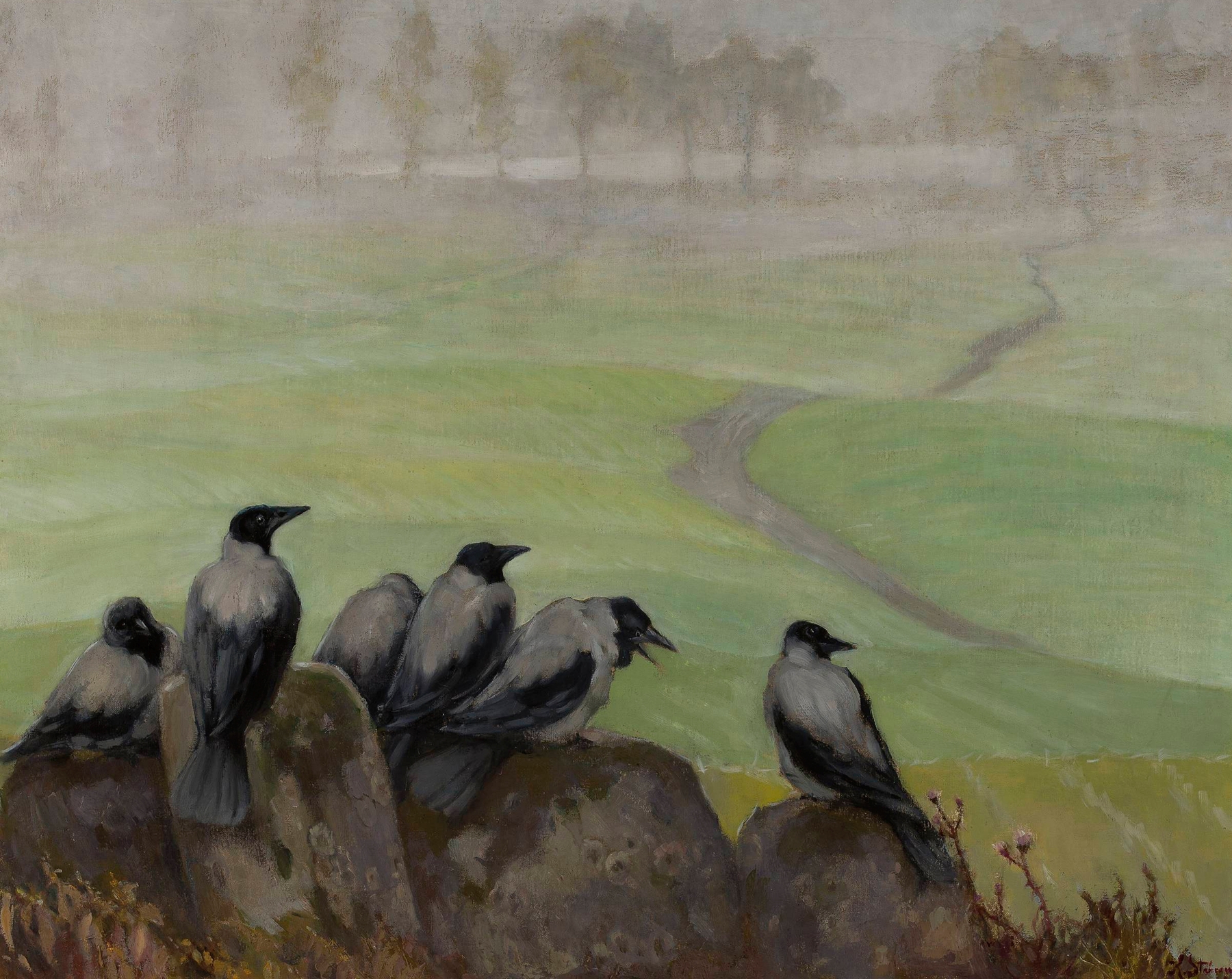
Image Credit: Kazimierz Stabrowski “Crows- Council of Seniors” (1923) Public domain image courtesy of Artvee

Sterling Warner: “Annas Bay Anglers”


Annas Bay Anglers

Oyster beds rise
from tidal pools
like spiritual mounds
nurturing creation
creating calcium shell reefs
flashing occasional nacre—
mother of pearl prosperity—
distracting fishermen with its
iridescence before recasting
lines opening their third eye
and crown chakras,
activating,
balancing,
energizing
a dreamscape where meditation
of purpose guides each rainy day
angler’s quest for silver perch,
steelhead,
sturgeon,
& salmon.

About the Author: An award-winning author, poet, and emeritus English Professor, Sterling Warner’s works have appeared many literary magazines, journals, and anthologies including Anti-Heroin Chic, The Galway Review, Lothlórien Poetry Journal, Ekphrastic Review, and Sparks of Calliope. Warner’s poetry/fiction include Rags and Feathers, Without Wheels, ShadowCat, Edges, Memento Mori: A Chapbook Redux, Serpent’s Tooth, Flytraps, Cracks of Light: Pandemic Poetry & Fiction 2019-2022, Halcyon Days: Collected Fibonacci, Abraxas: Poems (2024), and Masques: Flash Fiction & Short Stories. Presently, Warner writes, hosts/participates in “virtual” poetry readings, turns wood, and enjoys boating and fishing in Washington.

Image Credit: Public domain image originally published in The Naturalist’s Miscellany, or Coloured Figures of Natural Objects. London: printed for Nodder & Co.,1789-1813. Courtesy of the Biodiversity Heritage Library

Jason Visconti: “After The Drought”

After The Drought

The clouds just join till rain’s a melody,
I hear the words pitched in every drop,
something’s in the song the lyricist should steal,
the vocals are tense as strings of harps,
the flood just a concert unconcealed.

About the Author: Jason Visconti has attended both group and private poetry workshops. His work has appeared in various journals, including “Blazevox”, “Valley Voices”, and “The American Journal of Poetry”. He especially enjoys the poetry of Pablo Neruda and Billy Collins.

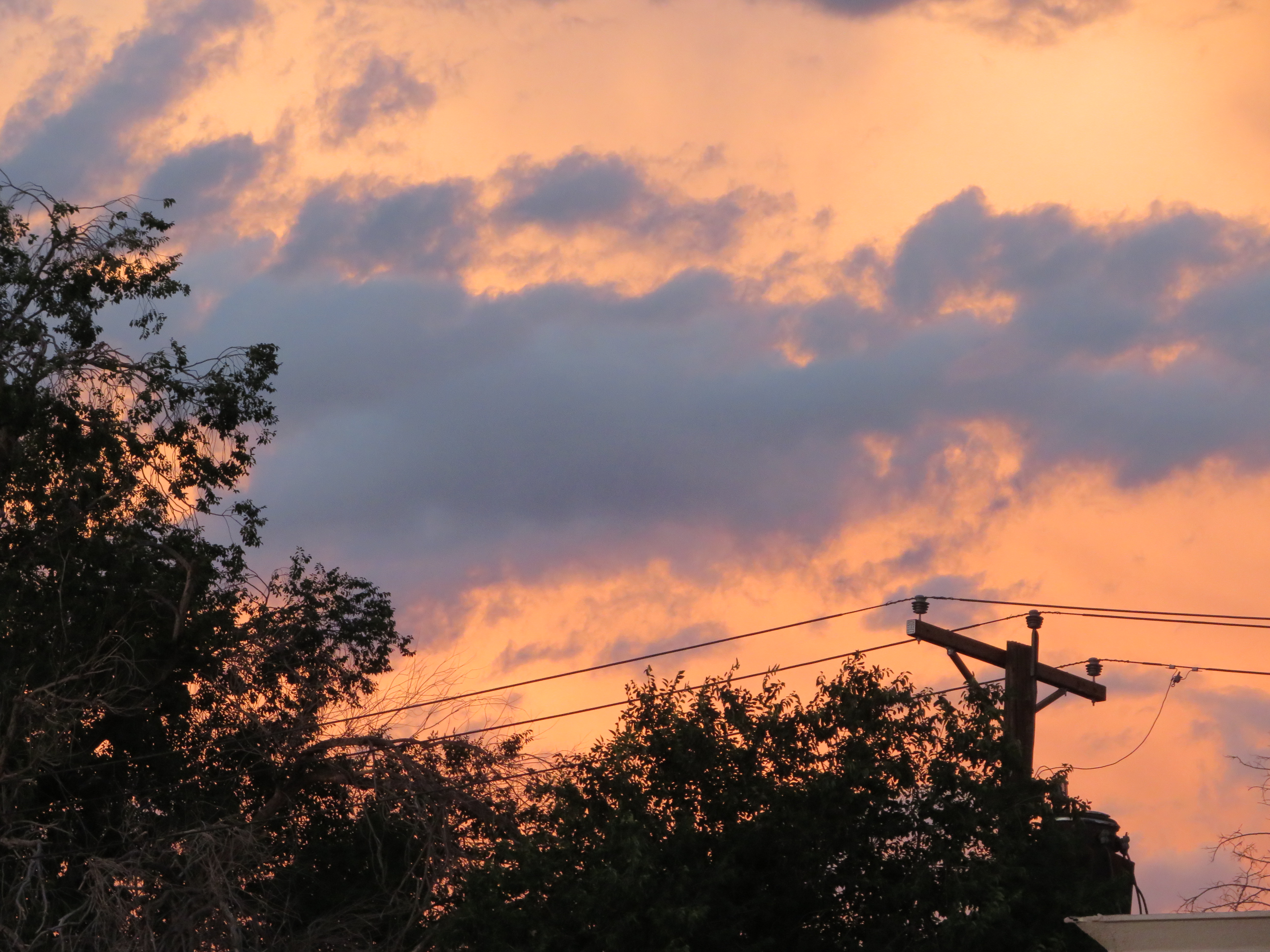
Image Credit: Chase Dimock “Rain Clouds at Night” (2021)

Cheryl A. Rice: “Fishing Both Sides of the River”

Fishing Both Sides of the River
-for Mike James


Between heaven and Earth is orange,
binder I’ve been missing all my life.
Only fish you catch can see in color,
but the ones that can tend to stay
on the right side of the bank.
Reds around me, peevish, gregarious,
shy away from the unmitigated optimism
that is yellow. I see orange now
as the missing link, mediator who can
bring these disparate sides of my palette
back to sanity, plum a distant cousin,
aquamarine the troublesome hue
that started all the fuss.

About the Author: Twice a Best of the Net nominee, Cheryl A. Rice’s books include Dressing for the Unbearable (Flying Monkey Press), Until the Words Came (Post Traumatic Press), and Love’s Compass (Kung Fu Treachery Press). Her monthly column, The Flying Monkey, can be found at https://hvwg.org/, while her occasional blog, Flying Monkey Productions, is at http://flyingmonkeyprods.blogspot.com. Rice can be reached at dorothyy62@yahoo.com.

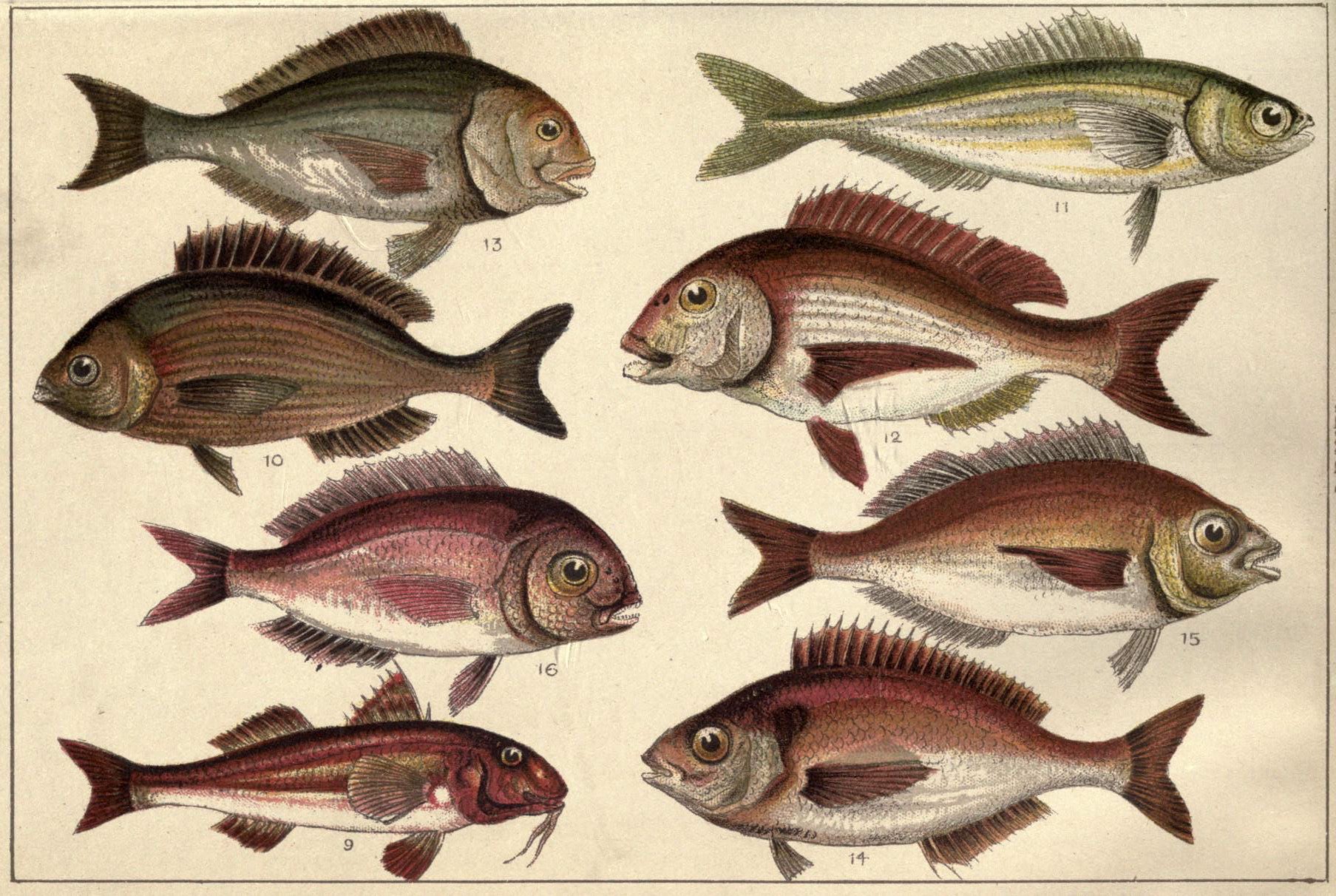
Image Credit: Public domain image originally from Our country’s fishes and how to know them London: Simpkin, Hamilton, Kent & Co.,[1902]. Image courtesy of the Biodiversity Heritage Library

Justin Karcher: “How Birdwatching Saved Your Life”

How Birdwatching Saved Your Life


This morning the birds in your backyard
disappear through sunflower wormholes.

Popsicle feathers blowing in the hot wind.

You try following but it doesn’t work like that.

So you drink some coffee instead
and hum your favorite song.

Life is all about getting through grief
then doing it again and again and again.

Did you know that if you Google
“Who is the patron saint of regret?”
there isn’t just one
and there’s still not enough.

About the Author: Justin Karcher (Twitter: @justin_karcher, Bluesky: justinkarcher.bsky.social) is a Best of the Net- and Pushcart-nominated poet and playwright born and raised in Buffalo, NY. He is the author of several books, including Tailgating at the Gates of Hell (Ghost City Press, 2015). Recent playwriting credits include The Birth of Santa (American Repertory Theater of WNY) and “The Trick Is to Spill Your Guts Faster Than the Snow Falls” (Alleyway Theatre).

Image Credit: Public domain image originally from Field key to the land birds … Boston, B. Whidden,1899. Image courtesy of the Biodiversity Heritage Library

Rusty Barnes: “Homage to Jim Harrison”

Homage to Jim Harrison

The grackle with its blue head
dunks violently his beak

in the bird bath while chickadees
and starlings battle the squirrels

for sustenance. Cars power by here
in the city and squirrels rush the street

for lack of places to run. On the porch
with my one-eyed dog,

I run my weathered hand on his
head and search fruitlessly for

the Zen moment like Jim Harrison's
dogs betray their owner's point of view.

I keep his grizzled nose pointed at
the source and breathe in his wisdom.

About the Author: Rusty Barnes lives with his family and a horde of cats in Revere MA. His work appears widely, and his most recent chapbook is DEAR SO & SO.

Image Credit: John James Audubon “Purple Grackle” Public domain image courtesy of Artvee

Royal Rhodes: “The Other Genesis”

The Other Genesis

What do we see outside 
except a canopy of ebony wings, 
garlands of feathery smoke 
moving on blackened water? 
Against the sketchy light 
it looks like a cancer patient 
showing us their fifth x-ray. 
The troubled lungs, highlighted: 
a cage of full-grown crows 
in a space too small for them 
and anxious for routes to escape, 
fanning their jittery wings 
against imprisoning walls. 
Something screamed in fear, 
locked inside us, watching. 
Resistance is useless, absurd, 
trapped in something we are. 
We saw their work when free: 
the substantial killing 
along the state route. They strutted 
around the roadkill, plucking 
at bits of the dying creatures, 
supple as the playful light. 
When will it end? we ask. 
And why did it ever begin? 
We are the understanding they lack. 
So we took them deep inside us. 

About the Author: Royal Rhodes, who was trained in the Classics, is a retired educator who taught classes in global religions and Death & Dying for almost forty years. His poems have appeared in: Ekstasis Poetry, Snakeskin Poetry, The Montreal Review, The Cafe Review, and other places. His poetry/art collaborations have been published with The Catbird [on the Yadkin] Press in North Carolina.

Image Credit: Image originally from British Ornithology: Norwich: Bacon,1815-22. Courtesy of the Biodiversity Heritage Library

Tina Williams: “Two Kinds”

Two Kinds

It was dusk
on a two-lane road
in deep East Texas
and we had not passed
a word for miles
when she said
there are two kinds
of people in the world.
Years later, the turtles 
in my neighborhood 
know nothing of
my friend’s philosophy.
Or how simply 
some things boil down.
The red-eared slider at my feet,
flipped over and still but still here,
knew seasons.
She knew navigation
and the grass best for nesting. 
Tenacity.
Now, spun senseless
to where the street met the curb,
she lay bloody, mud-baked legs
splayed flat and a gut-deep wound
cracked clean down her belly.

Turtles have inched their way
across hundreds of millions of years,
ducking one mass extinction
after another protected by nothing more
than the home on their back.
Today, the turkey vultures
working a squirrel
three blocks away
will catch wind
of this one at my feet,
an ancient traveler
felled handily enough
by steel on rubber
and the kind who
do not stop.

About the Author: Tina Williams is a former journalism instructor and advertising copywriter living in Austin, TX. Her poems have appeared in or are forthcoming in the New Verse News, Amethyst, Borderlands: Texas Poetry Review, and the Concho River Review.

Image Credit: Public domain image originally published in North American herpetology : Philadelphia, J. Dobson;1842. Courtesy of the Biodiversity Heritage Library