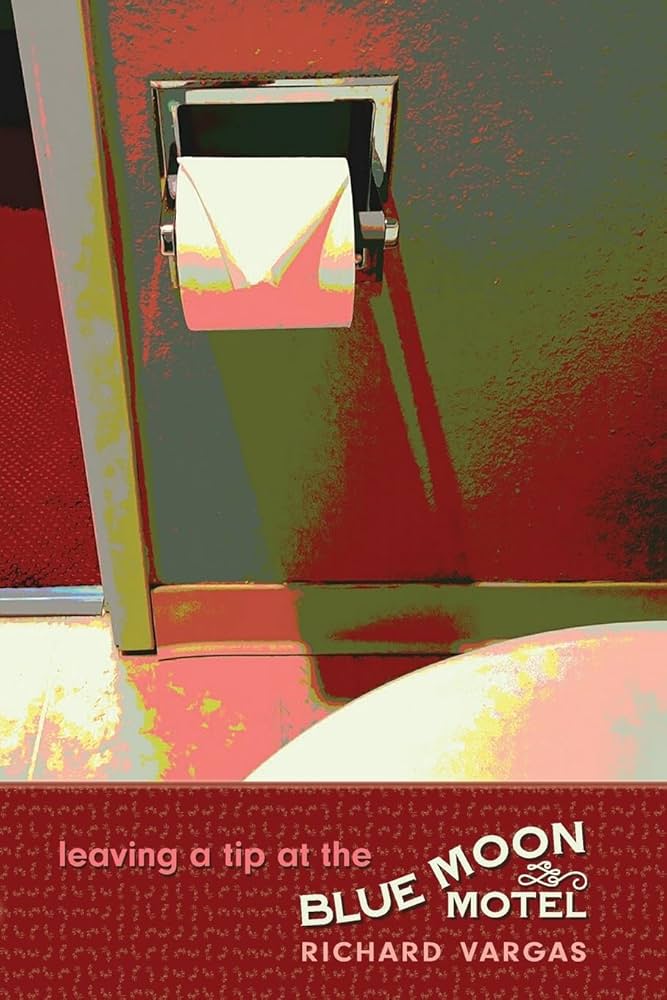
A Review of leaving a tip at the Blue Moon Motel By Richard Vargas

leaving a tip at the Blue Moon Motel

By Richard Vargas:

a book review

By J.T. Whitehead

I want to hit on about three things, all of which intersect, in praising Richard Vargas’s collection, “leaving a tip at the Blue Moon Motel.” I want to talk a little bit about what it means to do a ‘political poem,’ in the loosest sense that this means. Meaning: I want to talk about writing from direct experience, as opposed to writing from theory. This brings up Vargas’s unique sense of empathy. And last, I want to talk about style just a little bit, to remind us all that clarity and clean writing is not an abandonment of it. All these things explain why I like Richard Vargas’s poetry.

In an anthology of essays titled “Poetry and Politics,” edited by Richard Jones, I want to say I recall the poet Denise Levertov making a succinct point about some of what we call “political poetry.” She alluded to Bertolt Brecht’s version of the political poem as something akin to “marching orders.” I remembered this and wrote it down and it has stuck with me, but I don’t have the patience to re-read her essay right now. So if she did not characterize some political poetry, like Brecht’s, as something like “marching orders,” then let me do so now, and continue to credit her with the idea, just in case.

Don’t get me wrong. A theoretician or an academic poet who cares about humanity, without having experienced the bad jobs or prison experience he or she writes about, is still on the human and not the dehumanizing side of things. Bertolt Brecht was on the side of humanity. But when poets write about such things from some place other than their own experience, they must invariably do so in the third person, or do so in an abstract or at least imagined way. We, as readers, tend not to relate as much to such work. But Vargas only writes about what he has experienced himself, without assuming to understand worse. He wonders about it, and more on that later, but he never presumes.

Continue reading “A Review of leaving a tip at the Blue Moon Motel By Richard Vargas”

Paula Reed Nancarrow: “The Names of Birds”

The Names of Birds

My mother and the birds:
we watch them at the feeder.
I call out their names.

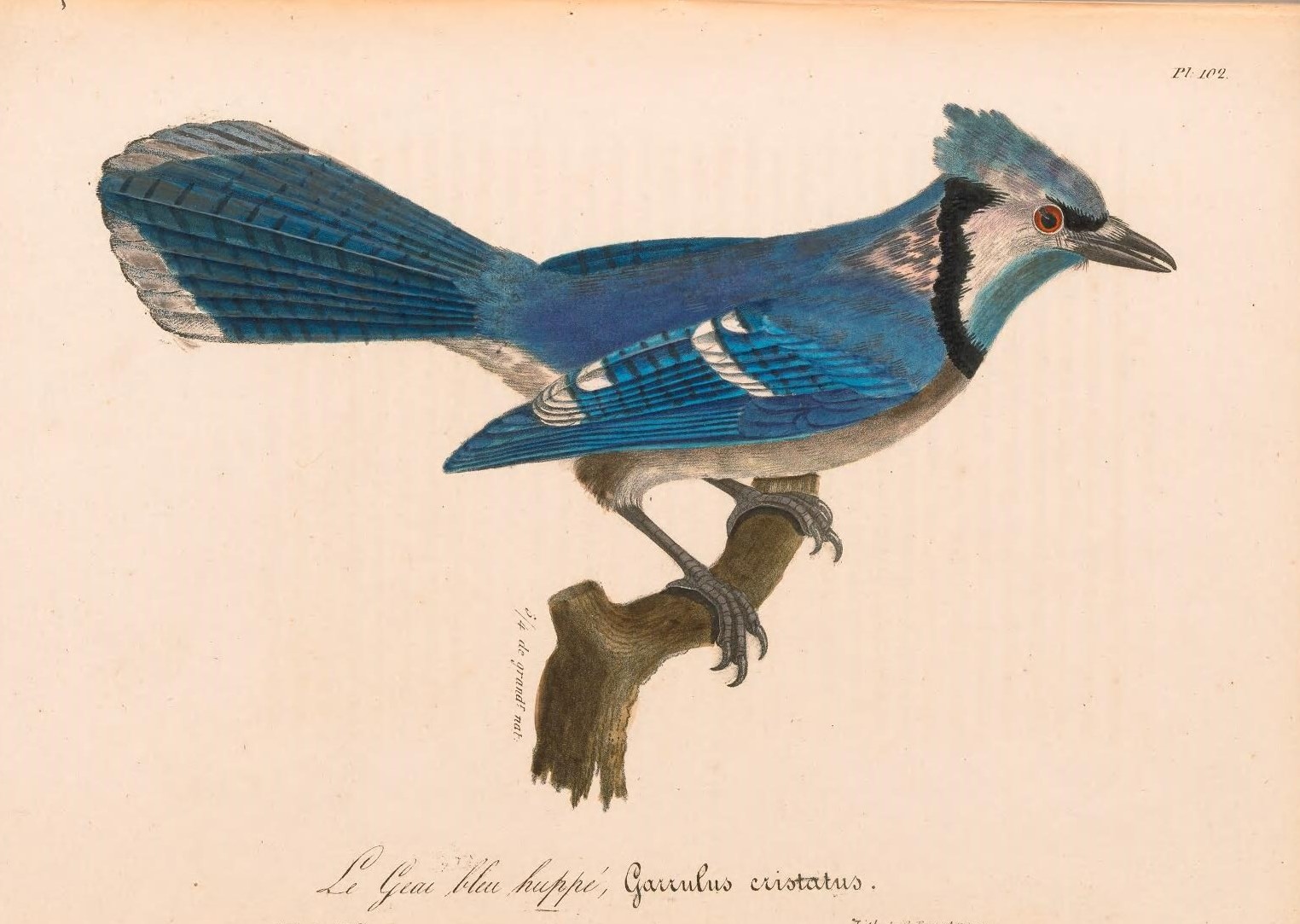
Look mom! The blue jay’s back!
That one! she says. That one!!
And the red-headed woodpecker–


Such a big…nose thing…
Yes, he has a long beak.
And there are the
chickadees, the little nuthatches

and the turtledoves, grey and homely
their sound all the beauty they own.
Then the red-winged blackbird – Mom, look!

They’re a sign of spring.
That will never
– she says….
Oh yes, my love. And the robin too. It will come. You will see it.

All the names she has forgotten
I recite like a litany: a prayer to the birds, distinct and various
as the language slipping away.

Good bye to wingéd words.
I say the names of birds; she does not repeat them.
Nor do I ever hear the name I own.

About the Author: Paula Reed Nancarrow’s work has appeared or is forthcoming in Ballast, Hole in the Head Review, and Book of Matches,  among other journals.  She is a past winner of the Sixfold Poetry Prize and her poems have been nominated for Sunrise Publications’ Best of the Net and the Pushcart Prize. Find her at paulareednancarrow.com

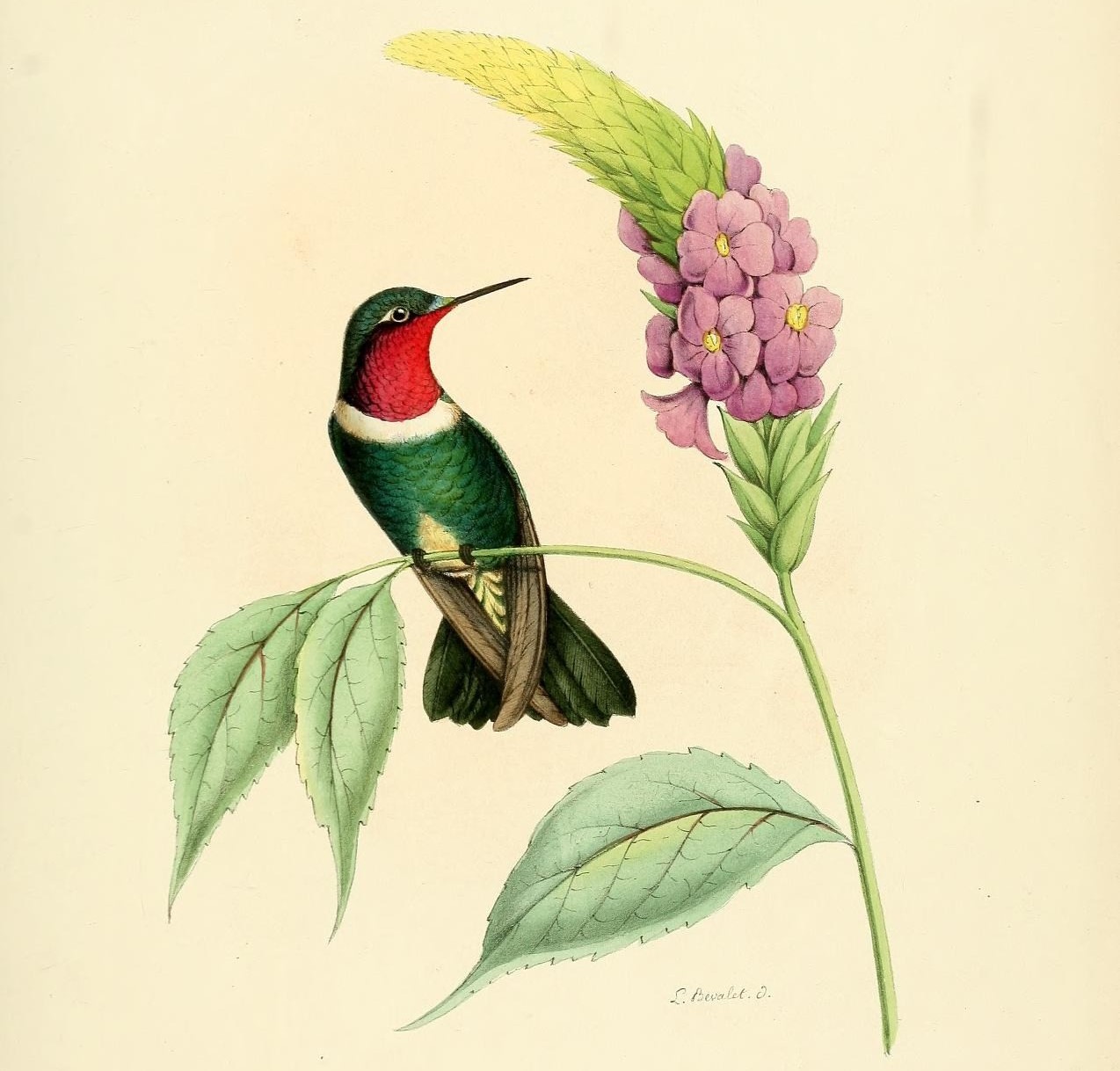
Image Credit: Public domain image originally from La galerie des oiseaux. Paris, Constant-Chantpie,1825-1826. Courtesy of the Biodiversity Heritage Library.

Paul Ilechko: “A Life in Art”

A Life in Art

Starting with charcoal
catch the movement
sixty seconds to finish

the drawing to capture
the gesture in the fewest possible
lines so much is about

touch move on to the camera
and now it’s about framing
it’s about depth of field

where so much depends on
the interaction of speed
and aperture talk to me

about art and how it defines
our lives we are windblown
through space and time

we are the green edges
that surround this city
the mailman on his rounds

the fish in the canal
where a man floated
slowly past a long pole

in his hands make a movie
from these elements
the story should tell itself.

About the Author: Paul Ilechko is a British American poet and occasional songwriter who lives with his partner in Lambertville, NJ. His work has appeared in many journals, including The Bennington Review, The Night Heron Barks, deLuge, Stirring, and The Inflectionist Review. He has also published several chapbooks. 

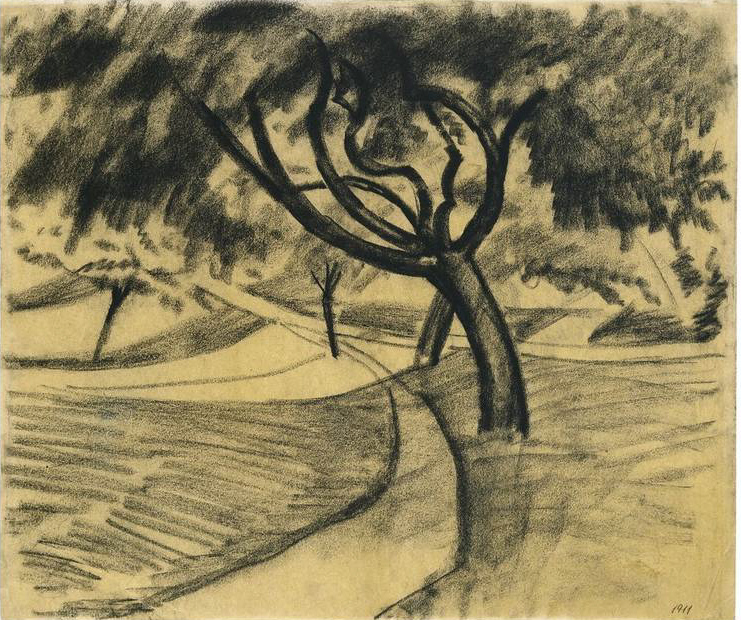
Image Credit: August Macke Baum und Felder. 1911 Public domain image courtesy of Wikimedia Commons

Richard Stimac: “Havok”

Havok

When the latest version of Dogs of War
dropped, adolescents of all ages kept vigil.

Children played like adults. Adults played
like children. True for all good fun, killing

felt almost real. In this virtual world
(“virtual” comes from the Latin for “manly”),

the human body springs alive with detail,
down to platelets and red and white blood cells.

In slow motion, you watch the discharged round
spin and spin and spin until you see the impact,

then hear the sound. The slow motion kill
effects are insane, down to shattering bone.

How could verisimilitude this true
not make anyone fall in love with war?

About the Author: Richard Stimac has published a poetry book Bricolage (Spartan Press), two poetry chapbooks, and one flash fiction chapbook. He is a fiction reader for The Maine Review.

Image Credit: Rik Wouters “Nightmare – War” (1914) Public domain image courtesy of Artvee

Connie Woodring: “And Then There was Death”

And Then There was Death

The last time I spoke to my husband was a Saturday night before bed.
We hugged and gave each other a smooch on the lips.
My husband put his hands on my shoulders and said,
“Now tomorrow morning we will go to Trower’s for sure!”
Several Sundays were missed because of bad weather.
He drove to Trower’s, a twenty-minute drive, because his cigarette brand was not sold in any of our local stores.
We used to go to Trower’s for breakfast, but that was before my husband became more depressed and weaker due to cancer, and vascular disease.
He began to withdraw from society, except for Trower’s.
He had given up his life-long hobbies making reproductions of Kentucky and Pennsylvania muzzle loaders and playing the banjo. He no longer practiced Buddhism.
On several occasions he said he wanted to die but didn’t want me left “flapping in the wind.”
I didn’t know how to respond to that, so I was always silent, just holding his hand.
If I would have assured him I would be okay,
would that be like giving him permission to kill himself?
If I said I wouldn’t be okay, that would put an extra burden on him.

What had we been through in the last two or more years because of his illnesses?
Endless doctor appointments, Cat-scans, bloodwork, X-rays, radiation treatment, stent surgery.
Bad reactions to several antidepressants.
Falling, requiring a hospital stay which revealed nothing.
Physical therapy to gain strength.
He didn’t become strong.
He became weaker, falling several more times.
On one occasion, he fell against the bedroom door, and I could barely get the door open
to lift him onto the bed.
I wouldn’t allow him to smoke in the house, only in his room.
I had uncontrolled asthma.
He didn’t resent this decision except on very cold winter days when his open ventilating window made the room unbearable.
But at least he smoked his half a cigarette very quickly: a half a cigarette every hour.
We had many disagreements about his smoking,
but since he had been smoking for more than 60 years,
the thought of him quitting was out of the question for him.
“The damage is done, I’m 80 so how many years do I have left anyway? I have to have one pleasure.”
I would rant and rave about the insanity of lethal corporations and government regulations that outlawed heroin and weed, but not cigarettes. My only coping mechanism.
“Well, it’s your choice to smoke, but at least I don’t have to enable your addiction by going with you to Trower’s.”
I eventually went with him, but I didn’t drive,
rationalizing that at least I wasn’t a total enabler.

On that last evening I ever saw my husband alive, I resigned myself to drive him in the morning to get his cigarettes rather than having him die in a car crash.
His decreased depth perception and slowed reflex problems didn’t bode well for a successful trip.
“Goodnight, sweetheart.” “Me, too.”
When he wasn’t out of bed by 6:30 am, I knocked on his door.
Since there was no reassuring answer that he was awake, I opened the door.
His head was sticking out of the covers.
I touched his cold head. I moved his head. There was no response.
I kissed him on the forehead and said, “I’ll always love you.”
I walked out to the living room to call 911.

“This is it!” I said to myself, as I ambivalently welcomed death into my house.

About the Author:  Connie Woodring is a 79-year-old retired psychotherapist who has been getting back to her true love of writing after 45 years in her real job. She has had many poems published in over 40 journals including one nominated for the 2017 Pushcart Prize. She has had ten excerpts from her novel Visiting Hours, published in various journals. She has had five excerpts from her non-fiction book, What Power? Which People? Reflections on Power Abuse and Empowerment, published in various journals. Her memoir was published in White Wall Review.

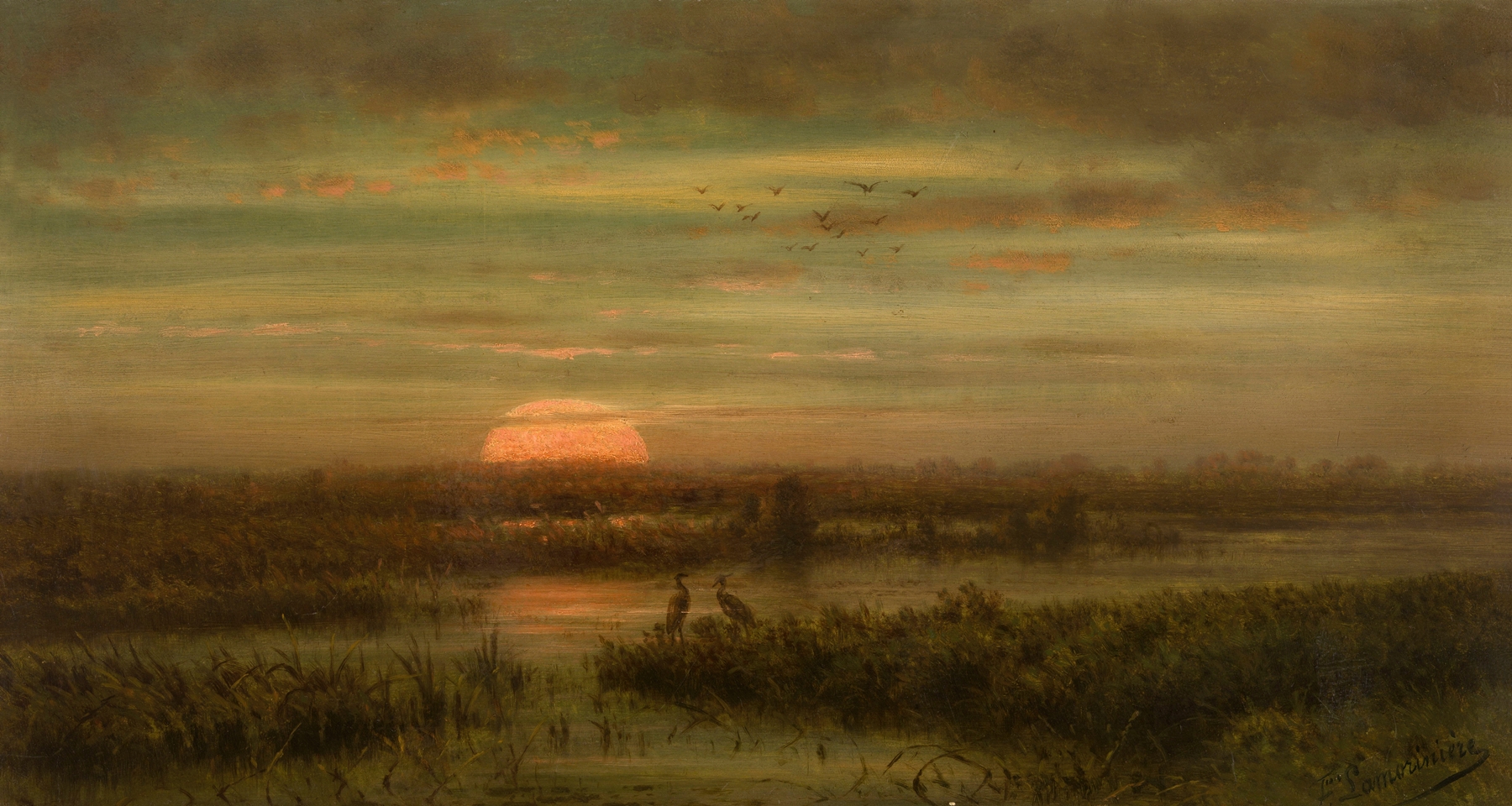
Image Credit: Jean Pierre François LamorinièreLandscape with Herons at Sunset” Public domain image courtesy of Artvee

James Duncan: “The Traitor”

The Traitor

sometimes in the bleak tangle of the evening
I will mute the television and watch the news
in silence, listen to the cars passing by in the
night, the house too close to the road but not
too close to all the bombing and cheating and
oil spills and threadbare calamity seeping into
the airwaves like radiation poison—no, not here
so far from the lights of town, where the hum
of the night creatures ebb from the trees and
the cedar swamp, the liminal infinity of night
and flora edging closer, trying to reclaim the
ground it has lost against the tide of humanity
and when I turn the television off, the darkness
gains a bit more ground, the natural world a little
bit stronger in the twilight, and I’m satisfied, a
traitor against my kind, a double agent living
in one world while hoping another’s counter-
attack will be swift, sweeping through the trees
to bring all of our flagellations to a quiet end

About the Author: James H Duncan is the editor of Hobo Camp Review and author of Cistern Latitudes, Proper Etiquette in the Slaughterhouse Line, and Vacancy, among other books of poetry and fiction. He also writes reviews of indie bookstores at his blog, The Bookshop Hunter. For more visit, www.jameshduncan.com. 

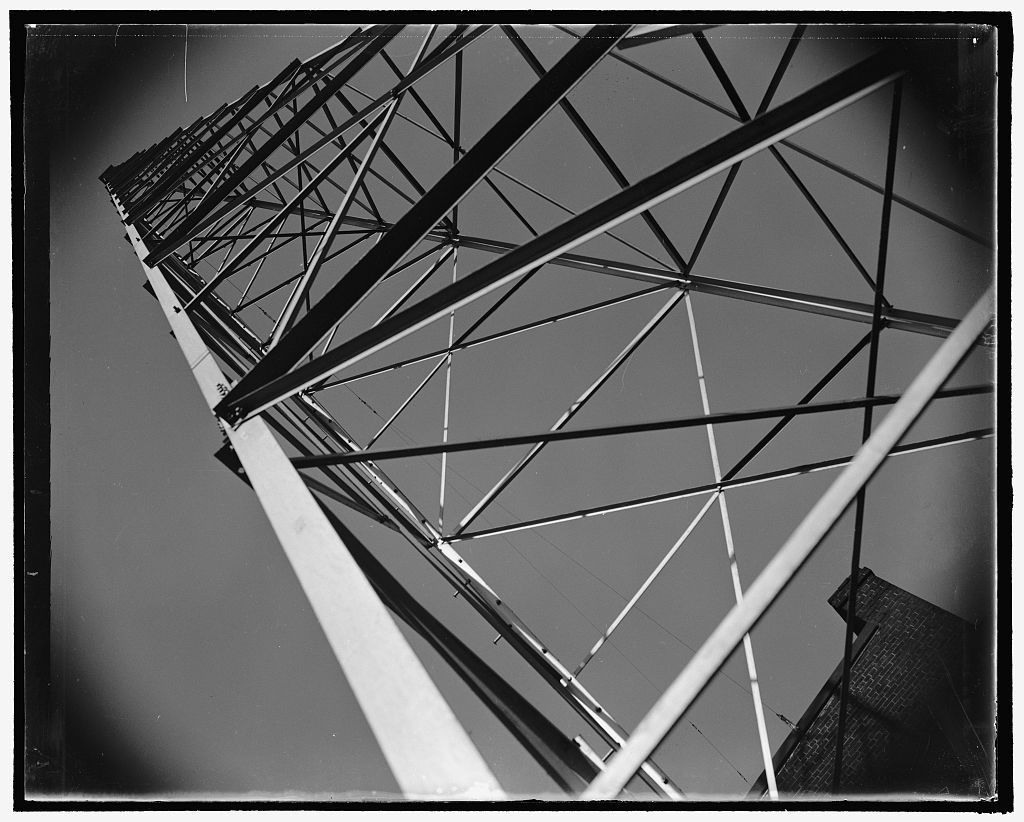
Image Credit: Harris & Ewing, photographer “Looking up at the antenna mast in the rear of the precinct station.” (1938) Public domain photograph courtesy of the Library of Congress
Andi Horowitz: “Shelley”

Shelley:

November 3, 1965
June 11, 2016


“Adieu, but let me cherish,
The hope with which I cannot part
contempt may wound, and coldness chill
But still, it lingers in my heart.”

Farewell by Anne Brontë


mourners filed into your home

gathered
around a table's harsh surface
in the dining room—
intended for birthdays
Thanksgiving Christmas—
gutting fish
shrouded in a makeshift cloth


instead of a boning knife
razor sharp
stockpiled photographs lay

two-inch thick faded heaps—

you—
Miss University of Florida
smile from a float

hold your bouquet —
dark roses

over your satin sash
over your heart-sounds

at the beach
tipped chin
brown eyes

deny rain

your smile
perched atop the grand canyon
refuses to wilt

free-falls all the way down

the color of your sore throat


fringed in distressed mahogany
wishing today was your birthday—

you’d blow out candles
in front of me

gusts blast through windows

winter storms july

your jigsaw-puzzle life
trembles
unlike never before

I hear your silence—
weightless
as a fly’s wing

the sound of your gun

About the Author: Andi (Andrea) Horowitz is an older emerging poet who lives in Fort Myers, FL., with her husband and their two cairn terriers, BeCa and Bleecker. She taught high school English and speech and was also the drama coach. Her students remain one of her life’s greatest gifts. Andrea can be read in VARIANT LIT, STONE PACIFIC, NEW NOTE, GRIFFEL MAG. and others. She has a manuscript titled: tasted lies, misnomers, and balderdash in chicken soup at a fine hotel serving cheap champagne coming out later this year. Andrea dreams of a world devoid of stains.

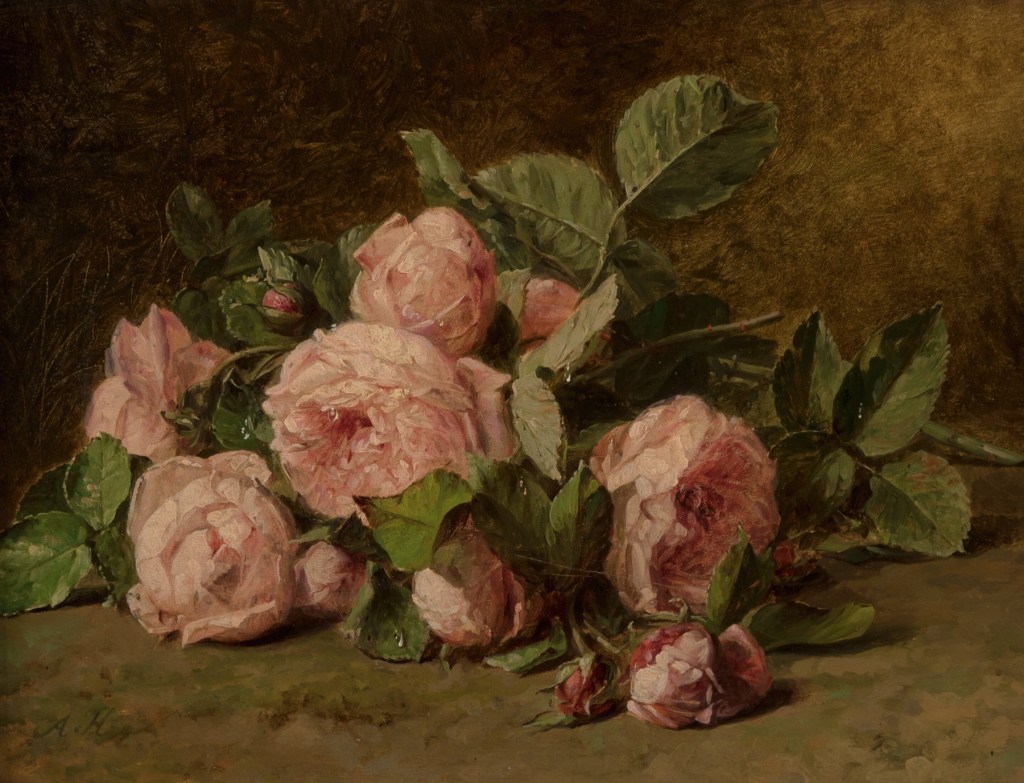
Image Credit: Adriana Johanna HaanenStill life of roses on mossy ground” Public domain image courtesy of Artvee

Alex Stolis: “Ode to the Serenity Prayer”

Ode to the Serenity Prayer
…the courage to change the things I can
& the wisdom to know the difference


Grief turns to obsession, you deify
and mythologize loss; daughters
sons spouses lovers become heroes,

you swath yourself in their legend;
bask in the soft glow of make believe
pasts, never allowing them to breathe

denying them the death and memory
they deserve. You become addicted
to torment, turned to stone by grief

start to hibernate, hide from the bloom
of a sunrise, deaf to the music of spheres
you become dead yourself, a ghost

haunting your own life; pieces thought
missing, never lost at all. The day I’m gone
I will watch over you,

be the whisper in your ear, the spark of light
in the darkest corners; we will create and love,
wake up alive, saved from death.

About the Author: Alex Stolis lives in Minneapolis; he has had poems published in numerous journals. The full-length collection, Postcards from the Knife-Thrower was runner up for the Moon City Poetry Prize in 2017. Two full length collections Pop. 1280, and John Berryman Died Here were released by Cyberwit and available on Amazon.  His work has previously appeared or is forthcoming in Piker’s Press, Jasper’s Folly Poetry Journal, One Art Poetry, Black Moon Magazine, and Star 82 Review. His chapbook, Postcards from the Knife-Thrower’s Wife is forthcoming from Louisiana Literature Press in 2024. He has been nominated multiple times for the Pushcart Prize.

Image Credit: Edvard Munch Melancholy (1892)Public domain image courtesy of Artvee

R.T. Castleberry: “FROM A HISTORY OF SERVITUDE”

FROM A HISTORY OF SERVITUDE

I’m in the wrong cycle.
Mondays marred by hospice runs,
mid-week to weekend languishing
in dramas of heat wave,
drunks on benders.
I am my own beast—
closer to insect than animal,
best friend to bastards who pay debts
with conflict diamonds and Juneau furs,
who fill their silences with
message blanks, rolled scraps of maps.
I’m aging out of despair.
Borne out by warnings
of drying rivers, drought sky,
I’ve wronged the weather.

About the Author: R.T. Castleberry, a Pushcart Prize nominee, has work in Steam TicketVita BrevisAs It Ought To BeTrajectorySilk RoadStepAway, and The River.  Internationally, he’s had poetry published in Canada, Wales, Ireland, Scotland, France, New Zealand, Portugal, India, the Philippines and Antarctica. His poetry has appeared in the anthologies: Travois-An Anthology of Texas PoetryTimeSliceAnthem: A Tribute to Leonard Cohen, and Level Land: Poetry For and About the I35 Corridor. He lives and writes in Houston, Texas.

Image Credit: Russell Lee “Wagon tracks down the dry bed of the Colorado River at Colorado, Texas. Rivers and streams of the Southwest are often dry during periods of drought” (1939) Public domain image courtesy of The Library of Congress

LB Sedlacek: “Displaced Existence”


Displaced Existence

If there’s butter
something sugary sweet
a difference in
how he looks
at you how
he touches you
and do you
welcome his touch
or not he’s
almost a stranger
if there’s anything
left at all
a difference in
where he looks
at you when
he looks at
you and do
you want to
be seen or
not by strangers
if there’s butter
or not something
a little bittersweet.

About the Author: LB Sedlacek has had poems and stories appear in “Impspired,” “River Dog,” “Hill Rag,” “Inverse Journal,” and “Iconoclast.”  Her short stories “Sight Unseen”  and “Backwards Wink” were awarded 1st Place Prose prizes in “Branches Literary Magazine.” For 20 years, she published the free resource for poets, “The Poetry Market Ezine.” LB also likes to swim and read.

Image Credit: Kenyon Cox Study of man and woman (1878) Public domain image courtesy of Artvee