Caleb Bouchard: “Slippage”

.

service-pnp-fsa-8c00000-8c00100-8c00102v

.

.

Slippage

A love letter tacked on a refrigerator slips from the grip of the magnet and lands inside the fridge, among the leftovers, uncooked meat, and vegetables. It grows cold over time, soaks in all the pungent smells of the tupperware food kept for too long. Grimy spinach. Sour soup. Chili caked in a layer of discolored fat. The letter’s edges curdle and the penned words blanch in solidarity with the forsaken dishes, until the words have completely faded and the page is empty, and somewhat crepey.

.

.

About the Author: Caleb Bouchard’s writing has recently appeared in or is forthcoming from The Atlanta Review, MORIA, Saw Palm, and Thimble Literary Magazine. His translations of the French poet Jacques Prevel will soon appear in Black Sun Lit and Poet Lore.

.

Image Credit: Russel Lee “Houses at Mineral King cooperative farm. Tulare County, California. They are equipped with electric refrigerators” (1940) The Library of Congress

Ryan Quinn Flanagan: “She Says Her Cat is in Love with Javier Bardem”

.

service-pnp-ppmsca-19000-19072v

.

.

She Says Her Cat is in Love with Javier Bardem 

She tells me she sat up late watching
Being the Ricardos.

That it is better than you would think 
which is what everyone says about everything
but the apocalypse.

Throwing one of those scrunchies up in her hair
like trying to contain the mess.

A trick of beauty that she still turns heads.
Says her cat is in love with Javier Bardem.

Woke up out of a dead sleep on the couch
to watch him most attentively.

When she sleeps, she’s out,
she says.
She doesn’t do that for anyone.

I’ve taken to calling her cat Mrs. Bardem
the last few days.

The cat seems to get embarrassed
if cat embarrassment away from the little box
is such a thing.

Throws litter all over the place.
She never did that before.

.

.

About the Author: Ryan Quinn Flanagan is a Canadian-born author residing in Elliot Lake, Ontario, Canada with his wife and many mounds of snow.  His work can be found both in print and online in such places as: Evergreen Review, As It Ought To Be Magazine The New York Quarterly, Cultural Weekly, In Between Hangovers, Red Fez, and The Oklahoma Review.

.

Image Credit: “One of the “smart set” (1906) Courtesy of The Library of Congress (public domain)

Larry Smith: “March 31, 1852 in Thoreau’s Journal”

.

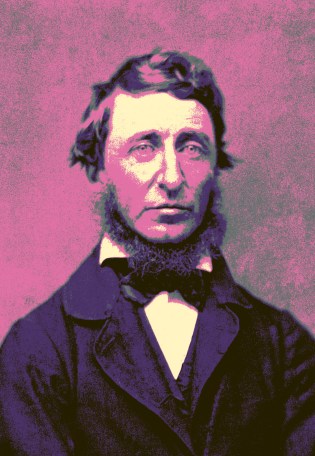
imgonline-com-ua-andy-warhol-rVfEVH7gPnFP

.

.

March 31, 1852 in Thoreau’s Journal:
What would the days, what would our life, be worth, if some nights were not dark as pitch, – of darkness tangible or that you can cut with a knife? How else could the light in the mind shine? How should we be conscious of the light of reason? If it were not for physical cold, how should we have discovered the warmth of the affections? I sometimes feel that I need to sit in a far-away cave through a three weeks’ storm, cold and wet, to give a tone to my system. The spring has its windy March to usher it in, with many soaking rains reaching into April. Methinks I would share every creature’s suffering for the sake of its experience and joy.

.

March 31, 1852 in Thoreau’s Journal:

What would the days, what would our life, be worth, 
if some nights were not dark as pitch, 
of darkness tangible or that you can cut with a knife? 
How else could the light in the mind shine? 
How should we be conscious of the light of reason? 
If it were not for physical cold, how should we 
have discovered the warmth of the affections? 

I sometimes feel that I need to sit in a far-away cave
through a three weeks’ storm, cold and wet, 
to give a tone to my system. 
The spring has its windy March to usher it in, 
with many soaking rains reaching into April. 
Methinks I would share every creature’s suffering 
for the sake of its experience and joy.

.

.

About the Author: Larry Smith, director of Bottom Dog Press in Ohio. Smith is from the industrial Ohio Valley and a professor emeritus at Bowling Green State University with over a dozen books of fiction, poetry, and memoir.

.

More By Larry Smith:

No Walls

Union Town

At The Country Store

.

William Taylor Jr.: “Little Windows and the People Behind”

.

service-pnp-gsc-5a06000-5a06000-5a06088v

.

.

Little Windows and the People Behind

They finally fixed my busted heart with a brand new 
robot valve and after a week in the ICU I’m well enough 
to be moved into a regular room.

The other bed is empty
so I have the place to myself .

From the hallways and other rooms I hear 
the sounds of people vomiting and moaning, 
bargaining with gods they don’t believe in, 

asking the nurses when they can go home 
or how long they have to wait before 
they can take their meds again.

I have a little chair and table by a window 
overlooking Geary Street and if the people
below look up they can see me here

gazing at crows resting on the tops of streetlamps
reading an old Sherwood Anderson novel that nobody remembers
breathing in and out and marveling at the fact of it.

The nurses bring me drugs and jello of myriad colors.

Countless days I’ve passed this building
on my way to the store or somewhere and I’ve always 
glanced up at the little windows and imagine 
the people behind, feeling both afraid of and for them.

And now here I am, one of the window people
sitting with my laptop writing the first 
draft of my first hospital poem.

I wave down to the sidewalk folk,
give them a thumbs up to let them know
that things are alright, and it’s not so bad 
except for the food.

.

.

About the Author: William Taylor Jr. lives and writes in the Tenderloin neighborhood of San Francisco.  He is the author of numerous books of poetry, and a volume of fiction. His work has been published widely in journals across the globe, including Rattle, The New York Quarterly, and The American Journal of Poetry. He is a five time Pushcart Prize nominee and was a recipient of the 2013 Kathy Acker Award. Pretty Words to Say, (Six Ft. Swells Press, 2020) is his latest collection of poetry.

.

More by William Taylor Jr.

“The Fire of Now”

“One of Pessoa’s Ghosts”

.

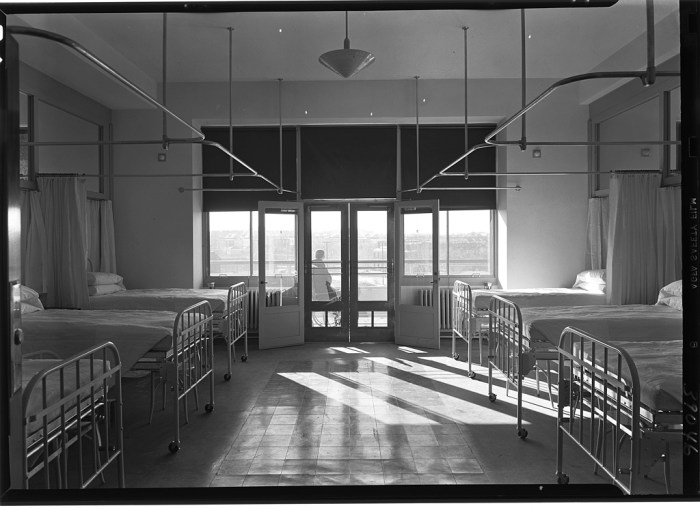
Image Credit:  Gottscho-Schleisner, Inc. “Triboro Hospital for Tuberculosis, Parsons Blvd., Jamaica, New York. Typical six-bed ward, to balcony” (1940) Image Courtesy of the Library of Congress


Matthew Wallenstein: “Washington”

.

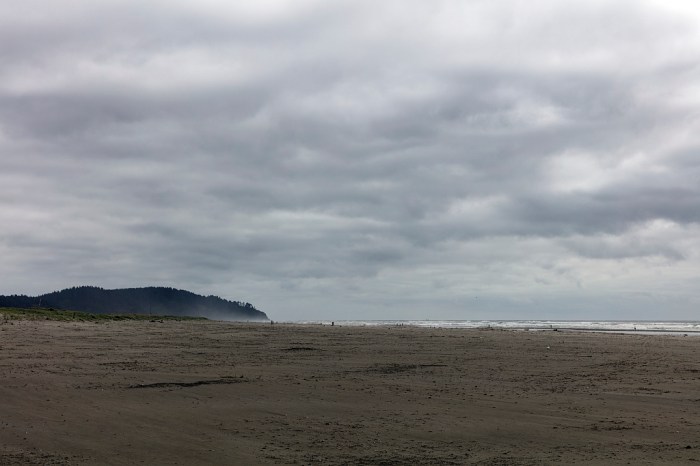
service-pnp-highsm-50400-50459v

.

.

Washington

Low 
tide. Across the bay 
the mountains are blue in moving fog. 
Animal 
corpse
in the brown grass. 
Headless and skinned.
About the size of a dog. Max says 
he thinks it is a deer that went 
In the ocean and drowned, 
washed up on shore. I nod, 
I don’t smile and I don’t mention its flippers.
Around a bend 
on the beach we find another—
skinned, headless. 
Its ribs grey, yellow, bending 
from its pile of body. It smells 
like seawater and rot. 
The flippers are splaying out 
more obviously this time, 
he sees them. 
“Oh,” he says, “it’s a seal, they are seals.”
I don’t let him forget 
that he thought it was a deer 
that went swimming.

.

About the Author: Matthew Wallenstein is a writer and tattooer. He lives in the Rust Belt. Much of his work concerns growing up in poor rural New Hampshire, the deportation of his wife, and mental illness, though it also captures every day life.

.

Image Credit: Carol M. Highsmith, “A distant shoreline view in a Washington State town fittingly called Long Beach, since it advertises its 28-mile-long Pacific Ocean strand as “the world’s longest beach.” (2018) The Library of Congress

John Brantingham: “Joan Miro’s Portrait of Vincent Nubiola”

.

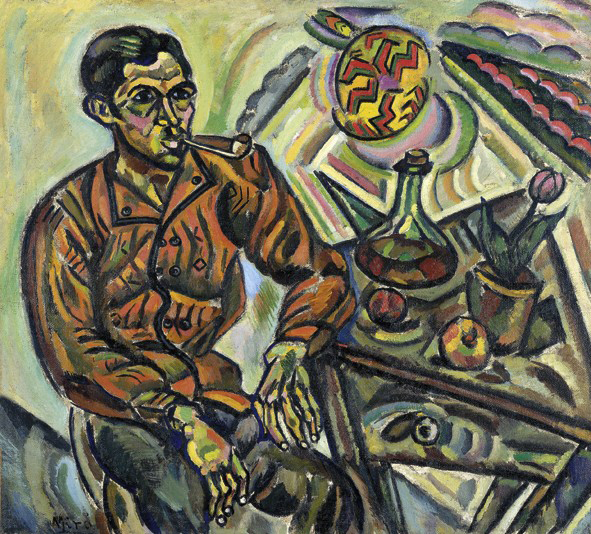
Vincent_Nubiola_Miro

.

.

Joan Miro’s Portrait of Vincent Nubiola

Before he started painting, Miro had 
a nervous breakdown, which seems rational
given that this was Spain, and a quiet hell
had cracked open in Europe, his world gone mad,
and what could he do but watch and resist
as Franco and Adolph got together 
to dream up cynical new ways to sneer
at what could be if we would just coexist.
And then Miro started to paint, which seems
more than rational. More than sane. Portrait 
of Vincent Nubiola was an early piece.
Miro catches him in a pipe-smoking daydream,
his elbow resting on a table with fruit,
a tulip, and wine. He’s at the kind of ease

that Miro must have dreamed of. Fields stretch
out beyond him, fields where he will no doubt
return for the day’s work, worrying about
things that matter while Miro will sketch
and paint and find a place where he can stand
against what is coming. He will turn 
toward the surreal, even as Europe’s dictators
call it degenerate, and it is banned.
I imagine the two of them, Miro 
still young, but wise enough to be alarmed
at what is building. Nubiola is
a professor of agriculture who knows
Miro’s genius, a man with training and wisdom.
They sit and talk of the coming hostilities.

“It feels like the end of everything that’s right,”
my imagined Joan says. Vincent replies,
“Every generation feels this. It’s an endless fight.”
And Joan can foresee an endless night
of terror. He thinks of all who will die
and to him it is the end of everything that’s right.
And Vincent remembers stories of knights
in his childhood and King Alfonso’s lies,
and he knows this is an endless fight.
Old men get a sexual thrill at the sight
of young men dying. They get off on cries
of anguish, and maybe it’s the end of right,
but he tells Joan they’ll keep moving despite
the horror of old men’s pornography.
This, Vincent tells Joan, must remain an endless fight
because these old men live for this kind of blight,
but this world was made for Miro’s kind of beauty.
We must keep going to keep everything right.
That is the beauty of our endless fight.

.

.

About the Author: John Brantingham was Sequoia and Kings Canyon National Parks’ first poet laureate. His work has been featured in hundreds of magazines, Writers Almanac and The Best Small Fictions 2016. He has nineteen books of poetry and fiction including his latest, Life: Orange to Pear (Bamboo Dart Press). He teaches at Mt. San Antonio College.

.

Image Credit: Joan Miro “Portrait of Vincent Nubiola” (1917) Public Domain

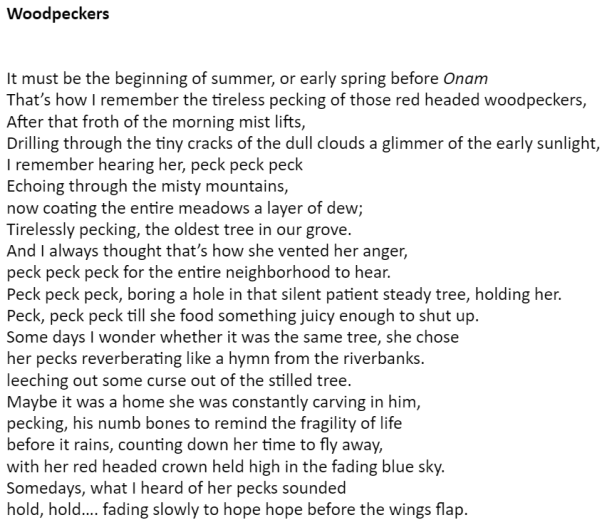
Joanna George: “woodpeckers”

.

51068443446_0dee97a4bd_o

.

.

Screenshot 2022-03-16 140342

.

.

About the Author: Joanna George (She/Her) writes from Pondicherry, India. Her poems appear or are forthcoming in Parentheses Journal, Cordite Poetry Review, Isele magazine, Honey Literary, Borderlands: Texas Poetry Review, West Trestle Review, Lumiere Review, Paddler Press and others. She tweets at j_leaseofhope.

.

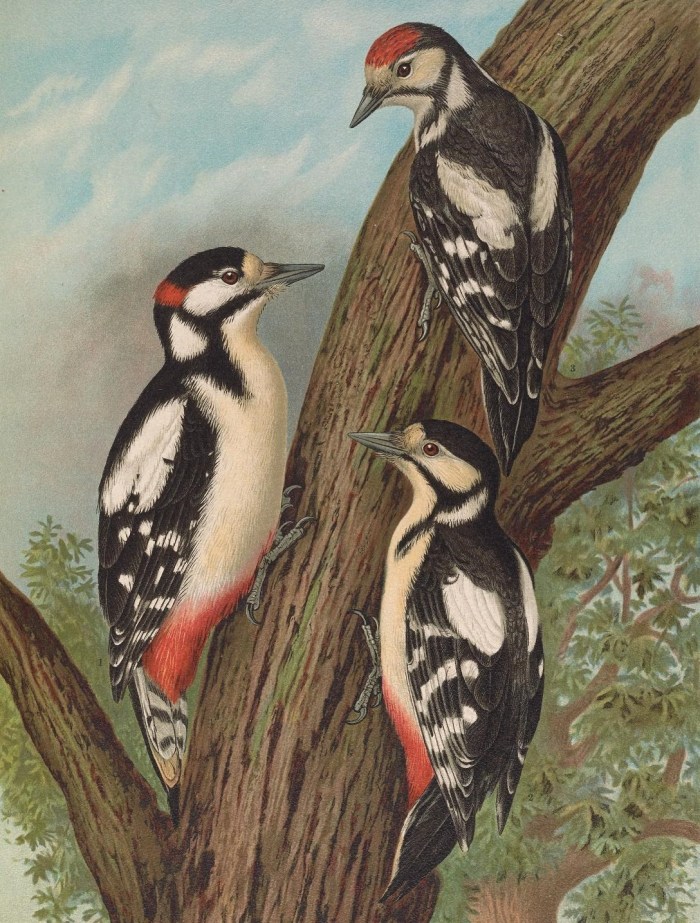
Image Credit: Image from Naturgeschichte der Vögel Mitteleuropas Gera-Untermhaus,F.E. Köhler,1897-1905 [v.1, 1905] Courtesy of the Biodiversity Heritage Library (public domain)

Sheila Saunders: “It is still, now”

.

36780433052_f377933e9c_o

.

.

It is still, now

The winds have exhaled with the tide, and the afternoon.
 Here the fields draw in the winter dusk,
drain the westerly plum- juice streaks
greying the pink and yellow 
in slow minutes. 

It is still.
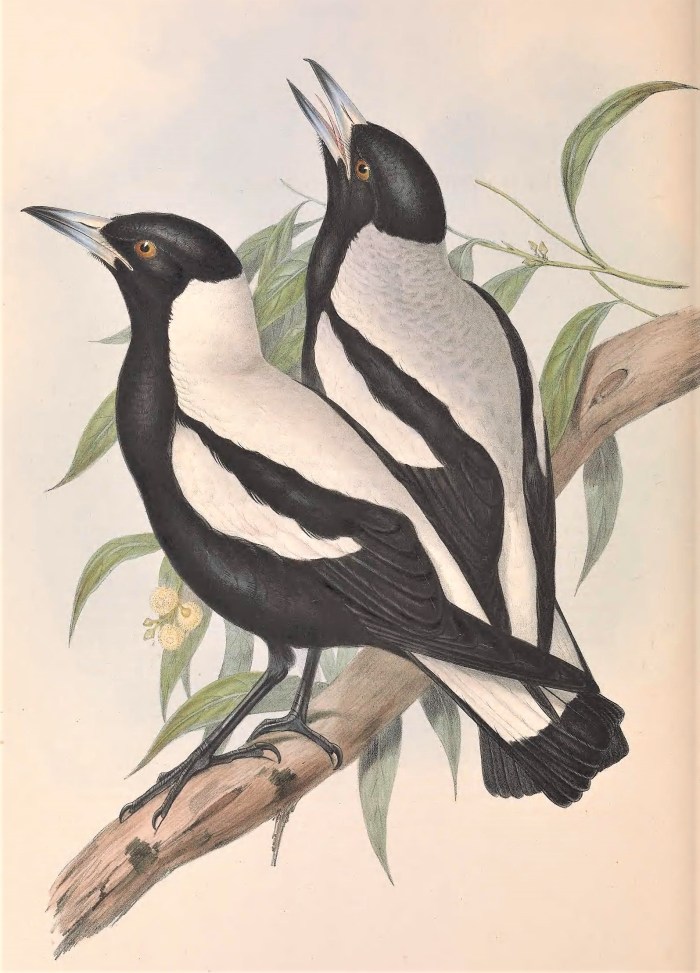
No chatter or shriek from the magpies
dumb on  black poplars’ broom-like branches
or aimlessly flopping over  sodden grass
crossing-  re-crossing. 

A near silence
wraps   the watcher in  comfort, 
who
 not hearing the  air breathing,
nor a leaf slip’s infinitesimal whisper,
is still, too.

.

.

About the Author: Sheila graduated from St Anne’s College, Oxford, with a degree in English Language and Literature, and since then worked as a reporter on local weekly and daily newspapers  in Lancashire, Lincolnshire and Buckinghamshire. After marriage to another journalist in 1961, Sheila brought up three children and continued to write as a freelance, and became involved in community organisations in Wirral, and voluntary work with special needs young people. She has always loved  theatre, music and art, but it is her observation and fascination with  her natural surroundings, including the wildlife of the coast, that has inspired most of her poetry.

.

More by Sheila Saunders: 

April Visitor

.

Image Credit: Image from, The birds of Australia. London, Printed by R. and J. E. Taylor; pub. by the author,[1840]-48. Image courtesy of The Biodiversity Heritage Library (Public Domain)

Jason Baldinger: “temporal, temporary and gone”

.

20220307_095500

.

.

temporal, temporary and gone

it’s black out in bar harbor
days after a thanksgiving 
prayer that was spoken
with no meaning, here it’s 
offseason and sunday
few residents creak 
through the vacant glaze
the early arrival of pitch black
the stars not shielded by light 

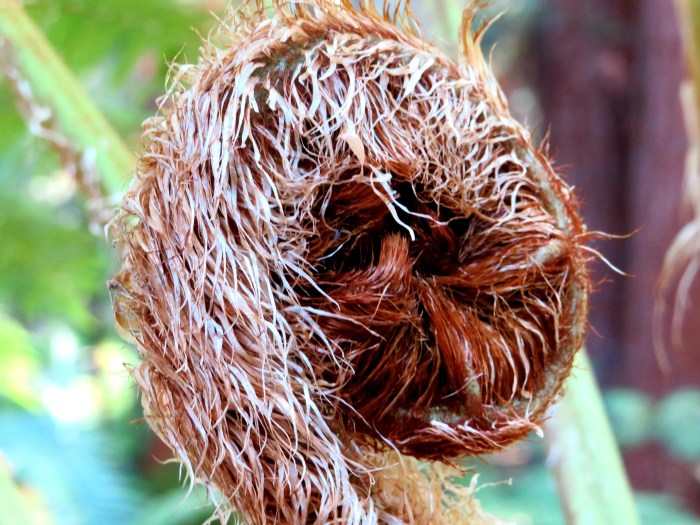
I follow a fiddlehead fern
down to a trout hatchery
where generations of tourist
feasted, fifty cents for each
wild caught dream cooked
over fire, picnic benches
for the family while you wait 

next month, i’ll be miles down coast
walking rehoboth beach with wine
stains and fireworks, dolle’s taffy
orange and boardwalk lights
lead me back from the mouth 
of breakers, footprints already
washed away, the infinite space
stoned and stealing time again
the new year a dragon
slayed at my feet 

these places, theses years
whisk by, dust in my beard
atoms along the air, no meaning
in moments anymore
it all builds to crescendo
I’ll never hear, this reality
a bubble, a vessel through 

tonight, memories flood
a mad swirl of stations 
some past, some present
some future, all materialize
temporal, temporary and gone

.

.

About the Author: Jason Baldinger was recently told he looks like a cross between a lumberjack and a genie. He’s also been told he’s not from Pittsburgh, but actually is the physical manifestation of Pittsburgh. Although unsure of either, he does love wandering the country writing poems.  His newest books include: A Threadbare Universe (Kung Fu Treachery Press), The Afterlife is a Hangover (Stubborn Mule Press) and A History of Backroads Misplaced: Selected Poems 2010-2020 (Kung Fu Treachery). He also has a forthcoming book with James Benger called This Still Life. His work has been widely across print journals and online. You can hear him read his work on Bandcamp and on lp’s by The Gotobeds and Theremonster.

.

More Poetry by Jason Baldinger:

This Ghostly Ambiance

It was a Golden Time

Beauty is a Rare Thing

.

Image Credit: Chase Dimock “Fiddlehead Fern” (2022)

Mike James: “Consequences of Elections”

.

20220304_095805

.

.

Consequences of Elections

It was about the time I added plastic house plants to my apartment. Fake foliage works for every season. I was still getting postcards from an ex-lover with a return address of Undisclosed Location. I’d given up Frisbee in favor of sitting very quietly in a favorite, stuffed chair. Much of my thought given to the new parliament. The old majority tossed out in favor of a coterie of meteorologists, nail technicians, and film noir enthusiasts. People were optimistic. I was agnostic. I never expected the wind to take on a new color which shimmered at the spectrum’s edge. And the wind blew the same as always. Though the moon, that old coin, seemed closer, brighter. It could just be I spent more time looking up. I no longer foraged with neighbors for cigarette butts and lost dreams.

.

.

About the Author: Mike James makes his home outside Nashville, Tennessee. He has published in numerous magazines, large and small, throughout the country. His poetry collections include: Leftover Distances (Luchador), Parades (Alien Buddha), Jumping Drawbridges in Technicolor (Blue Horse), and Crows in the Jukebox (Bottom Dog.)  In April, Red Hawk will publish his 20th collection, Portable Light: Poems 1991-2021.

.

More By Mike James:

Paul Lynde

Grace

Saint Jayne Mansfield

.

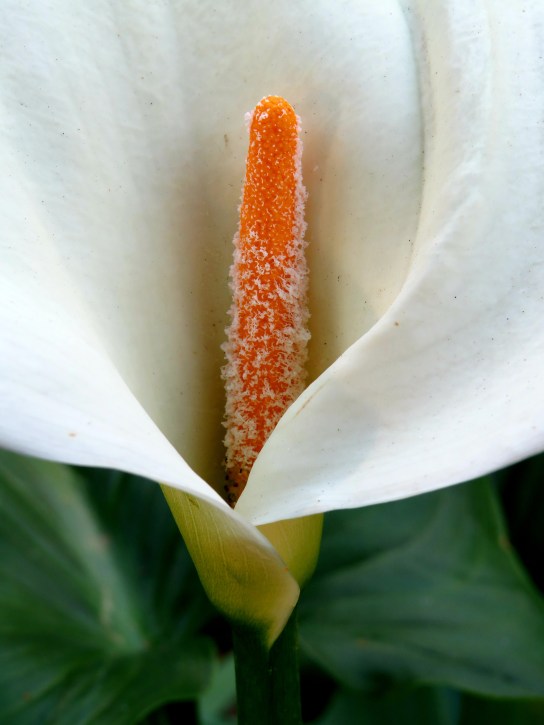
Image Credit: Chase Dimock “Descanso Calla Lily” (2022)