SEARCHING FOR THE ROSETTA STONE“He re-examined with pleasure the luminous
yellow, green, red little jars.”
-Nabokov, Signs and Symbols
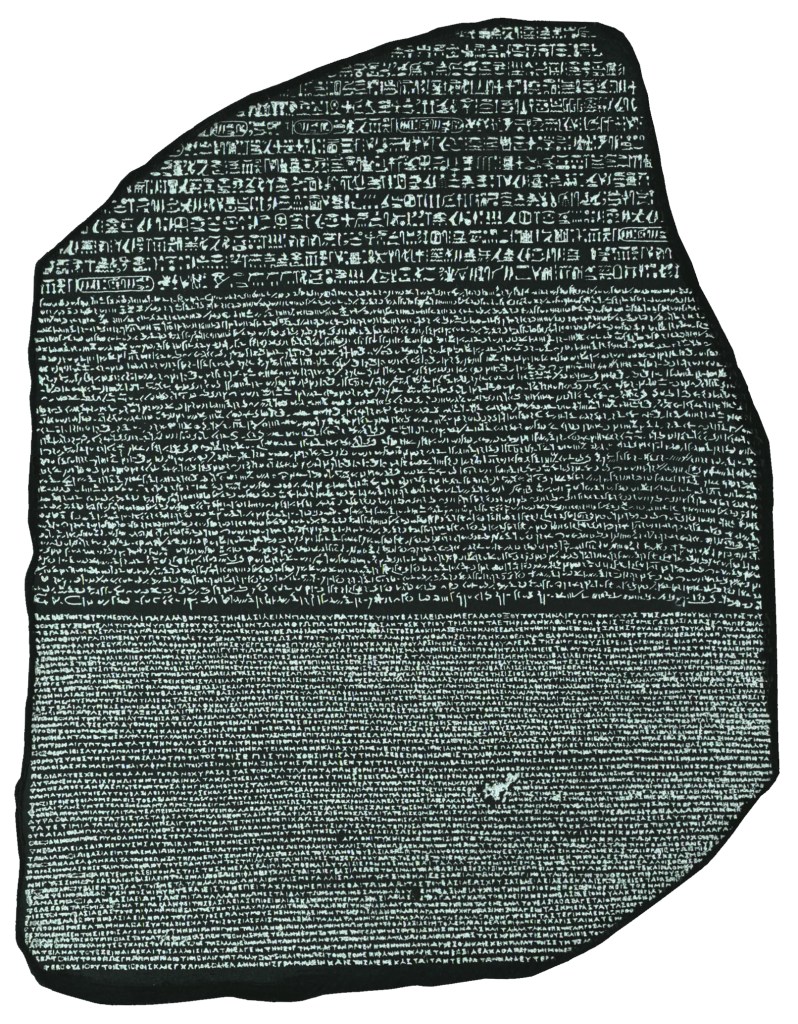
I couldn't find it in the British Museum, under renovation--
just representations, like "The Rosetta Stone" postcard
at a makeshift gift shop of two by fours in a hallway.
Until then, I had imagined a scalloped round
like the Notre Dame window, but opaque and blocking some tomb,
promising secrets to marauders if they'd go away.
From the postcard caption, I learned it began as homage to Ptolemy,
like a trilingual billboard announcing,
"What a great guy our mayor is! Signed, the Mayor's Cabinet."
Rosetta Stone scarves, notepads, and a two-dollar eraser
(white glyphs on black rubber), abounded too, at an airport gift shop,
making me think there had to be more.
Back home online
I found a hundred seventy-one sites, like one
on Rosetta Stone, the new leader of Gothic Rock,
influenced by the Headrops of Parma, Italy and another,
the publisher of Erotic Film Guide, Hottest Gay Male Site,
and Hot & Sexy Mature Women.
I found the Rosetta Stone Language Library
with its life-sized stone photo, a review of je tuil elle,
"a cinematic Rosetta Stone of female sexuality,"
the Cleopatra recording artist, Rosetta Stone,
and a link to the British Museum page about
that famous stone dug up at one site by Champollin--
but nothing on where in the museum it stands for real.
I skim one hundred sixty-three sites more, one side of the world
then the other, meaning less all the time,
as though too many jars shone stickily from the shelf,
preserves, and not jelly, too thick to see through.
About the Author: Diane Kendig‘s latest book is Woman with a Fan. Her writing has appeared in J Journal, Wordgathering, Valparaiso Review, and other journals. She ran a prison writing workshop in Ohio for 18 years, and now curates the Cuyahoga County Public Library weblog, Read + Write. Her website is dianekendig.com
Image Credit: “A picture of the Rosetta Stone, in a high contrast, readable format” Courtesy of Wikimedia Commons, Public Domain.
Memorial Day

A cousin tags me in the photo
of the tombstone. It’s my name
in liquid granite, not his,
though neither of us are expected
to live long, I expect I will
outlive him. Is that why I hide
the photo from my profile? Do I
see my face reflected in glass?
Am I afraid to go the way of my
grandparents? That they might be
lying in wait, robbers ready to
spring out and seize me
by the shoulders? Morning after
Memorial Day I hide the photo
I’m tagged in, tuck away the reminder
to die in a loose digital sheaf
and go on gassing up my lungs
with oxygen. Rain deafens the house
I sit in. Great swells of white noise
ocean waves gather and disperse.
My wife and children are sound asleep
sleep the sounder for this.
I examine the stone. Close my eyes
and listen to the rain.
About the Author: Cameron Morse (he, him) is Senior Reviews editor at Harbor Review and the author of eight collections of poetry. His first collection, Fall Risk, won Glass Lyre Press’s 2018 Best Book Award. His latest is The Thing Is (Briar Creek Press, 2021). He holds an MFA from the University of Kansas City-Missouri and lives in Independence, Missouri, with his wife Lili and three children. For more information, check out his Facebook page or website.
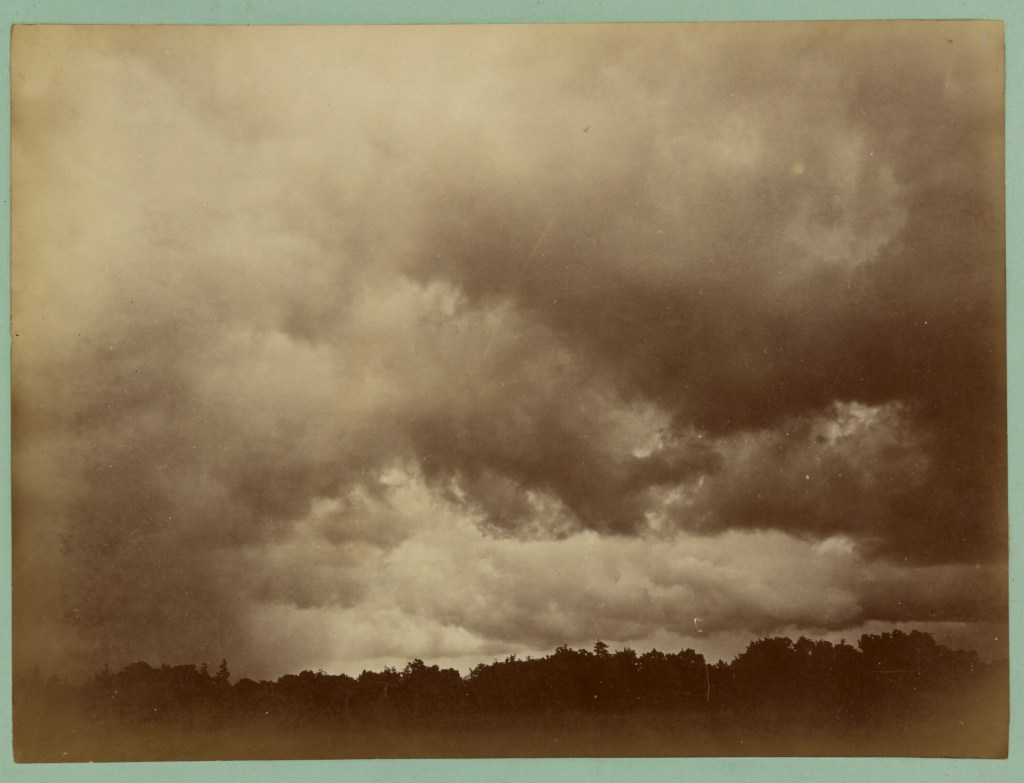
Image Credit: Unknown Photographer “Clouds” (1871) Digital image courtesy of Getty’s Open Content Program.
Wedding-bound Million-Dollar DreamI.
While people around me are getting married and having kids,
I am chained to the bottom of the sea.
“A start,” they say. What fools they are, like you.
I’ll get married before you, that’s for sure. I’ll go: “Excuse me,
Stranger, won’t you marry me?” (I have a bet
I need to win.) Just as your daddy and mommy
won’t let you marry your rich childhood friend a caste below you,
Master, as Aeneas did, dreams of resuscitating a lost dynasty,
which is difficult because his “busted” deposition
sounds like “bastard.” I was going to write back
“Bastard is not part of Master’s lexicon,” award-winning
Bullshit Artist that I am. Bounced between Master who says if only
he was me, and School filled with
pricks who teach me Shame, my World shimmers
with lunacy. Come morning, Master will fill the bathtub with water
waking me up alongside my million-dollar dreams, bubbling.
II.
When I hear the water thunder, I do not give thanks.
I curse pink-puckered dawn, who mocks us for still not knowing
the Rules of the Game at the back
of our hands. They call us “incompetent,”
“not duly diligent,” and “inadequate.” As the water
runs through me, I struggle to meet and confer
with one jerk after the other as you wait
for “please understand” to KO tenderly.
When the phoenix rises, we will no longer be pariah
pinned to the wall for our lousy copy-and-pasted work.
The troubadours will not sing of Master texting
the Defendants’ counsel about “shaking the mango tree.”
At nine p.m., unbillably, I play you weird animal music
before marching you to the 7 train
as you joke how each case is a million-dollar case
and I how this is my first walk outside of the Office.
III.
I swear—soon—we’ll leave
evil ladies tugging at men’s shirts behind
garbage bags in treeless streets
and go to your home in India, where the summer is even hotter
than the hellfire of New York.
It’ll only take a case or two under the largess of judges who ought to be on meds
for me to sit in the front row as your VIP,
all beaming in giving my Emma Woodhouse speech.
Then we will live happily ever after. That is, once troubles
worse than Achilles'
can be fought by lesser mercenaries,
Master will not dump me
for his trainloads of girlfriends
prettier and younger than I am,
leaving me alone with
my million-dollar dreams.
About the Author: Tiffany Troy is an interviewer and reviewer. Her interviews and reviews are published/ forthcoming from The Adroit Journal, The Cortland Review, The Los Angeles Review, EcoTheo Review, and Tupelo Quarterly, where she serves as an associate editor.
Ashtray

Paper and foil, relic from a time when
hospitality meant accommodating smokers,
waited for us in Pennsylvania, Mom and Pop diner
that serves pierogis like other places
dish up hash browns or white toast.

You were still a smoker then, rolled your own,
pure tobacco from pale blue cans,
Indian silhouette on the front
reassuring us of its sincerity.
I would wake to the sound of your little machine
sliding back and forth, ka-thuk, ka-thuk,
assembling your supply for the day.

It was already illegal to smoke in New York
unless you were fifty feet from anywhere.
Even restaurants lousy with smoke eaters were forbidden.
But here in Scranton, the place your people put down roots,
you could sit back, tap your homemade ash
into the proper receptacle, or your empty coffee cup,
but that’s bad manners, as we recalled.

Despite second-hand warnings,
I inhaled the smoke,
romantic intoxicant, nostalgic pollutant,
Marlboro mornings, Lemon Pledge afternoons,
childhood nights around the color console,
hair and teeth and t-shirts next day
reeking like the butts in that dish,
emptied infrequently as all the good miners
have gone to seed.
About the Author: Cheryl A. Rice’s poems have appeared in Home Planet News, Misfit Magazine, and Trailer Park Quarterly, among others. Recent books include Love’s Compass (Kung Fu Treachery Press), and Until the Words Came (Post Traumatic Press), coauthored with Guy Reed. Her blog is at: http://flyingmonkeyprods.blogspot.com/. Rice lives in New York’s Hudson Valley.
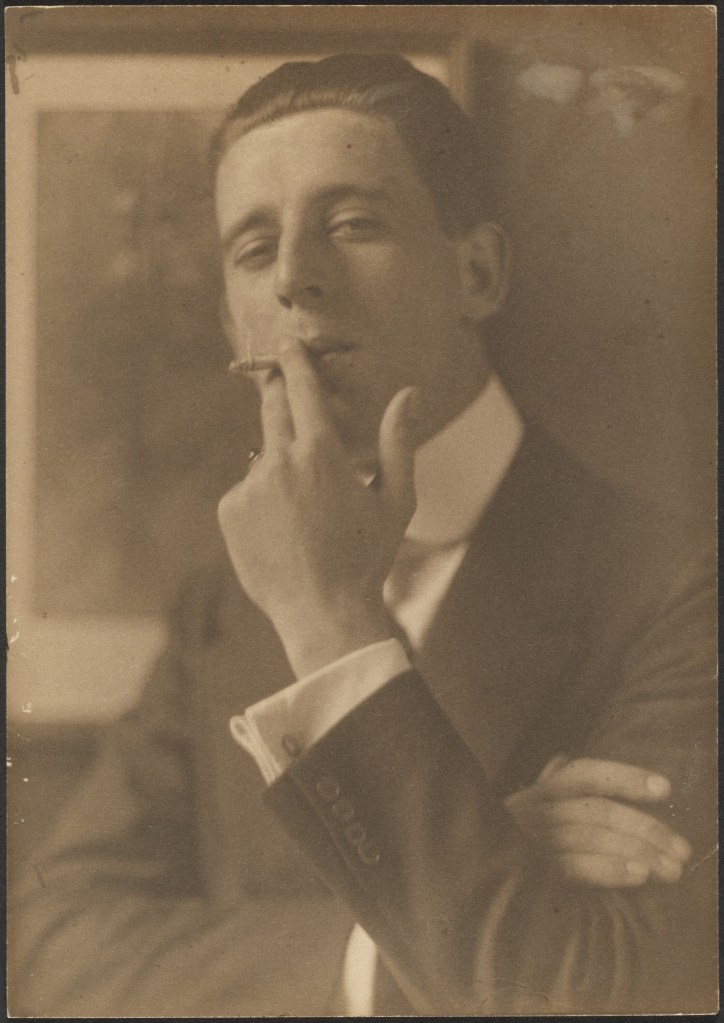
Image Credit: Louis Fleckenstein “Portrait of a Man Smoking Cigarette” Digital image courtesy of Getty’s Open Content Program.
NIGHT CONVERSATIONS (After Mei Yao Chen)

I watch a chilly night arrive.
Leaves die on the trees,
unable to survive.
Will I be afraid when
it’s my turn to die?
I tell myself words
that are probably lies.
Clouds solid as mountains
disappear from the sky.
Death is as mysterious
as is life to me.
I talk to my cat. He’s
concerned with a worm.
He’s incredibly wise.
He pays no attention
when I tell him my lies.
About the Author: George Freek’s poetry has appeared in numerous Journals and Reviews. His poem “Written At Blue Lake” was recently nominated for a Pushcart Prize.
About the Author: Rocío Iglesias is a queer Cuban-American poet and multidisciplinary artist with a law degree. She lives, breathes, and works in Minneapolis, MN.
Image Credit: Chase Dimock “Swimmers in a Malibu Sunset” (2022)
The Night I Lost My Souvenir Bucket Hat

  —Exhibition Game, August 8, 1977
      MacArthur Stadium, Syracuse, New York

We three—
Dad, little brother, and nine-year-old me—
watched from the low-rise, general admission bleachers
beside right field, a long walk to the concession stand
and nowhere convenient to shelter from the rain, and
it did rain that night we visited the ball park to see
the New York Yankees rival their Triple-A farm club
Syracuse Chiefs, who, after three innings, were ahead
on the scoreboard before the rain delay, when Dad said

the Yanks were letting the Chiefs win, rotating
bench players while big name starters schmoozed
at the fence-line, and luckily, that fence was close to
us fans who sat in nowhere-land just to see our sports
heroes because, let’s face it, we were there for
the Major Leaguers anyway, our pounding pulses,
giddy chatter, and broad grins underscoring delight in
sort of meeting our favorite soon-to-be
World Series Champs—

star hitter and right fielder Reggie Jackson, shortstop
Bucky Dent, second baseman Willie Randolph, pitcher
Ron Guidry, catcher Thurman Munson, among them—
signing autographs for more seasoned fans with
the foresight to bring baseballs and ballpoints as
we stood a mere Louisville Slugger’s length behind
them, our eyes wide and jaws on the gravel, until
the rain finally tapered off, antsy fans grew louder,
and the umpire again declared,

Play ball! and when the ninth inning had barely ended—
the Chiefs having proudly trounced the Yanks 14-5—
our soggy trio mad-dashed through the crowd, Dad’s firm
hands guiding us kids by our shoulders to the restrooms
for a pit stop, then onward to our trusty royal blue Ford
van in the crowded parking lot, where I realized I’d lost
my oft-worn, multi-colored Long Island Game Farm hat,
too late to buy a Yankees ball cap and keepsake pen,
ask Mr. October to sign the not-yet-broken-in rim.
About the Author: Leslie M. Rupracht has poems appearing or forthcoming in Aeolian Harp, Asheville Poetry Review, As It Ought To Be Magazine, Chiron Review, K’in, The Ekphrastic Review, Gargoyle, Anti-Heroin Chic, Kakalak, a chapbook, SplinteredMemories (Main Street Rag), and elsewhere. Editor, poet, writer, visual artist, and rescued pit bull mama, Leslie cofounded and hosts the monthly reading series, Waterbean Poetry Night at the Mic, in Huntersville, NC (on Facebook/Instagram @WaterbeanPoetryNightattheMic).
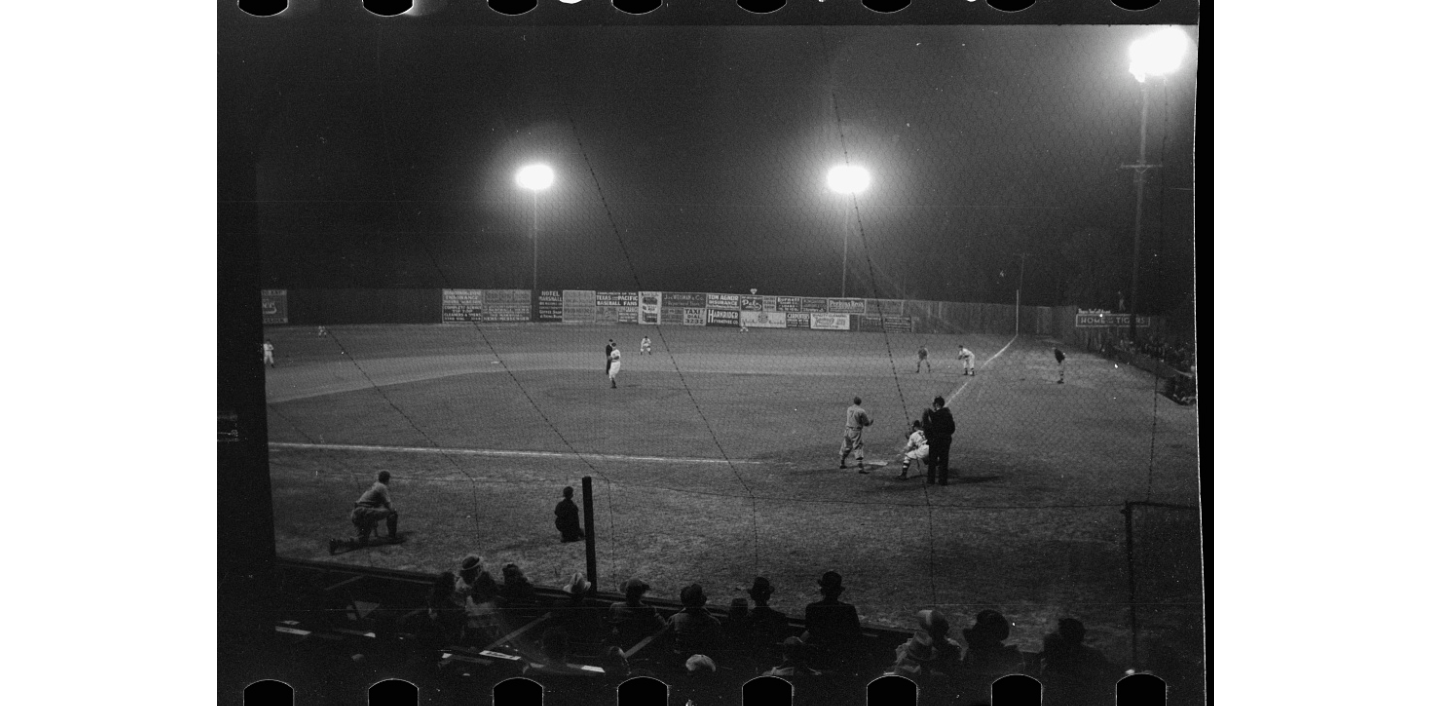
Image Credit: Russell Lee “Night baseball, Marshall, Texas” (1939) Public domain image courtesy of the Library of Congress
Casual Friday


When the evening arrives
John next door goes by
the name Lady Flamingo

and puts away the expensive suit
for a dress with sequins and feathers

hides his neatly combed hair
beneath curls of a pink wig

and trades in the quietness of his dress shoes
for the authority of eight-inch heels

he works business in the city by day
until business becomes hers by night.

This morning I hold the entrance door
for him while we both leave for work

sporting another Brooks Brothers suit
he tells me it’s Casual Friday
as he points to the pink flamingo on his tie.
About the Author: Cord Moreski is a poet from the Jersey Shore. Moreski is the author of Confined Spaces (Two Key Customs, 2022), The News Around Town (Maverick Duck Press, 2020), and Shaking Hands with Time (Indigent Press, 2018). When he is not writing, Cord waits tables for a living and teaches middle school children that poetry is awesome. His next chapbook Apartment Poems will be released by Between Shadows Press in late 2022. You can follow Cord here: www.cordmoreski.com
“It’s not dark yet, but it’s getting there.”
     - Bob Dylan
During his brilliant and destructive youth, Steve Earle (singer-songwriter extraordinaire) once proclaimed, “Townes Van Zandt is the best songwriter in the whole world, and I’ll stand on Bob Dylan’s coffee table in my cowboy boots and say that.” Later, older and sober. Earle recanted such unorthodoxy and admitted that Van Zandt was not as good as the forever mutable Dylan.
What does this story, which sounds almost apocryphal, have to do with the prose poetry of Howie Good? Well, like Steve Earle talking about Van Zandt, Good’s prose poems summon similar hyperbolic and unorthodox statements. In his varied landscapes which encompass the political, the personal, the pop, the historical, and the surreal, Good’s prose poems are unique in American literature.
Unlike the masterful prose poems of Robert Bly and James Wright, his work is seldom vatic. The characters which occupy his poems believe in horror more than transcendence. The god he comes across is “absorbed in his own thoughts” and acts “like he didn’t believe he ought to exist.” Within these poems, as in life, the mundane and the awful happen side-by-side. People die or climb a tree to survive, but hope left on a train to an unnamed camp long ago.
The world Good creates is both visual (he loves to reference painters) and apocalyptic. His work does not re-state the commonplace. A reader will not think, “I have also felt this way.” Instead, Good offers a kaleidoscope view of another reality which often bleeds into our own.
None of this is to imply that his work is without humor. Good often laughs at himself, but his humor is not like vaudeville. It is like the existential jokes of Steven Wright or the ironic jokes of Franz Kafka or the exit door jokes of the patient in the cancer ward. Even his many book titles like The Bad News First, The Titanic Sails at Dawn, and The Death Row Shuffle display his dark humor. Sometimes Good’s characters laugh until they cry and then they keep crying.
It’s important to say characters since these poems are occupied by various figures. There’s no self-willed persona in Good’s work as there is in the work of Bukowski and his acolytes. Only the constancy of themes (fear of the unknown, the certainty of pain and death, the cruelty of existence, and the occasional redemption of art) reveal anything about the man behind the writing.
In his essay, “A Small Note on Prose Poetry”, Good wrote, “All poetry worthy of the name exists in opposition to the churn of mass culture.” The idea of opposition is the force behind Good’s work and aesthetic. He writes as an outsider who makes arguments against the easy and expected.
Good’s background in journalism gives a clarity to his work even when he seems to take notes from a made up country. Journalism taught him the value of a strong declarative sentence and he is a solid student of the ways a sentence can be shaped.
Good’s outsider status is confirmed in his life and in his poetry. He’s a bit like Alfred Starr Hamilton: tied to no group or school he has few readers and fewer supporters, but many fine poems. His writing career includes approximately 40 books from small and tiny presses in the United States and England, but involves neither a MFA program nor a WPA conference. Since no one told Good what kind of poems he should write, he went off and wrote like no one else.
Uniqueness is both difficult and rare. Howie Good’s work is not difficult, but it is rare in the quality of the language, the vibrancy of the images, and the challenges of the worldview. What he offers the reader is a tilt-a-whirl ride where the landscape is always changing and where frogs rain in abundance.
About the Author: Mike James makes his home outside Nashville, Tennessee. He has published in numerous magazines, large and small, throughout the country. His most recent book, Portable Light: Poems 1991-2021, was published by Red Hawk in April 2022. Mike’s previous poetry collections include: Leftover Distances (Luchador), Parades (Alien Buddha), Jumping Drawbridges in Technicolor (Blue Horse), and Crows in the Jukebox (Bottom Dog.)
You shuddered and I shuddered and I smiled because of gravity. I moved you with my hands, and then we went to the movies. Full-screen, popcorn, real butter. You say we’ve sinned and our faces have dropped. I laugh and tell you I’ll pick your face up for you. You say you gave up women for an old yellow dog and magazines and a bad lower back. I say I wear a plastic-certainty mask when I greet the young pharmacist who knows my driver’s-license name. Your handwriting was here on my table last week. I’m not giving up on this.
About the Author: Meg Pokrass is the author of 8 collections of flash fiction.




 As It Ought To Be