Justin Karcher: “How Birdwatching Saved Your Life”

How Birdwatching Saved Your Life


This morning the birds in your backyard
disappear through sunflower wormholes.

Popsicle feathers blowing in the hot wind.

You try following but it doesn’t work like that.

So you drink some coffee instead
and hum your favorite song.

Life is all about getting through grief
then doing it again and again and again.

Did you know that if you Google
“Who is the patron saint of regret?”
there isn’t just one
and there’s still not enough.

About the Author: Justin Karcher (Twitter: @justin_karcher, Bluesky: justinkarcher.bsky.social) is a Best of the Net- and Pushcart-nominated poet and playwright born and raised in Buffalo, NY. He is the author of several books, including Tailgating at the Gates of Hell (Ghost City Press, 2015). Recent playwriting credits include The Birth of Santa (American Repertory Theater of WNY) and “The Trick Is to Spill Your Guts Faster Than the Snow Falls” (Alleyway Theatre).

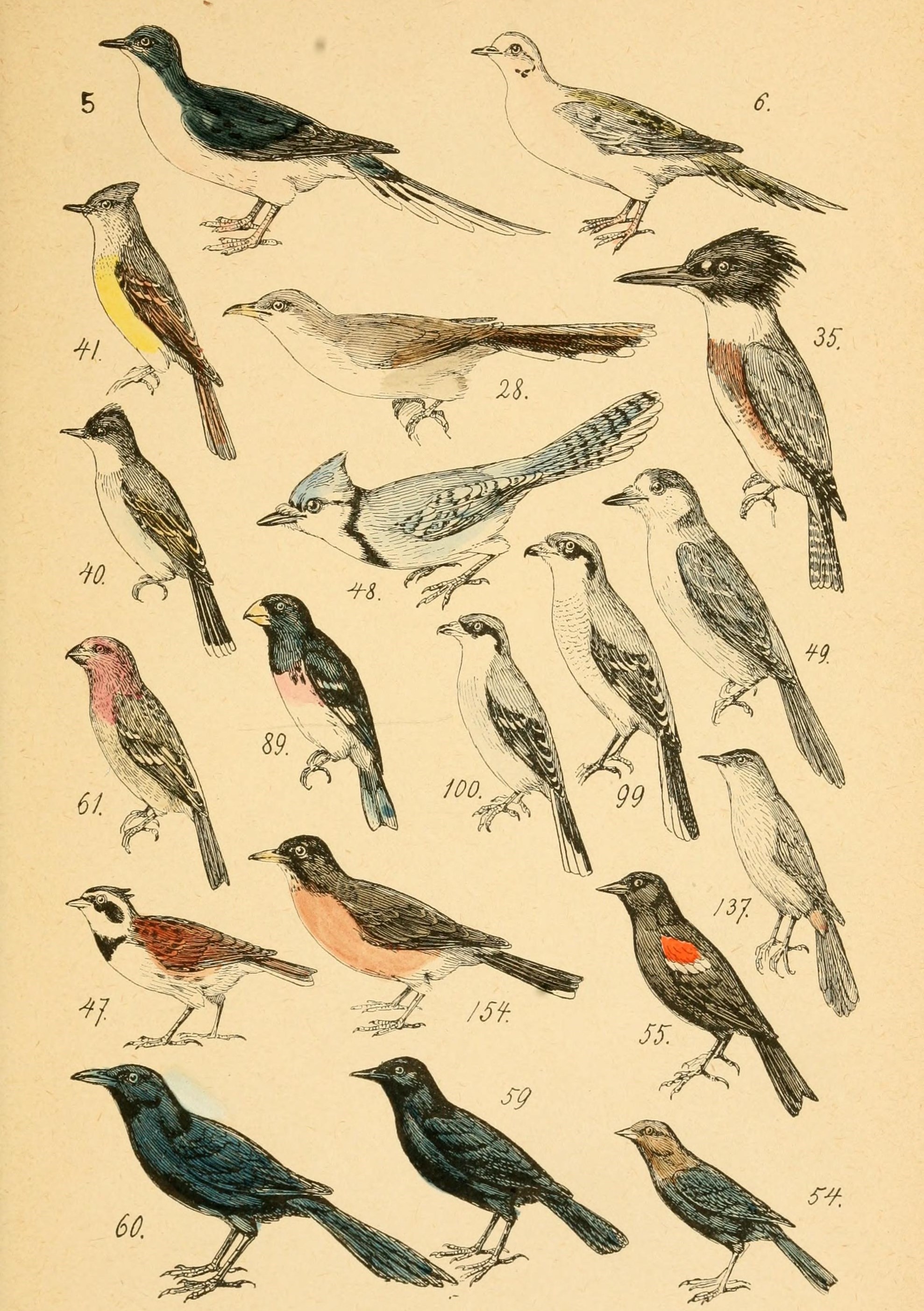
Image Credit: Public domain image originally from Field key to the land birds … Boston, B. Whidden,1899. Image courtesy of the Biodiversity Heritage Library
Rusty Barnes: “Homage to Jim Harrison”

Homage to Jim Harrison

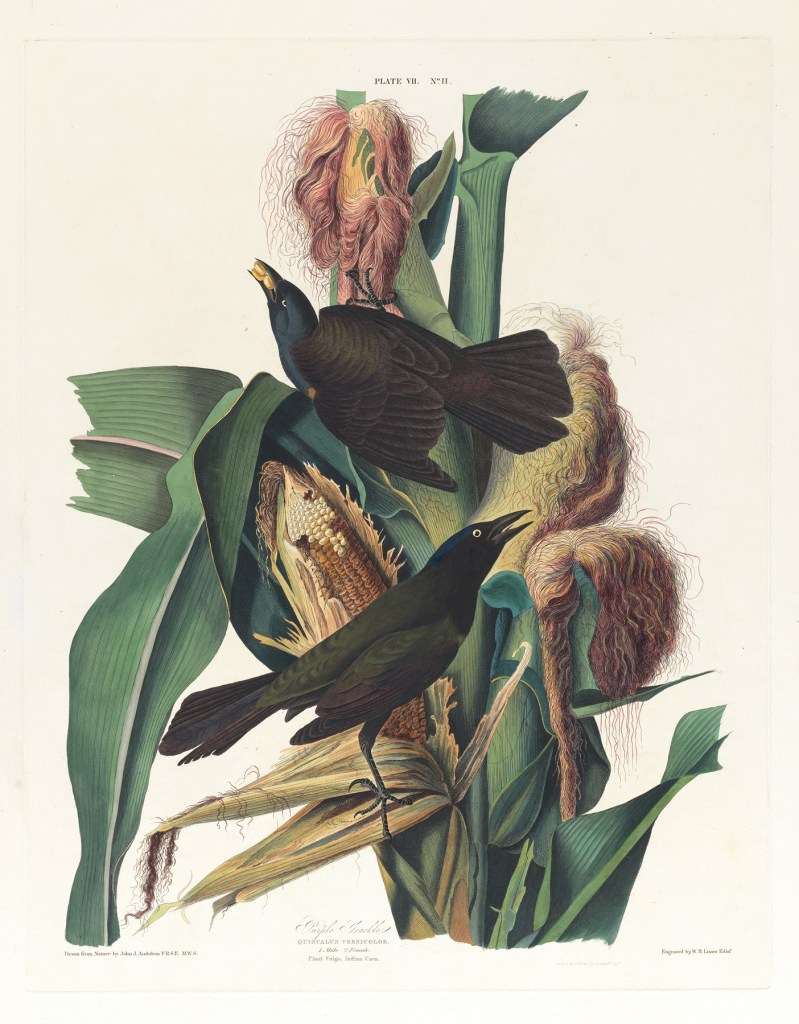
The grackle with its blue head
dunks violently his beak

in the bird bath while chickadees
and starlings battle the squirrels

for sustenance. Cars power by here
in the city and squirrels rush the street

for lack of places to run. On the porch
with my one-eyed dog,

I run my weathered hand on his
head and search fruitlessly for

the Zen moment like Jim Harrison's
dogs betray their owner's point of view.

I keep his grizzled nose pointed at
the source and breathe in his wisdom.

About the Author: Rusty Barnes lives with his family and a horde of cats in Revere MA. His work appears widely, and his most recent chapbook is DEAR SO & SO.

Image Credit: John James Audubon “Purple Grackle” Public domain image courtesy of Artvee

Royal Rhodes: “The Other Genesis”

The Other Genesis

What do we see outside 
except a canopy of ebony wings, 
garlands of feathery smoke 
moving on blackened water? 
Against the sketchy light 
it looks like a cancer patient 
showing us their fifth x-ray. 
The troubled lungs, highlighted: 
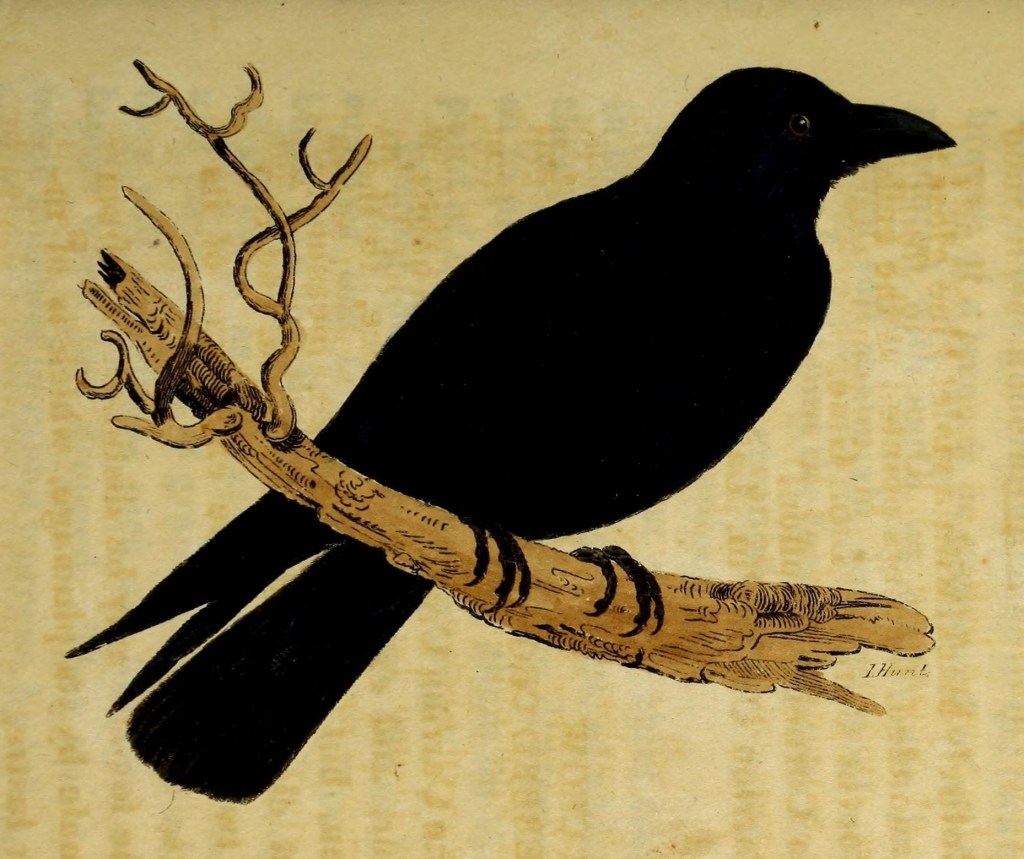
a cage of full-grown crows 
in a space too small for them 
and anxious for routes to escape, 
fanning their jittery wings 
against imprisoning walls. 
Something screamed in fear, 
locked inside us, watching. 
Resistance is useless, absurd, 
trapped in something we are. 
We saw their work when free: 
the substantial killing 
along the state route. They strutted 
around the roadkill, plucking 
at bits of the dying creatures, 
supple as the playful light. 
When will it end? we ask. 
And why did it ever begin? 
We are the understanding they lack. 
So we took them deep inside us. 

About the Author: Royal Rhodes, who was trained in the Classics, is a retired educator who taught classes in global religions and Death & Dying for almost forty years. His poems have appeared in: Ekstasis Poetry, Snakeskin Poetry, The Montreal Review, The Cafe Review, and other places. His poetry/art collaborations have been published with The Catbird [on the Yadkin] Press in North Carolina.

Image Credit: Image originally from British Ornithology: Norwich: Bacon,1815-22. Courtesy of the Biodiversity Heritage Library
Tina Williams: “Two Kinds”

Two Kinds

It was dusk
on a two-lane road
in deep East Texas
and we had not passed
a word for miles
when she said
there are two kinds
of people in the world.
Years later, the turtles 
in my neighborhood 
know nothing of
my friend’s philosophy.
Or how simply 
some things boil down.
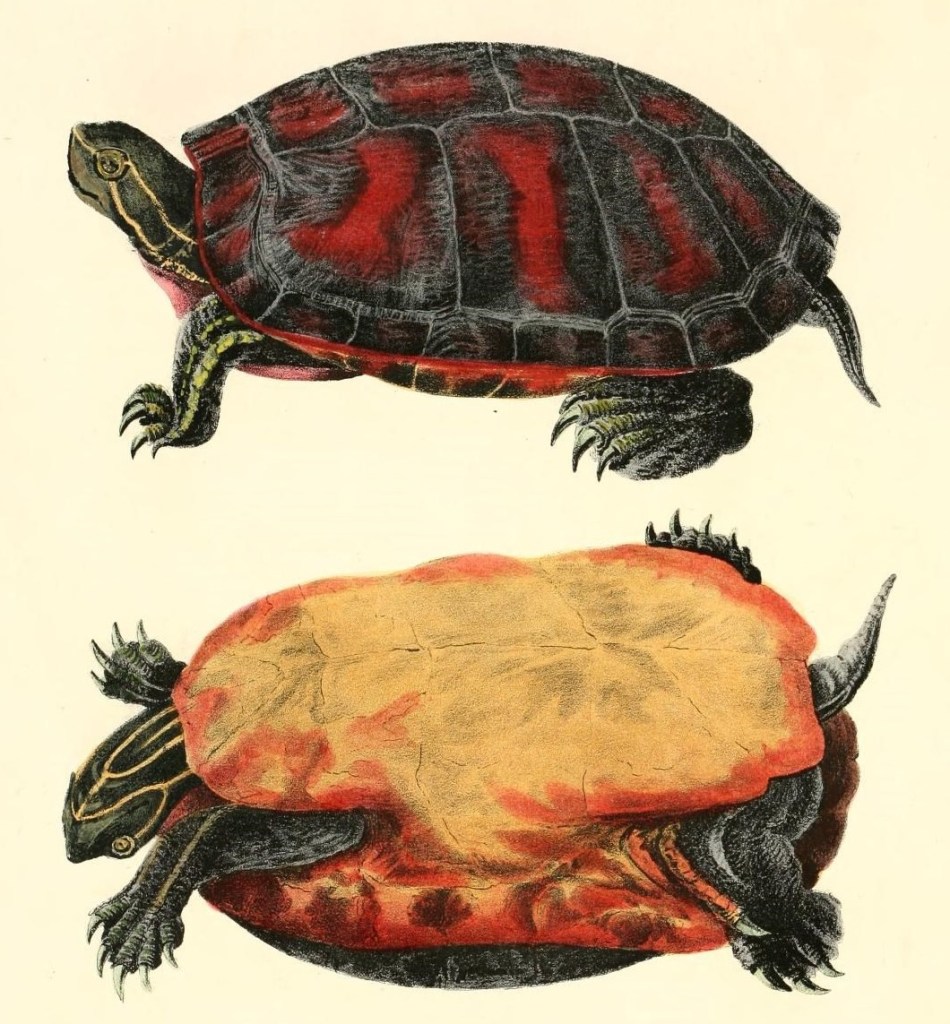
The red-eared slider at my feet,
flipped over and still but still here,
knew seasons.
She knew navigation
and the grass best for nesting. 
Tenacity.
Now, spun senseless
to where the street met the curb,
she lay bloody, mud-baked legs
splayed flat and a gut-deep wound
cracked clean down her belly.

Turtles have inched their way
across hundreds of millions of years,
ducking one mass extinction
after another protected by nothing more
than the home on their back.
Today, the turkey vultures
working a squirrel
three blocks away
will catch wind
of this one at my feet,
an ancient traveler
felled handily enough
by steel on rubber
and the kind who
do not stop.

About the Author: Tina Williams is a former journalism instructor and advertising copywriter living in Austin, TX. Her poems have appeared in or are forthcoming in the New Verse News, Amethyst, Borderlands: Texas Poetry Review, and the Concho River Review.

Image Credit: Public domain image originally published in North American herpetology : Philadelphia, J. Dobson;1842. Courtesy of the Biodiversity Heritage Library
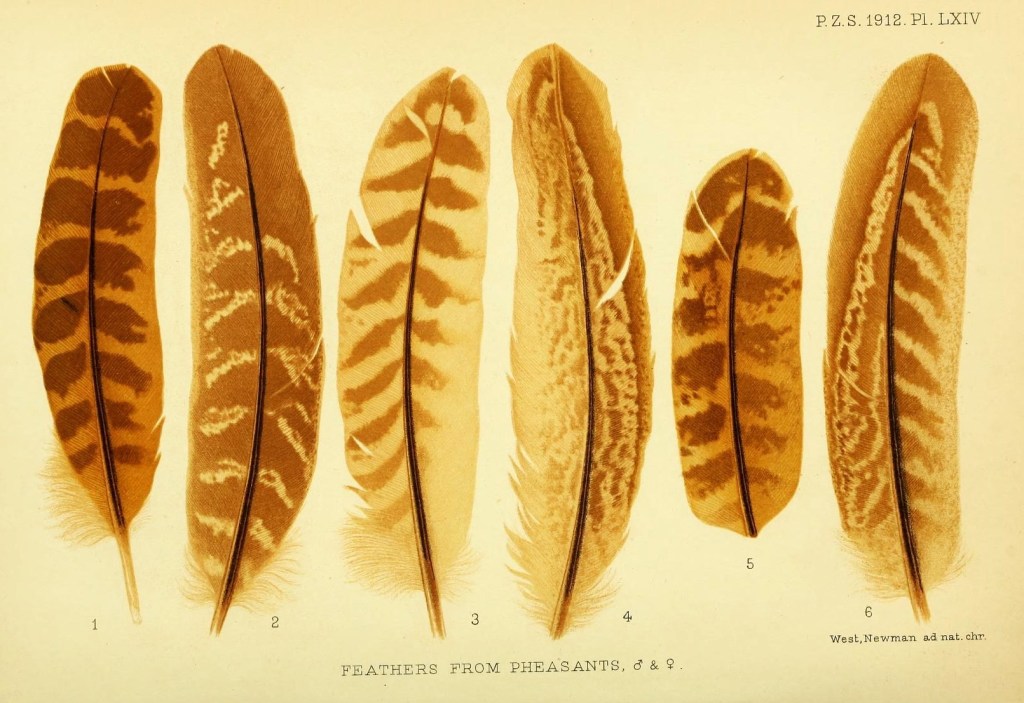
CL Bledsoe: “A Lightness of Feathers”

A Lightness of Feathers

Who among us hasn't broken a collarbone falling
out of a tree after we climbed into a bird's nest
and pretended to be an egg? The ghost of omelets
gone wrong. Something with feathers condemned
to a passing glance. A side table. Somewhere dust
calls home. I’ll rebuild my life with doilies
and photos of surgeries I’d like to have. Did I mention
so-and-so died after a lifetime of regret and forced
choices? Never forget your name is on someone’s
Do Not Love Again list. No matter how you measure
it, you’ll never have what you’ve lost again. Another
name for insouciance. At least you’re not the kind
of bird that kicks the other eggs out of the nest
when you settle in. It’s the small victories keep
us going and coming. That’s how they get you.
I don’t even know what kind of tree it was.

About the Author: Raised on a rice and catfish farm in eastern Arkansas, CL Bledsoe is the author of more than thirty books, including the poetry collections Riceland, The Bottle Episode, and his newest, Having a Baby to Save a Marriage, as well as his latest novels Goodbye, Mr. Lonely and The Saviors. Bledsoe lives in northern Virginia with his daughter.

.

Image Credit: Public domain image originally published in Proceedings of the Zoological Society of London, London : Academic Press. Image courtesy of the Biodiversity Heritage Library
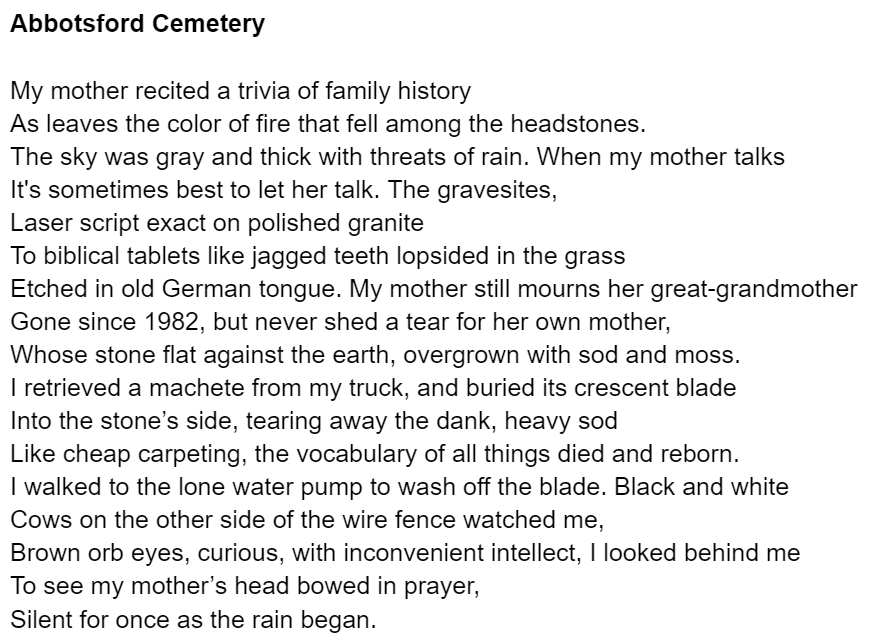
Troy Schoultz: “Abbotsford Cemetery”

.

.

.

.

.

About the Author: Troy Schoultz is a lifelong Wisconsin resident. His poems, stories, and reviews have appeared in Seattle Review, Rattle, Slipstream, Chiron Review, Fish Drum, Santa Monica Review, Steel Toe Review, Midwestern Gothic, Palooka and many others in the U.S. and U.K. since 1997. He is the author of two chapbooks and three full-length collections.  His interests and influences include rock and roll, vinyl LPs, found objects, the paranormal, abandoned places, folklore, old cemeteries, and the number five. He hosts and produces S’kosh: The Oshkosh Podcast. For more information check out https://troyschoultz.wixsite.com/website

.

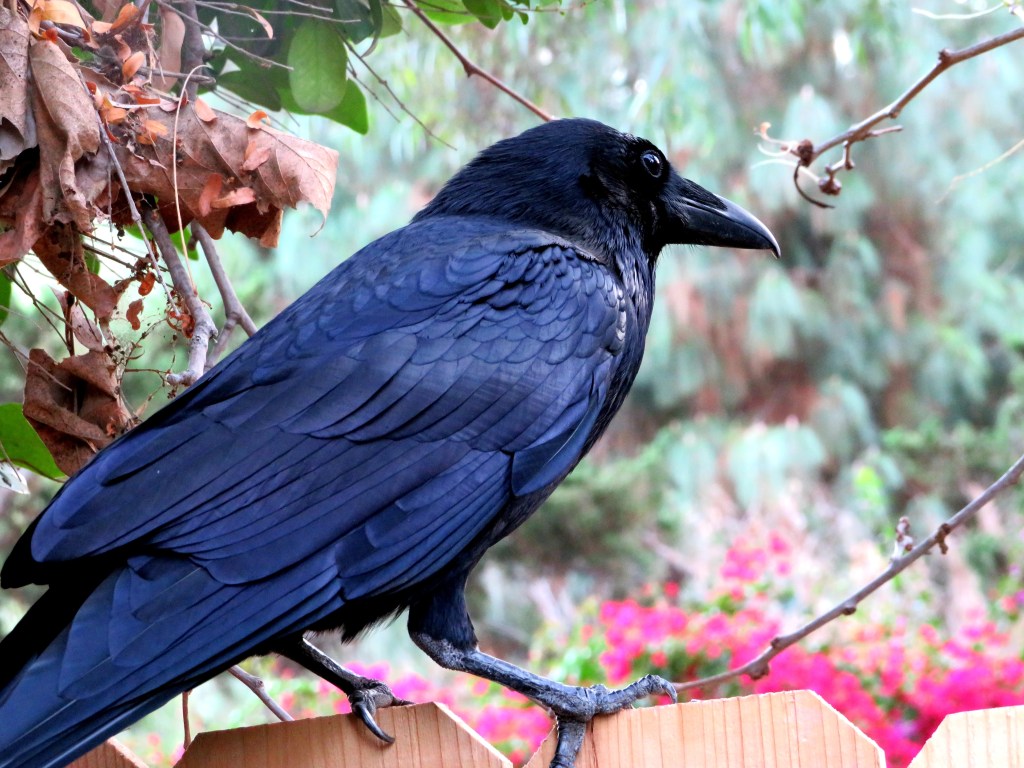
Image Credit: Chase Dimock “Crow on a Fence” (2021)

Joanna George: “woodpeckers”

.

51068443446_0dee97a4bd_o

.

.

Screenshot 2022-03-16 140342

.

.

About the Author: Joanna George (She/Her) writes from Pondicherry, India. Her poems appear or are forthcoming in Parentheses Journal, Cordite Poetry Review, Isele magazine, Honey Literary, Borderlands: Texas Poetry Review, West Trestle Review, Lumiere Review, Paddler Press and others. She tweets at j_leaseofhope.

.

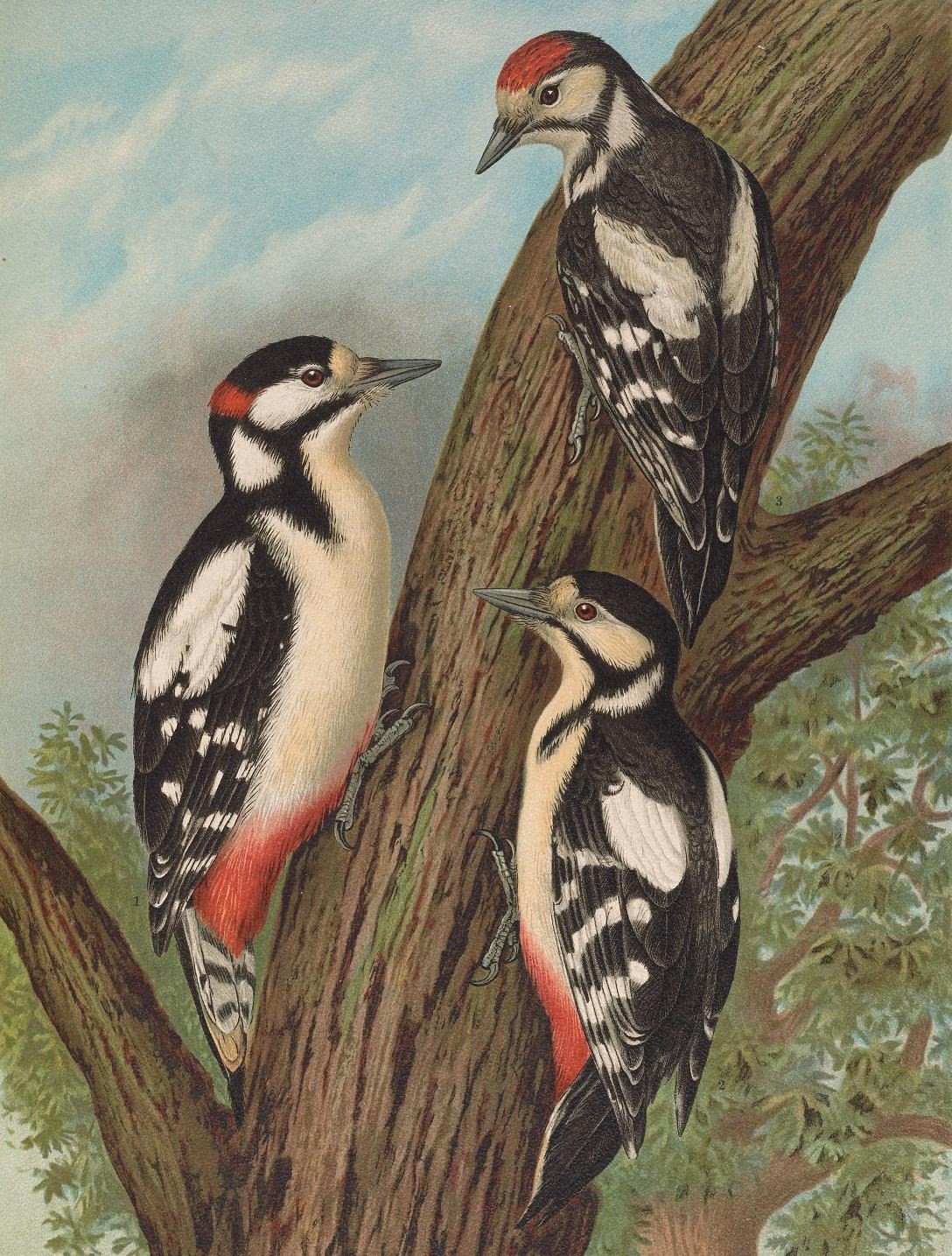
Image Credit: Image from Naturgeschichte der Vögel Mitteleuropas Gera-Untermhaus,F.E. Köhler,1897-1905 [v.1, 1905] Courtesy of the Biodiversity Heritage Library (public domain)
Sheila Saunders: “It is still, now”

.

36780433052_f377933e9c_o

.

.

It is still, now

The winds have exhaled with the tide, and the afternoon.
 Here the fields draw in the winter dusk,
drain the westerly plum- juice streaks
greying the pink and yellow 
in slow minutes. 

It is still.
No chatter or shriek from the magpies
dumb on  black poplars’ broom-like branches
or aimlessly flopping over  sodden grass
crossing-  re-crossing. 

A near silence
wraps   the watcher in  comfort, 
who
 not hearing the  air breathing,
nor a leaf slip’s infinitesimal whisper,
is still, too.

.

.

About the Author: Sheila graduated from St Anne’s College, Oxford, with a degree in English Language and Literature, and since then worked as a reporter on local weekly and daily newspapers  in Lancashire, Lincolnshire and Buckinghamshire. After marriage to another journalist in 1961, Sheila brought up three children and continued to write as a freelance, and became involved in community organisations in Wirral, and voluntary work with special needs young people. She has always loved  theatre, music and art, but it is her observation and fascination with  her natural surroundings, including the wildlife of the coast, that has inspired most of her poetry.

.

More by Sheila Saunders: 

April Visitor

.

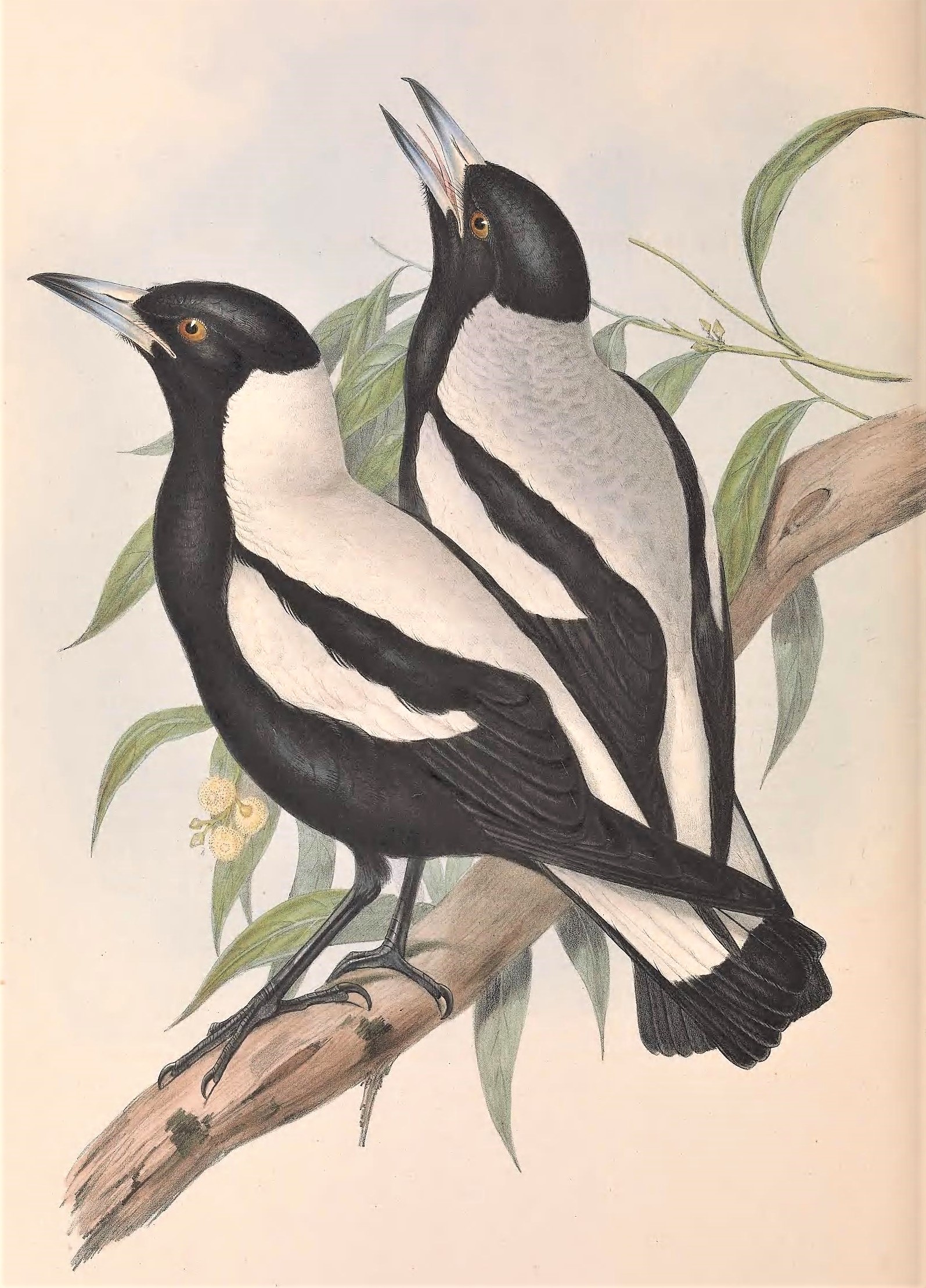
Image Credit: Image from, The birds of Australia. London, Printed by R. and J. E. Taylor; pub. by the author,[1840]-48. Image courtesy of The Biodiversity Heritage Library (Public Domain)

Barbara Daniels: “At Shearness Pool”

.

5632199255_1063c90a70_o

.

.

At Shearness Pool

After rain sandpipers snoop 
for food at the runoff pond 
by the old tennis courts, caught 

in the tides of migration. 
I ask a painter at his easel 
how to live. He says to choose 

exacting silence. Eight turkeys, 
not really wary, step gracefully 
out of the brush. Like a hunter, 

I hold my breath. It’s sudden 
joy to spot an owl mobbed 
by blackbirds, find orioles 

hidden like lovers, like fat 
jewels. I’m happy eating 
my tuna sandwich 

and watching an eagle 
across Shearness Pool. She stuns 
me to stillness. I ask a hiker

how to live. She says 
to watch silver water just 
as the eagle lifts her wings.

.

.

About the Author: Barbara Daniels’ Talk to the Lioness was published by Casa de Cinco Hermanas Press. Her poetry has recently appeared in Concho River Review, Dodging the Rain, and Philadelphia Stories. She received four fellowships from the New Jersey State Council on the Arts, the most recent in 2020.

.

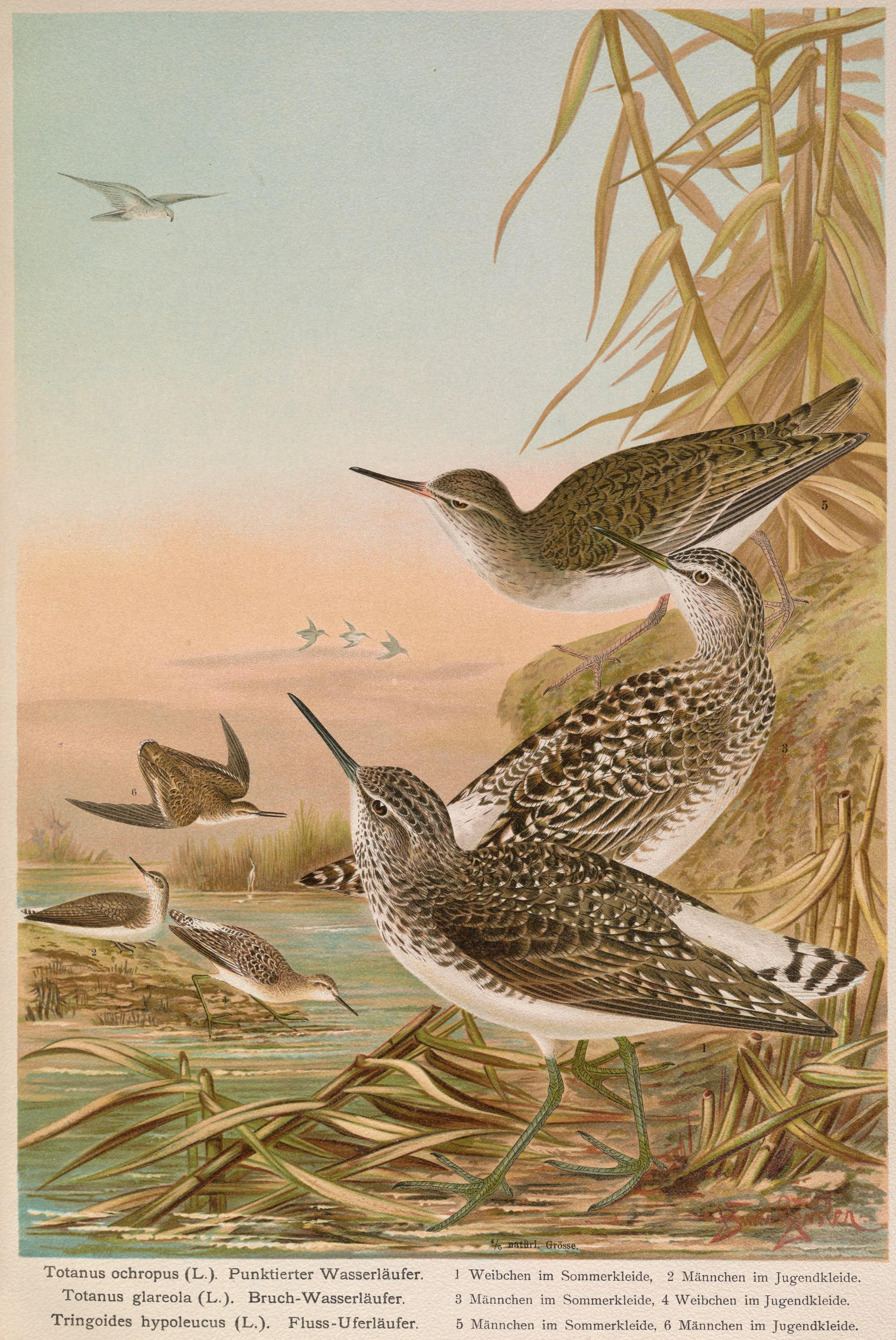
Image Credit: “A beautiful scene of some sandpipers at sunset” courtesy of the Biodiversity Heritage Library (public domain)
Julia Wendell: “Owl”

.

9495763530_ac351a4211_o

.

.

Owl,

High up in the crown
of a Monterey cedar,
saucer-yellow eyes
blinking down at us.
“Bird,” says the wee one.
“Owl,” I specify.
Next morning, he’s still
perched on the shaggy fronds,
a mouse in his talons, blood
stippling his feathers.
“Mouse,” says the girl.
“Dinner,” I elaborate.
I am not above revealing
violent cycles of need
to even the smallest soul.
It will eventually make sense.
She will grow up
and learn to kill and kill and kill—
bugs, engines, books, time, love.
But for now, the bird stays high up 
at the center of our globe.
“Owl,” says the budding girl.
“Life,” says the old one, me.

.

.

About the Author: Julia Wendell‘s sixth volume of poems. THE ART OF FALLING, will be published by FutureCycle Press in February, 2022. She lives in Aiken, South Carolina, and is a three-day event rider.

.

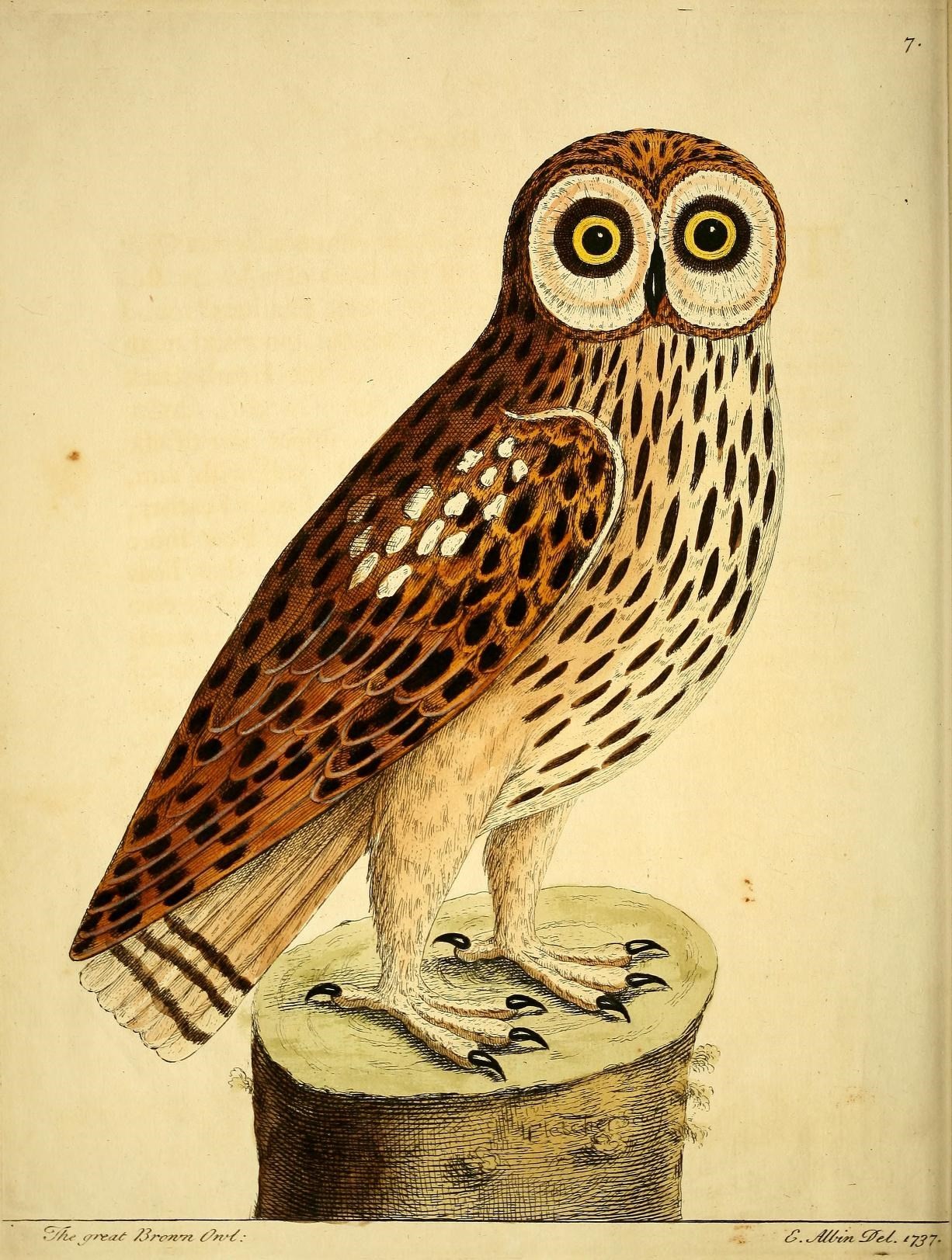
Image Credit: Image from A Natural History of Birds (Public Domain) Image courtesy of The Biodiversity Heritage Library