The Other Genesis

What do we see outside
except a canopy of ebony wings,
garlands of feathery smoke
moving on blackened water?
Against the sketchy light
it looks like a cancer patient
showing us their fifth x-ray.
The troubled lungs, highlighted:
a cage of full-grown crows
in a space too small for them
and anxious for routes to escape,
fanning their jittery wings
against imprisoning walls.
Something screamed in fear,
locked inside us, watching.
Resistance is useless, absurd,
trapped in something we are.
We saw their work when free:
the substantial killing
along the state route. They strutted
around the roadkill, plucking
at bits of the dying creatures,
supple as the playful light.
When will it end? we ask.
And why did it ever begin?
We are the understanding they lack.
So we took them deep inside us.
About the Author: Royal Rhodes, who was trained in the Classics, is a retired educator who taught classes in global religions and Death & Dying for almost forty years. His poems have appeared in: Ekstasis Poetry, Snakeskin Poetry, The Montreal Review, The Cafe Review, and other places. His poetry/art collaborations have been published with The Catbird [on the Yadkin] Press in North Carolina.
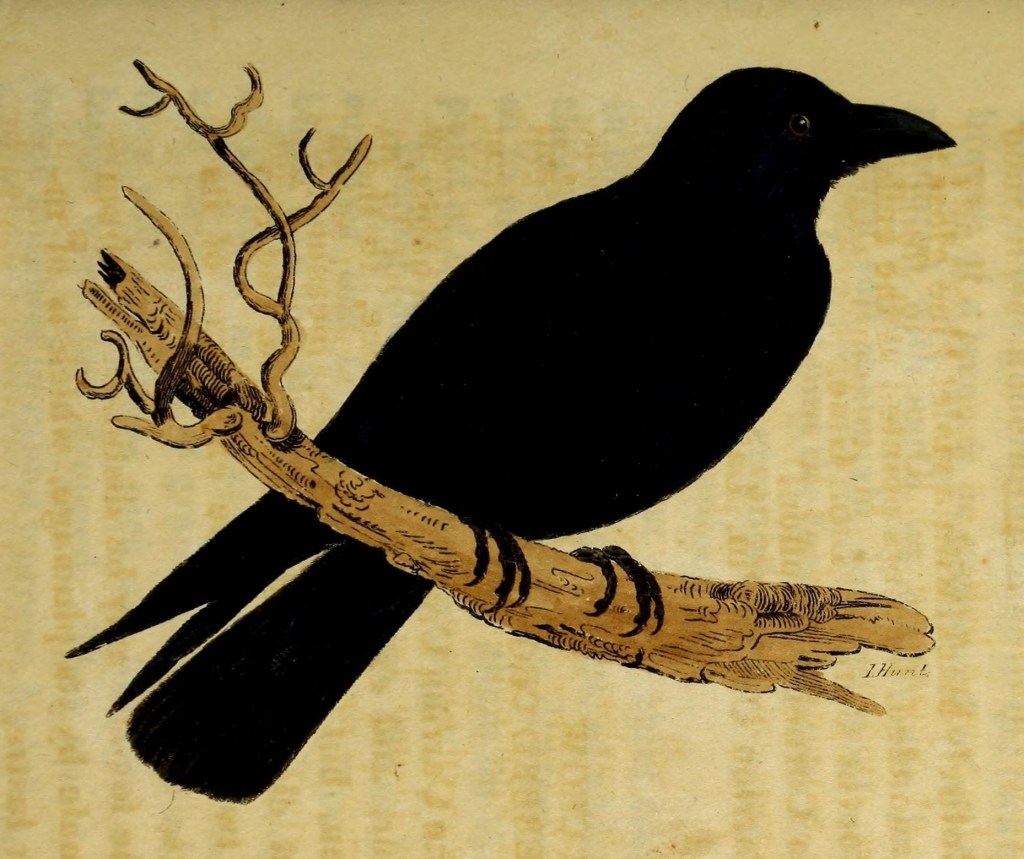
Image Credit: Image originally from British Ornithology: Norwich: Bacon,1815-22. Courtesy of the Biodiversity Heritage Library
Crabbing at Nehalem Bay: a virelai

After “Douce Dame Jolie” by Guillaume de Machaut

My will is that your claw should grab
This cat food, that your mind should stab
Its doubts and urge you, like its lab
Rat, into trying something new.

The tide is closing out my tab…
I swab
The weather’s face and ocean’s too.
I fill my boat with air and flab
To nab
Some pride and dinner for my boo.

I’m frightened not when shorelines blab;
I see the semi-love Les Schwab
Half-buried under sand. My cab
Is fate; we’re not just driving through!

My will is that your claw should grab
This cat food, that your mind should stab
Its doubts and urge you, like its lab
Rat, into trying something new.

The seagulls here all do the dab.
Ahab
I’m not, but niveous visions do
Call me away from any slab
A schlub
Could stand on; courage isn’t blue.

The clam beds sleep beneath Queen Mab
Despite my screams when every ab
I catch is slightly rounded. Drab
My engine’s soul and instinct’s clue.

My will is that your claw should grab
This cat food, that your mind should stab
Its doubts and urge you, like its lab
Rat, into trying something new.

Off Hwy 101 facts jab
Prefab
Experiences; they don’t come true
Because the gift of every crab
Is gab:
They rival Athens in a coup!

But south of Wheeler, night’s hijab
Is not on yet. My buoys scab
The waters so that Dr. Krabbe,
If he was here, would say, “Achoo!”

My will is that your claw should grab
This cat food, that your mind should stab
Its doubts and urge you, like its lab
Rat, into trying something new.
About the Author: Jake Sheff is a pediatrician and US Air Force veteran. He’s published a full-length collection of formal poetry, “A Kiss to Betray the Universe” (White Violet Press), along with two chapbooks: “Looting Versailles” (Alabaster Leaves Publishing) and “The Rites of Tires” (SurVision).
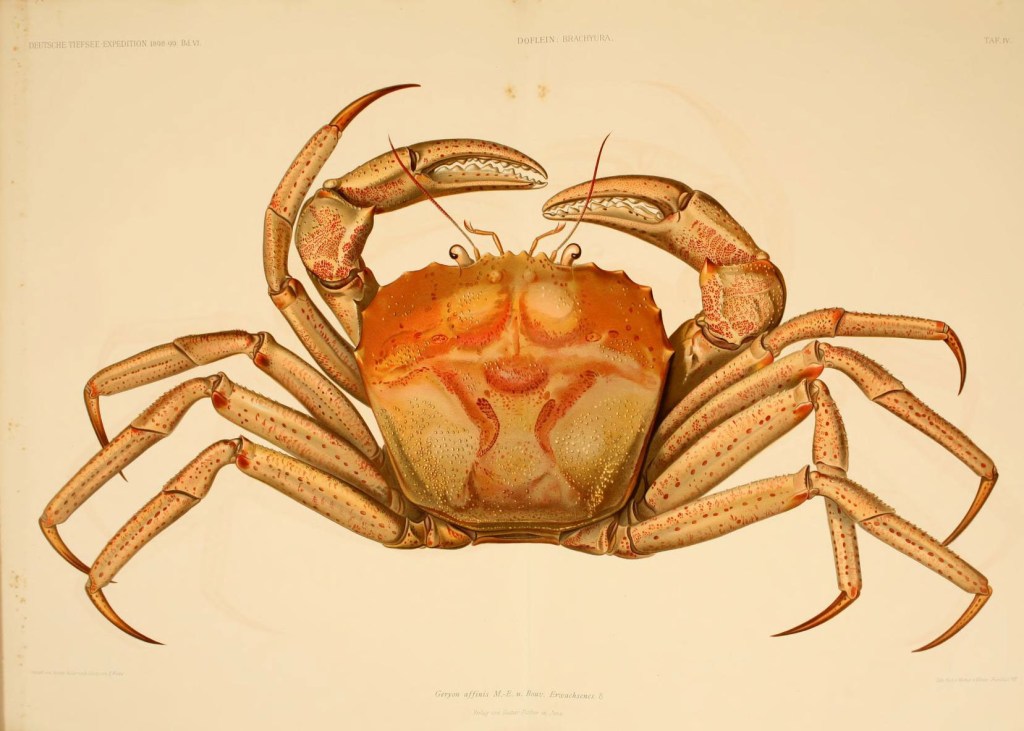
Image Credit: Wissenschaftliche Ergebnisse der Deutschen Tiefsee-Expedition auf dem Dampfer “Valdivia” 1898-1899. bd.6. Atlas Jena,G. Fischer,1902-40. Public domain image courtesy of the Biodiversity Heritage Library.
Two Kinds

It was dusk
on a two-lane road
in deep East Texas
and we had not passed
a word for miles
when she said
there are two kinds
of people in the world.
Years later, the turtles
in my neighborhood
know nothing of
my friend’s philosophy.
Or how simply
some things boil down.
The red-eared slider at my feet,
flipped over and still but still here,
knew seasons.
She knew navigation
and the grass best for nesting.
Tenacity.
Now, spun senseless
to where the street met the curb,
she lay bloody, mud-baked legs
splayed flat and a gut-deep wound
cracked clean down her belly.

Turtles have inched their way
across hundreds of millions of years,
ducking one mass extinction
after another protected by nothing more
than the home on their back.
Today, the turkey vultures
working a squirrel
three blocks away
will catch wind
of this one at my feet,
an ancient traveler
felled handily enough
by steel on rubber
and the kind who
do not stop.
About the Author: Tina Williams is a former journalism instructor and advertising copywriter living in Austin, TX. Her poems have appeared in or are forthcoming in the New Verse News, Amethyst, Borderlands: Texas Poetry Review, and the Concho River Review.
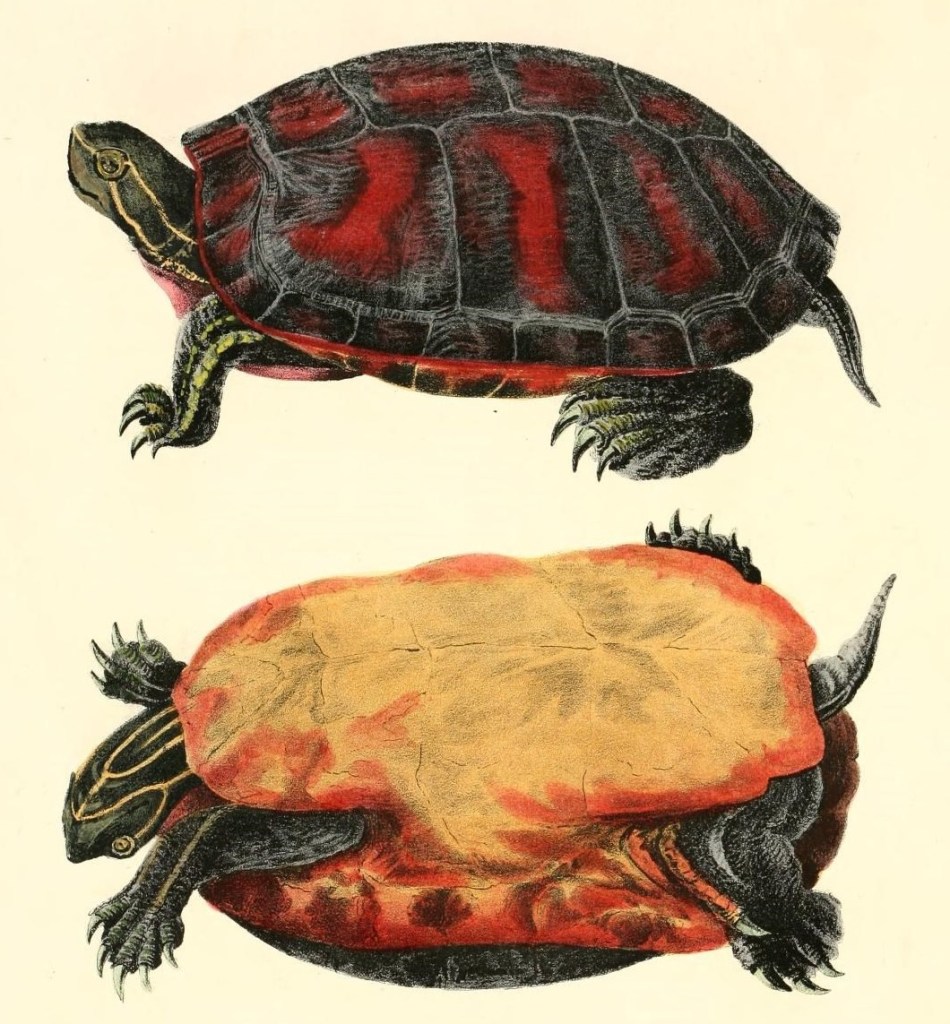
Image Credit: Public domain image originally published in North American herpetology : Philadelphia, J. Dobson;1842. Courtesy of the Biodiversity Heritage Library
Cat Tequila

Gathered ‘round a glass of milk,
the only question now:
who will eat the mouse tail
in the bottom?
Mess themselves up real good?
The tail sucks up all the milk,
you see!
About the Author: Ryan Quinn Flanaganis a Canadian-born author residing in Elliot Lake, Ontario, Canada with his wife and many mounds of snow. His work can be found both in print and online in such places as: Evergreen Review, As It Ought To Be Magazine The New York Quarterly, Cultural Weekly, In Between Hangovers, Red Fez, and The Oklahoma Review.
.
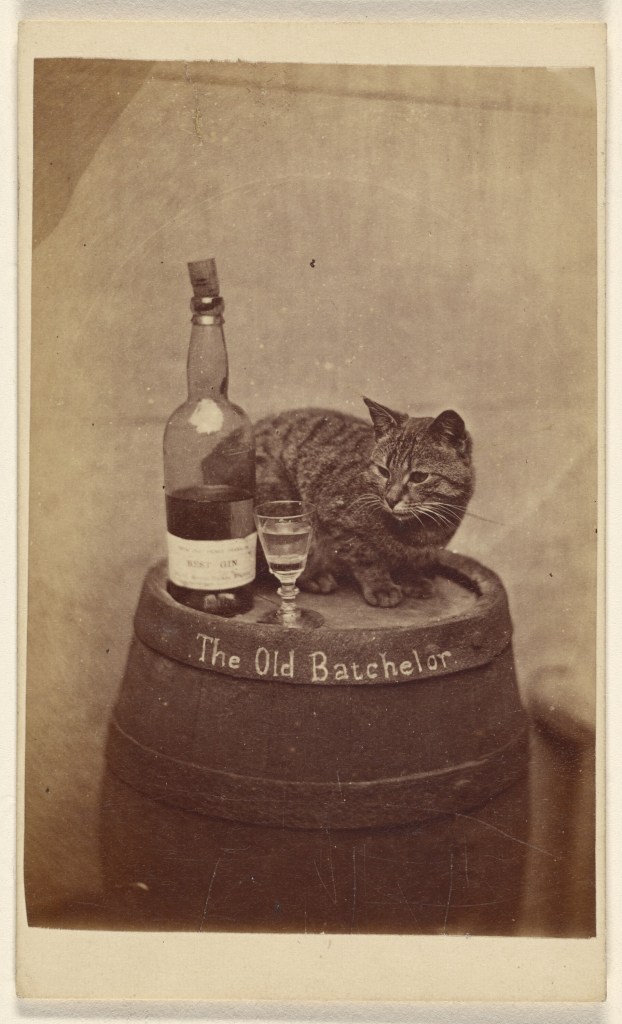
Image Credit: Henry Pointer “The Old Bachelor” (1865) Digital image courtesy of Getty’s Open Content Program.
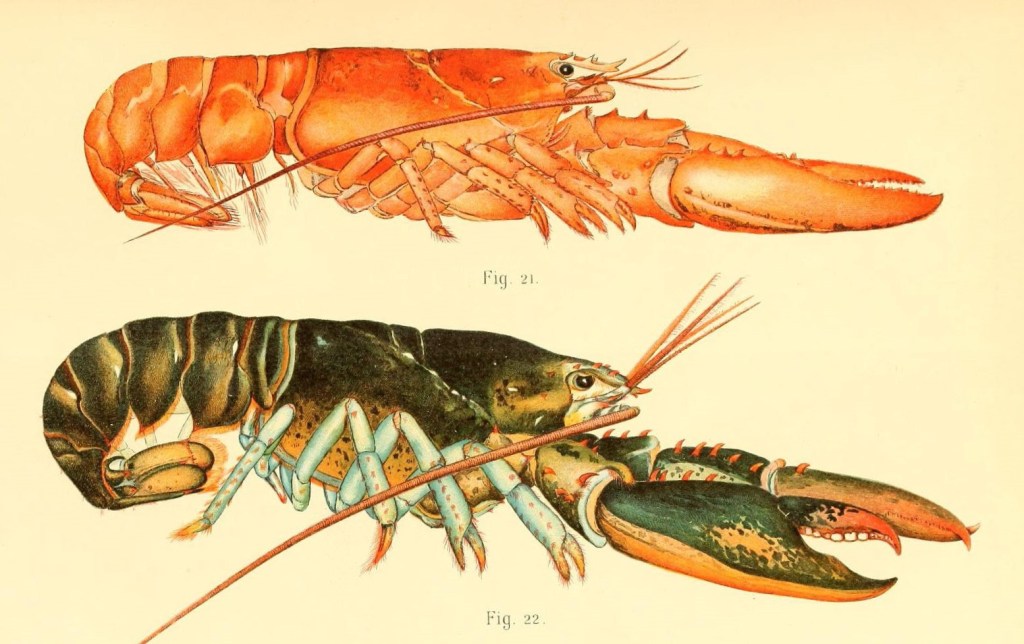
Do you think the lobsters

in the tanks at Red Lobster
are really red?
Or are they brackish and imperfect

with the blue rubber bands
around their claws?
Do you think the lobsters

know they could live
half a century
if given the chance?

Do you think the lobsters
know we have to believe
they don’t feel pain?

We sometimes believe that
about our own species too.

Do you think
the lobsters know?
About the Author: Geneva Webber is a sophomore Creative and Professional Writing major and is minoring in Political Science and Women and Gender Studies at the University of Pittsburgh at Greensburg. She is a member of the Writing Club, is Vice President of P.A.W.S. (Pro-activism With Service) and her work has been previously published in The Insider. She has lived in Pittsburgh, Chicago, and small-town Michigan, and derives much of her writing from small, intimate, personal experiences.
 As It Ought To Be