Funereal Geometry:  The Evangelical Congregation Concludes the Funeral by Singing “In Christ, There is No East or West / No North or South,” while Outside the Church and Midway Up, a Steeplejack Tests to See the Steeple’s True

If a plumbline’s run from Heaven’s door bell
to the red baize on Satan’s pool table;
and if such a line bisects their steeple;
and if the steeple’s perpendicular—

perpendicular, foursquare, ever true--
to the church’s temporal foundation,
the workman’s spirit level always rules
theology and recalibration.

Lacking such, the skewed will keep on skewing,
will mime secular drift–anathema
to the faith and the faithful, those who cleave
to the steeple's cleft, crowd a receding

circumference, and create a holy
right angle to the vertical axis.
That’s why the steeplejack’s climbed the steeple
even as the funeral rumbles, smacks

around his calibrations.   He’s allowed
no room for error in the elders’ view:
the journeyman’s warrant is the last word
in church doctrine.  The steeple must be true,

must aim straight up.  The soul shoots for a pole
implied by the steeple.  Off-plumb slivers
of a bubble, who knows where the launched soul
might end up.  Heaven's the point of a pin.
About the Author: Samuel Prestridge lives and works in Athens, Georgia. He has published work in numerous publications, including Literary Imagination, Style, The Arkansas Review, As It Ought To Be, Poetry Quarterly, Appalachian Quarterly, Paideuma, The Lullwater Review, Poem, Juke Joint, and The Southern Humanities Review.
He is a post-aspirational man whose first book A Dog’s Job of Work is seeking publication. He is currently an Associate Professor of English at the University of North Georgia. His children concede that he is, generally, an adequate father.
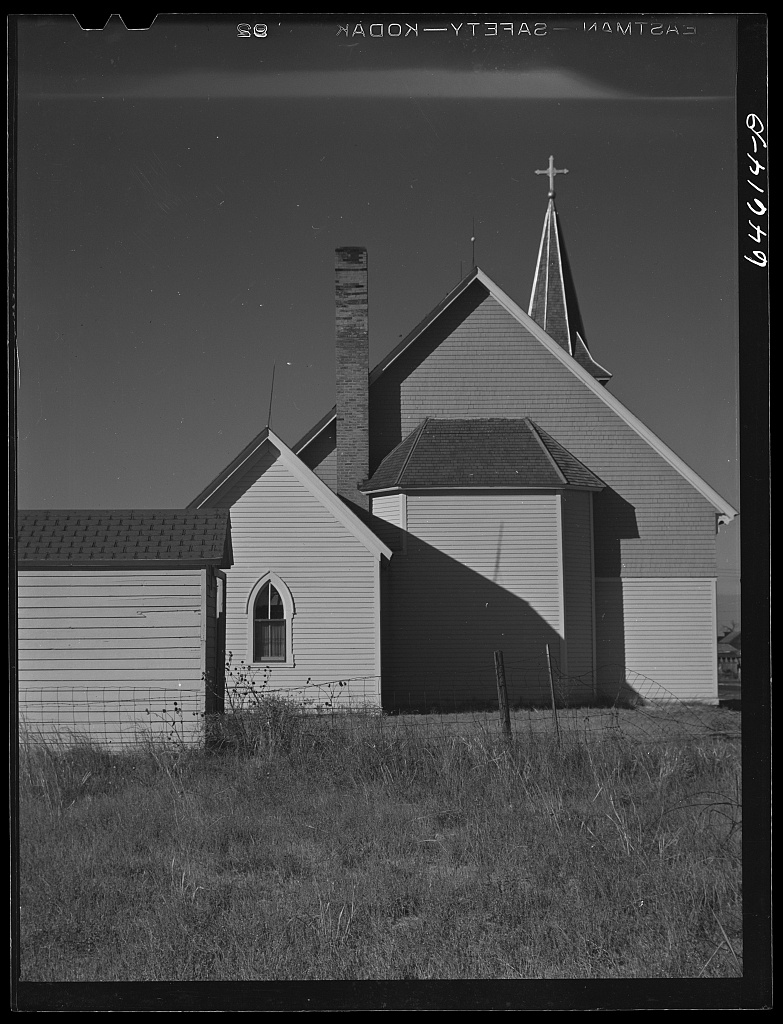
Image Credit: John Vachon “Zell, South Dakota. Church buildings” (1942) Public domain image courtesy of the Library of Congress
About the Author: john compton (he/him) is a gay poet who lives with his husband josh and their dogs and cats. his latest book: my husband holds my hand because i may drift away & be lost forever in the vortex of a crowded store (Flowersong Press; dec 2024) and latest chapbook: melancholy arcadia (Harbor Editions; april 2024)
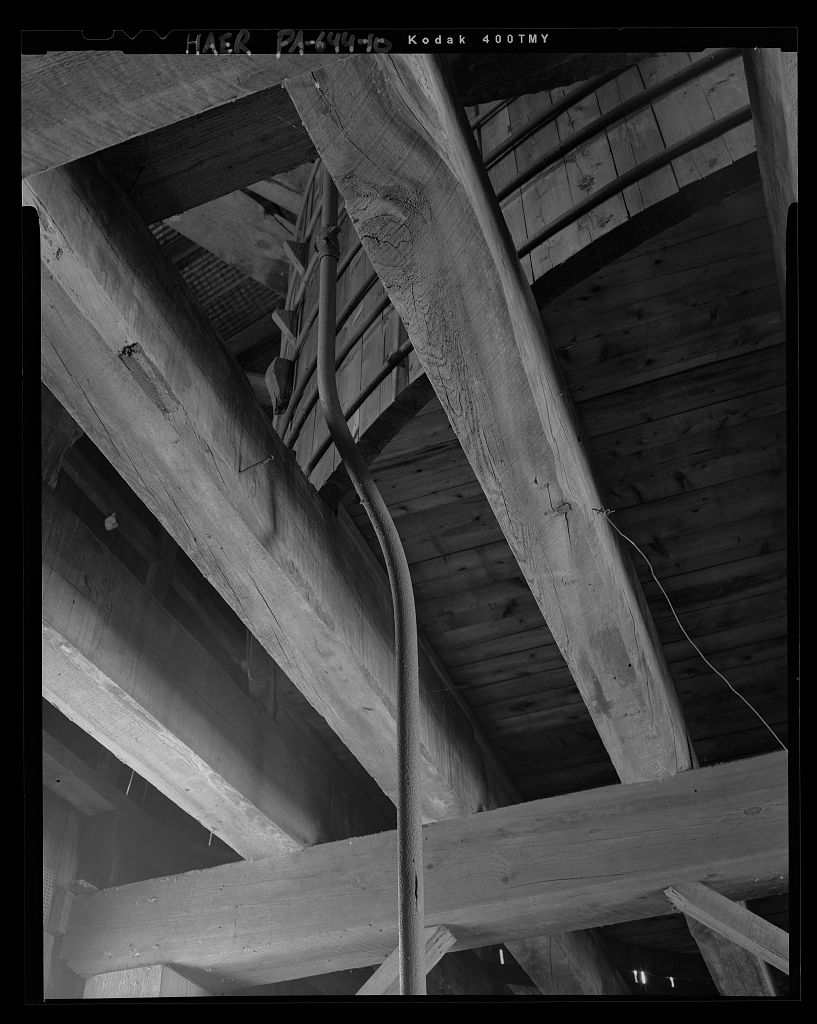
Image Credit: “Interior view, looking up toward project west at the heavy timber joists and center beam supporting the wood water tank” Public domain image courtesy of the Library of Congress
Wardenclyffe
The present is theirs. The future, for which I really worked, is mine.
-Nicola Tesla

Is what I imagined tangible—
this motor, powered by fireflies,
streamer arc threads of phosphorescent light
discharging from the center coil.

I go from idea to reality,
a star among the stars.
I do not think there is any thrill
like the inventor seeing a creation come to success,
the exhilarating sense of the future.

Sometimes we feel so lonely.
Someday we will know who we really are.

If my current can travel distances,
my work is immortal—
resurrecting my vision, broadcasting to Mars.

Thought is electrical energy.
Why can’t we photograph it?
The primary circuits of us all,
high-speed alternators—
many colors, myriad frequencies.

Sometimes we feel so lonely.
Someday we will know who we really are.

My tower dream ran out of funds—
demolished to scrap,
the property sold to the highest bidder.

I live on credit at the Waldorf,
along with spark-excited ghosts.
My only friends are pigeons in Bryant Park—
My favorite is a female.
As long as she lives,
There is light in my life.

Sometimes we feel so lonely.
Someday we will know who we really are.
About the Author: Susan Cossette lives and writes in Minneapolis, Minnesota. The Author of Peggy Sue Messed Up, she is a recipient of the University of Connecticut’s Wallace Stevens Poetry Prize. A two-time Pushcart Prize nominee, her work has appeared or is forthcoming in Rust and Moth, The New York Quarterly, ONE ART, As it Ought to Be, Anti-Heroin Chic, The Amethyst Review, Crow & Cross Keys, Loch Raven Review, and in the anthologies Fast Fallen Women (Woodhall Press) and Tuesdays at Curley’s (Yuganta Press).
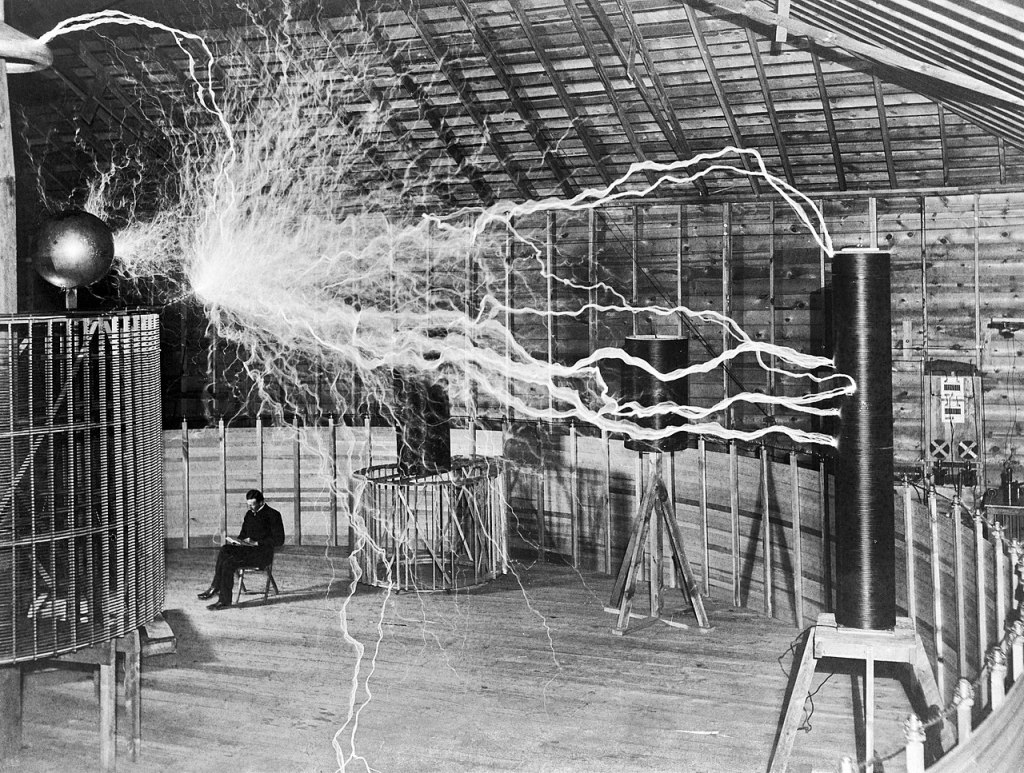
Image Credit: “Tesla sits with his “magnifying transmitter” in Colorado Springs in 1899″ Image courtesy of Wikipedia. CC BY 4.0
What We’re Here for
for bart solarczyk & bob phillips

your whole generation
seemed to know
how to swat away a compliment

kind words tossed
into a river
full of mud & rust
born out of houses
with tin roofs & tar paper hearts
by men & women
who knew the weight
of factory gloves
after so many years
their fingers piercing
the very edges of time

even poems are just about
doing the job

like pushing a mop
or wiping sweat
away from your heart
after the loss of a friend or a spouse or your sanity
knowing that’s just what time does
knowing you just have to keep putting the work in

because that’s what we’re here for.
About the Author:John Dorsey is the former Poet Laureate of Belle, MO. He is the author of several collections of poetry, including Which Way to the River: Selected Poems: 2016-2020 (OAC Books, 2020), Sundown at the Redneck Carnival, (Spartan Press, 2022, and Pocatello Wildflower, (Crisis Chronicles Press, 2023). He may be reached at archerevans@yahoo.com.
Image Credit: Carol M. Highsmith “Historic house with tin roof in Eutaw, Alabama” (2010) Public domain image courtesy of The Library of Congress
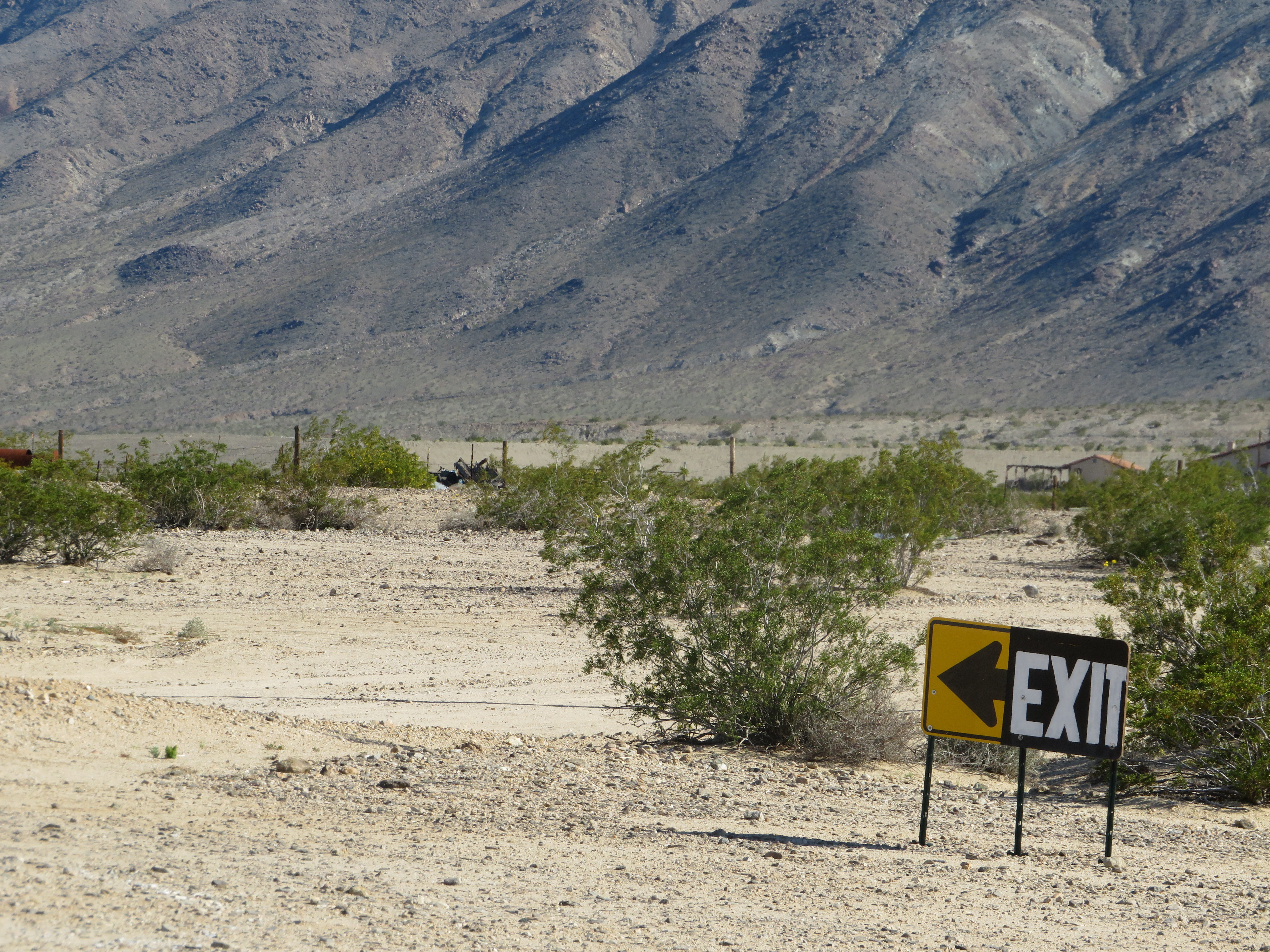
arid scrubland where life flees the sun water washes over color-stained rocks but provides little relief or support people trudge under sunhats, quietly swiping away their sweat but the lizards thrive and snakes coil in drowsy satisfaction a little is enough they seem to say today is just another day the flat horizon shimmers in waves of light and dry heat trucks roar along the interstate loaded with boxes and crate, the concerns of another world, while the scorpions work with the basics, ready to kill and eat as darkness falls and life slithers forward— always forward, not to be denied
About the Author: Chuck Kramer’s poetry and fiction have appeared online and in print, most recently Lothlorien, The Raven’s Perch and The Good Men Project. He has also been a finalist in the Gwendolyn Brooks Open Mic Poetry Awards in 2017 and 2023. Memoir in Chicago Quarterly Review (a Notable Essay in Best American Essays 2023), Sobotka, Evening Street Review. Journalism in Chicago Tribune, Sun-Times, Reader, Windy City Times and Gay Chicago Magazine.
Skin once taut over muscle and bone grows soft and softer still, as age moves on and may bring sadness unknown before, or a kind of thrill to mark the passage on a map of being in this place, this age. Adventures are remembered in crinkling folds. Sitting or standing will require slower motion. No matter the pain that is now no small matter. An old drum at rest for a while needs the essential oil of caring hands, each touch and each beat deepening into warm inviting sounds, smelling of vanilla rain. Pitter patter, falling softly. Softly enfolded in loved arms. Hush and listen, safe and dear one, ever close to heart, where ear is at the center, just as art is in the earth, and ripples continue beyond the edge of the pond.
About the Author: Geraldine Cannon is a poet, scholar, and editor, also working as a Professor of English and Creative Writing at the University of Maine at Fort Kent, under her married name–Becker. She has been published in various journals and anthologies. She published Glad Wilderness (Plain View Press, 2008).. She has been helping others publish, and had stopped sending her own material out, but she was encouraged to do so again, and most recently has a new poem in the Winter issue, Gate of Dawn (Monroe House Press, 2024).
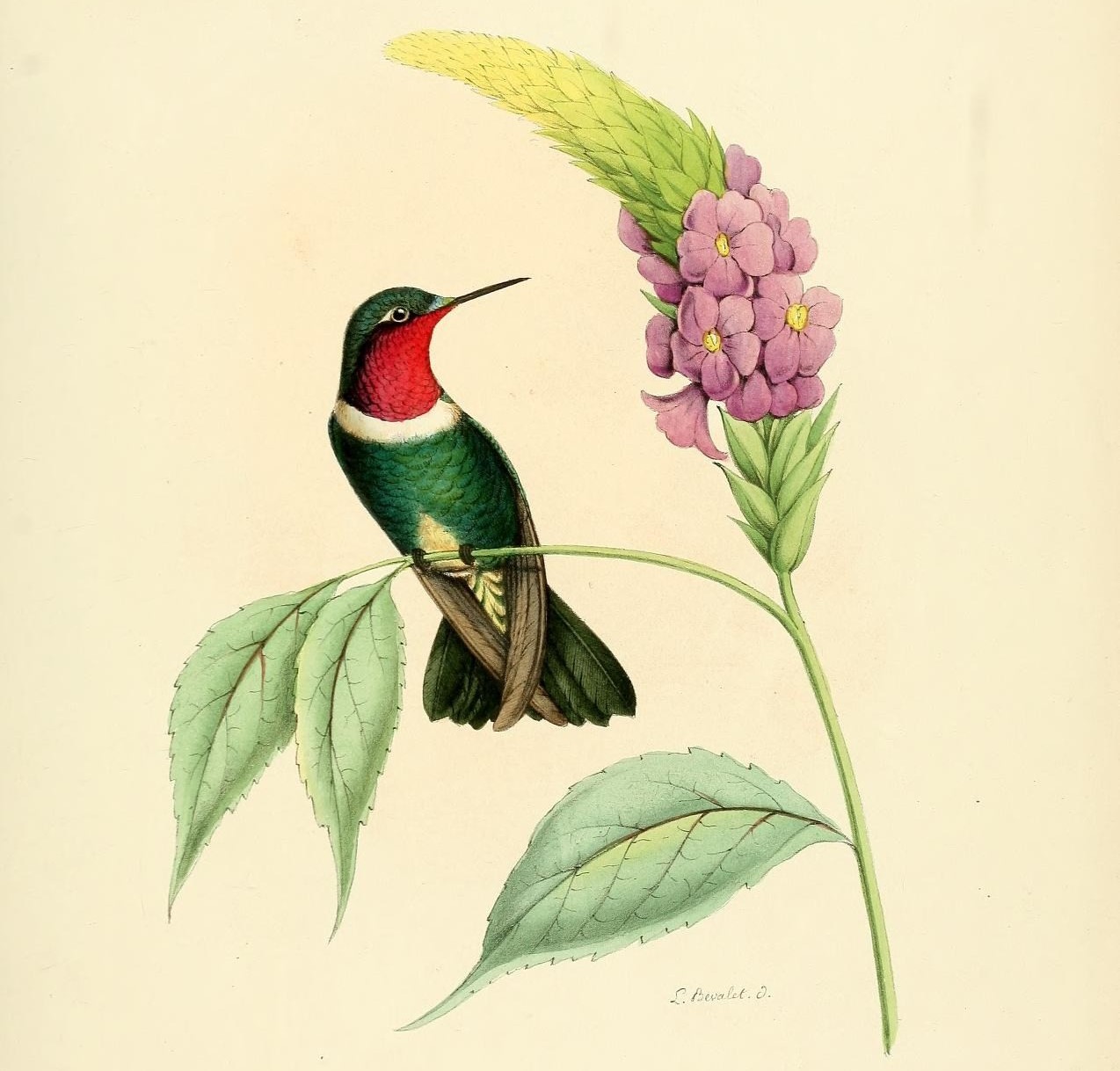
The counselors had no bands that fit a hummingbird, but should one get caught in the mist net, you rattled it between cupped hands until it lay in your palm (unhurt, we were assured) with a quiet that seemed, except for its heartbeat, calm.
Then everyone who might admired its smallness, red enamel throat, wings a green suitcoat, but suddenly it took flight, slid steeply up a ramp of air full-powered, pivoted in the leaves to a hopeful gap and sped out of there.
God! to feel my head clear for good, to recognize the windy or waiting skies are real, to get out of here.
About the Author: Gerald Friedman grew up in the suburbs of Cleveland, Ohio, and now teaches physics and math in northern New Mexico. He has published poetry in various magazines, recently Rat’s Ass Review, The Daughter’s Grimoire, W-Poesis, and Cattails. You can read more of his work at https://jerryfriedman.wixsite.com/my-site-2
Image Credit: Public domain image originally from Histoire naturelle des oiseaux-mouches, ou, Colibris constituant la famille des trochilidés. Lyon: Au Bureau de la Société Linnéenne,1874-1877. Courtesy of the Biodiversity Heritage Library.
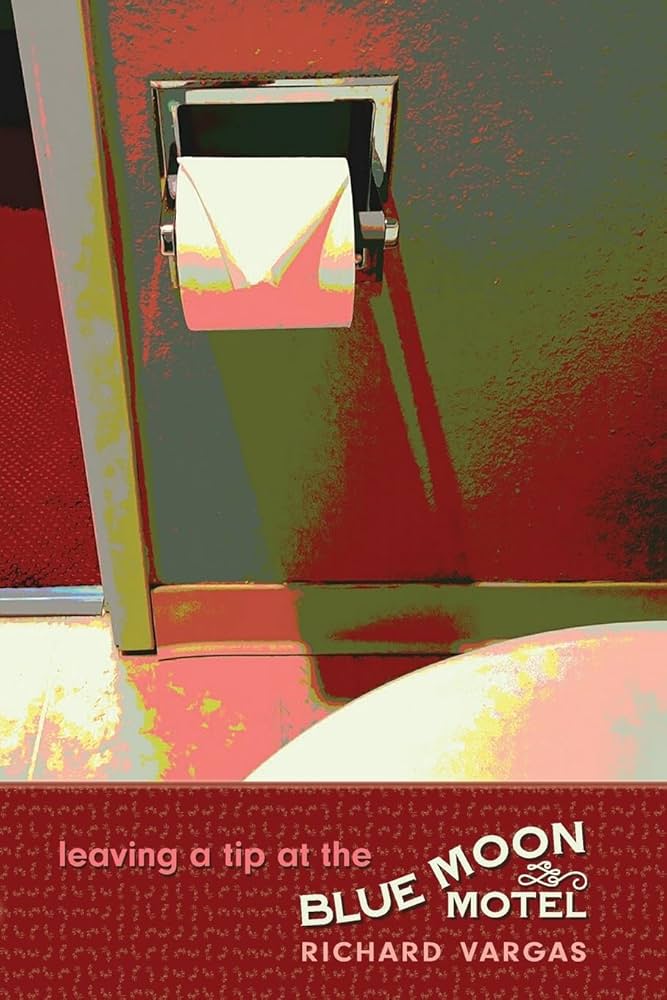
I want to hit on about three things, all of which intersect, in praising Richard Vargas’s collection, “leaving a tip at the Blue Moon Motel.” I want to talk a little bit about what it means to do a ‘political poem,’ in the loosest sense that this means. Meaning: I want to talk about writing from direct experience, as opposed to writing from theory. This brings up Vargas’s unique sense of empathy. And last, I want to talk about style just a little bit, to remind us all that clarity and clean writing is not an abandonment of it. All these things explain why I like Richard Vargas’s poetry.
In an anthology of essays titled “Poetry and Politics,” edited by Richard Jones, I want to say I recall the poet Denise Levertov making a succinct point about some of what we call “political poetry.” She alluded to Bertolt Brecht’s version of the political poem as something akin to “marching orders.” I remembered this and wrote it down and it has stuck with me, but I don’t have the patience to re-read her essay right now. So if she did not characterize some political poetry, like Brecht’s, as something like “marching orders,” then let me do so now, and continue to credit her with the idea, just in case.
Don’t get me wrong. A theoretician or an academic poet who cares about humanity, without having experienced the bad jobs or prison experience he or she writes about, is still on the human and not the dehumanizing side of things. Bertolt Brecht was on the side of humanity. But when poets write about such things from some place other than their own experience, they must invariably do so in the third person, or do so in an abstract or at least imagined way. We, as readers, tend not to relate as much to such work. But Vargas only writes about what he has experienced himself, without assuming to understand worse. He wonders about it, and more on that later, but he never presumes.



 As It Ought To Be
