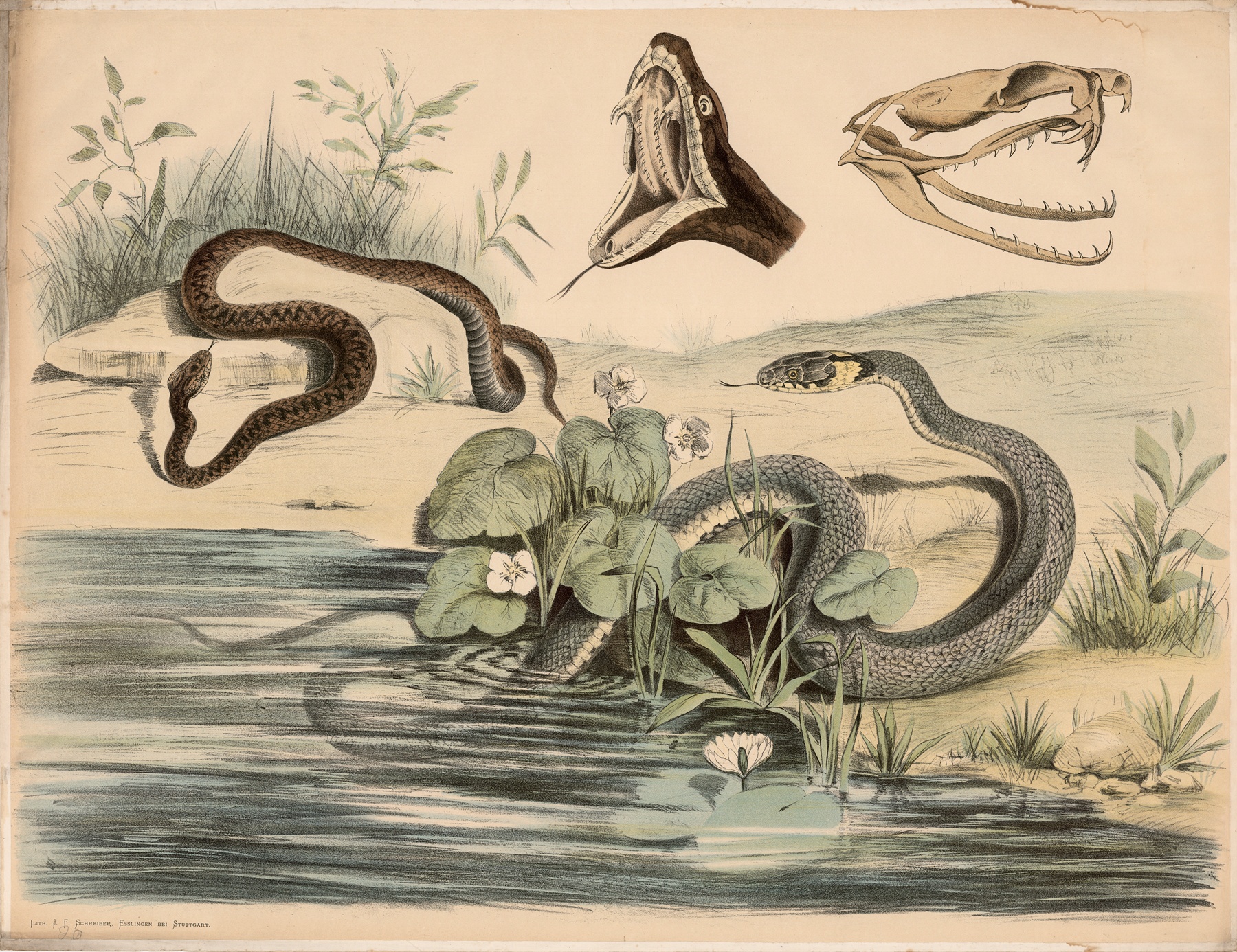
Tradition Said that Snakes Went Blind & Crazy in Late Summer, and They’d Actively Seek Us Out to Bite, Especially in the Water, so We Went Swimming Anyway

Dog days, late summer, and the snakes went blind,
got nervy, mad, would strike at anything,
would slither luke-warm, murky creeks to find

pin-white legs wading the shallows, would ping
us out, somehow, the middle of their night,
would strike.  Folks' certainty was trying.

Every time they told us, it seemed a slight,
a lie for the knuckleheaded, a tale
told for the idiots, signifying . . . .

But they all believed,  conveyed without fail
a terror coloring the summer's slack–
another thing to fear, a chance to rail.

We had our doubts about blind snake attacks.
It seemed the latest way to make us cower,
to cede the summer days we'd not get back.

Their tone gave snakes an almost hellish power,
so we countered:  snakes bite only boneheads
not looking where they step or steeped in dour

reflection–on dog days' blindness, on the rest
of the tales that set us straight at odds
with the earth. Plus, the creek was still wet,

the air, still molten.  We'd throw in dirt clods,
let the blind-assed snakes know we were running
to dive, to belly flop, skinny bodies

protected by a counter-myth just dumb
enough to satisfy: snakes can't bite
underwater.  They'd drown.  They have to come

to the surface to bite–we'd see them, light
out for the bank, throw rocks toward the slither.
They'd go under, not out of mind, but sight.

Thus braced, we discounted all but the worst
of everything they said & did what we did.
Still, we made the dumbest of us jump in first.
About the Author: Samuel Prestridge, a post-aspirational man, lives and works in Athens, Georgia. His book A Dog’s Job of Work is available from Sligo Creek Publishing. He is currently an Associate Professor of English at the University of North Georgia. His children concede that he is, generally, an adequate father.
Image Credit: Franz Engleder: Kreuzotter, (Pelias berus) Ringelnatter, (Tropidonotus natrix) Schädel und geöffneter Rachen der ersteren verg (1860) Public domain image courtesy of Artvee

