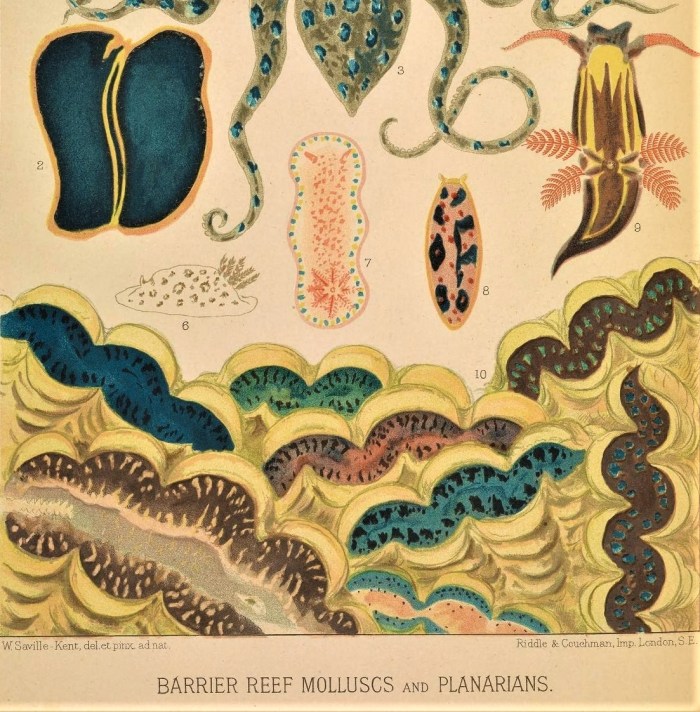
Ruth Hoberman: “Planaria”

.

7044672793_bd23a8f608_o

.

.

Planaria 

Over pie, Len talks about worms. Dice them,
he says, and each regrows its missing parts!  

His eyes glow under tangled brows, entranced
by immortality. I picture eyeless

mouths groping for their eyes and mouthless eyes
their mouths. Hungry for their hunger, old

in need of new. We’re old, our gray hair wild
and worried as brambles clinging to a cliff.

The question is where to look. He looks for doors
from body into bliss or second chances—dicing

as self-renewal? recycling as lizard or crow?
Anything to start again. I fork a peach wedge

on my plate. Sweet in my mouth the slice,
the talk with friends.

.

.

About the Author: Ruth Hoberman mainly lives in Chicago. She writes poetry and essays, which have been published in such places as RHINO, Calyx, Smartish Pace, Naugatuck River Review, and Ploughshares.

.

Image Credit: Image from The Great Barrier Reef of Australia;. London :W.H. Allen,[1893]. Courtesy of The Biodiversity Heritage Library
Jenna K. Funkhouser: “Chihuly’s Baskets”

.

.

.

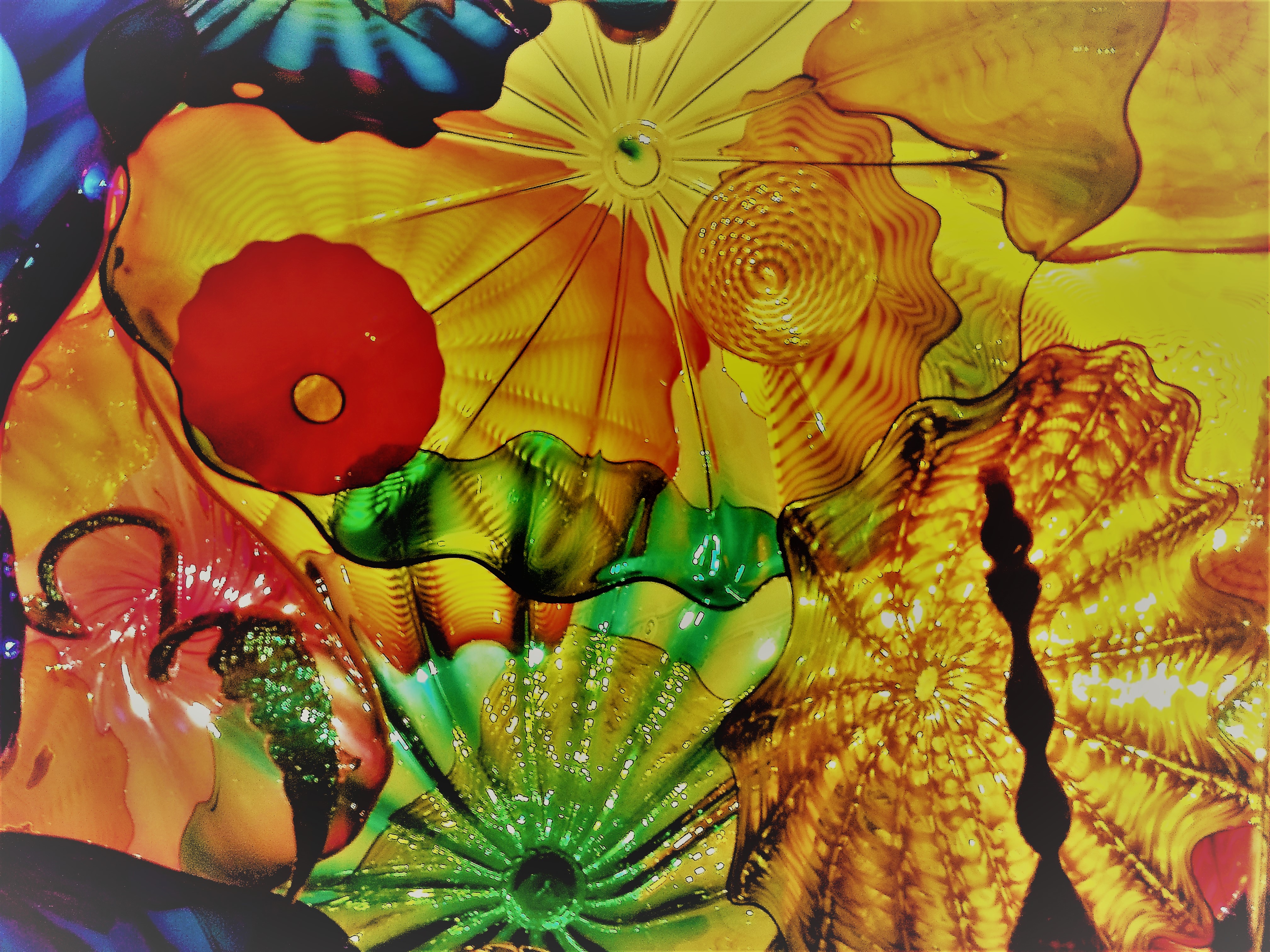
Chihuly’s Baskets

How carefully we preserve the emptiness
      in these theaters of light

how the man spins silken robes
      of turquoise and pebbled gold
            from the hot mouth of the kiln
and clothes oxygen in its fragile gowns,
            now
drawing its tensions away
   from the point where there must be
nothingness

cupped in its pale, deep hands

and the prayer he breathes is nothing but
good, good. 

To remain filled is
      to remain heavy

to resist your capacity to hold
invisible things
                          to grow lucent
lose everything
even your darkness

let the fire touch you

it whispers 

this bright shell husked
from the seed of eternity.

.

.

About the Author: Jenna K Funkhouser is an author and nonprofit communicator living in Portland, Oregon. Her poetry has recently been published by Geez Magazine, the Saint Katherine Review, and the Oregon Poetry Association, among others; her first book of poetry, Pilgrims I Have Been, was released in October 2020.

.

More by Jenna K. Funkhouser:

Persephone

Gerald Friedman: “A Race of the Red-tailed Hawk”

.

86_Black_Warrior

.

.

A Race of the Red-tailed Hawk 

Audubon shot a hawk,
mostly black-brown.  Painting it
while it still lived, he said,
he chocolate-covered its white marks,
tidied its tail pattern,
not thinking both were typical.
He wrote tall stories:
his specimen bred in Louisiana,
feared him only when he carried his gun.
He baptized it in Latin
after his friend Dr. Harlan;
in English, “Black Warrior”,
maybe something good to have
dying or dead
to be depicted as he saw fit.

Morning frost by the Rio Grande.
All summer Harlan’s, black or rare white,
glided down from Alaska
in my mind.  Now
a red-tail screams. At me?
I sneak, a commando,
to capture it with my camera,
barely disturbing
fragile cottonwood leaves.
By some occult sense
it feels me, flies, straight
as limbs slip by.  Out of view.
But I’ll call it a Harlan’s,
tail white constellated in black.
A stereotypical birdwatcher,
I’m already checking my pictures.
One shot caught that tail,
so I’ll get an accepted sighting.

.

.

About the Author: Gerald Friedman grew up in the suburbs of Cleveland, Ohio, and now teaches physics in Santa Fe, New Mexico.  He has published poetry in various magazines, recently Rat’s Ass Review, Entropy, The Daily Drunk, and Better Than Starbucks.

.

Image Credit: Plate 86 of Birds of America by John James Audubon depicting “Black Warrior Falco harlani” Public Domain

Lorraine Henrie Lins: “Pelican”

.

20201107042410_IMG_1298

.

.

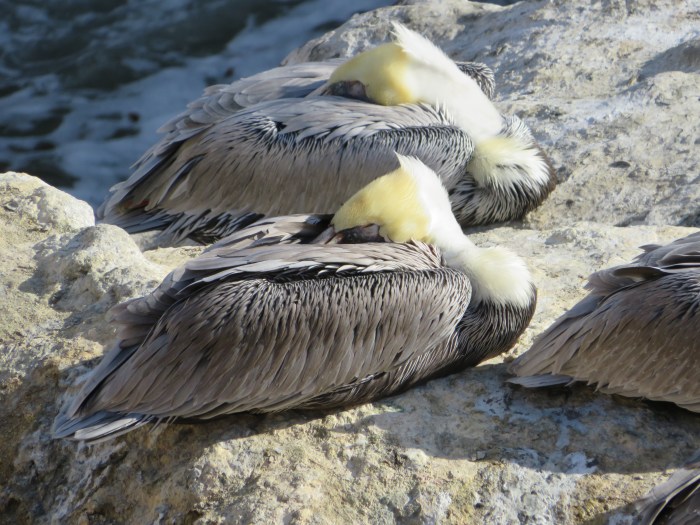
Pelican  

I see it
just as he catches its scent.
He drops the tennis ball
and I know
by the distant shape it’s a bird,  a
large one left by this morning’s tide.

The dog
stills his body and tail
and I expect him to paw it,
test it
with his teeth as he does
with fish heads,
driftwood, crab shells—

instead,
he leans forward,
snuffles its parted, flat eyes
and hovers
whisker-close over the tangled
feathers and tide-kinked wings,
elongated in a mid-flight mien,

lingers
the length of its body
and breathes in the brine-cleaned
wound on its neck and sits.
I re-clip his leash,
give short leading tugs
but again he stills, pulls
against the command
and waits.

.

.

About the Author: Lorraine Henrie Lins is a Pennsylvania county Poet Laureate and author of four books of poetry: All the Stars Blown to One Side of The Sky, I Called It Swimming, Delaying Balance and most recently, 100 Tipton.  She serves as the Director of New and Emerging Poets with Tekpoet and is a founding member of the “No River Twice” improvisational poetry troupe.  Lins’ work appears in wide variety of familiar publications and collections, as well as on a small graffiti poster in New Zealand. Born and raised in the suburbs of Central New Jersey, the self-professed Jersey Girl now resides along the coast of North Carolina.  www.LorraineHenrieLins.com

.

More by Lorraine Henrie Lins:

OST DOG

.

Image Credit: Chase Dimock “Sleeping Pelicans” (2020)

Julene Tripp Weaver: “Precious Little Sister”

.

30591dr

.

.

Precious Little Sister

Born days before I turned eight
she arrived September 8th—
my birthday September 11th—
I’ve no memory of a party,
of her entry, but pictures—
she’s in a stroller on trips with Mom
and Dad. Soon father started
getting sick, disappearing for weeks
under observation, mother moves us
to the city—our Grandmother
in a hospital with cancer. Life
distorted with change, I walked
alone to school feeling lost
on the streets in Queens.

Now her diagnosis, multiple myeloma,
wheelchair bound at retirement—
chemo, radiation for a blood cancer
like our father’s—facing a stem cell transplant,
the next and only option to extend her life.
Six rounds and there is no remission.
She has her partner, a wife, their son—
in college—a few friends with busy lives,
and me, three thousand miles away,
she’s not asked for my presence.

After Uncle died—she did it all—
a lawyer, she sold three houses,
buried him, later buried Mom,
no more family to die but us.
If the doctors are right she may
stick around with that wheelchair.
My baby sister walked with me
in Paris, New York, Bermuda,
Mexico, Seattle, Portland, and her
home, Philly. She wants to live,
says it’s okay if she can’t walk.
I dread seeing her enfeebled
like our mother after her stroke.
Injustice to retire into this disabled
door—to wheel up the ramp made
for mom. My precious baby sister
so agile raising her son, her final
goal, to see him graduate.

.

.

About the Author: Julene Tripp Weaver is a psychotherapist and writer in Seattle, WA. Her third collection, truth be bold—Serenading Life & Death in the Age of AIDS, was a finalist for the Lambda Literary Awards and won the Bisexual Book Award.  Her book, No Father Can Save Her, is now available as an Ebook.

.

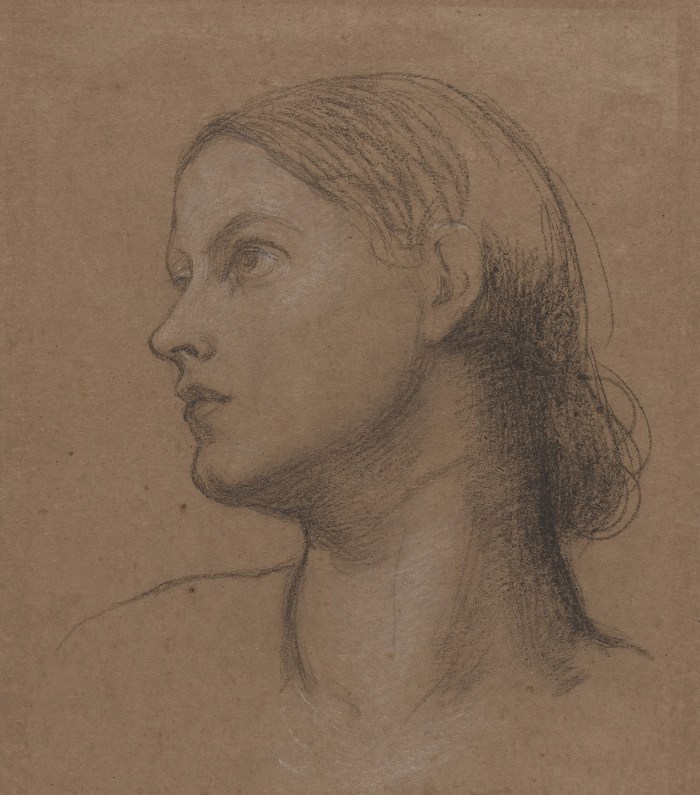
Image Credit: George Frederic Watts “Head of A Young Woman” (1860s) Image Courtesy of Artvee

John Grey: “Bat In the Attic”

.

.

.

Bat in the Attic

It was no bird trapped in the attic
but a bat.
And the bat knew exactly
what it was doing,
where it was going.
Why risk a chilly winter’s night in the wild
when it can somehow infiltrate
a warm human space.

To be honest,
I’d have preferred mice
though rats would be a different story.
But a mouse can be caught and released
with no guilt on either side.
But I’ve no dominion over flying mammals.
Waving a broom in its direction,
I felt like a man with a sword
up against another with a pistol.
Besides, I have an unnatural fear of bats
and it knew it.
And my armory was merely household implements.
It had folklore on its side.

Eventually, it left of its own accord.
I have no idea how it got in,
how it got out.
At least it didn’t bite me,
turn me into a vampire.
I wasn’t undead,
merely unsatisfied, unavailing
and a little unhinged.

It was no bird trapped in that attic.
For all my false bravado,
I was.

.

.

About the Author: John Grey is an Australian poet, US resident, recently published in Sheepshead Review, Poetry Salzburg Review and Hollins Critic. Latest books, “Leaves On Pages” and “Memory Outside The Head” are available through Amazon. Work upcoming in Lana Turner and International Poetry Review.

.

More By John Grey: 

Move On

Downsizing

Maud

.

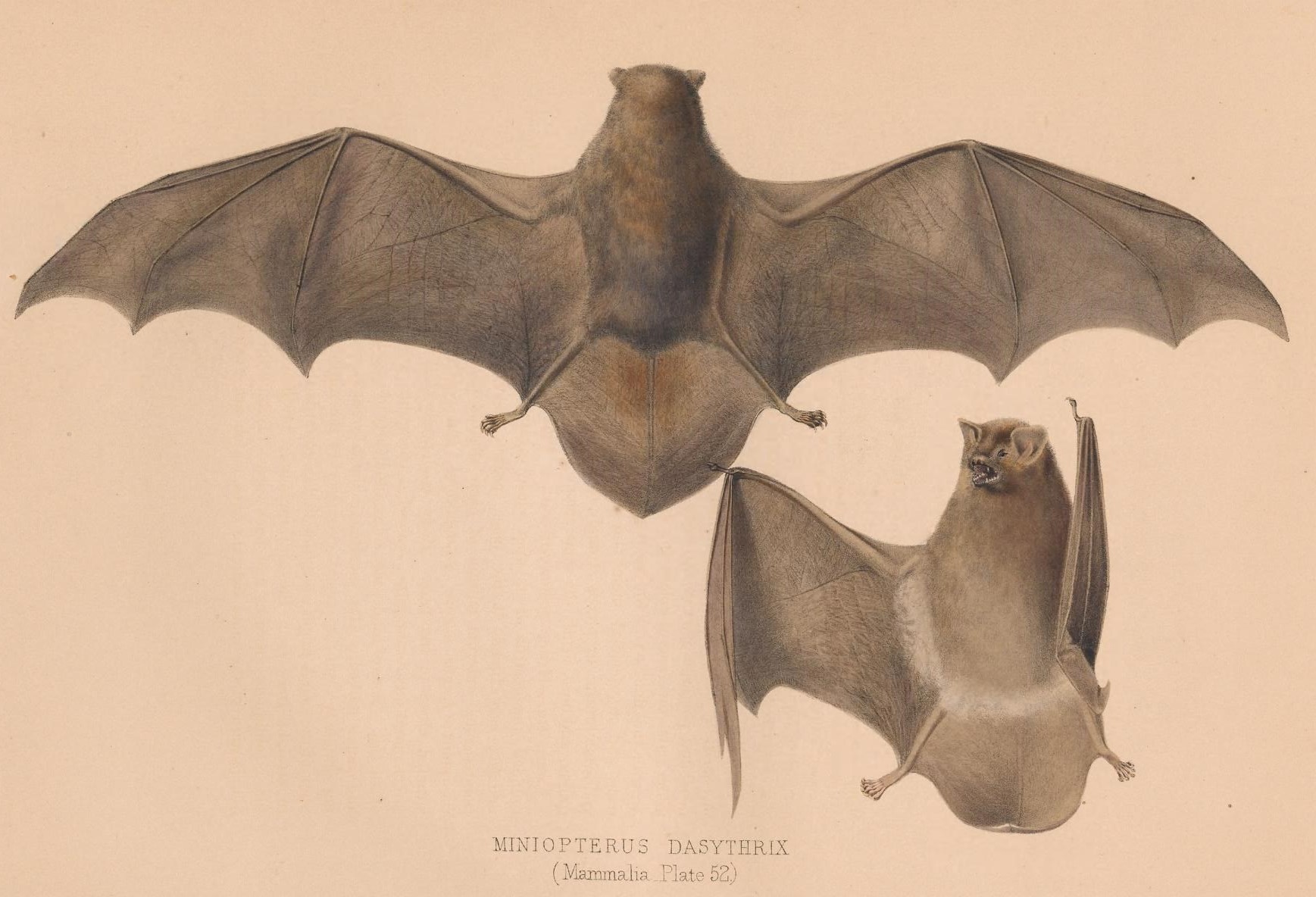
Image Credit: Image from Illustrations of the zoology of South Africa : London : Smith, Elder and Co.,1849. Courtesy of the Biodiversity Heritage Library
Sterling Warner: “Ebb & Flow”

.

20201106070449_IMG_1202

.

.

Ebb & Flow

I.
Amber beer bottles
back floating on turbid tides
some corked carrying messages
most reduced to glass shards,
razor sharp edges rounded
by the selfsame sand thrust
over rocks, against cliff faces,
around feet wading shoals.

II.
Bull whip kelp wash ashore
after tempests, sunburned beach combers
pop bulb-like heads before gathering
long tentacles, cracking them
like riding crops or cat-o’-nine tails,
flagellating sandcastles & sunbathers
knowing pliable algae’d harmlessly flog
friends & objects of their joyful aggression.

III.
Children tip-toe through flotsam jetsam
scrawl their names in the wet shoreline
place star fish in piles surrounding them
with sea urchins & periwinkle shells
as waves roll in, their creations melt
into a watery fray & they scream
as salty ice hands clutch youthful ankles,
& horseshoe crabs pierce naked feet.

.

.

About the Author: A Washington- based author, poet, educator, word-lover, Sterling Warner’s works have appeared in dozens of literary magazines, journals, and anthologies such as  Ekphrastic ReviewA Washington-based author, educator, and Pushcart nominee for poetry, Warner’s works have appeared in many international literary magazines, journals, and anthologies such as  Street Lit., The Ekphrastic ReviewAnti-Heroin Chic, The Fib Review, The Vita Brevis Poetry Magazine, and Sparks of Calliope. Warner also has written seven volumes of poetry, including Without Wheels, ShadowCat, Memento Mori: A Chapbook Redux, Edges, Rags & Feathers, Serpent’s Tooth, and Flytraps (2022)—as well as. Masques: Flash Fiction & Short Stories. Currently, he writes, hosts virtual poetry readings, and enjoys retirement. 

.

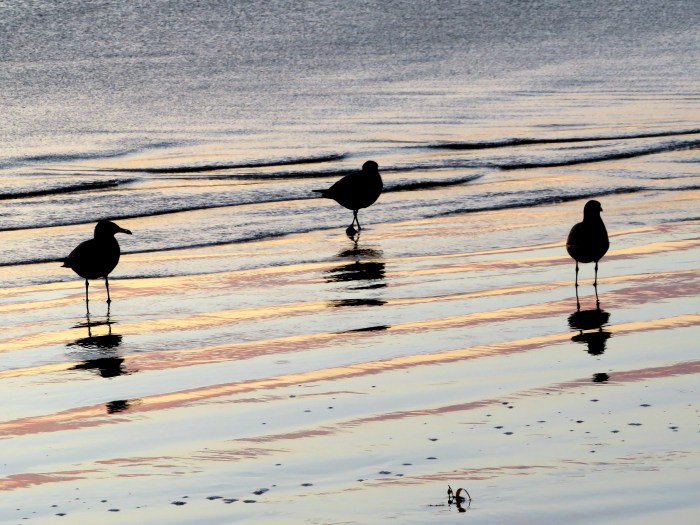
Image Credit:  Chase Dimock “Seagulls at Sunset” (2020)

Jim Murdoch: “Empties”

.

.

.

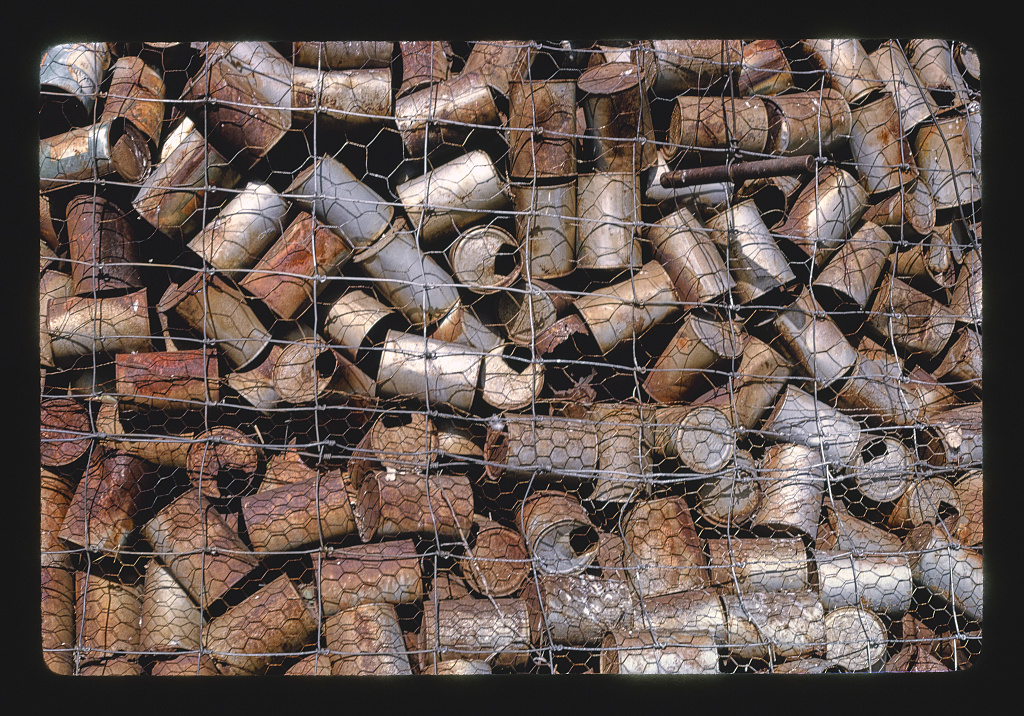
Empties

When Dad passed we found
bottles everywhere:
behind the settee,
within the cistern,

beside the tallboy,
in coat pockets and
underneath his bed.

We completely missed
all the emptiness
hidden in plain sight.
It was everywhere.

Some of it even
inside the bottles—
very clever that.

But most of it went
with him to his grave.
The worms must have felt
so disappointed.

Some rubbed off on me.
Otherwise I would
never have noticed.

.

.

About the Author: Jim Murdoch has been writing poetry for fifty years and has graced the pages of many now-defunct literary magazines and websites and a few, like Ink, Sweat and Tears, The Lake and Eclectica, that are still hanging on in there. For ten years he ran the literary blog The Truth About Lies but now lives in relative obscurity in Scotland with his wife and (occasionally) next door’s cat. He has published two books of poetry, a short story collection and four novels.

.

Image Credit: John Margolies “The Can Pile, Casselton, North Dakota” (1992) The Library of Congress

Cheryl A. Rice: “Remember the Goldfish Will Be Dead By Morning”

.

7506916742_3886ef474c_o

.

.

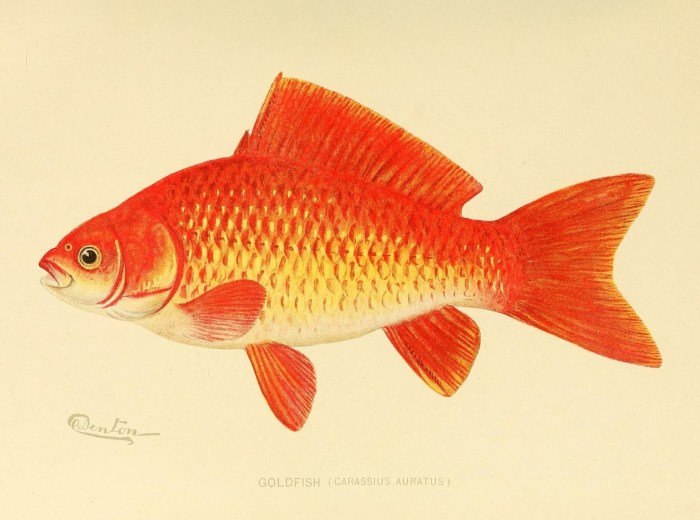
Remember the Goldfish Will Be Dead By Morning, 

as will the thready cobwebs of carnival light
strung above scraps of pavement
that’s seen better days, industrious employees
parking in a fresh lot, neatly painted
plots from end to end,
paint now faded, workers retired,
transferred or deceased.
In the morning, stars will have moved on
to other fairs, or the other side of the globe,
rides beyond not yet unplugged,
not yet spattered with vomit and sweat,
freshly hosed, engines revving.
In the morning, somewhere, there is popcorn
waiting to be heated, holding explosions
tight inside their vegetal chests.
Lemons are being sliced, water chilled,
hot dogs start their hours-long sauna.
But here in our town, all that remains
are tire tracks on the ballfield,
garbage drums full of discarded soda cups,
French fry boats anointed with catsup,
napkins cycling in the breeze.
The sun surveys the damage.
Crews pick debris from the ground,
recycling antics be damned.
And that goldfish you won
tossing rings at impossible pins?
The one you carefully slipped in an empty beer stein
when you got home late, so as to not wake him?
He’s been dead for hours, floating in
glass and baggie, back to tank, egg, essence,
gold all that remains by morning,
a sort of orange sunrise to remind the masses
of reflective vests, steel-toed boots,
the circle of days that we swim around,
in our own bags, without air,
with too much light.

.

.

About the Author: Cheryl A. Rice’s poems have appeared in Home Planet News, Baltimore Review, Up The River, and Misfit Magazine, among others. Recent books include Love’s Compass (Kung Fu Treachery Press), and Until the Words Came (Post Traumatic Press), coauthored with Guy Reed. Her blog is at: http://flyingmonkeyprods.blogspot.com/. Rice lives in New York’s Hudson Valley.

.

Image Credit: Image originally from Annual report 8th; 9th (New York State Forest, Fish and Game Commission) (1902-1903) Image courtesy of the Biodiversity Heritage Library
Jo Angela Edwins: “How It Feels to Be Bodiless”

.

20210803081311_IMG_2302

.

.

How It Feels to Be Bodiless

So often in the center of a street
a single shoe—frayed laces, fractured heel—
lies sad and inert as a dead bird,
as if he too fell from the sky and waits
like a fool for the other to drop,
but she doesn’t. Somewhere in the heavens
she dances her indie hop jauntily,
happy perhaps that her bumble-tongued mate
took at last that lonely flying leap,
lost himself in rubber-wheeled traffic,
the perfect place to bare his step-worn soul.
No one wants him now.
He will be battered by everything, elements,
Hondas, Harleys, harried pedestrians
who kick him from underfoot to save themselves
from falling in his place. He will discover
what it means to lie in the gutter.
He will, like all of us someday, understand
how it feels to be bodiless forever,
a vessel for nothing, a thing without use—
that freedom, that terrible freedom.

.

.

About the Author: Jo Angela Edwins has published poems in various venues, recently including Amethyst ReviewBreakwater ReviewFeral, and Thimble Literary Magazine. Her chapbook Play was published in 2016. She has received awards from Winning Writers, Poetry Super Highway, and the SC Academy of Authors and is a Pushcart Prize, Forward Prize, and Bettering American Poetry nominee. She lives in Florence, SC, where she serves as the poet laureate of the Pee Dee region of the state.

.

More by Jo Angela Edwins:

Housewarming Party

.

Image Credit: Chase Dimock “Albuquerque Light” (2021)