WALTER BENJAMIN

angelus novus1920

Paul Klee’s 1920 watercolor, Angelus Novus (once owned by Walter Benjamin and now part of The Israel Museum, Jerusalem collection).

PROTOCOL I: HIGHLIGHTS OF THE FIRST HASHISH IMPRESSION

[by Walter Benjamin:] Written 18 December [1927]. 3:30 a.m.

Translated by Scott J. Thompson

1. Apparitions hover (vignette-like) over my right shoulder. Chill in this shoulder. In this context: “I have the feeling that there are 4 in the room apart from myself.” (Avoidance of the necessity to include myself.)

2. Elucidation of the Potemkin anecdote[1] by the explanation, be it suggestion: to present to a person the mask of their own face (i.e., of the bearer’s own face).

3. Odd remarks about aetheric mask [Äthermaske], which would (obviously) have mouth, nose, etc.

4. The co-ordinates through the apartment: cellar-floor/ horizontal line. Spacious horizontal expanse of the apartment. Music is coming from a suite of rooms. But perhaps the corridor [is] terrifying, too.

5. Unlimited goodwill. Suspension of the compulsive anxiety complex. The beautiful “character” unfolds. All of those present become comically iridescent. At the same time one is pervaded by their aura.

6. The comical is not only drawn out of faces but also out of situations. One searches out occasions for laughter. Perhaps it is for that reason that so much of what one sees presents itself as “arranged”, as “test”: so that one can laugh about it.

7. Poetic evidence in the phonetic: for a while at one point, no sooner had I made an assertion than I’d have used the very word in answer to a question merely by the perception ( so to speak) of the length of time in the duration of sound in either of the words. I sense that as poetic evidence.

8. Connection; distinction. Feeling of little wings growing in one’s smile. Smiling and flapping as related. One has among other things the feeling of being distinguished because one fancies oneself in such a way that one really doesn’t become too deeply involved in anything: however deeply one delves, one always moves on a threshold. Type of toe dance of reason.

9. It is often striking how long the sentences one speaks are. This, too, connected with horizontal expansion and (to be sure) with laughter. The arcade phenomenon is also the long horizontal extension, perhaps combined with the line vanishing into the distant, fleeting, infinitesimal perspective. In such minuteness there would seem to be something linking the representation of the arcade with the laughter. (Compare Trauerspiel book: miniaturizing power of reflection). [2]

10. In a moment of being lost in thought something quite ephemeral arises, like a kind of inclination to stylize [a few words here illegible] one’s body by oneself.

11. Aversion to information. Rudiments of a state of transport. Considerable sensitivity towards open doors, loud talk, music.

12. Feeling of understanding Poe much better now. The entrance gates to a world of grotesques seem to open up. I simply prefer not to enter.

13. Heating-oven becomes cat. Mention of the word ‘ginger’ in setting up the writing table and suddenly there is a fruitstand there, which I immediately recognize as the writing table. I recalled the 1001 Nights.

14. Thought follows thought reluctantly and ponderously.

15. The position which one occupies in the room is not held as firmly as usual. Thus it can suddenly happen –to me it transpired quite fleetingly –that the entire room appears to be full of people.

16. The people with whom one is involved (particularly Joël and Fränkel) are very inclined to become somewhat transformed: I wouldn’t say that they become alien nor do they remain familiar, but rather resemble something like foreigners.

17. It seemed to me: pronounced aversion to discuss matters of practical life, future, dates, politics. The intellectual sphere is as spellbinding as is the sexual at times to persons possessed, who are absorbed in it.

18. Afterwards with Hessel in the cafe. Departure from the spirit-world. Wave farewell.

19. The mistrust towards food. A special and very accentuated instance of the feeling which a great many things occasion: “Surely you don’t really mean to look that way!”

20. When he spoke of ‘ginger’, H[essel]’s writing table was transformed for a second into a fruitstand.

21. I associate the laughter with the extraordinary fluctuations of opinion. More precisely stated, it is, among other things, connected with the considerable sense of detachment. Furthermore, this insecurity which possibly increases to the point of affectation is to a certain extent an outward projection of the inner feeling of ticklishness.

22. It is striking that the inhibiting factors which lie in superstition, etc.,and which are not easy to designate, are freely expressed rather impulsively without strong resistance.

23. In an elegy of Schiller’s it is called “The Butterfly’s Doubting Wings” [“Des Schmetterlings zweifelnder Flügel”].[3] This in the connection of being exhilarated with the feeling of doubt.

24. One traverses the same paths of thought as before. Only they seem strewn with roses.

–Translated by Scott J. Thompson

FOOTNOTES:

[1] The Potemkin anecdote from Alexander Pushkin’s Anecdotes was used twice by Benjamin: at the beginning of the essay “Franz Kafka” (Schriften II, p. 196f.) [Trans.: see “Franz Kafka” in Illuminations, by H. Zohn, Schocken Press, NY, 1969, pp. 111-112] and in the story “Die Unterschrift” [“The Signature”] in Prager Tagblatt 5. Aug. 1934 and Frankfurter Zeitung 5. Sept. 1934. It can also be found under the title “Potemkins Unterschrift” [“Potemkin’s Signature”] in Ernst Bloch’s Spuren.

[2] Walter Benjamin, Ursprung des deutschen Trauerspiels, hrsg. von Rolf Tiedemann, 1969, S. 78 [See Origins of German Tragic Drama, trans. by J. Osborne, London: New Left Books, 1977, p. 83 ].

[3] Compare “Der Spaziergang” [“The Stroll”]: “Mit zweifelndem Flügel/ Wiegt der Schmetterling sich über dem rötlichen Klee.” [“With doubting wing/ The butterfly sways above the red clover”].

HER BOTTOM LINE?

lady esq 3

ASK LADY ESQ.

Relationship advice from a divorce attorney.

Dear Lady Esq.,

I need your sage advice. Here is my story. My girlfriend, whom I’ve been dating for the past year, has made clear to me her desire to have children and raise a family. She is 37 years old and like many women her age she feels that her time is limited in this regard.

When we first met each other she was in a previous relationship of three years that she ended so that we could start dating. This boyfriend was ready to get married and raise a family with her. Although she felt he was not the right person, she seriously considered going down the family path with him. After we met, however, she realized he was the wrong person for her and ended it.

From the beginning I have communicated to her that I was not ready to get married and have children. She accepted that and never really made it an issue. Until now.

We have a wonderful loving relationship. Our only issue has been the family one. She would be a wonderful mother and she deserves to have her desire to have children fulfilled. Unfortunately I cannot provide that for her and her desire for children is only getting stronger.

I have come to the conclusion that I have to end the relationship. Recently I broached the subject of ending things, and as expected, it went awfully. She absolutely does not want to end our relationship. I am in a real quandary on how to end this relationship without devastating her.

Lady Esq, what should I do?

– Dilemmaed in San Francisco


Dear Dilemmaed,

It seems to me the trouble here is one of bottom lines. Clearly you are willing to end this relationship over your desire to not get married and have children. The fact that you’re willing to pull the plug on this relationship over this issue makes not wanting to get married and have children your bottom line.

You are assuming her bottom line is wanting to get married and have kids. Yet when you broached the subject of ending the relationship over this issue she did not want to do so. If getting married and having kids were her bottom line, your girlfriend would be willing to walk away from this relationship when she knew that her bottom line will not be met with you.

You seem to be a caring person and you seem attentive to your girlfriend’s desires. Clearly you know she wants marriage and kids, and you want her to have that. But, at the end of the day, ensuring that her desires are met is her job, not yours.

Find out whether your girlfriend’s desire for marriage and kids is her bottom line, or if it is merely a strong desire. The way to do this is by telling her your bottom line. Let her know clearly and unequivocally that you do not want to get married and have kids. And let her know that this is your bottom line. Period. That no matter how much you love her and want to be with her, this issue is non-negotiable for you.

This leaves the forum open for her to be honest with you (and herself) about what her bottom line is. If her bottom line is wanting marriage and children, then the relationship must end. But the mere fact that she wants marriage and children does not in and of itself a bottom line make. Her bottom line may be that she wants to be with you. As important as getting married and having kids might be, she might prefer to stay with you without these things rather than lose you in order to pursue them.

Until you are open and frank with her about exactly where you stand and encourage her to do the same you’ll never know what her bottom line is. And if you are happy with her and want to be with her then it is unfair to both of you to end this relationship over an assumption that marriage and kids is not only a desire for her, but her bottom line.

Now, I’ll be honest with you. I sensed in your message that you want to end this relationship regardless. Maybe I am wrong. (As much as I like to think I am all-knowing, I cannot, in fact, read minds.) But something in the wording of your question made me think that you wanted advice on how to end this relationship regardless of your girlfriend’s bottom line.

If I am right, and you want out of this relationship one way or the other, then you just have to bite the bullet. Tell her you want to end things and that’s that. Breakups are never clean or easy. In fact, they can be quite messy. But being clear and unequivocal and unrelenting is the only answer. Once you end it and sever the ties that bind you then you both need time to accept it and move on, so no contact for at least a few months is a good idea, particularly if she’s not accepting of the idea.

But I’m getting ahead of myself. Are you breaking up with her because you think she deserves marriage and children, or are you breaking up with her because you really want out of this relationship?

If you are breaking up with her because you really want out of this relationship then you need to own up to what you really want and end it because it’s what you want, not pin it on your girlfriend’s differing desires.

If you are breaking up with her because you think she deserves marriage and children, then that is a decision she needs to be allowed to make for herself. She must be honest with herself and with you about what is and is not her bottom line. Her bottom line should dictate this decision under the circumstances. Your unselfish desire for her to have everything she wants in life should not.

As is most often the case in relationships, open, honest communication is the answer. And if you feel the two of you can’t do it alone then perhaps you should enlist the professional assistance of a couple’s therapist. Go for a few appointments to work through this one issue and to have someone to help both of you determine whether to continue or end this relationship. I can recommend a great one in your area if you’re interested.

Thank you for sharing. I hope this helps.

– Lady Esq.

askLadyEsq.com

CINDY SHEEHAN’S SOAPBOX

StopBAf

WARNOGRAPHY

by Cindy Sheehan

“We’ll know it when we see it.”
Richard Holbrooke, Special US Envoy to Afghanistan and Pakistan on defining victory in Af-Pak

“I shall not today attempt further to define the kinds of material I understand to be embraced . . . [b]ut I know it when I see it . . .”
Supreme Court Justice Potter Stewart defining pornography in 1964

Well, there you go…Richard Holbrooke has defined the US’s demented mission in Af-Pak as an indefinite proposition and when I say “define” I am joking, because what kind of definition is “we’ll know it when we see it?”

Oh yeah, I know what kind of definition that is; it’s a Bush era definition, which is totally appropriate because it seems like in so many ways that we are still in the Bush/Cheney era…or error.

In a related article, Bush/Obama Secretary of Defense, Robert Gates, spells success in Af-Pak even more ephemerally than Holbrooke when he said: “Mysteries were those where there were too many variables to predict. And I think that how long U.S. forces will be in Afghanistan is in that area.” I know I had to read that last sentence a few times before it even began to make sense to me.

Does this inspire confidence in anyone that A) high ranking officials in the Obama Administration are either profoundly stupid, or deliberately obfuscating on the length of the “mission;” and that B) as in Iraq, the US is never leaving that beleaguered region unless our ass get deservedly handed to us like the USSR’s was.

What is a “mystery” to me is where the anti-war movement is.

There has been no significant removal of troops from Iraq and there has been a very significant increase of troops to Af-Pak, with the unfortunate commensurate increase in casualties on all sides, yet there is very little movement in the “movement.”

McCain would be doing the exact same thing that Obama is doing in Iraq-Af-Pak: the EXACT same thing. There is no difference between what Obama is doing and what McCain would be doing, except Obama has a (D) behind his name.

The profound difference to us here in the grassroots would be that if McCain were president, faux-gressives would still be up in arms about the wars and, even though our protests wouldn’t change McCain’s mind, at least we could retain our moral high-ground, that has been sold out to the Democrats for absolutely nothing in return.

War always has been and always will be the most obscene slasher-porn ever invented by deeply sick minds and perpetuated in the 21st century by even sicker minds that kill indiscriminately for power and profit.

I know evil when I see it.

War is evil and the US Empire that is the “greatest purveyor of violence in the world today,” (MLK, Jr.) is the greatest evil no matter who is at the helm of the ship of state.


— Cindy Sheehan

This piece first appeared on Cindy Sheehan website: Cindy Sheehan’s Soapbox on 8/14/09.


WITNESS IN PALESTINE

hebron

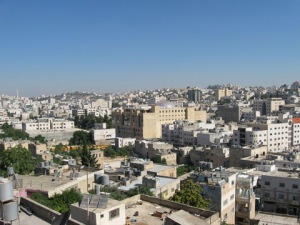
Hebron, the largest city in the West Bank.

FROM JERICHO TO HEBRON

by Anna Baltzer

I took a short day trip to Jericho several days ago; it was love at first sight. My friend and I were welcomed to the city with free bananas by friendly merchants who sold us fresh fruit from orchards within walking distance. Jericho is more like a big farm than a city. I had never been to a desert with so much green (it turns out Jews aren’t the only ones who can make a desert bloom). The air smelled like citrus and flowers; and in the late afternoon, a family sitting in their garden invited my friend and me for tea. We accepted after the requisite three refusals, and soon tea turned into supper, which turned into an invitation to stay the night that we couldn’t refuse.

The evening air was warm, and from the garden I watched the local children riding their small bicycles home from school and the well-dressed adults riding their bigger bicycles home from work, past the palm trees and setting sun. Behind the orchards we could see the mountains, dusty and still, peaceful.

The next morning I took a walk to the ruins of Hisham’s Palace, one of the city’s biggest attractions. The archeological site is beautiful, and the mosaics are extraordinary. I received a personal tour from a 1948 refugee working there, who said “the pleasure of my company” would be his payment.

I wondered why Jericho felt like such a different world from the rest of the West Bank, so relaxed, spontaneous, and open. Then it hit me: I hadn’t seen a jeep or heard a sound bomb my entire time there. There were no Humvees zooming past in the middle of the night, no soldiers demanding who I was and where I was going. Jericho is—almost—Palestine without the Occupation. And it is beautiful. It’s a vibrant reminder of what Palestine could—and hopefully someday will—be. Who says all Palestinians would rally against Israel if left alone? Nobody I met talked much about Israel while I was there. They were too busy living their daily lives, like most people in the world.

It takes just 2 hours to get from Heaven to Hell. At least, that’s how long it took for me to go the next morning from the paradise of Jericho to the nightmare of Hebron. Until recently, Hebron was the only city in the West Bank besides East Jerusalem suffering from settlements within its city limits. Usually settlers establish themselves on hills surrounding villages or cities, but many of the settlers in Hebron have moved into the second floors of Palestinian homes in the Old City, always by force and sometimes with the help of the army.

Hebron’s were the first settlers in the West Bank after Israel occupied the area in 1967, when the Old City’s Palestinian population was around 7,500. Twenty-five years later, that population had shrunk by 80% to 1,500, a mass exodus provoked by Israeli settler and state violence and dispossession. The wealth left with the refugees; only the poorest residents remain, those with nowhere else to go. Today the old market, which used to be bustling and vibrant, is run-down and abandoned. Unemployment hovers around 80%. The local economy is in shambles, as are the hopes of many Hebron residents.

I took a tour of the city led by Christian Peacemaker Teams (CPT), a faith-based organization that witnesses and intervenes nonviolently to prevent violence in Hebron and other hotspots around the world. We walked through the market area, where the few remaining Palestinian merchants have hung netting above their shops to catch trash that the settlers throw down from their apartments onto the Palestinians’ streets and rooftops. Said one merchant, “I’m not here to make money anymore. I just sit here because there’s nothing else for me to do. I’m waiting to die.” Even if his old customers had the money to spend, the merchant couldn’t get to his shop because it’s in the Old City, which is now cut off from the rest of the holy city of Hebron by a checkpoint. The people of Hebron can no longer go freely to their city center, nor to their main place of worship. I wonder how Israel would react if Palestinians started moving into the Jewish section of old Jerusalem by force, and then cut everyone off from it but themselves.

It doesn’t make sense. In a city of more than 120,000 Palestinians, there are about 600 settlers calling the shots, and about 2,000 soldiers and police stationed to protect them. In 1994, Baruch Goldstein, a local settler from New York affiliated with the Kach Israeli extremist political party, opened fire on a mosque full of praying Palestinians. He waited until they were bent over with their heads to the floor in worship before shooting 29 men to death, injuring about 100 more.

According to the imam who was present during the shooting, when the soldiers heard the shots they assumed they were from “Arab terrorists” and began to target Palestinian residents in retaliation, including one in the process of evacuating the body of a friend who had just been slaughtered. Riots following the massacre left 9 Israelis and 26 more Palestinians dead. Since the massacre, Hebron settlers have built a monument in Goldstein’s honor and make pilgrimages to his tomb.

The 1994 massacre was not the first Hebron has seen. In 1929, some 30 Jews were brutally murdered by Palestinians who resented their growing presence in Hebron. A native from Hebron named Hisham sometimes gives tours of the city, sharing little-known details about the time of the 1929 massacre, which he himself witnessed as a young boy. According to Hisham, before the massacre there was a large population of Jews in Hebron who considered themselves Arabs. They were well-integrated and respected in the community. As the Zionist movement gained ground, some people began to resent the huge influx of Jews flooding to Hebron with hopes of establishing an exclusivist Jewish state. Hisham said the vast majority of Jews killed in the massacre were recent immigrants from Europe, because most of the native Hebron Jews were saved by their Muslim neighbors who hid them in their homes.

Hisham’s family members, for example, were “shabbes goys” (non-Jews whom Jews hire to perform work that is forbidden for observant Jews on the Sabbath, such as switching lights on and off and cooking) for a Jewish family next door, whom they took in during the massacre. Hisham added that the majority of perpetrators of the massacre were not from Hebron.

It’s disappointing that these stories of Jewish and Palestinian solidarity are not more well-known. People remember the non-Jews who risked their lives to help Jews escape the Nazi Holocaust, but those who sheltered Jewish Hebron residents in 1929 are mostly forgotten. Similarly, the Arab media doesn’t go out of its way to talk about Israeli activists who risk attack and arrest every day for standing in solidarity with Palestinians against the Occupation. It seems the media on both sides have an interest in perpetuating fear and racism rather than taking advantage of the solidarity that has always existed here, albeit limited.

Although the native Palestinians in Hebron can be blamed for neither Goldstein’s massacre nor the one of 1929, they continue to pay the price for both. The earlier massacre is still used to justify excessive security measures at the expense of Palestinian freedom of movement and self-determination in Hebron. Ironically, Goldstein’s crimes are used to justify the same security measures. After he opened fire in the mosque, Palestinians in Hebron were put under curfew for a month (presumably to prevent retaliation), while the settlers were allowed to roam freely shortly afterwards. The Palestinians, who had been the target of the massacre, were shut in their homes for 30 days, unable to go to work or school, let alone visit one another and pay their respects to the dead.

Another result of the Goldstein massacre was that the site of the massacres—the Cave of the Patriarchs, where Hebron’s main mosque, the Ibrahimi Mosque, sits—was split into two, with one side for Muslims and one side for Jews. Both the curfew and the division were allegedly to prevent further confrontation, but in reality they served to further curtail the rights of the very population that had been attacked. The Israeli army and government call Goldstein’s gang terrorists, but in practice they are the group’s most crucial suppliers of security and impunity.

–Anna Baltzer

This piece was originally published on Anna Baltzer’s website: AnnaInTheMiddleEast.com on 3/12/05.

Further Reading:

The Olive Harvest by Anna Baltzer, 8/7/09


COMMENTARY

mercurydime_xlungex

Photo of what is commonly called a Mercury dime, but which actually depicts Liberty wearing a Phrygian cap with wings, symbolizing both liberty and freedom of thought. It was designed by Adolph Weinman.

TOWARDS A DEMOCRATIC, COOPERATIVE, AND CARING ECONOMY

by Mira Luna

There has been a lot of talk lately about how we should reform our economy. In order to figure out where we want our economy to go, we need to evaluate where we currently are. The economy we operate within in the US is, by many measures, not taking care of our most basic needs. The US spends more on healthcare than any other country, but is now ranked 50th in longevity and 47 million people in the US are without health insurance. 3.5 million people, 39% of them children, currently experience homelessness every year and 30% of Americans are on the edge of poverty. 36.2 million people live in households considered to be food insecure, including 12.4 million children. Even by the most conservative standards, the US ranks 23rd in world happiness despite its enormous wealth, making up one quarter of the world’s GDP. We work longer hours for less pay doing unsatisfying work and have little time to connect with each other, as the social fabric of our communities slowly disintegrates. Why is wealth being pulled away from the things that we need and the things that make us truly happy?

Where money flows is partly determined by where it comes from. US dollars are issued solely by the Federal Reserve (a private financial institution) as debt (usually from loan agreements, including to the US government), which means it must be paid back with interest. The money to pay for this growing debt comes out of one person or institution’s pocket and interests accumulates in another’s pocket, creating inequalities and pooling wealth in fewer and fewer hands. The Federal Reserve attempts to set the value of the dollar by controlling the supply of it as a scarce resource. So even though there is enough food or housing for everyone, there will not be enough money in the hands of those that need it to pay rent or buy food, especially in times of economic recession. Markets also create artificial scarcity for the sake of increasing value, making only somewhat scarce resources and very abundant resources seem very scarce.

Scarcity created by the centralized monetary system and the market encourage unnecessary competition and greed out of fear that there isn’t enough resources out there for everyone. In the US, the top 10% of the population now possesses 80% of all financial assets while the bottom 90% holds only 20%, a significant threat to democracy, as concentration of wealth also leads to concentration of unchecked power. A continually growing economy is not sustainable, a boom-bust economy is not secure, and an unjust economy will lead inevitably to other social problems.

With the current economic crisis, we have an opportunity to create tools and structures that facilitate a shift away from wealth accumulation and competition for scarce resources to a more democratic, cooperative, and caring economy. How do we start to make this transition? We must start to decentralize our economy and develop aspects of it that have disappeared after decades of free market and capitalist fundamentalism.

If you can imagine, we operate within three economic circles. In the innermost circle, immediate family and friends give freely amongst each other (though less than they used to) – this network of trust is primarily a gift economy, usually with no expectation of direct reciprocity.  Our local communities used to provide the middle circle of economy, meeting most of our basic needs that our families and friends couldn’t. This middle circle was made up of local government and also people and business we knew well, trusted and exchanged with regularly, usually reciprocally through barter or exchange of money. Evaluations of who needs what the most, who we trust, and who deserves the most would influence our trading. Today most of this middle circle is gone. Now the outer circle, consisting exclusively of anonymous monetary exchanges in the global economy, determined primarily by the highest market value or profit, has consumed most of the two inner circles. We have very little control over this outer circle of trade and it has done great damage as it is run by businesses and people who have little vested interest in or responsibility towards the communities that they affect.

In order to create a better economy, we need to redevelop the inner and middle circles and reduce the dominance of the outer circle. There are many grassroots projects already underway to develop the inner and middle circles – worker cooperative development organizations, cohousing and cooperative housing projects, community credit unions, land trusts, urban community gardens, bicycle kitchens, free clinics, sustainable local investment programs, ridesharing, recycling stores, and community currencies are just a few examples. Though we can’t completely jump ship right away from the current economic system, we can slowly build alternatives as a transition to the new economy. Community currencies, though not a panacea, can be an especially potent fulcrum point in making this shift.

Regional or municipal community currencies that are well constructed can help redirect wealth away from corporations and towards local businesses, local governments, and not for profit groups. They can also provide stability in a roller-coaster market economy so that people don’t lose their jobs and public services don’t need to be cut. Local currencies re-pattern behavior by encouraging local exchanges, relationships and local self- and small business employment, increasing local community self-sufficiency and sustainability. Spending locally results in three times the income effects, three times the wealth effects, three times the jobs, and three times the tax income, before it leaves the community. Community currencies combined with import replacement could drastically increase local wealth and stability. Ithaca Hours and Berkshares paper currencies are two good examples of paper currencies successfully being used in the United States, as well as the Worgl in Austria and the Chiemgauer in Germany. Over 300 alternative scrips issued in North America during the Great Depression.

For other needs and wants, we should create soft currencies within the middle circle that transition us towards the gift economy and indirect reciprocity.  We should design these currencies so as to maximize feelings of abundance and trust in communities. Soft currencies include mutual credit systems like time banking and LETS (Local Employment/Exchange Trading Systems). Time banks are based on hour-for-hour exchange that reduces the emphasis on keeping score, creates abundance because we all have some time and skills to offer, and reduces inequalities through a single standard metric, the hour, rather than the market value of that hour. Because there is no interest in this system, there is no incentive to accumulate credits and no problem with being in debt.  Wealth then circulates more fluidly throughout the community, which means people are taking care of each other. Time banks and other mutual credit systems now number in the hundreds in the US and in the thousands across the world. The most successful mutual credit system is the Swiss WIR bank, a business to business trading and accounting system, which has captured a significant portion of the economy and buffered it from depressions.

In order to create a more loving economy, we should also create as many opportunities for gift giving as possible. Gifting builds a collective consciousness that we are all in this together and we trust each other to take care of each other.  There are many examples of successful gift economies. The entire country of Mali functions primarily on a gift economy. Other examples of gift economy are practiced in Black Rock City by participants of Burningman and in the Pacific Northwest by indigenous peoples during potlatch ceremonies.  Spreading around the world contagiously are small events which epitomize the gift economy, called Really Really Free Markets, in contradistinction to the capitalist free market, which actually gives nothing away for free and tries to commodify everything. In a Really Really Free Market, skills are shared, services are offered, music is often is provided, and goods are given away, but no money, barter, or advertising is allowed.  Everyone receives reward merely by seeing others benefit from their gifts and they may take whatever they need, whenever they need it, building trust that all will be provided for.

As we grow these inner and middle circles, we will see a shift toward a more democratic, cooperative, caring , and dare I say, loving economy. Our currencies, businesses, banks, and investment mechanisms should all be based on our highest values and the kinds of relationships we want rather than these tools and structures determining our relationships and our values. It is time to move forward consciously, deliberately and and fearlessly to create the new economy.

–Mira Luna is a San Francisco based activist who is working on developing an alternative economy in the Bay Area. She helps coordinate Bay Area Community Exchange, a local timebank, JASecon, and the Really Really Free Market. Her blog is Trust is the Only Currency.

I WANT TO BE BETTER

Ajanta caves in Northern India

Reclining Buddha carved in the Ajanta Caves in Northern India, dating to the 2nd century B.C.

I WANT TO BE BETTER

by Eve Toliman

I once read about a young man who joined an ashram (I think his name was Chris and I think the ashram was in San Francisco).  At a certain point he slowed way down.  He smiled sweetly and spoke less and less.  His peers were awed by his spiritual progress.  They tried to emulate what they believed was his serenity.  Over a period of about a year, he became slower and stiller until he didn’t speak at all.  He just smiled.  A shiny, round, apple-cheeked young Buddha.  Enlightenment.  Turns out he had a massive brain tumor.  His fellow aspirants had mistaken dullness for serenity.  (I think pharmaceutical companies capitalize on a similar confusion.)  I fear I am Chris (minus the sweetness) — something vital in me is being eclipsed by something vacuous.

I have a friend who won a silver medal for basketball at the World Games.  Like many athletes, her body pioneering new limits, her performance a testament to human spirit and will, she was debilitated by injuries.  Two surgeries later, never having achieved the peak of her athletic capability, she could no longer walk without pain.  She can’t even bear to watch the game anymore.  The love of her life is whole and well, blithely wooing others.

When I was 26 my mother was diagnosed with a terminal cancer.  Ironically (or not) she had worked at Sloan-Kettering as an aide to an oncologist studying the same cancer that took her life at 55.  We were a spirited and unbalanced group to begin with.  During this last year of her life, when all hope died and the shadow of a guillotine draped everything we did, we were launched to new extremes. We drank harder, laughed harder, and pushed harder against the huge inevitability that was pushing toward us. I was doing computer projects — tedious, relentless attention to detail.  As an antidote to the colossal left brain activity that occupied too much of my other time, I started drawing — a lot.  On Mondays, Wednesdays, and Fridays, I took two three hour drawing classes back-to-back.  I sketched still lifes in the morning with a brilliant, laser-like, high-speed printmaker whose work hung in the Guggenheim.  As he passed by, people muttered about the effects of long-term exposure to printing chemicals.  Hushed and inconclusive, it nonetheless impressed me with a desire to avoid printmaking.  In the afternoon, I drew nude models with a sardonic landscape painter whose chosen genre had fallen out of popular consideration.  He pursued his craft knowing it would never amount to anything more than it was, his own private communion with creativity.

One morning, I was drawing in Robert-the-twisted-printmaker’s class.  He was talking non-stop, as usual, but for some reason on that particular morning he kept looming over my shoulder when I least expected it.  I was trying to get into that right brain groove, just be my hands as Andrew Wyeth put it, when BAM, in my ear, rapid fire conceptual jargon.  I would stop and wait for the clatter to move on.  I finally gave up and just listened.  Intermingled brilliance and nonsense.  Impossible to ignore.  Fascinating and grating, my left brain sifting, panning for gold.  When I showed up for figure drawing, chalks in hand, model prepared, quick sketches done, I was paralyzed.  I just stared, hoping, waiting for that right brain relief.  Walt-the-pragmatist-painter finally asked, “Why aren’t you drawing?”

“I was listening to Robert all morning.”

“Oh, I understand.”

Here I sit, waiting for relief, stunned by the non-stop, clattering demands of a life — meals, laundry, dishes, money, phone snafu again, still haven’t replaced that spare tire, my daughter’s tooth needs to be pulled, I need a crown, (where are my son’s adult teeth?), finish the web copy, my passport’s expired, new doctor for the kids, back-to-school night, we are out of bread, invoice that client, oh god, I forgot to call the insurance agent — hoping, waiting for that right brain relief, spaciousness in which to feel and dream and do nothing at all.  I feel dullness creeping over me.  I watch my love blithely wooing others.

When my mother died, I stopped drawing all together. Ten years and two kids later, when divorce seemed inevitable, I started writing.  It felt as if my soul had been startled into some kind of action and was now fighting for her life.  It is ten years later again.  My soul seems to be in some kind of tug-of-war with modern life.  I am the rope.  We are the rope.   I hear the same things from friends.  These are people who love their work, love their families, but feel eroded by the demands of managing their worldly lives.  Perhaps it’s time of life.  For those of us who didn’t give up, time is taunting us, drawing us out.  If our souls are to have expression, it is now or never.

Perhaps the tug-of-war is created by my misperception.  It is not the inevitable effect of an evil world against a pure soul, of endless tasks eclipsing meaning  — it is the result of a false split.  It is not worldly here and spiritual there, mundane here and creative there, rather it is love throughout.  Driving to the mechanic, watching the teens in the crosswalk, waiting at the post office, calling the dentist,…  The mundane simply raw material for creativity.  Spaciousness throughout.  No destination, just this.  When I stop resisting the tug and just fall, a curious reversal occurs.  That place of tension becomes the opening.

My boyfriend and I have been having the same fight for over a year.  Every month or so, we approach the heated topic gingerly and within minutes it blows up again and we retreat.  Yesterday morning, for the first time, we moved safely over the mined border into an entirely new landscape.  Just like that, peace.  In the evening, he turned to me and said, “I want to be better — better to you, better for you — than I know how to be.”  I felt it enter my chest and move around.  I realized, I want to be better, too — much better than I know how to be.  Suddenly the tug-of-war is recast: It is not what’s keeping me from the fullness of my human life — it is my human life.

–Eve Toliman

Further Reading:

I Dreamt of My Father Last Night by Eve Toliman, 8/4/09

Prodding Baudelaire by Eve Toliman, 7/28/09

Beneath the Damage and Apology by Eve Toliman, 7/24/09


A HALF MAST REBEL

csg1

A HALF MAST REBEL

by Gabriela Barragan

When I discovered what the religiously-tinted definition of a prude was, back in the 6th grade, I decided I didn’t want to be one.

In my 11-year-old mind, already indoctrinated by a steady stream of Catholic-infused political beliefs and dogma, prudes didn’t sneak Guns N’ Roses tapes, heavy metal magazines, or try smoking an abandoned pack of cigarettes.

But I wasn’t about to turn full-fledged rebel.  In concert with the floweret of rebellion beginning to bloom there was a flash of the most boring of all adages, ready for harnessing at any moment (especially by dieters), and one my Mom stated constantly:  “Everything in moderation”.

So, while I was determined not be a pre-makeover Charlotte Vale from Now Voyager (young spinster goes from nunnery dress to sophisticate on celluloid in black and white) I also wasn’t going to manifest the exhibitionistic Catholic school girl stereotype, with a skirt hiked up to there – the maximal anti-prude.

But the rebel floweret inched a bit taller.  I may not have attempted to set my uniform skirt on fire, but I watched.  And I was disappointed, like everyone else, that the material kind of melted and curled, and that the resulting acrid stench made me and my adolescent comrades run away and stuff our mouths with contraband Hubba Bubba to stave off the caustic tang that permeated our polyester, our Peter Pan collars, and even it seemed, our skin.

More than 20 years later, I’m not as fascinated by cloying bubble gum flavors, burning my uniform in effigy, or espousing the Catholic doctrines I was taught by teachers with (mostly) good intentions.  In those 20 years I’ve met many people of diverse backgrounds.  Through more than a few I observed that faith (not religion, but faith) is not just housed among the very good, the very dogmatic, and those who shun all forms of venial sin.

A notable example:  The best yoga teacher I ever had, a former heroin addict, could drink a bottle of wine and get blazed the night before class and still teach with the kind of patience and in-the-moment presence only gifted instructors possess.  She was a good time gal, and a dedicated and very spiritual yogi – not an either/or.  It gradually became clear that I didn’t have to run from the religious prude archetype proffered by teachers back in my uniform days.  I just had to merely give it my regards and say, “No, thank you”.

I may have veered off the path my parents put me on back in Kindergarten, while they have become even more devout, but I now understand the importance of respecting their beliefs even though they are not okay with mine (maybe slightly alarmed is more like it).  We’ve even managed to have some conversations about our differences without skyrocketing blood pressures on either side (of the aisle).

So, instead of continuing to run, or drowning out the dogma with GN’R, I’ll listen.  I won’t necessarily accept or adopt, but I’ll listen.  My yoga instructor once said:  “flexible in the body, flexible in the mind”.  My sprint now is away from narrowness and rigidity, and toward a more catholic view – but allow me emphasize that lower-case “c”.

–Gabriela Barragan

Further Reading:

My Musical Corkage Fee by Gabriela Barragan, 7/21/09

JACOB LAWRENCE

270_fs

Ironers by Jacob Lawrence, gouache on paper, 1943.

JACOB LAWRENCE IRONERS 1943

by Nathan Birnbaum

This painting plays into the labeling of Jacob Lawrence’s early work as “primitive,” bringing to mind descriptors such as “folksy” and the “common-man.” Clearly, we have a piece that is directly addressing the social, political, and economic underpinnings of a cultural task.

Both in the post-Emancipation era and before, during, and after the Great Migration of African Americans to the North, black women found themselves pigeonholed into domestic labor jobs, among them ironing and washing the clothing of more affluent white families. Although this work could be seen as demeaning, these women in fact came to look upon the work as a way to express their new-found freedom, a theme addressed in a book entitled To ‘Joy My Freedom by Tera W. Hunter (which ironically chose this particular painting for its cover).  When competing with other ethnic populations for jobs in the economic sector, washing was fiercely defended, even violently at times, as an African-American trade. However, after moving North in the Great Migration (and I suspect that Lawrence’s rendering comes from what he observed in Harlem in the late 30s and early 40s), this work not only came to symbolize entrenchment in the lower class sector, but long hours slaving over what amounted to labor intensive work for little pay.

But determination to embrace identity, like that in the post-Emancipation era, was a characteristic of the New Negro which Lawrence famously addressed in his Migration Series. According to one scholar, he “simply interpreted life as he saw it” and Lawrence himself might appropriately comment that this photo addresses the fact that African Americans “didn’t have a physical slavery” but rather, an “economic slavery.”

In terms of aesthetic qualities, Lawrence’s use of broad, square, large, and block-like figures not only speaks to the theme of domestic labor, but immediately brings out the strength of the women. The figures jump out of the photo, expanding the viewing capacity of one examining the painting, and the fact that there are multiple women serves to tread the line between sympathy for and truthful depiction of entrenchment in the labor force. Lawrence employs techniques that typified Modernist art, such as repetition of forms, reduction and simplicity of these forms (for example, there is no differentiation in the faces, clothing, and expressions of the women, as Lawrence chooses to leave these details out entirely), and furthermore, he chooses largely arbitrary colors for his canvass. Much of the painting appears superficially flat, except for the irons, which might serve to highlight the heaviness and cyclical nature of the labor.

But given the background that we can ascertain from the historical information I addressed earlier, Ironers easily fits Lizzetta LeFalle-Collins’ claim that Lawrence “not only was telling the history of the Negro, but also introducing viewers to a new way of seeing objects and compositional relationships.”  These women clearly have a defined relationship with their work.  And perhaps seeing the prominence of their irons and the size of their working arms serves to present domesticity in a new way, removed from a society that was deep in the throes of World War II.  Washing of the clothes wasn’t grounded in war but rather it was grounded in everyday life for these women, and had been historically as well.

–Nathan Birnbaum

Further Reading:

An Argument for a Core, By Nathan Birnbaum, 8/1/09

“A New Era of Engagement”, But for Whom? by Nathan Birnbaum, 7/15/09

COMMENTARY

rn_age2_wLaura_1936

Ralph Nader aged 2, with his older sister Laura (who has been a Professor of Anthropology at UC Berkeley since 1960).  This photograph was taken in 1936.

THE HOLY TRINITY OF INELIGIBILITY?

by Rod Ciferri

I’ve previously written inquiries into the eligibility of the two major party candidates of the last presidential election in “War Is Over!” and “McCain’s Natural Born Problem”.  Therein I noted that being a U.S. citizen is not enough to be eligible for president.  The U.S. Constitution, in Article 1, Section 2, sets a higher standard, “natural born citizen”, which requires a presidential candidate be born in the country to at least a U.S. citizen father.

I’ve come to the conclusion that McCain’s undisputed Panamanian birth crushes his eligibility since the mere U.S. proprietary rights acquired in the Panama Canal Zone did not make it part of the U.S., and, absent pulling a rabbit out of the hat, and explaining some gigantic lies about his personal life, Obama’s eligibility is non-existent as well due to his father’s apparent Kenyan citizenship.

What about Nader?  He did come in third place according to popular vote (although didn’t reach the radar screen with the Electoral College).  If McCain and Obama are both disqualified, then Nader would be the presumptive front-runner to win the Electoral College vote. Is he a natural born citizen, and, thus eligible for president?

The short answer is:  Maybe, maybe not.

Like Obama, it depends upon the citizenship of his father.  Although information about Nader’s public life is voluminous on the internet, details about his parents are skeletal in comparison.

A glance at wikipedia.com reveals that Nader’s parents, Nathra and Rose, who were natives of Lebanon, were married in 1925 and “immigrated to the United States.”  Nader was born in Winsted, Connecticut in 1934.  It is not clear to me when Nader’s parents immigrated to the United States.

The question of Nader’s natural born citizenship, hinges upon whether or not Nathra was a naturalized U.S. citizen prior to Nader’s birth.  If so, Nader is a natural born citizen, having been born in the country to a father who was a citizen, and, thus, eligible for president.

The immigration statute governing naturalization in effect from 1924 through 1952 was the Immigration Act of 1924.  Under this law, it was possible for an immigrant to become naturalized a U.S. citizen within five years.

If Nader’s parents immigrated shortly before or after their marriage in 1925, they would have been in the country for nine years when Nader was born.  Therefore, it is possible they had become U.S. citizens before Nader was born.

However, since I’ve found no information about the natural born citizen issue regarding Nader, his eligibility for president remains unclear.

–Rod Ciferri

Further Reading:

McCain’s Natural Born Problem by Rod Ciferri, 8/2/09

War is Over! by Rod Ciferri, 7/17/09