Andreas Economakis

That Whirring Noise

by Andreas Economakis

“I’m trying to figure out where that high-pitched noise is coming from,” I say in Greek, tired eyes scanning over her shoulders.

“What noise?” she asks, innocently. Her eyes circle over my head, like two crows coming in for a landing.

“That noise,” I say, pointing to where I think it’s coming from.

“I don’t hear anything,” she replies, calmly.

“You don’t hear that whirring noise? It sounds like a high pitched engine that’s out of tune.”

“No, I don’t hear anything.” She adopts the classic Greek island facial shrug, the one with that tiny, crooked smile. I can’t tell if she’s pulling my leg. “Maybe you’re thinking of the noise from the desalinization plant?” she adds.

“Ah! That must be it!” I say, triumphantly. “It kept me up all night!”

She shakes her head slowly, faintest smile still in place. “It can’t be. The plant is closed at night.”

“Then they must have kept it open last night. My nerves are wrecked,” I say.

“No, no, it doesn’t work at night. Who knows what you heard… Are you sure you heard something?”

I smile and lower my head, shrugging. Defeated. Without knowing it, I adopt the same quizzical island smile and pad away from the Loutra Spa Hotel, toward my parked motorcycle. I’m looking forward to a quiet coffee in the village square. Then, maybe, I’ll ride out to the beach for a nap. There I’ll be able to get some sleep.

Silence is rare in Greece. Greeks are by far the loudest people I have ever met. And I’ve been around. I’ve slept in fleabite hotels in downtown Cairo, stained-sheet pensions in the middle of Rome, even in small dorm rooms two meters over a rumbling and rambling Broadway in the heart of New York City. Greece is, hands down, the loudest country on planet earth. The little remote island I’m visiting is not an exception to this rule.

The whirring noise at the Loutra is just the tip of the iceberg when it comes to noise at the old spa hotel. First off, there’s my bed. Any small movement and the ancient wood frame squeals like a giant redwood coming down in a windstorm. Then there’s the floorboards. They’re so old and noisy that I fear crashing through them and into the old timer’s bed in the room below. When I walk around in my room, the Pope in Rome can hear me. And as for the old geezer below, every time he gets out of bed the entire hotel squeaks like a thousand mice being stepped on at the exact same moment.

My first night at the hotel I jumped out of a deep sleep in a sheer panic, convinced that bloodthirsty Turks were fornicating in my room. Later in the same night, I thought I heard a camper-van emptying its toilets on corrugated metal. It was the old timer again, clearing his throat. The following night I was awakened once again in terror, this time dead sure that a rat the size of Lassie was nibbling on my flip-flops in the corner of the room. It was the same old timer, taking a pee in a cup or something down below. That noise has repeated itself constantly since I moved in. At the exact same hour of the night. I guess the incontinent old fellow down below is too lazy or tired to walk to the communal bathrooms. Or maybe he’s afraid he’ll make too much noise walking down the creaky hallway.

The old timer and the other nighttime apocalyptic sounds in my hotel are merely the frosting on the cake. They are nothing compared to the racket that the obviously deaf octogenarians make every morning right below my window, hollering at top volume through their missing front teeth. This starts before the crack of dawn. Every day. No exception. My window has the wonderful advantage of being directly above the entrance to the Loutra, the very spot that has shade throughout most of the day. All the ancient geezers of this famous little island spa congregate in this spot from before sunrise until after sundown.

My first morning at the hotel, I was startled out of a restless sleep by two old men plumb screaming at each other. It sounded like they were going to come to blows at any moment. I cringed, waiting for that sudden gunshot crack of rusty World war Two guns going off, or that telltale soft thump of a body landing on concrete. I tried to figure out what the fuss was all about. It seemed like the old men were screaming about the quality of water on the island. That couldn’t be right.

I sat up in my squealing bed, wondering what national water crisis had just unfolded. As I listened, drops of salty sweat rolling down my overheated neck (there was no ventilation in my ancient room), I realized that they were simply weighing the pros and cons of drinking tap water on the island. At full volume. The old geezers were soon joined by two women, who, god bless them, were even louder and shriller that their toothless male companions. Their high-pitched yells sounded like donkeys braying in a room filled with cheering, drunk frat boys. They damn near shattered my windows. Dear god, I’ve just realized that I am in a hotel for the hearing impaired! No, I am on the island of the deaf!

–Andreas Economakis

This piece is part of a collection of stories on Greece entitled: The Greek Paradox.

Copyright © 2010, Andreas Economakis. All rights reserved.

For more stories by Andreas Economakis click on the author’s name below.

Duopoly Must Go: An Appeal for Score Voting

24529v


Duopoly Must Go: An Appeal for Score Voting

by Andrew Jennings, Clay Shentrup, and Warren D. Smith


Progressive thinkers on all sides of the political spectrum often wonder why the United States seems incapable of escaping a two-party political system. Is it a result of an extreme demographic situation, an urban and a rural America so large and obstinate that they are incapable of cooperation? Does it somehow come from the unique American spirit, a tradition steeped in individualism and adventure? Are the third parties being silently stifled because of their opposition to our incessant march toward rule by large corporations? The answer, in fact, may be so simple that it is right at our fingertips at least once a year. Every time we vote, in fact.

Fifty years ago, French sociologist Maurice Duverger observed that the plurality voting method tends to favor a two-party system, whereas “the double ballot majority system [a.k.a. ‘top-two runoff’] and proportional representation tend to multipartism.” Observations in the social sciences are never absolute, but this tendency for plurality voting to maintain two-party domination is so reliable that it has become known as Duverger’s Law.

Plurality voting (a.k.a. “first past the post”), by far the most common system in the United States, is where each voter votes for one candidate and the candidate with the most votes wins, even if he receives fewer than 50% of the votes. Top-two runoff (a.k.a. “TTR” or “delayed runoff”) is just like plurality voting, except that if no candidate receives a majority of the votes, then a subsequent election is held between the top two finishers.

Few would expect the way we count our votes to be the primary factor determining the layout of our political landscape, but the evidence is overwhelming. Beyond the empirical trends to which Duverger referred, mathematical analysis of these voting methods suggests a causal relationship. For instance, a plurality voter who prefers a Green Party candidate will often take the tactical route, casting an insincere vote for the Democrat in order to prevent the Republican from winning. This costs the voter very little, since a minor party candidate is by definition unlikely to win anyway. It seems clear that such tactics keep us locked in a two-party system.

A top-two runoff system differs considerably. To echo Duverger, most of the approximately 30 countries which use this system have escaped two-party domination, even in single-seat non-proportional elections. And as with plurality voting, analysis of the runoff system strongly suggests that this is not a coincidence, but in fact a result of voter psychology and the different tactical incentives at play. For instance, voters in the runoff have no incentive to cast an insincere vote, as there are only two choices. And once the options are narrowed down to two candidates, voters often have a better chance to get to know an otherwise unknown challenger. These factors may largely explain how Green Party candidate Matt Gonzalez was able to come within striking distance of Democrat Gavin Newsom for mayor of San Francisco in 2003 (the margin was less than 6%) despite being outspent five to one, and despite Newsom’s being endorsed by a host of powerful beltway politicians.

Opinions vary as to the relative merits of TTR versus other systems, and the above is not meant as an endorsement of TTR per se. Rather, it is a testament to the extent to which the voting method determines the party composition of a government. It seems clear that if we want to escape the two-party stranglehold, we must adopt a different voting method; specifically one which is not known to also maintain two-party domination.

Many of the modern efforts for voting reform promote an alternative form of runoff, called instant runoff voting (“IRV”), which allows voters to rank the candidates and appears to offer us a way out of our electoral difficulties. Unfortunately, communities and scholars are discovering that the hope IRV offers us for escaping our two-party system is only illusory.

Like TTR, IRV doesn’t fix the spoiler problem: a bloc of voters may get a worse result by supporting their sincere favorite candidate. For instance, in the 2009 mayoral election in Burlington, Vermont, a group of voters who preferred Republican over Democrat over Progressive could have gotten the Democrat instead of the Progressive by insincerely top-ranking the Democrat instead of the Republican. It may seem strange to think of the GOP candidate as the spoiler, but the ballot data shows that a majority of voters in left-leaning Burlington would have taken the Progressive or the Democrat over the Republican in a runoff election, making the GOP more akin to a third party in this particular circumstance — albeit a strong third party.

And therein lies the rub. See, most voters picture runoffs in the context of weak third parties. The thinking goes that if you prefer, say, Green over Democrat over Republican, then you can safely support the Green. If the Green doesn’t make it to the runoff, then your support will simply go to the Democrat. But that is only the first phase of a third party’s growth. Next imagine that the Green Party, freed from the fear of “wasted votes,” grows to encompass more and more of the electorate until it can outlast the Democrats and make it to the runoff. Finally, imagine a third phase in which the Greens have grown enough to not only defeat the Democrats, but to win against the Republicans in the runoff. This third phase represents the greatest hopes for those who see IRV as a way to end the stifling two-party stranglehold on government.

But this rosy picture starts to darken the moment we take account of two crucial factors. First, it must be noted that each of these three phases is generally a prerequisite for the next. This is explained concisely as follows: as a third party grows, it will become powerful enough to defeat its most similar major party before it will become powerful enough to defeat both major parties. Second, the middle phase is effectively a barrier to the third. It is precisely the scenario experienced in Burlington. In this phase, the Greens defeat their most similar opponent, only to lose in the runoff. For Greens who prefer the Democrat to the Republican, the announced ballot totals will make clear to them that their honesty caused them to get the Republican instead of the Democrat. If even a mere 10% of them decide to cast a tactical vote for the Democrat in the next election, then even a prodigious 10% increase in their popularity by that time will be completely nullified. More realistically, their popularity would increase by less than 10%, in which case the tactical behavior would bring them down faster than they could increase their membership.

Many IRV proponents have argued that such strategy is infeasible and/or inadvisable, since it is likely to “backfire.” We address this theoretical argument in detail elsewhere, but for now let’s put aside contentious theorizing, and turn our attention to empirical reality. Australia uses instant runoff voting to fill each of the 150 seats in its House (has used IRV since 1918). It also uses other methods for other elections, e.g. its Senate is elected with a multiwinner method called PR-STV (proportional single-transferable vote). Australia’s House is two-party dominated; in the elections of 2001, 2004, and 2007 combined, not a single house seat was won by a third-party member. In contrast, quite a few seats in their Senate (e.g. 9 out of 76 in their 2005-2008 Senate and 6 in the 2008-2011 Senate) were/are occupied by third parties, mainly the Greens.

The same trend has been observed with IRV elsewhere, such as the Irish presidency (a near monopoly despite being mostly ceremonial), and in Malta and Fiji (before it was a dictatorship). And it is interesting that San Francisco supervisor Ross Mirkarimi (who helped found the California Green Party) switched from Green to Democrat in early 2010, despite the fact San Francisco now uses IRV, instead of the delayed runoff system it used when Matt Gonzalez made his impressive mayoral bid.

Of all these examples, Australia may be the most pertinent. We noted that their Senate uses STV, while their House uses IRV. STV is a multiwinner proportional system, and it so happens that IRV is actually the single-winner form of STV, so both systems use the same ranked ballot. Thus it is not too surprising that many American election activists see the adoption of IRV as a crucial “stepping stone” to proportional representation via the adoption of STV. IRV gets voters accustomed to ranking the candidates, and puts the basic machinery in place to tabulate those ranked ballots in the specific manner that STV entails. Even IRV proponents who are aware of its tendency for duopoly often support it for this very reason; they want proportional representation. In fact FairVote, the organization most often associated with the push for IRV, was founded in 1992 as “Citizens for Proportional Representation” (and later the “Center for Voting and Democracy”), and it seems that behind the scenes, their pursuit of IRV is a long-term play for proportional representation in America.

The stepping stone strategy might actually make sense were it not for the USA’s rigid impediments to proportional representation, which was made illegal at the federal level via a 1967 law which outlawed multi-member districts. In 1996, congresswoman Cynthia McKinney (who later ran as the Green Party candidate for US President) wrote, but failed to pass, bill HR 2545, which would have overridden that previous 1967 law. She re-introduced a similar bill, HR 1189, in 2001. It failed again. Then she tried again with HR 2690 in 2005. It failed yet again.

This leads us to believe that PR will be federally unobtainable in the USA as long as we are two-party dominated (a Congress dominated by two parties will continue to block anti-duopoly legislation such as McKinney’s). We therefore believe that proponents of PR must find a single-winner voting method which doesn’t maintain duopoly, as a prerequisite to PR. As has been noted, ordinary top-two runoffs fit that description, but they have their own problems, both in terms of voter turnout and the cost and fatigue associated with extra elections. And they can still leave voters justifiably fearful of supporting candidates they sincerely prefer to the apparent frontrunners, in the first round. (As a reminder, voters have no incentive to be insincere in the runoff.)

There are other voting systems that work with a ranked ballot and have several advantages over instant runoff voting (e.g. Condorcet methods), but even more exciting is a simpler class of voting systems discovered in the past few decades, based on an entirely different paradigm: ratings rather than rankings. These systems let each voter consider each candidate separately and assign to each a score or grade.

In his 2008 book Gaming the Vote, author William Poundstone (an MIT physics grad) suggests a voting method called range voting (a.k.a. score voting), in which voters rate the candidates on a scale such as 0-10 or 1-5. When the scale is reduced to 0-1, we effectively have approval voting, which is identical to plurality voting except that there is no limit on the number of candidates a voter may support. A third method, the Majority Judgement, asks the voters to use a few natural-language terms (Excellent/Good/Acceptable/Unacceptable, for example) to grade the candidates and chooses the winner by finding the candidate who was given the highest grade by a majority of voters (the median grade).

Score voting has historically been overlooked, based on the assumption that it would succumb to pervasive tactical exaggeration. But that view was debunked back in 2000, when a Princeton math Ph.D. named Warren D. Smith performed an extensive set of computer calculations which showed the system working extremely well, even with high rates of tactical voting. This is based on an objective “economic” indicator of voter satisfaction with (or “representativeness of”) election outcomes, called Bayesian regret.

This can be understood if we think for a moment about a voter whose preferences are Nader=10, Gore=6, Bush=0. If this voter is sincere, he casts those very scores. But if he is a tactical voter, like those who voted for Gore instead of Nader under plurality voting, how should he vote under score voting? For starters he wants to give Gore a 10, and Bush a 0, to maintain the tactical advantage he sought under plurality voting. But he can additionally give a 10 to Nader, and any other candidates he prefers to both frontrunners, with no fear of negative consequences. (In election theory parlance, we say that score voting passes the Favorite Betrayal Criterion.) Whereas you will recall that with IRV, tactically placing the Democrat in first place absolutely requires a Green voter to place the Green lower than first place. But with score voting, giving Gore a maximum score in no way prevents a voter from still giving Nader a maximum score too. So third parties face no artificial barrier to growth, as they do with IRV.

A simple way to think of it is that a tactical score voter should support the same candidate as he would with a plurality ballot, and then also support all the candidates he likes better. This means that the appearance of being “unelectable” need not become a self-fulfilling prophecy, like with plurality, IRV, and so many other methods. If it turns out that enough voters prefer a minor party or independent candidate to the presumed frontrunners, then he can actually win, even if the voters are highly tactical! Empirical evidence strongly suggests election outcomes will then be vastly more representative of the actual relative support for the candidates.

We believe this has enormous consequences, beyond the obvious opportunity to escape from two-party domination. For instance, the inordinate importance of cash in elections is largely a product of the need to prove electability. Consider exit polling from 2000 in which 90% of Nader supporters claimed to have voted for someone other than Nader. This shows that the number of votes Nader could have received by convincing voters he could be elected (e.g. by having an enormous campaign “warchest” and/or getting the nomination of a major party) was nine times as large as the number of votes he won by trying his best to convince voters he should be elected. Also consider that in the 2008 US presidential election, Mitt Romney spent large amounts of cash from his personal fortune to bus in voters to straw polls with no legal consequence whatsoever, apparently in order to be seen early on as a frontrunner, so as not to be abandoned by tactical voters, who fear wasting their vote on candidates who can’t win.

These may seem like anecdotes, but their prevalence amounts to something greater. Money matters far too much in today’s political process. And efforts to curb that with typical campaign finance reform are inherently unstable, as cheaters will be more likely to win elections, and then just make their cheating retroactively legal, and/or intimidate government officials who dare to try to prosecute them. We believe it may be more effective to try to reduce the inherent importance of cash, than to wage a potentially futile battle to level the playing field. With score and approval voting, a candidate need not prove his electability in order to earn your vote.

In summary, we would be wise to realize that the lack of alternative choices in American politics is unlikely to be repaired without changing to a better voting system, and that instant runoff voting is probably not the answer. We should give serious consideration to voting systems based on ratings, where voters can evaluate each candidate independently, and never fear giving their full support to the candidates they prefer to the frontrunners. While it’s impossible to predict exactly how these systems will play out in practice, the theory and a great deal of empirical evidence make them seem promising, and it’s clear that the systems we have now are not working and it’s time to look outside the box for a voting system that will truly support smaller parties and encourage alternative ideas in our political discourse.


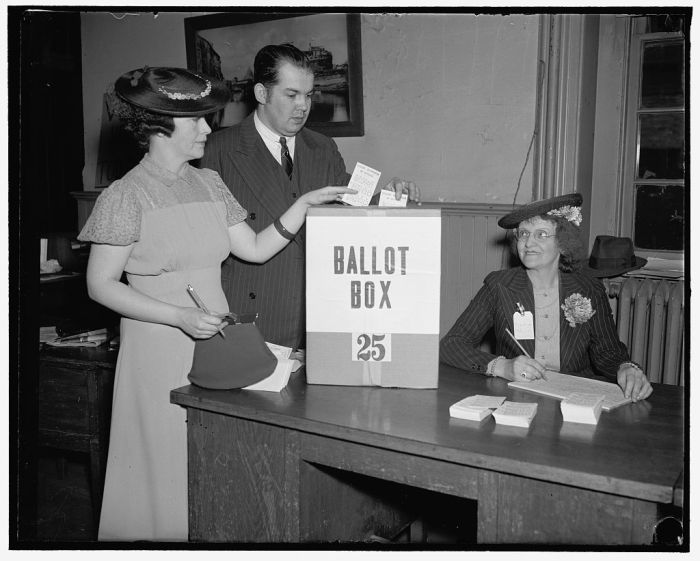
Image Credit: Creator(s): Harris & Ewing, photographer

“Washington Votes; first time since 1874. Washington, D.C., April 30. It was a long time between votes, 1874 to 1938, but the Capitol bridged a gap today when its residents cast a city-wide ballot on the question of whether suffrage shall be voted to the voteless community. Mr and Mrs Paul R. Henry are shown depositing their ballots while Miss Magdalena Gale registers them, 4/30/38”

From The Library of Congress

Ray DeCapite (1924-2009)

RAY DECAPITE (1924-2009)

by Thomas Baughman

One of my favorite authors is Cleveland novelist Ray DeCapite, a writer who devoted his entire life to writing fiction that took place on the very streets where he was born and raised. More specifically, his work chronicled life among Cleveland’s ethnic working class.

In 1960, DeCapite published his first novel, The Coming of Fabrizze, a celebration of ethnic working class community set in the 1920s. Fabrizze is an almost mythical tale of an immigrant who succeeds by hard work, marries a beautiful girl, wins the admiration of the immigrant community, then fails on a large scale. Even so , it ends well with the hero retaining the love of his neighbors.

The next year, the author would publish his second novel, A Lost King, which is a small masterpiece. As writer Thomas DiPietro has written ,“this elegant little novel beautifully captures the double consciousness of American ethnicity in its tale of an emotional struggle between a son and his father.”

Carl, an immigrant crane operator who has recently retired, cannot comprehend his carefree son. Paul, the slacker son, is content to play his harmonica and sell watermelons from a cart rather than pursue success or gainful employment. The ensuing conflict in the novel is both heartbreaking and uproariously funny.

Even though both books were greeted critical acclaim, they also met with public indifference and soon went out of print. Further complications ensued when DeCapite’s editor died and his publisher went out of business. Then to top it all off, several publishers passed on the authors next novel because the hero was a garbage man.

It would be 35 years before DeCapite would publish another book. In 1996, Pat The Lion on the Head was published by University Editions. This book, a novella really, tells the story of a trash sweeper at Cleveland’s West Side Market in the in the 1950s. Christy, an aging, lonely, hard-drinking veteran, meets and finds love with a lonely widow named Jenny. Ultimately he loses Jenny and ends up alone. While the story sounds simple the book is a small miracle of precise writing and nuanced detail. Four years later, the author would publish his last book, Go Very Highly Trippingly To and Fro/ The Stretch Run, which would again delineate life at the bottom.

Ray DeCapite died last year at the age of 84. He left behind an unpublished manuscript entitled All Our Former Frolics.

Lest the reader find the above story depressing, there is good news. Kent State University Press has republished both The Coming of Fabrizze and A Lost King. I can only hope that a new generation of readers will read and revere these two wonderful books.

SATURDAY POETRY SERIES PRESENTS: CHARLES BERNSTEIN


ALL THE WHISKEY IN HEAVEN
by Charles Bernstein

Not for all the whiskey in heaven
Not for all the flies in Vermont
Not for all the tears in the basement
Not for a million trips to Mars

Not if you paid me in diamonds
Not if you paid me in pearls
Not if you gave me your pinky ring
Not if you gave me your curls

Not for all the fire in hell
Not for all the blue in the sky
Not for an empire of my own
Not even for peace of mind

No, never, I’ll never stop loving you
Not till my heart beats its last
And even then in my words and my songs
I will love you all over again

From All the Whiskey in Heaven by Charles Bernstein. Copyright © 2010 by Charles Bernstein.

Charles Bernstein is an American poet, essayist, writer, and editor who has authored over 40 books. His works, accomplishments, and accolades are too numerous to note here. For a thorough look at Charles Bernstein check out the Electronic Poetry Center.

Editor’s Note: Today’s post is dedicated to Nathan W.

Recently a dear friend and faithful reader of this series took me for my inaugural visit to Green Apple Books in the Richmond District of San Francisco. Holed up in the poetry section I came across a copy of All the Whiskey in Heaven, a book named for a poem of the same name. Nathan W. had chosen this poem for me about two years ago when it appeared in The Nation, and it has been a part of the map of my heart ever since.

Today’s poem will always remind me that no matter how fleeting, no matter how much lost or gained, it is a blessing to be loved.

Want to read more by and about Charles Bernstein?
Poets.org
The Poetry Foundation
Electronic Poetry Center

The Chalice and the Burger

Adela and I were calling it a road trip, mainly because it made driving three hundred miles down through Central Valley in a car without air conditioning seem much more glamorous.
“Like Thelma and Louise,” my fellow pseudo-American mom enthused.
“Or Raoul Duke and Dr Gonzo, or even Sal and Dean,” I suggested, thinking more of the extra curricular possibilities of the long drive back without our thirteen year old boys.
We were dropping our kids at skate camp in the southern Sierra Nevada on 4th of July weekend and we were ready for pretty much anything; we’d paid the AAA a pretty penny for a premium membership and knew we could get a tow for at least a hundred miles if the Honda happened to give up the ghost.

We weren’t far past Orinda when our “Free Palestine” and “No War On Iran” bumper stickers began to draw attention to our otherwise lo-pro ride. Several times mini-vans paced alongside us and slab-faced white women scrutinized us with meanly scrunched up eyes, as if to say “ We’ll recognize you bitches if you show up at Dennys”.

“Did you bring your card?” I asked Adela, envisioning the slabby ones calling the cops to alert them to hippy moms in the vicinity. “Of course!” she laughed as she raised her eyebrows in that fierce Czech way of hers, intimidating those provincial ladies who floored their Town and Country and sped off towards Modesto.

Modesto reminded me of the story of a more inspiring matron, Florence Owens Thompson, the famous Migrant Mother that Dorethea Lange photographed during the Great Depression. Florence was 32 yrs old when Ms. Lange spotted her sitting in the back of her truck with her seven fatherless children. Her portrait was so poignant that it not only became the emblematic image of that dreary era but also made Lange’s reputation as a documentary photographer. For years nobody knew the identity or fate of this sad and beautiful mama, but then in the 70’s Florence came forward and told her story: she was born on an Oklahoma reservation and drove out West with her husband in search of work, he died while she was carrying their seventh child. To feed her children Florence picked cotton and anything else, including peas, which was what she was picking in Nipomo, when her famous portrait was taken. I heard a crackly audio recording of Florence on the internet where she told of how she’d ended up in Modesto and landed a janitorial job at the new hospital where she worked sixteen hour days for eight years straight. For decades she had remained anonymous because she didn’t want to shame her children with their poverty. There was some bitterness over the fact that Lange had never recompensed Flo for the use of her image which is world-famous, but most importantly Mrs Owens lived eighty years, a grand old lady, happy in her mobile home, loved and cherished by her children.

What I remembered most from the recording was how Flo spoke of the other children at the pea-picking farm in Nipomo, “They all crowded round and asked if they could eat with us” she recalled,” I fed them all out of the pot, they were starving.”

Speaking of starving, our boys were howling hungry by the time we hit Chowchilla on that pot-holed two lane blacktop, Route 99. We ate at Carls Jr much to the kids’ delight, everybody else munched burgers while I slurped up Chili Cheese Fries which looked for all the world like dog food and chips. Our sons share the burden of foreign-born mothers but in Chowchilla those unfamiliar accents of ours worked like a charm and the obliging counterboy made a fresh pot of coffee for us. Why is it Carls Jr and not Carl Jr? something curious that I can’t be bothered to research, but it is noted in the hinterland of my brain where I store similarly useless information — like the fact that these franchised businesses are the cultural simulacra that I was once thrilled to read about in Baudrillard’s Travels In America. It all seems passé now, but truly, the homogenous attributes which link a disparate population with symbols and semantic underpinning are plain to see out here and even we San Franciscan sophisticates know the constituent meaning of a combo! There was a beautiful Indian girl with long loose brown hair who came in. She acknowledged us with a smile and began to text with a tranquil expression. The other interesting-looking customer was a Latino, clean-shaven and smart in his polished cowboy boots and pristine straw cowboy hat. He also sat in a booth but didn’t look at us, he seemed correct and humble and made me feel kind of sad.

As dusk came down and the headlights came on, the preservatives or the karmic contamination of that cheap burger meat got me thinking about the darker realities of these country towns strung out through the valley. The Norteno/Sudeno gang wars, the crystal meth culture, the scary aberrant social crimes committed out here in the dusty strip mall neon church land that upsets the urban sensibility so much. Parents still shiver at the cold calculated ransom desires of three middle-class white boys who hijacked a busload of schoolkids in Chowchilla in the 70’s. More recently the unassuming Tracy, Merced and Modesto have raised profoundly horrible murderers like the dreadful Melissa Huckaby, Cary Stayner and Scott Peterson. Its true that these crimes happen in big cities too but somehow the ordinariness of tract home settlements under the big sky seems to magnify the human horror.

We drove through the night and climbing out of Fresno into the dark mountains we finally found the Humming Bird cabins where the owner, true to her word, had left Cabin Two open for us. We woke to the smell of a joint being smoked around the side of our cabin. It was the friendly breakfast chef from the Humming Bird Café getting baked mid-shift. He loved Adela’s bumper stickers and filled us in on most of his life: he was a Kosovo/Gulf War vet, a father of four, and had a gimpy leg from dirt bike riding, its true to say his cooking wasn’t nearly as good as his stories.

After a greasy breakfast the boys were twitching to sign in at camp, throw their bedrolls and backpacks in their cabin and get skating. Suddenly childless, we moms spent the afternoon high up in Kings Canyon, swimming with the holidaymakers at Hume Lake, getting lost in a vast encampment of Christian Schools and marveling at the massive sequoias named inappropriately after army generals.
Only half done with our road trip we took the downward road back towards the valley as the afternoon wore on, it was still hot as we pulled into yet another Carls Jr, this time in a run-down Fresno suburb. There was no real sense of Independence Day celebrations here except for a stall in the parking lot selling fireworks and business looked slow. Mercifully there were none of those unfriendly white ladies to be seen on this side of town, just pleasantly indifferent Latinos who took little notice of us burger-munching stonermoms.

So much for the burgers, but what about the Chalice?

We had packed light, I only had my toothbrush, a spare pair of knickers, my swim-suit and a copy of The Chalice and the Blade, self-banned from reading fiction, I’d brought along Riane Eisler’s classic. Eisler’s theory is that our prehistory and early cultural development was characterized by lovely partnership societies, violence came in with the dominator cultures which have held sway up ever since. When The Chalice and the Blade was first published thirty years ago the endemic prehistoric cult of the Great Goddess was not acknowledged, but Eisler’s painstaking research and multi-disciplinary approach brought our peaceful, artistic, nurturing Neolithic age back into sight, our paradise lost. Much as  Orwell’s Ministry of Truth rewrote history in 1984 so did the conquering dominator tribes: the Goddess was replaced with fearful war-hungry man gods, at best the Great Mother was turned into a consort deity. This is how our natural gender equality was destroyed, women became second to men and this perverse trajectory of human culture has led us directly here.

Out of kilter, the burger and the blade rule us, our meat-eating is eroding the environment faster than our fossil fuel consumption and our war lust is so deeply ingrained to deny it is heresy to most.

As the land falls away, the warm air pours over us, the clear night sky is illuminated sporadically by momentary flashes of the municipal fireworks of the tiny valley towns. Mothers heading home dream of a magical paradigm shift that allows us to partner with fathers again.

A Coney Island of the Belly

Lafayette Coney Island, Detroit
Coney Island hot dogs with trimmings from Lafayette Coney Island in Detroit. Photo by Beau R from Yelp. Used by permission.

A Coney Island of the Belly
By John Unger Zussman

June 1968. We emerge boisterous from the prom, the night still balmy. Six of us pile into my GTO and speed toward downtown Detroit to Lafayette Coney Island. Brightly lit, open till three, the Lafayette serves unkosher hot dogs on a Wonder Bread bun, slathered in mustard, smothered in thin chili, topped with a pile of raw onions, greasy fries on the side. Heaven. These Coney dogs have little to do with Coney Island, New York, but they are a Detroit institution and we grew up with them. We cram sweaty into a booth, raising scarcely an eyebrow in rented tuxedos and spaghetti-strap gowns. The Lafayette has seen it all. No need for menus: One Up Without for me, foregoing the onions, hoping for later; One Chili Only for you. We are young, fearless, on the town.

By the eighties, Coney Islands have gone upscale, dotting the wealthy Detroit suburbs like rhinestones among sapphires. We live in California now, married all these years, but we make a point when visiting to go for Coneys. Though our tastes run now to crusted salmon and risotto, and the fries go straight to our waists, the Coneys always taste like 1968, and youth, and prom night, and eager kisses in the back seat.

October 2001. In town for my sister’s funeral, we make our customary pilgrimage, but the Coneys seem flat and empty, the flavors crass, the mustard cheap, the chili a health hazard. I can’t believe we’re still eating this crap. We’ve turned a corner, crested a hill. Next stop, geezerhood. We’ve lost sight of 1968, buried in the dark recesses of our memories and taste buds. We look ahead to senility and the early-bird special at Bouchon.

Copyright © 2010 by John Unger Zussman. All rights reserved.

Why “America the Beautiful” Should Be Our National Anthem
By John Unger Zussman

No, it’s not because the “Star-Spangled Banner” (let’s call it SSB) is unsingable. The notes span about an octave and a half, which is within most people’s range. (The issue is that different people’s ranges don’t necessarily overlap.) But I digress.

Andreas Economakis

Barbie on the Rocks (photo by Andreas Economakis)

There’s Something Wrong With Willy!

by Andreas Economakis

When a boy discovers how to masturbate, the world ceases to exist as he knows it. Everything revolves around yanking willy. Morning, day and night. In the bedroom, in the bathroom, in the school bathroom, in the restaurant bathroom, in the library, behind the soccer field, in the woods, on the desk, under the desk, on the way to school, on the way back from school, carefully, everywhere. And the props! Sports Illustrated’s February swimsuit issue had a 2-second lifespan in my school library. Next on the list was National Geographic with its nude pygmies, nude natives, nude nudists. And the luscious lingerie ads in the Sunday paper! My mother must have thought I was a closet fashion designer, creating a scrapbook of Macy’s and Caldor and Woolworth’s clothes catalogs.

I was twelve when I discovered that excessive rubbing, in and of itself a pleasurable activity, could lead to the big Medina, the holy cow(!), Nirvana. I’ll always remember how, when we were younger, my brothers and I would sneak up into the water tower of our summer house with warm beers we’d nicked. We would sip the beers and then tuck ourselves into our sleeping bags to yank our willies. I didn’t fully understand what the big deal was. No matter how hard I yanked I could not for the life of me reach that state of bliss that my brothers seemed to achieve after a bit of strenuous yanking. My eldest brother was convinced that it was all technique, that somehow my wrist movement was wrong, that simply, I was a bad masturbator. I tried and tried, to no avail. My brother then decided that my willy was too small, possibly even deformed, and that only the three-finger approach would work for me. Needless to say, I became very worried that there was something wrong with willy. Fears of an 8-year old.

By the time I hit twelve, I was still apprehensive about my deformed willy. Of course that didn’t stop me from playing with it. And then it happened. Good God all mighty! Now I needed more props. I ransacked the library but found very little to feast my eyes on. How many other 12 and 13-year olds have pillaged and looted before me?

Back home, I eagerly tore through my collection of lingerie catalogues in my bathroom, pants bunched up hastily around trembling pubescent ankles, pimpled butt practically soldered to the toilet seat. That’s when I became even more worried that willy was indeed deformed. Careful examination of the catalogues confirmed what I already knew about female anatomy. Women had pubic hair. Behind it was a hole. The Hole. The Mother of all Holes. Logic dictated that the hole was like the belly button, only deeper. But my willy stood straight up. Shouldn’t it point straight out, horizontally, instead of up? Big problem! I pushed and pushed willy down but he kept springing back up. Dear God!! I was deformed!! There’s something wrong with willy!

–Andreas Economakis

This piece is part of a collection of stories on blindness entitled: The Blindness of Life.

Copyright © 2010, Andreas Economakis. All rights reserved.

For more stories by Andreas Economakis click on the author’s name below.

México: el país de no pasa nada

Seis años atrás, Ismael Hernandez Deraz aspiró a la gobernatura de Durango con la promesa de que llevaría al Estado hacía el progreso, haciéndose llamar “EL” como adjetivo característico del cambio que denotaría un antes y un después en la historia de la ciudad. El resultado de su proceso electoral no dejó en duda que el pueblo estaba con EL, pues obtuvo una ventaja de casi diez por ciento sobre los demás candidatos quienes aceptaron la victoria del Partido Revolucionario Institucional como un resultado legítimamente jurídico.

No tardo mucho en verse el cambio del que Ismael tanto hablaba; las oportunidades de trabajo empezaron a concederse a un limitado grupo de personas, todas ellas cercanas al gobernador dejando en la quiebra a varios negocios locales pues un monopolio había comenzado. Los medios de comunicación denunciaron esta práctica inconstitucional y poco a poco fueron callados por el mismo gobierno llegando a las consecuencias de que ninguno de ellos podría publicar ningún tipo de información sin que antes no fuera aprobada por EL. La ciudad comenzó a quedarse muda y sorda, conociendo las novedades por testigos presenciales cuya veracidad terminaba en rumores. Poco a poco, Ismael comenzó a demostrar quien realmente era, nunca le importó Durango, lo único que le importaba era su propia riqueza y habiendo dejado en claro que nadie podía estar en su contra, comenzó a desalojar a los habitantes de una manzana completa para el ahí, construir su mansión. La educación pasó a último término, pues para estos casos es preferible un pueblo ignorante.

Cierto día comenzó a circular en la red una amenaza de un grupo llamado “Los Zetas”, quienes anunciaban que en un plazo de dos meses llegarían a Durango armados y que no se detendrían ante nadie ni ante nada, que la población debería tener cuidado y evitar salir de sus casas. Durango se vió exceptico ante esta situación y lo tomó como una broma, por que para cadenas en internet, esa, no era la única.

Las cosas cambiaron cuando los primeros enfrentamientos entre la policía estatal y “los Zetas” tuvieron lugar dentro de un fraccionamiento conocido y cobró vidas inocentes a las que nunca se les hizo justicia. Durango empezó a conocer el miedo cuando hieleras ensangrentadas aparecieron frente a la Procuraduría General de Justicia del Estado conteniendo las cabezas de once hombres que habían sido reportados como desaparecidos apenas un día antes, acompañadas con una cartulina cuya leyenda decía “Ya llegamos, y no nos vamos”. A partir de entonces, Durango dejó de ser esa ciudad colonial y tranquila que le caracterizaba para convertirse en uno de los primeros estados con un alto índice de inseguridad a nivel nacional, las ejecuciones estaban a la orden del día, las amenazas de bombas, balaceras, los levantones, sucedían a cualquier hora, en cualquier parte, y eran tantas las denuncias de la ciudadanía que la autoridad optó por ignorarlas alegando que ya tenían demasiado trabajo para intentar con mas. Al poco tiempo, las denuncias terminaron, pues cada que se realizaba una, se recibía una llamada de amenaza por parte de este grupo del crimen organizado pidiendo por las buenas, que se callaran. A Durango no le quedo mas que ser testigo de todo lo que el crimen organizado era, no le quedó más que ser victima de sus miles de atropellos y no le quedó mas que aprender a quedarse callado, pues quienes debían protegernos, quienes debían llevarnos al progreso, tenían nexos con el narco.

Seis años le tomó a Ismael deshacer Durango, hacerlo inhabitable, inseguro, impune, negando siempre ante los medios el grado de violencia y cinismo que se vive actualmente en lo que fué una de las ciudades más tranquilas de la República. Y no obstante, reacio a dejar su poder dentro de la política, para estas elecciones del 2010, postuló a un candidato saltandóse todos los requisitos legales para poder postularse como candidato a gobernador, pues sabría podría manejarlo cual títere y así, alargar su gobierno durante seis años más. Los duranguenses cansados de vivir con miedo, votarón por el candidato del partido opositor, José Rosas Aispuro y al ver Ismael que su derrota era inminente, el día de las elecciones, el pasado 4 de Julio, mandó comandos armados a robar las urnas que contenían el material electoral y a pesar de las denuncias ciudadanas exigiendo el respeto de su voto, el candidato de Ismael, Jorge Herrera Caldera y el Partido Revolucionario Institucional se declararon ganadores, e incluso agraviados, pues declararon que Rosas Aispuro había sido el responsable del robo de urnas,  ya que  habían encontrado pruebas tales como publicidad en contra del PRI y boletas electorales en casas de miembros del partido opositor, e hicieron públicamente responsable de cualquier cosa que pudiera sucederle a Ismael, pues Aispuro tenía fuertes nexos con el narcotráfico. Cabe mencionar que los miembros del partido opositor en quienes supuestamente encontraron el material electoral robado, fueron puestos en libertad días después por falta de pruebas.

Diversos medios de comunicación anuncieron la victoria de Herrera Caldera incluso días antes de que el conteo oficial hubiese terminado sin darle importancia a las 30 urnas robadas, las cuales contenían aproxidamente de 10 mil a 20 mil votos. Rosas Aispuro  ante esta situación declaró que pedirá el recuento voto por voto una vez que las investigaciones sobre las urnas robadas que realiza la PGJE terminen  y que de ser necesario llevará este asunto a los tribunales electorales federales.

El pasado 8 de Julio, el pueblo de Durango salió a las calles para realizar una protesta pública contra Ismael, y a pesar de que este prohibió el transporte público ese día,  alrededor de 50mil personas recorrieron las calles de la ciudad exigiendo que se respetara su voto, su derecho a la democracia, a la vida y a la seguridad, que el pueblo de Durango ya había decidido y había decidido a Rosas Aispuro, que era tiempo de que Ismael dejara el poder, incluso la ciudad.

Nosotros no queremos una dictadura, no queremos que nos impongan un candidato, no queremos seguir viviendo en constante inseguridad y en un atropello interminable de nuestras garantías individuales, y mañana, 11 de julio, estamos a la espera del resultado final de las elecciones del 4 de julio, donde esperamos que nuestro derecho al voto sea respetado y Rosas Aispuro tome el poder el 5 de septiembre del 2010, como el pueblo de Durango lo decidió.


Ana Rzeznik is an activist and law student in Durango, Mexico.

SATURDAY POETRY SERIES PRESENTS: CARL R. MARTIN


LATE TO THE PARTY
by Carl R. Martin

I like the country except sometimes at night
when the old red-brick church stands a black hulk
near softly fluttering leaves by the wood
and the Pentecostal shadow bears down on his horse
pursuing you on spurred flanks of the road
and steps over graves, praying with his ten league hooves,
never whistling and rustling like the air or the owl.

You think up something crazy and unreal
and speak it to yourself, “It’s like dueling tractors these caterpillar heads
that piss in the grave.”
But the spirit’s still knocking, still biding
its time on thought over faces, and love’s limping cocoon,
whose translucent wings stand empty by the nightstand.

Carl R. Martin has been published in numerous literary magazines including Combo, Rhizome, Monatshefte, Pembroke Magazine, New American Writing, Denver Quarterly, and The American Poetry Review. He has won grants from the North Carolina Arts Council and the Wesleyan Writers Conference and he is a MacDowell Fellow. His first book of poetry Go Your Stations, Girl was published in limited and trade editions by the world renowned fine press printer Arion Press in San Francisco, now located in the Presidio and presided over by master printer and designer Andrew Hoyem. His second book of poetry Genii Over Salzburg was published by Dalkey Archive Press which publishes the Review of Contemporary Fiction as well as a distinguished list of classic modern innovative voices. His latest book of poetry is titled Rogue Hemlocks. (Annotated biography of Carl R. Martin courtesy of Here Comes Everybody, with edits.)

Editor’s Note: Recently I was thoughtfully loaned a book of poetry by creator and former Managing Editor of As It Ought To Be, Matt Gonzalez. I was captivated by the book before I even reached the first poem. I suggest you pick up a copy of Carl R. Martin’s first book, Go Your Stations, Girl. The fascinating story of how Martin came to be a published poet is in-and-of-itself worth the read, even before you have the pleasure of his simple, elegant, and instantly classic poetry.


Want to read more by and about Carl R. Martin?
Here Comes Everybody
Cold Front Mag
Bookslut

Andreas Economakis

Adoration of Crude Oil (by midian-Regina Angelrum)

A Heap of Burning Bunny Rabbits

by Andreas Economakis

Are all children pyromaniacs?  When my brothers and I were kids, man, you just couldn’t keep us away from fire.  We pretty much torched everything in sight.  If quick-dial had existed back then, I think my mom would have had the fire department on number 1 (for us) and the psychiatric ward on 2 (for her).  I’m not sure why we were so attracted to flames.  From hurling homemade napalm on walls to tossing aerosol cans into fires to setting random garbage piles on fire, we were the holy inferno of our entire Athenian neighborhood.

I must have been 6 or 7 years old when my two older brothers dragged an old foam mattress out of the basement and placed it under the big pine tree in our back yard.  My brothers were having an argument about whether the petrol-based mattress would catch fire right away when a match was put to it.  This was an ongoing family debate back then, whether or not petrol catches fire like gasoline.  Well… hmmm… the mattress not only caught fire, it virtually exploded in our faces, the spectacle scattering us in a terror-induced glee.  Huge flames licked upwards through the black smoke and a moment later the tree caught fire.  Luckily, the neighbor was on to us and rushed in with his hose, extinguishing the fire.  I think he also called the police.

I seem to remember the police stopping by our house regularly, be it for pellet gun violations or more often than not because we’d set someone’s garden or whatever on fire.  Most of the time we got away with the mischief.  We were very good at bolting when the shit hit the fan, or at least covering up or extinguishing our tracks before someone paid notice.  One thing is for sure: we were the masters of raising all kinds of hell.  At least my brothers were.  Did my cherubic young age absolve me of all the mayhem we created?  I guess I’ll find out in my next life.

One afternoon I was awakened from my innocent afternoon nap by my frantic brothers.  Something catastrophic had just happened and they needed my help instantly.  Bleary-eyed and struggling to put a skinny leg through my small shorts, I was hustled down into my dad’s study, heart pounding.  This place was strictly off limits to us kids.  My dad was no fool; he knew he lived with three pint-sized terrorists.  The study was a kid-free zone.  Or was it?  Seems that my brothers had put their siesta hour to good use, sneaking into the study to mess around.  My dad kept a huge, industrial fire extinguisher in the little kitchen by his study. I’m not quite sure where he got this thing. Anyway, my two brothers, permanently fighting since childbirth like Cain and Able, got in to some sort of epic brawl in the study.  My oldest brother, always a believer in total, absolute, cataclysmic, terminal retaliation, rushed into the small kitchen.  He emerged struggling, pulling the huge extinguisher, which was as tall as he was.  Like Rambo with a flame-thrower, he opened the valve, and blasted the shit out of his cowering younger sibling.

Shocked by the intensity of his firepower, my eldest brother tried to shut off the valve.  He twisted and twisted.  Nothing.  The jet of powder continued at full force, reducing my other brother into a pathetic, coughing snowman.  I couldn’t believe my eyes when I entered the study.  There was a half-meter of white, sudsy powder on the floor and absolutely everything was coated in white dust.  It looked like Christmas.  I was snapped out of my reverie by my sweating, panicky brothers.  “We’ve got to clean it up before daddy gets home!” they blurted out, almost in unison.  Before I knew it, I was shoveling white powder out the small window in the kitchen while the two of them filled bags and garbage cans and dragged them out to the back yard.  It was only a matter of time before the entire back yard was coated in white powder as well, our German shepherd padding about the snowy landscape like he was walking on needles, a perplexed look on his face.

Legs coated to the knees in white suds, I shoveled and shoveled, but the powder just seemed to multiply.  Pretty soon, all three of us were exhausted.  We realized that this would take much longer than expected.  Plan B.  My middle brother, ever the diplomatic one, suggested that we distract our father when he arrived home.  Perhaps he would not go into his study and we could continue the next day.  Good plan! (How did I get dragged into this mess?)  Well, the old man finally did show up from work and, miraculously, we managed to whisk him away from the door of his study, all three of us begging to be taken to dinner with mom that night.  Luckily my mom had remained oblivious to the whole affair, sleeping through the whole thing.  The plan was working.  My brothers and I behaved like little adorable angels that night, hoping our parents wouldn’t notice that all three of us were wearing sneakers that were dusted white.

In the end, we almost got away with it.  Much to our misfortune, our dad decided to visit his white study in the middle of the night while my guilty brothers and I slept. I remember all hell breaking loose and my dad’s dusty white suede shoes leaving angry white footprints around the house.

“At least we didn’t burn the house this time,” I remember thinking to myself, recollecting the several times we had burned or almost burned our house down.  I think it was my oldest brother who had placed a large pile of firecrackers and candles on the living room carpet and set it ablaze back when we lived in Lausanne.  I was only a toddler then, but I somehow recall the mayhem and smoke and hasty departure.  By comparison, the fire extinguisher tragedy was pretty minor and definitely in the right direction.  Isn’t it better to extinguish a house than to set it alight?  I wondered if my parents saw it that way….  Indeed, we always kept extinguishers around on account of the many fires that seemed to light up our lives.  My dad’s Titanic-sized extinguisher was indicative of the sort of fires he expected from his sons.

Well, like I said, we had a lot of fire extinguishers laying around when I was a kid.  But not always.  The summer after the fire extinguisher incident, my brothers and I found ourselves down in our house in the Peloponnese.  As always, total anarchy ruled here.  If things were relaxed in Athens, here we had virtually unadulterated free reign as my dad was generally absent in Athens and my mom was too busy drinking or avoiding us.  I guess you can call it anarchy, though my eldest brother was the leader of the anarchist group, a group which sought to create as much mayhem and damage as possible.  Our exploits with shotguns and pellet guns and firecrackers and bullhorns and nicked beers are legendary in the village. I think that the local villagers actually feared us.  As for us, we were having a ball.  It was kind of like Fear and Loathing meets Apocalypse Now, only in Greece and with plenty of goats and donkeys and barefoot Greek kids as observers.

I think our incendiary ways must have whooped our dog into quite a state of frenzy because one morning we found all the chickens and bunny rabbits that my mom kept in the old hutch, slaughtered.  The German shepherd must have entered the hutch at night and spread around a little of that holy terror he was so accustomed to seeing every day from his three little masters.  It was quite a sight, bunny and chicken carcasses strewn across the blood-soaked dirt, feathers everywhere, blood and guts stuck on the chicken wire fence.  Botis, the property caretaker, was convinced it our German hound had committed the grievous slaughter (he had fought the Nazis during World War Two and had a deep-rooted distrust of all things Deutsch).  Not helping his case, the pooch was sleeping the sleep of the century in the living room, totally content and full and with a bloody chicken feather stuck to his tail.

We gathered the carcasses into two piles.  Bunny rabbits on the left, chickens on the right.  I think it was my more sensitive middle brother who proposed that we create funeral pyres for the dead animals.  He must have read about them in National Geographic.  Always eager to oblige with fire ideas, the eldest one ran off and returned with a can of some sort of liquid.  He doused the rabbits and produced a box of matches.  The old debate ensued as to whether petrol catches fire when a match is put to it.  I think I sided with my eldest brother, having recalled that petrol takes a while light up, compared to gasoline.  The mattress hadn’t really convinced me as it was made of rubber.

Anyway, the argument raged on and pretty soon I was selected to solve the dispute.  I was handed the matches and pushed toward the mountain of dead, bloody rabbits.  I hesitated, the eyes of the little dead ones throwing me glassy, angry looks.  It was intense, looking into all those dead little faces.  I kneeled down and pulled a match out.  I thought again about the petrol and decided that, mattress aside, I was pretty sure it wouldn’t catch fire easily.  Reassured by my memory, I struck the match and thrust my hand into the heap of dead rabbits.   An explosion ensued.

The rest is kind of a psychedelic blur.  My eyes and skin stinging, I was hustled off by my brothers and Botis.  I remember the heap of bunny rabbits burning and crackling as I was hauled down to the house.  Before I knew it I was stuffed into a bathtub.  One brother turned on the cold water while the other one ran in a panic to find my mother, who must have been down at the beach sleeping off the night before.  I touched my face and my eyelashes and eyebrows crumbled off.  I smelled of burnt hair.  Indeed, even the hair on my head crumbled to my touch.  I sat all flash-charred in the bathtub, crying my eyes out as our agitated German shepherd barked and yelped up a storm by the bathroom door.  Botis, a mountain of man, someone who was not afraid of anything (I had once seen him chop off the head of a huge snake with a shovel, holding the snake down with his bare foot), reappeared, trembling and flustered from anxiety.  He was clutching a bottle of olive oil.  He uncorked it and started to pour it all over me.  I started screaming.  My god, they were planning to cook me up for dinner!  Pretty soon I was calmed by Botis, who reassured me that I wasn’t on the menu that night.

As the heap of burning bunny rabbits crackled and sizzled outside, Botis explained that olive oil would soothe my skin.  Well, the old village remedy didn’t exactly work.  What happened instead, and this I was told after I woke up in the hospital the next day, is that the olive oil clogged my skin pores and my temperature shot up.  Charred and overheated as I already was, my clogged pores sent me over the edge and I passed out from fever.

I awoke to presents and candy at the hospital the next day, feeling much better.  My brothers and mother were beside me.  Luckily, I was only flash burned and there was no permanent damage.  My eyelashes and eyebrows and hair would grow back.  On the way back home, my brothers continued their argument about petrol.  I starred at them without my eyebrows, batting my eyelash-less eyelids and wondering if they were as dumb as they seemed.  I finally intervened, mentioning that I was living proof that petrol catches fire like gasoline.  “Uhmm no, not really…” my eldest brother told me. “I guess I made a mistake. The stuff we poured on the rabbits was gasoline.  I thought it was petrol…”

–Andreas Economakis

This piece is part of a collection of stories on blindness entitled: The Blindness of Life.

Copyright © 2010, Andreas Economakis. All rights reserved.

For more stories by Andreas Economakis click on the author’s name below.