who sleep in the mud,
who cling to the trees and sing me
to sleep each night: I confess
a love for your instrument.
Your throats fill like instant bellows
with enough air for those
profundo lows: quick clench
of muscle that needs
the whole body, the Baby,-
I’m-Your-Man muscle, the muscle
that coils all the way down
to your toes. Then gone:
a belching horn blast of a note
that blows across the pond.
I love to listen to your ethereal choir –
your basses and altos, tenors
and sopranos – through my window
after making love, when you sing
of all the world’s loneliness,
and I lie sweaty on the sheets,
nerves jangling like a hotwired Yes.
“I love that sound,” my wife says,
her voice dreamy and slow;
I listen to the flavor of the dark,
its mosses, its mud and still water –
the insects, the leaves breathing –
as my body cools, and I feel
the drowsy tendrils of sleep
bring me down easy, so easy.
“To All the Frogs” was originally published in Thrush Poetry Journal and appears here with permission from the poet.
Steve Mueske is an electronic musician and the author of a chapbook and two full collections of poetry, most recently Slower Than Stars. His poems have been published in The Massachusetts Review, Crazyhorse, Crab Orchard Review, Third Coast, Court Green, Hotel Amerika, CURA, Water-Stone Review, Best New Poets, and elsewhere, with work forthcoming in The Georgetown Review. His music is available on Bandcamp. He can be reached on Facebook or Twitter @SteveMueske.
Editor’s Note: Today’s poem pays homage to the wonder of the frog and the glory of its song. The appreciation is inspired: “I confess / a love for your instrument,” while the poem is humid, steamy, evoking earth and water, sweat and music. “I love to listen to your ethereal choir…through my window / after making love… I listen to the flavor of the dark, / its mosses, its mud and still water – / the insects, the leaves breathing.”
Norma Liliana Valdez is an alumna of the VONA/Voices Writing Workshop, the Writing Program at UC Berkeley Extension, and a 2014 Hedgebrook writer-in-residence. Her poems have appeared in Calyx Journal, The Acentos Review, As It Ought To Be, La Bloga, and Dismantle: An Anthology of Writing from the VONA/Voices Writing Workshop. She is the poetry winner of the 2015 San Miguel Writers’ Conference Writing Contest. Additional work is forthcoming in Poetry of Resistance: A Multicultural Anthology by University of Arizona Press. She lives and works in the San Francisco Bay Area.
Editor’s Note: Over the years Norma Liliana Valdez’s writing has grown much in the way bougainvillea grows. Along earth-toned buildings in warm places. A steady, fertile spread erupting in vibrant blossoms. Like the sight of bright and blooming bougainvillea, today’s poems take my breath away.
“Unaccompanied,” winner of the 2015 San Miguel Writers’ Conference Writing Contest in poetry, is a work of art. The title is evocative, deftly making its mark. The narrative envelopes us in a gripping and heart-wrenching tale that speaks as much to the experience of the few as to the dreams and suffering of the masses. This work is vocal, political, and brave. Brimming with stunning lyric, we feel “the kind of cold that enters marrow,” see how “there is so much winter in the eyes,” and are left with what reads like a told fortune: “He is bones / and destiny.”
While “Unaccompanied” is yin-like—covert and treacherous—”Hummingbird” is like the yang—in relief, open, belonging to this world. The energy is sensual and intense, with “each hand like prayer.” And while both poems end spectacularly, “Hummingbird” is volta-like in its finale, confessing that “you must have known my anthem / when you left / urgent as an animal.”
This is the poet’s third Saturday Poetry Series feature. Three is a sacred number. The Holy Trinity. Maiden, Mother, Crone. The Triple Bodhi. The Trimurti. Which is fitting, as the poet divines poems that are alchemical. Spiritual. Faithfully wrought and nearly religious in their lyricism. Evocative of a humanity made palpable through poetry.
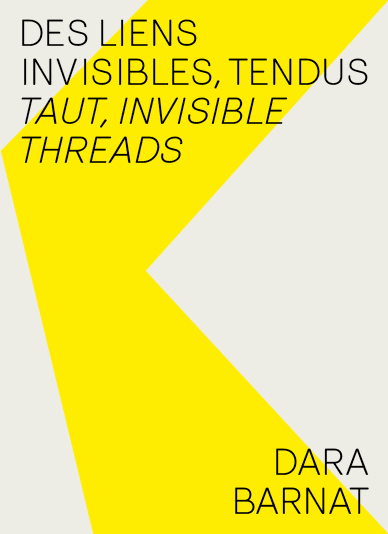
Des liens invisibles, tendus / Taut, Invisible Threads is a bilingual collection of poems by the American poet Dara Barnat, translated to French by Sabine Huynh. Dara Barnat explores migration (between New York, where she was raised, and Tel Aviv, her adopted city), the experience of being an English-language poet in Tel Aviv, intimate familial relationships, her father’s long illness and passing, as well as secrets, history, and memory. Loss is certainly at the core of the poems; although she succeeds in guiding her readers to comfort, even joy, with wisdom she has learned from enduring grief. In the last poem of the book, the speaker addresses her father in the afterlife, and they are both happy to be “alive.” This exhilarating vision demonstrates how Walt Whitman informs the poet’s elegies. She imagines herself walking down the street with Whitman. It is also not surprising to encounter Emily Dickinson or Robert Frost, since the power of Dara Barnat’s poetry resides in its capacity to observe our solitude with grace and honesty.
Dara Barnat was born in 1979. Her poetry appears widely in journals in the United States and Israel. She is the author of the chapbook Headwind Migration (2009), as well as poetry translations and scholarly essays. Dara holds a Ph.D. from the School of Cultural Studies at Tel Aviv University. Her dissertation explored Walt Whitman’s influence on Jewish American poetics. She teaches poetry and creative writing.
Sabine Huynh was born in 1972. She holds a Ph.D. in Linguistics (Hebrew University of Jerusalem), has authored poetry and prose books (novel, short stories, academic book, literary essay, diary), and has edited an anthology of modern French poetry, which were published by Galaade Editions, Voix d’encre, La Porte, éditions publie.net, Recours au poème éditeurs, E-Fractions Editions, among other French publishers. She writes in English and French, translates daily, occasionally teaches creative writing classes, and regularly contributes to the French literary journals Terre à ciel, Terres de femmes, and Recours au poème. Her website: http://www.sabinehuynh.com
Editor’s Note: The opening poem in Dara Barnat’s debut collection begins, “Please know that taut, / invisible threads / tethered us / to those years.” Threads that bind the speaker to mother and home, to father and illness, to time, to what comes into being and what inevitably slips away. And so Des liens invisibles, tendus / Taut, Invisible Threads invites us into a deeply personal yet resonant world of life and death, love and loss, relationship and the human experience.
Nestled within the honest, reflective, beautiful lyric of these poems are the moments poetry was made for: “maybe / we should part now, because oceans / dry up in time, / even the whitest bones / turn to ash.” Equally powerful are so many of the poems’ closing stanzas and end-lines: “daughter, / you will have your own life, / and your own garden, / just pray for rain, and grow your vegetables;” “May we live // a thousand years together / in another life.”
Throughout the book we are welcomed into a private, sacred space. Into kitchens and gardens, hospitals and homelands. We are invited to bake bread and receive intimate moments like sacrament. Crossing the wide span between memory and horizon, Taut, Invisible Threads is like a migrating bird that “fights the seasons, / and lands wherever / there are seeds, / water, and soft earth, // until it arrives.”
I wish that I were well-versed in French and thereby able to comment on the translations by Sabine Huynh housed within this moving bilingual collection. Falling far short of that wish, I can only say that I have had the pleasure of hearing the translator read some of her poetry translations aloud in French, and it was a transformative experience. Her voice is emboldened by its quiet humility, and the passion she has for translation is well-known amongst the numerous writers who seek to have their work translated by this gifted writer and translator.
I have had the pleasure of featuring both Dara Barnat and Sabine Huynh on this series, and am thrilled to see these two incredibly talented writers and translators brought together in one stunning collection. This book—and this collaboration—is a gift to the poetry world that should be read, shared, and celebrated.
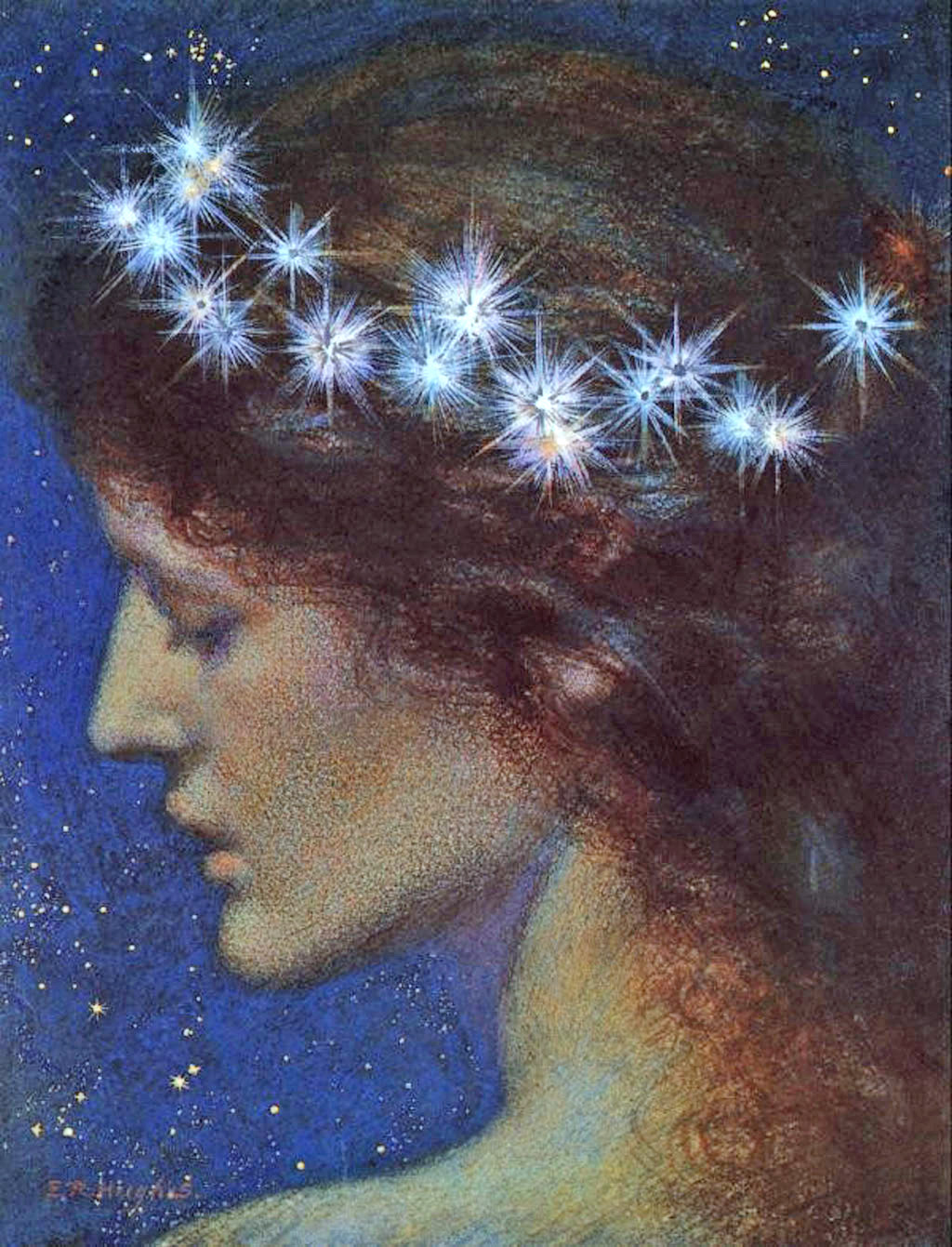
Eternities before the first-born day,
Or ere the first sun fledged his wings of flame,
Calm Night, the everlasting and the same,
A brooding mother over chaos lay.
And whirling suns shall blaze and then decay,
Shall run their fiery courses and then claim
The haven of the darkness whence they came;
Back to Nirvanic peace shall grope their way.
So when my feeble sun of life burns out,
And sounded is the hour for my long sleep,
I shall, full weary of the feverish light,
Welcome the darkness without fear or doubt,
And heavy-lidded, I shall softly creep
Into the quiet bosom of the Night.
(Today’s poem is in the public domain, belongs to the masses, and appears here today accordingly.)
James Weldon Johnson (1871-1938) was an American author, educator, lawyer, diplomat, songwriter, and civil rights activist. In addition to being known for his leadership of the NAACP, Johnson was known during the Harlem Renaissance for his poems, novels, and anthologies collecting both poems and spirituals of black culture. (Annotated biography of James Weldon Johnson courtesy of Wikipedia, with edits.)
Editor’s Note: This Yuletide season I have been thinking—and writing—about ancient holiday traditions that we still practice, and how we received them. So when I came across today’s poem I was struck by the homage it seems to pay to the ancient festival of Mothers’ Night. This winter celebration was held on the eve of Yule, and celebrated The Mothers (goddesses) giving birth to the sun and the new year.
Beyond its title, today’s poem is rich with images of this ancient holiday: the night of labor, the birth of the sun, and the cycle of a year, when “whirling suns shall blaze and then decay.” Yet just as winter is a kind of death, in the second stanza the poet turns “Mother Night” into a metaphor for his own eventual death, imagining that when his time comes he will “Welcome the darkness without fear or doubt” and “softly creep / Into the quiet bosom of the Night.”
From THE GLAD HAND OF GOD POINTS BACKWARDS By Rachel Mennies:
HOW GRANDMOTHER PAID HER PASSAGE TO NEW YORK
One by one her mother sold her silver spoons
and heirloom bracelets; goodbye, porcelain bear,
silk blouses, patent-leather Mary Janes, the scarves
and stud earrings for newly pierced ears, the red wool coat
spotted walking on another tiny body’s shoulders
down Wittenbergplatz. Goodbye, books bound
in leather, bone china, even the hangers, the goblets
and cabinets; goodbye to the Torah buried in the backyard,
the neighbors, the schoolmates, the mothers dressed so well
at services, the men with businesses who stayed behind
one week, two weeks more. What stylish
objects they became: the coins from fillings
and wedding rings, the soap, the wigs, lamp
after lamp to light a thousand decorated homes.
PHILADELPHIA WOMAN
The old sisters spoke with the wild gestures of trapped birds, snared or
cooped, their wings working toward an impossible escape. They stood
on street corners in Germantown and gesticulated the full span of their
arms. They argued over coffee, over books, over the dinner table, food
chilled to the temperature of the air. They hewed their beliefs for the
sake of debate. Soft-handed and pale-skinned, they lived mostly inside.
They took the trolley to Center City when they were in their twenties,
living in Logan with the rest of the refugee Jews. They told wild stories
of their childhoods, never explored or questioned. They worked as
bookkeepers, secretaries. They went to Girls’ High School, classrooms
filled with young women speaking foreign tongues, caught and released,
caught and released each day, back when men and women were kept
separately until marriage, fine china and daily dishware.
The oldest of the three married a soldier (never explored) who loved her
dearly (never questioned). When he died his mouth made words that
opened her chest like shrapnel. Tell them whatever you want, he said, but I need you to know. I need you to know. Her hands stayed slack at her
side. Her name was. It was. She left his bedside and paced a block of Old
York Road, north and south, east and west, as if a cage around her kept
her close.
YAHRZEIT
Here the eye of God opens, unblinking,
at the throats of our grandmothers. The small pale
candle flickers on the windowsill, making
constellations of all our deaths.
How long a wick, how short a year. And here,
the family site, the only real estate
that’s mine—how clever, the way earth
makes us into mud—how heavy
the feet of our commemorators, how white
the knuckles that clasp their books of prayer.
The Glad Hand of God Points Backwards: In her first poetry collection, Rachel Mennies chronicles a young woman’s relationship with a complicated God, crafting a nuanced world that reckons with its past as much as it yearns for a new and different future. These poems celebrate ritual, love, and female sexuality; they bear witness to a dark history, and introduce us to “our God, the / collector of stories / and bodies,” a force somehow responsible for both death and liberation. Here, Mennies examines survival, assimilation, and intermarriage, subjects bound together by complex, if sometimes compromised, ties to the speaker’s Judaism. Through wit and careful prosody, The Glad Hand of God Points Backwards lays bare the struggles and triumphs experienced through a teenage girl’s coming of age, showing the reader what it means to become—and remain—a Jewish woman in America. —TTUP
Rachel Mennies is the author of The Glad Hand of God Points Backwards, winner of the Walt McDonald First-Book Prize in Poetry (Texas Tech University Press, 2014), and the chapbook No Silence in the Fields (Blue Hour Press, 2012). Her poems have appeared in Hayden’s Ferry Review, Poet Lore, The Journal, and elsewhere, and have been reprinted at Poetry Daily. She teaches in the First-Year Writing Program at Carnegie Mellon University.
Editor’s Note:The Glad Hand of God Points Backwards is an absolutely stunning collection. It is that rare breed of poetry book that you cannot help but read cover to cover, knowing all the while that you will return to it again and again. There is magic in this work. Ritual. Tradition. Its stories rise from the page in painstaking detail—vivid, emotive, and all too real. History is both honored and excavated; bones and memories are buried in the backyard. Time is not linear, but fifth dimensional; the past, present, and future unfold more like a snowflake than a line. The soundscape is rich and evocative, the themes resonant and deeply lyric, the entirety layered and striking.
And then there are these moments. These perfect, brilliant, heartbreaking moments. Reveals like the volta in “How Grandmother Paid Her Passage to New York,” when we discover what became of “the men with businesses who stayed behind / one week, two weeks more.” Lines like “When he died his mouth made words that / opened her chest like shrapnel.” Like every freakin’ moment of “Yahrzeit.”
Easy to invest in, the rewards of The Glad Hand of God Points Backwards are “as numerous as the stars in the sky and the sand on the seashore.”
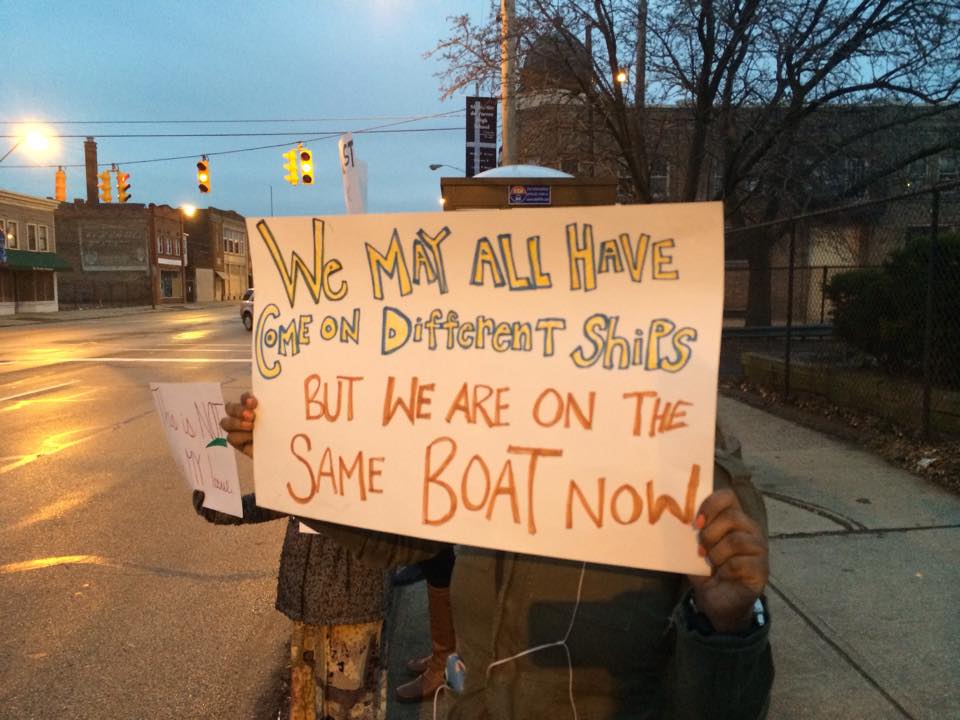
High school students in Cleveland protest for #BlackLivesMatter
We Can’t Breathe
Cleveland high-school students respond to state violence.
An introduction from teacher and project coordinator Sarah Marcus:
I never wanted to be a teacher. It took some weathering to arrive here. Years of resisting the inevitable. Growing up, entitled and drug addicted, I was quite vicious to my own teachers. I couldn’t wait to “get out.” But, at some point, we become aware that people are watching us.
I am impossibly lucky to get to work with students at an urban high school in Cleveland, Ohio. It turns out that their determined spirit is the chant I told my child-self to remember. They remind me every day why our actions matter. They remind me to be patient and to be generous. They remind me why it’s important to stay in a place that is struggling. Because if we leave, who will be there to help advocate?
Black Lives Matter. Reverse racism does not exist. You will not find me saying “All Lives Matter.” The problem isn’t with the words themselves. They make sense, all lives should matter. But the reality on the ground is that they don’t. Not here. Not right now. The evidence is suffocating (literally). Because racism is institutionalized, All Lives Matter is a misguided response to Black Lives Matter. It works to soften the truth, to bury it, to make it more bearable. This is a terrible mistake. We should not be allowed to swallow this injustice. It hurts on purpose. More insidiously, All Lives Matter works to completely negate Black Lives Matter. This is the way we rewrite history. The way we forget on purpose.
As a white, Jewish woman I can’t even begin to pretend to know or relate to what my kids are up against. I speak from a place of privilege. I can only guide them to use their voices. I can only teach them about civil disobedience. I can only encourage them to write and speak, because they matter. They matter so much. My whole heart is filled with gratitude as I stand beside them while they walk through this messy, dangerous world with such dignity and grace.
The following is a collection of creative student responses to the recent extrajudicial killings and the deep-rooted issues that continue to plague our communities.
We mourn for the family of Clevelander Tamir Rice. We mourn for all of the families touched by this abhorrent abuse of power. We won’t hold our breath. We will fill their air with song.
– Sarah Marcus, Cleveland teacher and poet
*
“Premonitions” of Hope
Perspective is one of the most important things you are granted in life. It’s the opinion you have that no one can understand unless they’re you. Being a young black man from inner city Cleveland your perspective is to feel hopeless. Our school system and economical position continuously shows us we aren’t meant to have any self worth. I’ve grown up in a society that feels hopeless. Like their meaning of life is nothing more than what they have been told their whole lives. Rather, it’s on TV, in movies, or in reality that their lives don’t matter. The reason the Mike Brown and Eric Garner cases are so pivotal is because it’s people telling us through the legal system that the worth of black lives isn’t even jail time for a murder. They justify murder through personifications like “he was a hoodlum” or “he disobeyed the law” like asking “why” to a man putting handcuffs on you is reason for murder. They say things like “it’s a black president” to set precedent for inequality, but acting if change is really happening. It’s deeper than a life. It’s a statement. We look at the problem and say “how?” We live in a world where there is almost no black heroes from the streets to comic books, and black men have a murder rate from police that is 6 times higher than whites when we’re 1/3 of the population. It’s been almost 50 years since segregation, yet we protest and profess pain like it’s 1968. It’s 2014, yet we march and fight for our lives to be equal as one that is white. Malcolm X once said, “if you stick a knife in 6 inches and pull it out 3 inches you can’t act like the problem has been resolved.” The problem, the cause, and the solution is that it’s deeper than police brutality, it’s deeper than the wrong decisions. The problem is for 150 plus years, equality between the lives that are black and white seems like fiction. That’s the reason there is so much black crime and the reasons why we feel worthless and hurt, because we’ve been fighting since we were slaves and obviously…… no one hears us.
– DeJuan Rocius Brooks, a human being, also class of 2015
*
I CAN’T BREATHE!!
I can’t breathe…
gasping for air while I’m on my knees,
feeling like I’m dying from a severe disease
YELLING FOR HELP BUT THERE IS NO ONE I SEE!!
Please…
I CAN’T BREATHE!!
It’s killing me, its killing me!
This disease that’s constantly hurting me,
is …
well, …
SOCIETY…
My mother, my father,
my sister, my brother…
Not just “my”…
Why?
Why can’t we all be together?
You see, the world looks out for themselves…
Everyone wants to make it home,
Who would ever want to be alone?
Racism?
Really? Is that still going on?
Is it true the ones they want us to look up to and respect are the very ones who are killing us with their very own gun?
Why? …
Day After Day… WE CRY!!
Because The Ones We Adore…
Unfortunately, Are The Ones We Having To Say Those Words Too…
That “Bye-Bye”
That We Hate To Say
Day After Day,
We Pray..
Hoping There Will Be Unity Across The USA
I said I CAN’T BREATHE!!!
Will You Watch Me Die Or Will You Help Me Change Society?!
– Malik D. Anderson, Class of 2015
*
I Can’t Breathe
I can’t breathe. I can barely gasp for air knowing that my brothers are being killed and have no chance of success. It hurts me deeply to know that my ancestors fought for me and everyone around me to have equality and justice, but years later we are still fighting for life and talking about the same problems. The time changes but the history of it all stays the same, and although history can never be changed, we as leaders of the community have the power to break the cycle so that history does not continue to repeat itself.
Unfortunately, most of the time it takes a person to be affected directly by violence for one to make a change. This is what happened to me. My freshman year of high school, I lost one of my friends to violence; he was shot 3 times in the head. T’John would now be eighteen years old and looking forward to graduation day. Because I went through this hard loss of a friend, I did not want anyone else to feel the pain that I had felt. Losing a life to violence is always hard to deal with, but when a community loses a child, it is a feeling that cannot be explained.
When I heard the news of 12 year old Clevelander Tamir Rice being killed by a police officer, I experienced the same pain that I felt when my friend was killed. I lost another T’John it was as if I knew Tamir. My heart hurts knowing that his family is now going through what I went through; another child whose dreams have been snatched away from him by a bullet.
I can’t understand why so many people are treating the African American race as if we do not belong in this society. I hear too often in my surroundings that its “Us vs. THEM.” I never want to believe that someone is against my life because I am not the same color as them. Karter Zaher said, “We were all human beings until race disconnected us, religion separated us, politics divided us, and wealth classified us.” I am surrounded by tons of people everyday who care deeply about my future and what it should look like; some of these people are not the same race as me, however, that doesn’t change the level of love that they have for me. It seems as if we as a people have forgotten that we are all humans. We were all made in God’s image and likeness of him. The injustices that are going on in Ferguson and Cleveland and New York and across this country are a reflection of this disconnection that we have from our creator. The injustice that has happened to Tamir Rice, Trayvon Martin, Michael Brown, Eric Garner, Ronald Madison, James Brissette, Sean Bell, Oscar Grant, Kimani Gray, Kendric McDade, and countless others is a reflection that there is no dignity left in the value of human life. How many more people need to die for you to take action?
– A’bria Robinson, Class of 2015
*
We Will Breathe
Who is man?
Am I man?
Is my brother man?
Is my father man?
I am man.
I am black
Negro
Colored
I am man.
All African Americans are man.
We are equal to you whites,
To all people.
Characteristics of a man:
Two-handed (check)
Laughs (check)
Weeps (check)
Intelligence beyond that of animals (check).
The black man meets all of these and more.
Speech, reason, power of knowledge, heaven-erected face, inclinations, hopes, fears, aspirations, and prophecies all set the Black man apart from animals.
So, who are you to deny one that is clearly man
FREEDOM?
Of injustice
Of prejudice
Of dignity
Of life
HOW ARE YOU TO DENY THESE BLACK MEN THE RIGHT TO WHAT IS DUTIFULLY THEIRS?
The Negro is a man!
He deserves all rights available to whites.
“Man is distinguished from all other animals, in that he resists as well as adapts himself to his circumstances.”
Anglo-Saxon whites ripped us from our home, but we adapted to this new land.
YOU made us slaves, servants, animals.
YOU forgot – no disregarded – the fact that
Blacks are men.
Man does not take things as he finds them, he adapts, he changes his circumstance
The black man will no longer take this current treatment of life.
BLACK MALES
young
old
are
MEN.
The black man will gain his right to dignity
His right to life
His right to justice
His right to opportunities.
Whites will no longer:
Enslave
Discriminate
Oppress against the African man.
HE is equally a man
WITH
whites.
The Negro is refusing to be read out of the human family.
The BLACK man will be made a FREE MAN!
Whether you are or not willing to let this liberation ensue.
Negroes
Blacks
African Americans
Are men and will be treated as such.
We will be free.
We will be recognized as who we are–
MAN.
–Saiida Bowie-Little, Class of 2015
*
I Can’t Breathe
The violence around the nation has taken a tremendous toll on the people. As I sit and listen to all the pleas, opinions, and declarations I am worried. I don’t understand the theories regarding all the violence that’s going on in Ferguson. All I hear is black and white, and it should not be so. I cannot believe the insight people are going towards. It’s like our morals as people have completely changed. The people see a white man killing another black man. It’s way bigger than that. It’s about one human being killing another. It’s so simple. We don’t love each other anymore. What happened to the respect of life and dignity? There was a boy that I knew in grade school. Sadly, he was shot and lost his life. My friend and I went walking down the street one day, and the pool of blood where he got shot was never cleaned up. They just left it. We no longer look out for one another and look at each other as brothers and sisters. You’re either my enemy or you’re nothing. What kind of logic is that? Race is not the issue anymore; it’s the value of human life. Human lives are being taken for no reason. We’re beating each other and ridiculing each other. Where is the love? We are all called to love each other. Instead of destroying we should be loving. Someone’s life being taken away should be mourned, but the reaction is not receivable. The receivable action is when my brothers and sisters come together. Regardless if they’re black, white, Latino, Muslim or Catholic. We want them to all come together and not fight each other, but fight the injustice of the system.
– Asia Terry, Class of 2015
*
How Dare You
Please don’t ask me.
Please, don’t ask me why I have so much hate in my heart.
Why I’m losing hope in my society.
Look at the people, the children.
Look at how beauty is not in the eye of the beholder,
It’s in society’s hands if you are acceptable.
Look at how we label ourselves and our peers
Calling women bad bitches or guys niggas
Instead of ladies and gentlemen.
Whereas back then that was taken as an insult
That’s become one of the labels we accept to call ourselves.
Being labeled by our skin color and not our intellect or potential
Being labeled as a criminal
Not being able to trust people because you don’t know if they will harm you or stay by your side
“I thought I could trust you” that’s a phrase I haven’t heard, instead it’s “I’ll just fall back” or “I never trusted them in the first place.”
Get shot, raped, or kicked in the face, but you have nobody to blame but yourself.
It’s your fault that you were black while walking down the sidewalk of a white neighborhood.
It’s your fault for looking the way you do they had to search you for weapons that you might have
They don’t shoot to disarm but to kill.
They shoot whoever seems “dangerous”
Do you think they care that you are innocent?
That you aren’t really a threat?
No, they don’t.
That little boy, he had hopes and dreams and wishes.
That young man, he has a family that loves him and just lost a father and brother and husband.
These young men and women had lives that weren’t finished yet.
Lives ended for them, before they even had a chance to make a difference in this hate filled world.
All we have is each other, and sometimes that doesn’t even work
Even we tell each other things need to change, nothing is done.
Instead, we blame each other and hurt each other and worsen the problem.
We can stand up 7 times but fall down 8
I have to worry about if I have a son
If he will be labeled as a thug or juvenile delinquent
Or a daughter
Who will only be identified by her skin color or her body shape
So how dare you,
Ask me
That.
– Ashley Williams, Class 2015
*
I Can’t Breathe
I always hear that it’s a cold world, but does it have to be? We make this world cold by our evil ways. I feel our black community is blinded by the truth of what is really going on. Yes, African American men are being killed, but why is race involved? Does it always have to be? We don’t have to act in violence to get a point across. How many people are going to die to show that violence is never the answer? Nothing is going to improve or change if we keep thinking in rage. We must start thinking with our heads and our hearts. The students at my high school organized a silent protest that affected many people that drove down St. Claire that morning. We didn’t act violently or yell. Our silence, our posters, were just enough to show people that we care. These shootings have not only broken the African American community, but have impacted everyone in some type of way. I have witnessed numerous violent altercations in my life. I had a friend that was trying to disarm someone with a fake gun that was threatening to shoot them. When the cops arrived, my friend had the gun in his hand and the police immediately pulled out their gun ready to shoot. This moment was the scariest moment of them all. I just cried and cried because I felt like there was nothing that I could do to convince them that it was fake. No, my friend didn’t get killed, but the thought of it happening would have crushed me. Our policemen are trained to kill and it’s sad to say. But everyone deserves to live! God wanted us to love each other regardless of color, ethnic group, or where we came from. There is no longer love in this world, because we are all blind to the truth: the truth that we are all brothers and sisters of Christ. It’s time to make a change in history and stop repeating it. Take Cleveland’s Hough riots that happened during the mid 1960s. Blacks still felt unequal to whites and really nothing good came out of it. The majority of African Americans were killed and things didn’t just magically improve. Everything isn’t just going to change all of sudden. We need to stand together and work together to make a change. To want a change!
– Niesha Johnson, Class of 2015
*
Some Neglect, Some Honor & Protect
My perspective was that every police officer promised to serve and protect no matter what, especially in our young black community. Coming from a household where my dad is a Police Officer, I just know that he would do anything to protect his city, and so would every officer he is associated with, who was sworn in on under the same oath that he was. Looking at the world today I see teenagers who look just like me getting killed left and right, but the worst part of it is realizing that our officers are the people doing it. Most people in my community are scared of the police, and they know that there are hundreds of people behind them ready to do whatever it takes to get their point across so that they are heard. That’s what scares me especially after the shooting death of Tamir Rice. My community believes in their mind that EVERY police officer is the enemy. That’s not true! The officer I know would never follow the actions of Officer Darren Wilson or Timothy Loehmann. I know that firsthand, because I’m with my father everyday of my life, and he’s kept the promise to serve and protect since the day I was born, not only to me, but to my mother, his family, and our city. I want to see Officer Wilson and Loehmann indicted more than anything, because I couldn’t imagine someone close to me being gunned down for nothing more than merely being black or looking suspicious. But, a war on police officers is definitely not the answer, because Police Officers will just have another reason to keep killing our young men. Just like innocent teenage African American lives were lost, believe it or not, there are innocent, good, and honest police officers in our community, our city, and our world who have families that love them and kids that love them. I’m not asking anyone to stop fighting for what’s right, I’m asking to keep it peaceful because everyday my dad leaves out for work I never know if that will be the day someone decides a police officer’s family should feel the same way as Mike Brown, Eric Garner, or Tamir Rice’s family has. I know that there are police officers who don’t do what they should I know some police officers neglect, but I’m asking everyone to stop, and realize that some do honor and protect.
Sally Bliumis-Dunn’s poems have appeared in The Academy of American Poets’ Poem-a-day series, Bellevue Literary Review, From the Fishouse, The Paris Review, PBS NewsHour, PLUME, Poetry London, the NYT, Terrain.org, and The Writer’s Almanac, among others. In 2002, she was a finalist for the Nimrod/Hardman Pablo Neruda Prize. Her two books, Talking Underwater and Second Skin, were published by Wind Publications in 2007 and 2009, respectively.
Editor’s Note: Poetic meditations on death are an ancient art. In today’s pieces Sally Bliumis-Dunn contemplates the micro and the macro, “the dead” representing lost individuals and the masses alike. Her poems mirror the Vietnam Memorial of which she writes, etching into the lyrical landscape an act of remembrance and mourning. These poems are beautiful, heartbreaking, and reflect the longing of those left behind: “I want / to be in these tiny silences / that cannot hold their deaths.”
We climb, all legs and hands
clutching for each other’s
eyes that we cannot see.
Before I see you, I have met you.
Clutching for each other’s eyes
& faces, your moon-shape up to my swollen one.
There is Green’s Bayou meeting thick vines,
plastic bags scuttling across the water.
Where I rode up and down the shore, swelling
with solid loneliness, clay and sand repeating.
Click and hum from houselights, grasshoppers rasping on water
the evening when my father was on his way
home, the twitch of his fingers a solid loneliness repeating
as he played piano on top of my fingers.
He picked up my mother’s hand on his way to some place
in the backseat of his car. She climbed out of her house for good.
She watches her shows, I hold onto her fingers
when she says to the television I always wanted to do that,
to a woman climbing out of sequins
dancing across the stage, face drowned out by light.
I always wanted to do this,
to ride my bike beside the wildness, the surge
& the bayou where drowning is so close to surviving
& my mother’s face as she washes the dishes by hand.
Baby, now you are born into this surge, a wild
search of dirt paths and bayous. You are a signal
sent back to the world, the hand
I held in the air, the shadow it made in the dusk
as I held onto the handlebar, a signal to myself
that I can conjure something out of barely.
Shadows and dusk.
Climbing, all my legs, your hands.
“Labour Pantoum” appears here with permission from the poet.
Leslie Contreras Schwartz has an MFA from Warren Wilson College in poetry, and her work has appeared in Pebble Lake Review, Southern Women’s Review, and the anthology Improbable Worlds, an Anthology of Texas and Louisiana Poets, edited by Martha Serpas and published by Mutabilis Press in 2012. She also writes personal essays and fiction. She lives in Houston.
Editor’s Note: There are few poetic forms as subtle and lulling as the pantoum. A skilled hand knows how to manipulate the repetition, creating ripples and echoes as lines reemerge in new contexts. Leslie Contreras Schwartz has just such a hand. Through the mists of the form a story emerges, elliptical and swaying. A story of what was and what was unrequited, “a solid loneliness repeating” in a world where “drowning is so close to surviving.” But also a story of what is and how it came to be. A world where the poet “can conjure something out of barely,” out of “Shadows and dusk.”
In Using My Voice and Social Media Platforms More Effectively (step two)
by Perry Janes
*A version of this originally appeared as a post on the author’s Facebook page. It’s reprinted here with permission.
There are people on my newsfeed with posts and memes that read “Michael Brown is dead because of Michael Brown’s actions.” There are others voicing their support of the NYC police officer who choked and killed Eric Garner. There is literally no word in the English language to express the outrage I feel at these sentiments – at seeing them when I log in to my account – or to unpack the levels of racism and hatefulness implied here. Let’s set aside the fact that an armed, white police officer in a community already rife with racial tensions fired six shots into an unarmed teenager – six shots against an unarmed youth – and, for argument’s sake, let’s set aside any perceived ambiguity about what did or did not happen on that street. Let’s also set aside the fact that Eric Garner said “I can’t breathe” at least 7 times (verifiably, on video) before he died of asphyxiation on the sidewalk, that chokeholds are not approved by the NYC police force, and that Eric Garner did not appear to be an aggressor in this situation.
Instead, let’s talk about the people on Facebook, and in the world, who default to a racist and fearful narrative with or without realizing it, who level sweeping generalizations about how black and minority cultures respond to injustice (the recent riots in Ferguson with the possibility of further unrest now in NYC and across the country) while treating the myriad riots perpetrated by white people (the 2011 Vancouver Stanley Cup riots being one small example, incited over hockey, I might add) with completely different levels of rhetoric and criticism; let’s also acknowledge that you can question and inspect this disparity in these dialogues (and the power structures informing this disparity) without approving actions you may view to be personally destructive.
Let’s talk for a second about how easy it is in too many white communities to unplug from this discussion entirely, to wave it away or disengage, and to disregard how impossible it is for other members of our community and our country to do the same.
Let’s talk, also, about the infrastructures of power and authority that exist in this country, about how these structures have been clearly abused, and what that does to a collective level of trust in the police, in government, in judicial systems; and then let’s talk about how positive and influential it would be if these same policemen and lawyers and authority figures – rather than be defensive of their colleagues – listened to public concerns, and validated them, and stood in solidarity of cultural and professional reform in order to repair this broken trust.
Let’s talk about history, too, about how short a time it’s really been since America was a country with institutionally and governmentally sanctioned policies based on skin color, a country where unsanctioned, regular, and rampant acts of racial violence were overlooked and accepted; about how that history doesn’t erase or vanish in a generation, or two, or ten, and how it persists in a variety of forms (readily seen and unseen) today.
Most of all, let’s talk about how these Facebook posts – that attempt to invalidate criticism or rigorous examination of the events in Ferguson and NYC, as elsewhere – reduce and undermine the ability to hold any conversation at all.
Let’s talk.
Part of talking means sharing. In this spirit, I’d like to share a poem. I’ve not yet had the opportunity to meet Danez Smith – I hope to, we share a handful of wonderful friends and colleagues – but this poem, which you can see him read (masterfully) elsewhere on the web, stopped me absolutely cold the first time I read it. This poem – featured in POETRY Magazine and on poetryfoundation.org following Smith’s recent Ruth Lilly Fellowship – hits about twenty different frequencies at once. And it couldn’t be any more relevant to the conversations taking place today.
So, to the people on Facebook making these posts: my first impulse – my desire – is to delete you from my network. It is hard to imagine us belonging to the same community. But the truth is: you’re also the ones I want to read this, to stop at some point – any point – during your day and think about the historical, personal, and political frequencies that fuel your denial of the voices expressing hurt and anger in the world around you. To acknowledge and engage with these voices means, ultimately, practicing empathy. To delete you from my network would only make it is easier for you not to take in outside voices, or not to engage with them. So this is me throwing a bottle into the endless Facebook breach – filled with voices of all kinds, some of which give me great hope and others that inspire nothing but sadness – and hoping for the best.
Melissa’s poetry, fiction, essays, reviews, and articles have appeared in dozens of journals and anthologies, including Boulevard, Connecticut Review, Pleiades, and Poets & Writers. In addition to writing, Melissa serves as editorial advisor for The Criterion and a host for Tiferet Talkradio. She received her MFA from Sarah Lawrence college and is a professor for the Lone Star College System and a teaching artist for The Rooster Moans Poetry Cooperative.
***
Okla Elliott: Your work engages with politics and philosophy without ever becoming pedantic or didactic. What role does poetry play in these larger cultural matters? (And feel free to answer either for yourself personally or for the culture at large or both.)
Melissa Studdard: Thanks for the compliment, Okla. So many of the things I’ve avoided in order to have time to make poetry, it turns out, are the things that make poetry. I tend towards solitude, meditation, and quiet communion with the keyboard. Like many poets, I often feel compelled to cloister myself in cave of words—and though that cave may be where the breath of poetry originates, it is not where the body of poetry moves. The body of poetry wants to kneel in the temple, protest in the streets, ramble through open-air markets, dance in clubs, and serve lunch at soup kitchens.
Even the most private-seeming poems are not truly private, but, rather, bottled messages sent from the island of self to the world. They say, “I’m here! I understand you.”
Because I enjoy writing so much, I used to think it was a self-indulgent waste of time. I thought there were more important contributions I could make. But all it takes is hearing an elegy recited at one funeral to know that poetry matters. It only takes one inaugural poem to see that poetry works a magic plain language cannot. Poetry lights the world on fire, whether in lament of a broken heart or in calling voters to the booth. It enacts an enchantment that touches the deepest place of care in us and lingers. It opens people to awareness and concern, without telling them to care. So—the more engaged culture and politics are with poetry, and the more engaged poetry is with culture and politics, the better.
OE: Since we know each other and each other’s work due to being friends on Facebook, and given that so many publishers and publicists are fixated on social media these days, I wonder if you have some thoughts about the good and the bad that the online literary community has brought about in the past decade or so. How has it helped independent publishers and authors? What have we lost because of it?
MS: In short, we’ve lost a little depth and gained a lot of breadth. There’s so much more of everything, but it’s harder to sort through and engage with in a deeply sustained way. Our attention is pulled in many directions at the same time. The good news is we now have access to information, people, organizations, works, and platforms that we did not have access to before. This is terrific, especially, for people who would not have been able to make these connections otherwise. I’ve learned about authors I probably would not have discovered any other way. In this sense, social media is a fantastic vehicle for small-budget publicity, which is, of course, a boon to indie publishers and authors.
However, the expectations set by online publicity are spreading some writers too thin. So much is demanded of authors that it’s hard for many to find time to write. We’re to be cheerleaders for our own work, yet for many of us, promotion does not come naturally, nor is it how we want to spend our time. I spoke above about poetry’s essential place within culture at large, but I am a firm believer in balance—and writers do need time in the cave—to simply be, observe, and reflect.
Driving back from the bank today, I noticed a thin strip of clouds in the pink sky, and I felt hungry for that sky and those clouds—not a picture of the sky, not a sky meme with an inspirational quote, not a YouTube video of drifting clouds. I was hungry to plop down in the grass and watch real clouds for hours, as I did when I was a kid. Much of life has become virtual, and I wonder how that will impact language and imagery in the long run. This does feel like a loss.
As well, many of us look to others regarding matters for which we should be looking inside. For a while, I was waking up and rolling over to my phone to text, email, and instant message before I even got out of bed. I’ve had to remind myself to write in my journal and meditate and look at the clouds and walk in nature. I’ve had to remind myself to write down my dreams and connect to my subconscious mind before connecting to the Internet. Lately, I’m trying to write in my journal, meditate, or read an actual, physical book last thing before bed and first thing in the morning. I feel so much more at peace.
Yet, despite the fact that I feel we need to remember to call on our internal resources first, I do believe the online literary community has fostered an amazing kinship among writers. I’ve made great friends through social media, as I know you and many other have. Writing can be a lonely occupation. It’s easy to feel isolated. Through the Internet, we can connect with others at all times of the day or night. And that can be an extraordinarily beautiful thing.
OE: Okay, now for the obligatory process question. How do poems happen in Melissa Studdard’s world? How do you revise? Do you research for your poems or just gather data organically and let it filter into the work as it will?
MS: I think I must mate with a different muse for each poem. It seems every poem is born from a new process. Some are hard-wrought, and others spring onto the page nearly fully formed in a matter of minutes. What I do know is that the poems that come easily ride in the wake of the poems that did not come easily. After struggling with a poem for weeks, I can be almost certain that within days of finishing it, one or more poems will flow quickly after. I don’t mind struggling with difficult poems to get to easy ones, either. The only thing that breaks my heart is not writing at all.
There is one pattern I sometimes repeat though, and which I love, and that is starting a poem in my journal and then carrying it to the computer once I see it’s really headed somewhere. Starting in the journal feels less formal and allows for a sort of raw expression I cannot quite achieve at the computer. The fluid movement of my hand across the page elicits an organic, intimate utterance that can later be sculpted through the facility of editing, revising and moving passages on the screen. Without both the keyboard and the pen as very different sorts of tools working together, I feel that many of my poems would have been different.
The research question is an interesting one. I follow my passions in life—reading about and engaging in the things that interest me. In that sense, my “research” is organic. However, if I am writing about something and need more information, I will seek it out—sometimes going back and forth between composition and research, and sometimes waiting until the first draft is done.
***
Creation Myth
So there God lay, with her legs splayed,
birthing this screaming world
from her red velvet cleft, her thighs
cut holy with love
for all things, both big and small,
that crept from her womb like an army
of ants on a sugar-coated thoroughfare.
It wasn’t just pebbles and boulders
and patches of sky, but the soul of sunlight,
the spirit of moon. She bore litters
of stars that glistened like puppies,
purring galaxies
robed in celestial fur, and galactic
clusters dusted with the scent of infinity.
It was her moment of victory:
the unveiling of seven billion milky breasts,
and she glowed—like a woman
in love with her own making, infatuated
with all corners of the blemished universe,
smitten with every imperfect thing:
splotchy, red-faced & wailing—
flawless in her omniscient eyes.
***
I Ate the Cosmos for Breakfast
—after Thich Nhat Hanh
It looked like a pancake,
but it was creation flattened out—
the fist of God on a head of wheat,
milk, the unborn child of an unsuspecting
chicken—all beaten to batter
and drizzled into a pan.
I brewed some tea and closed my eyes
while I ate the sun, the air, the rain,
photosynthesis on a plate.
I ate the time it took that chicken
to bear and lay her egg
and the energy a cow takes
to lactate a cup of milk.
I thought of the farmers, the truck drivers,
the grocers, the people
who made the bag that stored the wheat,
and my labor over the stove seemed short,
and the pancake tasted good,
and I was thankful.
***
When You Do That
It feels like millions of tiny
harps are playing inside my body
and all the extinct animals
that ever were
are again
running into you
inside me
their hooves and claws
burning on the unexpected
asphalt
their tongues alive
with the ministry of light