Poetry: August 2025

Sarah Angstadt: “Counterproductive Side Effects”

Luis Cuauhtemoc Berriozabal: “Hearing Aid”

Sue Blaustein: “Serving Orders at Brother’s Foods”

John Brantingham: “The Greening of Creatures”

J.D. Isip: “Triceratops”

Paul Jones: “Two Flamingoes at Pea Island Reserve”

Samuel Prestridge: “My Father, Hailing from Ignorant Hill, Texas…”

Diana Rosen: “NEWS ITEM: Westside Pavilion to be UCLA Biomedical Research Center”

Poetry: July 2025

M.J. Arcangelini: “A List of Lessons”

Susan Cossette: “Bad Marguerite”

Joseph Geskey: “STEM As Part of A Flower”

Justin Karcher: “In Buffalo, Our Dads Come Back From the Dead to Watch the Big Game With Us”

Robert S. King: “Behind Some Photographs”

Tim Peeler: “Before the Storm, the Hawks”

Agnes Vojta: “Refuge”

Jennifer Worrell: “Behind the Lines”

Poetry: June 2025

James Benger: “Entrance”

Barbara Daniels: “White Horses”

Cal Freeman: “Always”

Mari Kitina: “Only the Rice Cries”

Michael Lauchlan: “Trout”

Richard Levine: “For Want of Care”

Dudley Stone: “Turbulence”

Meredith Wattle: “Erie Goliath”

Ann Weil: “Living Through”

Poetry: May 2025

Jean Biegun: “On Call”

Karina Castrillo: “I never wanted you to be like us”

John Grey: “Photographs”

Geoffrey Heptonstall: “Floating”

Andrea Horowitz: “Behind Midnight’s Curtain I Recompose Your Birth”

Leonard Kress: “A Night at the Opera”

Laurie Kuntz: “Sooner or Later”

Leigh Parsons: “Still Frozen”

Matthew Pritt: “Joseph F. Seaborn, 1898-1956, Mary B. Seaborn, 1906-“

William Taylor Jr.: “Poem for the New Year”

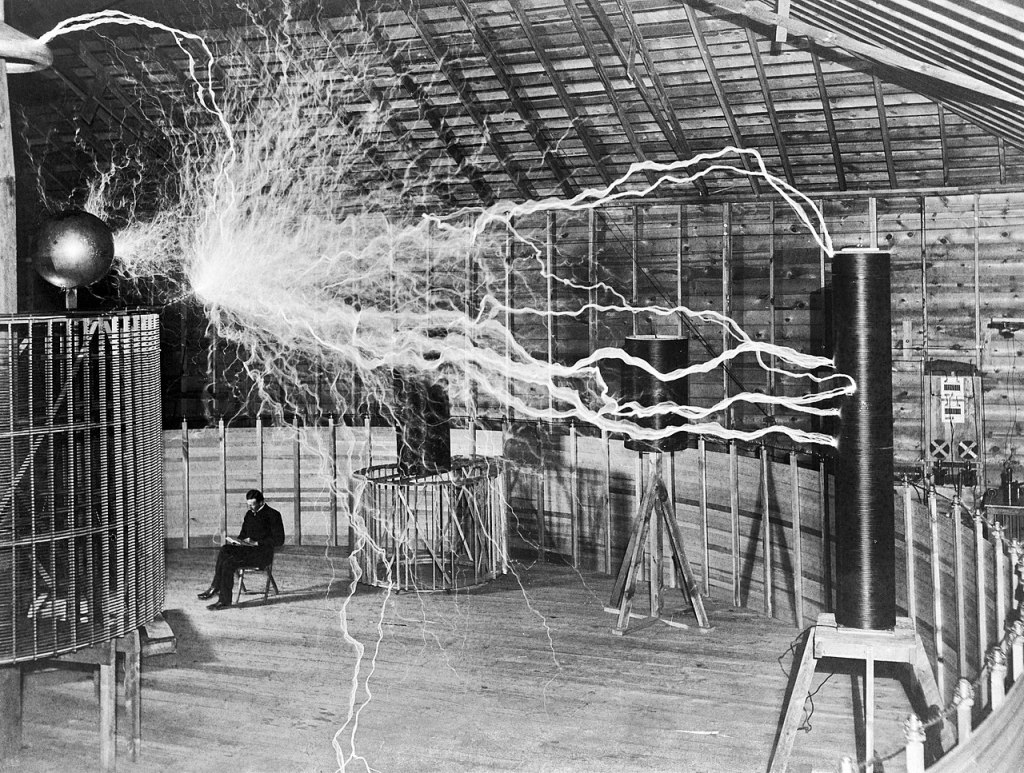
Susan Cossette: “Wardenclyffe”


Wardenclyffe
The present is theirs. The future, for which I really worked, is mine.
-Nicola Tesla
 
Is what I imagined tangible—
this motor, powered by fireflies,
streamer arc threads of phosphorescent light
discharging from the center coil.
 
I go from idea to reality,
a star among the stars.
I do not think there is any thrill
like the inventor seeing a creation come to success,
the exhilarating sense of the future.
 
Sometimes we feel so lonely.
Someday we will know who we really are.

 
If my current can travel distances,
my work is immortal—
resurrecting my vision, broadcasting to Mars.
 
Thought is electrical energy.
Why can’t we photograph it?
The primary circuits of us all,
high-speed alternators—
many colors, myriad frequencies.
 
Sometimes we feel so lonely.
Someday we will know who we really are.

 
My tower dream ran out of funds—
demolished to scrap,
the property sold to the highest bidder.
 
I live on credit at the Waldorf,
along with spark-excited ghosts.
My only friends are pigeons in Bryant Park—
My favorite is a female.
As long as she lives,
There is light in my life.
 
Sometimes we feel so lonely.
Someday we will know who we really are.

About the Author: Susan Cossette lives and writes in Minneapolis, Minnesota. The Author of Peggy Sue Messed Up, she is a recipient of the University of Connecticut’s Wallace Stevens Poetry Prize. A two-time Pushcart Prize nominee, her work has appeared or is forthcoming in Rust and Moth, The New York Quarterly, ONE ART, As it Ought to Be, Anti-Heroin Chic, The Amethyst Review, Crow & Cross Keys, Loch Raven Review, and in the anthologies Fast Fallen Women (Woodhall Press) and Tuesdays at Curley’s (Yuganta Press).

Image Credit: “Tesla sits with his “magnifying transmitter” in Colorado Springs in 1899″ Image courtesy of Wikipedia. CC BY 4.0

Connie Woodring: “And Then There was Death”

And Then There was Death

The last time I spoke to my husband was a Saturday night before bed.
We hugged and gave each other a smooch on the lips.
My husband put his hands on my shoulders and said,
“Now tomorrow morning we will go to Trower’s for sure!”
Several Sundays were missed because of bad weather.
He drove to Trower’s, a twenty-minute drive, because his cigarette brand was not sold in any of our local stores.
We used to go to Trower’s for breakfast, but that was before my husband became more depressed and weaker due to cancer, and vascular disease.
He began to withdraw from society, except for Trower’s.
He had given up his life-long hobbies making reproductions of Kentucky and Pennsylvania muzzle loaders and playing the banjo. He no longer practiced Buddhism.
On several occasions he said he wanted to die but didn’t want me left “flapping in the wind.”
I didn’t know how to respond to that, so I was always silent, just holding his hand.
If I would have assured him I would be okay,
would that be like giving him permission to kill himself?
If I said I wouldn’t be okay, that would put an extra burden on him.

What had we been through in the last two or more years because of his illnesses?
Endless doctor appointments, Cat-scans, bloodwork, X-rays, radiation treatment, stent surgery.
Bad reactions to several antidepressants.
Falling, requiring a hospital stay which revealed nothing.
Physical therapy to gain strength.
He didn’t become strong.
He became weaker, falling several more times.
On one occasion, he fell against the bedroom door, and I could barely get the door open
to lift him onto the bed.
I wouldn’t allow him to smoke in the house, only in his room.
I had uncontrolled asthma.
He didn’t resent this decision except on very cold winter days when his open ventilating window made the room unbearable.
But at least he smoked his half a cigarette very quickly: a half a cigarette every hour.
We had many disagreements about his smoking,
but since he had been smoking for more than 60 years,
the thought of him quitting was out of the question for him.
“The damage is done, I’m 80 so how many years do I have left anyway? I have to have one pleasure.”
I would rant and rave about the insanity of lethal corporations and government regulations that outlawed heroin and weed, but not cigarettes. My only coping mechanism.
“Well, it’s your choice to smoke, but at least I don’t have to enable your addiction by going with you to Trower’s.”
I eventually went with him, but I didn’t drive,
rationalizing that at least I wasn’t a total enabler.

On that last evening I ever saw my husband alive, I resigned myself to drive him in the morning to get his cigarettes rather than having him die in a car crash.
His decreased depth perception and slowed reflex problems didn’t bode well for a successful trip.
“Goodnight, sweetheart.” “Me, too.”
When he wasn’t out of bed by 6:30 am, I knocked on his door.
Since there was no reassuring answer that he was awake, I opened the door.
His head was sticking out of the covers.
I touched his cold head. I moved his head. There was no response.
I kissed him on the forehead and said, “I’ll always love you.”
I walked out to the living room to call 911.

“This is it!” I said to myself, as I ambivalently welcomed death into my house.

About the Author:  Connie Woodring is a 79-year-old retired psychotherapist who has been getting back to her true love of writing after 45 years in her real job. She has had many poems published in over 40 journals including one nominated for the 2017 Pushcart Prize. She has had ten excerpts from her novel Visiting Hours, published in various journals. She has had five excerpts from her non-fiction book, What Power? Which People? Reflections on Power Abuse and Empowerment, published in various journals. Her memoir was published in White Wall Review.
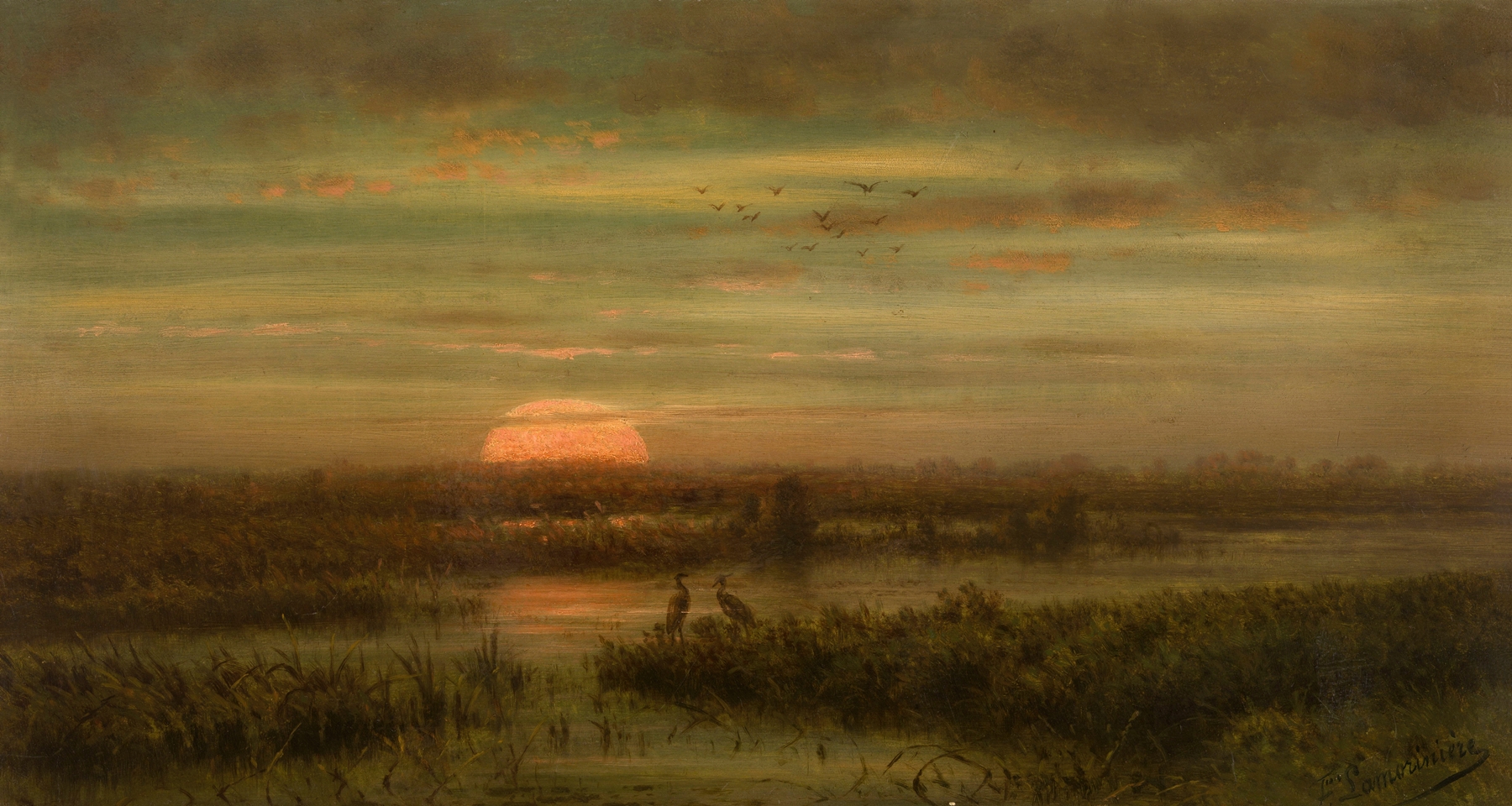
Image Credit: Jean Pierre François LamorinièreLandscape with Herons at Sunset” Public domain image courtesy of Artvee

AIOTB’s Nominees for Next Year’s Pushcart Prize

As It Ought To Be is proud to announce our nominees for next year’s Pushcart Prize:

.

John Dorsey: “On the Prospect of Dying in December”

James Croal Jackson: “Poppy”

Savannah Lauren: “If I ever have a daughter”

Royal Rhodes: “The Other Genesis”

Sandra Rivers-Gill: “A Distant Hymn”

Agnes Vojta: “The Pope Coffin”

.

Congratulations to our nominees and thank you to all our writers and readers for your continued support!

Agnes Vojta: “The Pope Coffin”

The Pope Coffin

I do not know whether dad
believed in heaven.
He had a sense for the sacred.
Sometimes all you see is the fruit;
the root remains secret.

My father never discussed death,
except to say he wanted a coffin
like Pope John Paul II: clear
lines, no frivolous embellishments –
an architect’s choice.

The minister spoke about the city-to-come,
solemn and hopeful, consoling
without the saccharine promises
dad would have hated. One must leave
space for uncertainty.

About the Author: Agnes Vojta grew up in Germany and now lives in Rolla, Missouri where she teaches physics at Missouri S&T and hikes the Ozarks. She is the author of Porous Land, The Eden of Perhaps, and A Coracle for Dreams, all published by Spartan Press. Most recently, she has been collaborating with eight other poets on the book Wild Muse: Ozarks Nature Poetry (Cornerpost Press, 2022.) Her poems have appeared in a variety of magazines; you can read some of them on her website agnesvojta.com.

Image Credit: Jules-Edmond-Charles Lachaise “Design for a ceiling with trompe l’oeil balustrade and sky” Public domain image courtesy of Artvee

Year in Review: Our 50 Most Popular Posts of 2022

As the Managing Editor of As It Ought To Be Magazine, I want to thank all of our contributors and our readers. 2022 was a great year for poetry and I am grateful for everyone who shared their work with AIOTB. Here’s to another bumper crop of poetry, reviews, and nonfiction in 2023!

.

-Chase Dimock

Managing Editor

As It Ought To Be Magazine

.

.

POETRY

.

Hannah Bagley

-Stay A Spell

.

Jason Baldinger

– i remember the royal river

– temporal, temporary, and gone

.

Ruth Bavetta

– Stargazers

– A Year Turned Upside Down

.

Jon Bennett

– Winter Apples

.

Rose Mary Boehm

– Sirocco

.

Ace Boggess

– End of the Fence

– Psychic Day

.

John Brantingham

– Joan Miro’s Portrait of Vincent Nubiola

.

Rick Christiansen

– Anarchists in the Kitchen

.

Susan Cossette

– The Persistence of Memory

.

John Dorsey

– Five Erasure Poems

– The History of Rivers

– Paul & the Trailer Park Tornado

.

Joanne Durham

– Homage to Angelica

.

Ryan Quinn Flanagan

– She Says Her Cat is in Love with Javier Bardem

.

Tony Gloeggler

– For Mom

.

Nathan Graziano

– Stuck Inside the Supermarket with the Beautiful Blues Again

.

Bill Griffin

– Prescribed Burn

.

Ruth Hoberman

– Planaria

– Make Way for Ducklings

.

Mike James

– Quotations

.

Marc Janssen

– The Wooden Cross

.

Beth Kanell

– Do the Next Right Thing

.

Diane Kendig

– Searching for the Rosetta Stone

.

Richard Levine

– Playing at Forever

.

Cord Moreski

– Space Shuffle

.

Christian Paulisich

– Whale Watching

.

Marissa Perez

– Shark Smile

.

Meg Pokrass

– On My Road

.

Cheryl A. Rice

– Ashtray

– Infrequent Flyer

.

Damian Rucci

– Here’s Looking at You Kid

.

Leslie M. Rupracht

– The Night I Lost My Souvenir Bucket Hat

.

Jason Ryberg

– Passion Puzzles and Puzzle Boxes

.

Alex Z. Salinas

– Overboard

.

Anna Saunders

– A New Skin

.

Carolyn Sperry

– Updates from Sour Lake

.

William Taylor Jr.

– Little Windows and the People Behind

.

Tiffany Troy

– Wedding-bound Million-Dollar Dream

– A Thank You Card

.

K. Andrew Turner

– Monsters

.

Victoria Twomey

– The Healing Properties of Tony B

.

Agnes Vojta

– I don’t usually dream

.

Laura Grace Weldon

– Butternut Ridge Cemetery

.

Julia Wendell

– Owl

.

Robin Wright

– Make-believe

.

REVIEWS

Mike James 

– Howie Good’s Path of Most Resistance 

– A Review of James Dickey: A Literary Life

AIOTB Magazine’s Nominees for the 2023 Best of the Net Anthology

As It Ought To Be Magazine is proud to announce our nominees for the 2023 Best of the Net Anthology, published by Sundress Publications.

Rocío Iglesias: “The Human Body is a Nightmare”

Joe Mills: “The Scientist After the Operation”

Cord Moreski: “Space Shuffle”

Marissa Perez: “Shark Smile”

Cheryl A. Rice: “Remember the Goldfish Will Be Dead By Morning”

Anna Saunders: “A New Skin”

Congratulations to our nominees, and thank you to everyone who contributed to AIOTB Magazine this year!

-Chase Dimock
Managing Editor