Wardenclyffe
The present is theirs. The future, for which I really worked, is mine.
-Nicola Tesla

Is what I imagined tangible—
this motor, powered by fireflies,
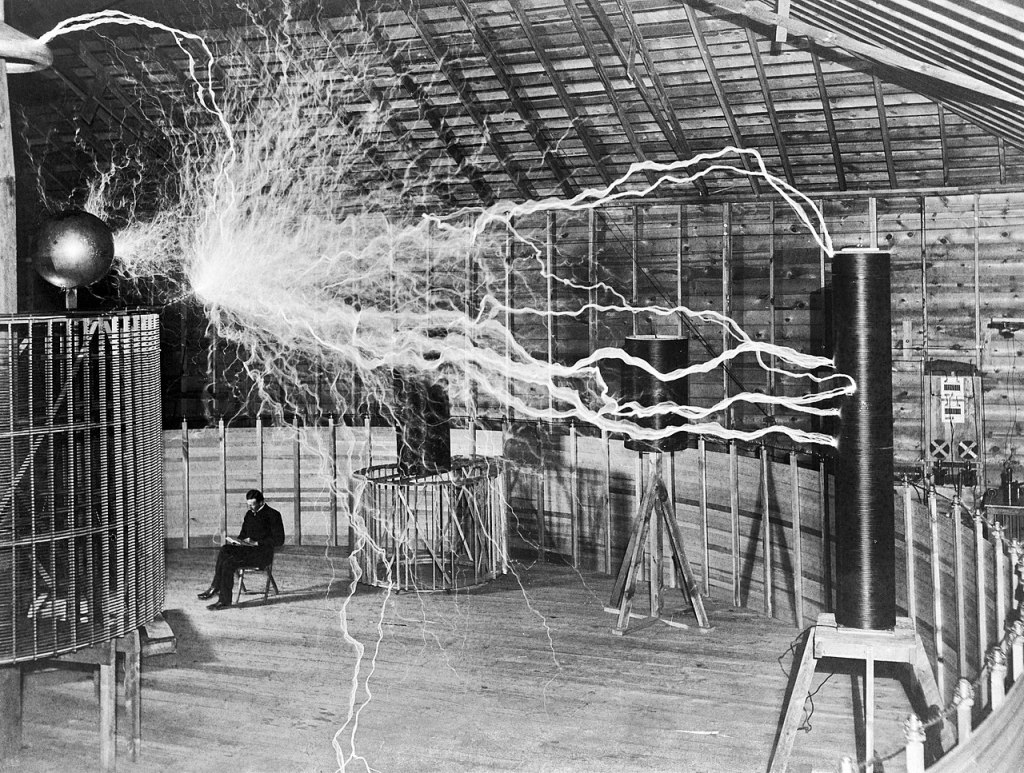
streamer arc threads of phosphorescent light
discharging from the center coil.

I go from idea to reality,
a star among the stars.
I do not think there is any thrill
like the inventor seeing a creation come to success,
the exhilarating sense of the future.

Sometimes we feel so lonely.
Someday we will know who we really are.

If my current can travel distances,
my work is immortal—
resurrecting my vision, broadcasting to Mars.

Thought is electrical energy.
Why can’t we photograph it?
The primary circuits of us all,
high-speed alternators—
many colors, myriad frequencies.

Sometimes we feel so lonely.
Someday we will know who we really are.

My tower dream ran out of funds—
demolished to scrap,
the property sold to the highest bidder.

I live on credit at the Waldorf,
along with spark-excited ghosts.
My only friends are pigeons in Bryant Park—
My favorite is a female.
As long as she lives,
There is light in my life.

Sometimes we feel so lonely.
Someday we will know who we really are.
About the Author: Susan Cossette lives and writes in Minneapolis, Minnesota. The Author of Peggy Sue Messed Up, she is a recipient of the University of Connecticut’s Wallace Stevens Poetry Prize. A two-time Pushcart Prize nominee, her work has appeared or is forthcoming in Rust and Moth, The New York Quarterly, ONE ART, As it Ought to Be, Anti-Heroin Chic, The Amethyst Review, Crow & Cross Keys, Loch Raven Review, and in the anthologies Fast Fallen Women (Woodhall Press) and Tuesdays at Curley’s (Yuganta Press).
Image Credit: “Tesla sits with his “magnifying transmitter” in Colorado Springs in 1899″ Image courtesy of Wikipedia. CC BY 4.0
The last time I spoke to my husband was a Saturday night before bed. We hugged and gave each other a smooch on the lips. My husband put his hands on my shoulders and said, “Now tomorrow morning we will go to Trower’s for sure!” Several Sundays were missed because of bad weather. He drove to Trower’s, a twenty-minute drive, because his cigarette brand was not sold in any of our local stores. We used to go to Trower’s for breakfast, but that was before my husband became more depressed and weaker due to cancer, and vascular disease. He began to withdraw from society, except for Trower’s. He had given up his life-long hobbies making reproductions of Kentucky and Pennsylvania muzzle loaders and playing the banjo. He no longer practiced Buddhism. On several occasions he said he wanted to die but didn’t want me left “flapping in the wind.” I didn’t know how to respond to that, so I was always silent, just holding his hand. If I would have assured him I would be okay, would that be like giving him permission to kill himself? If I said I wouldn’t be okay, that would put an extra burden on him.
What had we been through in the last two or more years because of his illnesses? Endless doctor appointments, Cat-scans, bloodwork, X-rays, radiation treatment, stent surgery. Bad reactions to several antidepressants. Falling, requiring a hospital stay which revealed nothing. Physical therapy to gain strength. He didn’t become strong. He became weaker, falling several more times. On one occasion, he fell against the bedroom door, and I could barely get the door open to lift him onto the bed. I wouldn’t allow him to smoke in the house, only in his room. I had uncontrolled asthma. He didn’t resent this decision except on very cold winter days when his open ventilating window made the room unbearable. But at least he smoked his half a cigarette very quickly: a half a cigarette every hour. We had many disagreements about his smoking, but since he had been smoking for more than 60 years, the thought of him quitting was out of the question for him. “The damage is done, I’m 80 so how many years do I have left anyway? I have to have one pleasure.” I would rant and rave about the insanity of lethal corporations and government regulations that outlawed heroin and weed, but not cigarettes. My only coping mechanism. “Well, it’s your choice to smoke, but at least I don’t have to enable your addiction by going with you to Trower’s.” I eventually went with him, but I didn’t drive, rationalizing that at least I wasn’t a total enabler.
On that last evening I ever saw my husband alive, I resigned myself to drive him in the morning to get his cigarettes rather than having him die in a car crash. His decreased depth perception and slowed reflex problems didn’t bode well for a successful trip. “Goodnight, sweetheart.” “Me, too.” When he wasn’t out of bed by 6:30 am, I knocked on his door. Since there was no reassuring answer that he was awake, I opened the door. His head was sticking out of the covers. I touched his cold head. I moved his head. There was no response. I kissed him on the forehead and said, “I’ll always love you.” I walked out to the living room to call 911.
“This is it!” I said to myself, as I ambivalently welcomed death into my house.
About the Author: Connie Woodring is a 79-year-old retired psychotherapist who has been getting back to her true love of writing after 45 years in her real job. She has had many poems published in over 40 journals including one nominated for the 2017 Pushcart Prize. She has had ten excerpts from her novel Visiting Hours, published in various journals. She has had five excerpts from her non-fiction book, What Power? Which People? Reflections on Power Abuse and Empowerment, published in various journals. Her memoir was published in White Wall Review.
The Pope Coffin

I do not know whether dad
believed in heaven.
He had a sense for the sacred.
Sometimes all you see is the fruit;
the root remains secret.

My father never discussed death,
except to say he wanted a coffin
like Pope John Paul II: clear
lines, no frivolous embellishments –
an architect’s choice.

The minister spoke about the city-to-come,
solemn and hopeful, consoling
without the saccharine promises
dad would have hated. One must leave
space for uncertainty.
About the Author: Agnes Vojta grew up in Germany and now lives in Rolla, Missouri where she teaches physics at Missouri S&T and hikes the Ozarks. She is the author of Porous Land, The Eden of Perhaps, and A Coracle for Dreams, all published by Spartan Press. Most recently, she has been collaborating with eight other poets on the book Wild Muse: Ozarks Nature Poetry (Cornerpost Press, 2022.) Her poems have appeared in a variety of magazines; you can read some of them on her website agnesvojta.com.
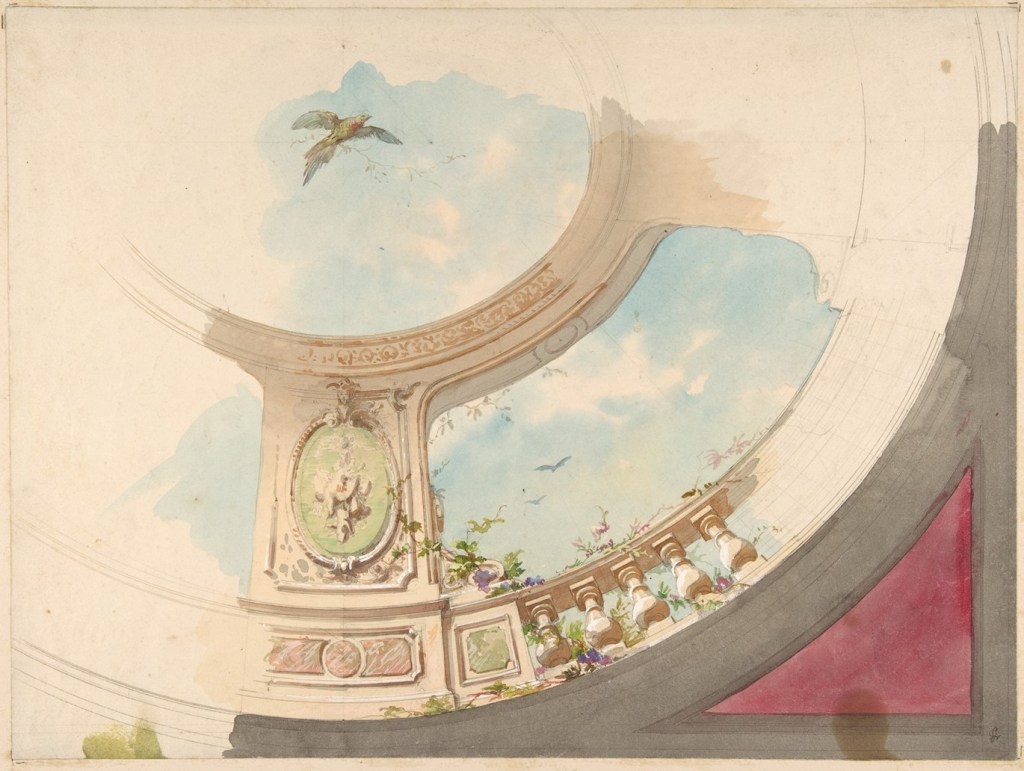
Image Credit: Jules-Edmond-Charles Lachaise “Design for a ceiling with trompe l’oeil balustrade and sky” Public domain image courtesy of Artvee
As the Managing Editor of As It Ought To Be Magazine, I want to thank all of our contributors and our readers. 2022 was a great year for poetry and I am grateful for everyone who shared their work with AIOTB. Here’s to another bumper crop of poetry, reviews, and nonfiction in 2023!
With his trademark spare and exact style, John Dorsey’s latest book of poetry guides us through a carnival of characters that stretches across the country in space, and deep into his decades on the road. What sets Dorsey apart from the other geographers of trailer parks, small town diners, and dollar stores is the balanced empathy of his writing. There isn’t anything sensationalized or exploited. What he reports may shock, but his work never relies on shock value or gratuitously gruesome description to strike its blow. The power of his work is in his ability to make his readers empathize with the marginalized and grotesque without straying into the cheap pathos of pity.
In a poem about a man who lost part of his nose to cancer, Dorsey concludes in the final stanza:
but he’s not pretty enough for heaven
or the silver screen
& not ugly enough
to hide his face
& let some lonesome dirt road
forget he was ever there
This liminal space between beauty and ugliness, between heaven and hell, is where Dorsey’s redneck carnival is located. Beauty is always tempered by the constraints of the environment in which it lives, and what gets written off as ugly is infused with humanity, glowing with careful understanding. At this carnival, the “prettiest girl in town,” “pours drinks/ &becomes a wingless canary/ singing for tips/ in a cage filled with smoke.” Later, Dorsey’s poem for his grandmother similarly envelops us with smoke, describing her with the following:
I never remember you looking young
shaky hands lighting one cigarette
off the other
black rings under your eyes
but your smile was magic
talking about tv preachers
by their first names
as if they really did care
about your salvation
Cigarette smoke is the before and after: beauty destined to shrivel in its environment and the unsinkable beauty deep within an already withered face. As you thumb through Dorsey’s poems, the question is always, who is living in the before and who is living in the after? Who is the young and beautiful destined for pain and age, and who is the weathered soul whose beauty still flickers from inside a battle scarred body?
Take his short “Trailer Park Song, 1982” for example:
my brother
angry
red faced
screaming
& beautiful.
Brief, simple, yet unexpected. Dorsey hands us the unanticipated connection of anger and beauty without a treatise on their causal relationship. In another poem, “Love Letter for Jana Horn”:
the mailbox is full of postcards
from hipster boys
&aging dreamers
who just want
to be swallowed whole
by a desert rose
The young who are destined to become old, and the old who cling to what makes us young in spirit all desire to be consumed by beauty. In Dorsey’s poetry, beauty is as much an aspiration as it is a physical state. Physical beauty is fated to fade, which in of itself is beautiful, but the aspiration toward beauty is what remains after flesh fails.
The only time Dorsey is explicit in labeling true ugliness, is ironically, when he describes a young woman asking “for donations/ for a baby beauty pageant”:
$10 here
$5 there
for a twirl
at the baton
of immortality

sometimes there
is nothing uglier
than
hope.
It’s here where Dorsey draws somewhat of a line where his appreciation of the aspiration toward beauty stops. There is an inherent ugliness in these pageants that exploit the bodies of young people and inculcates in them a belief that beauty should be subject to the judgment of others. Yet, even in his distaste for the pageant, Dorsey isn’t judgmental of the young woman asking for donations. She has bought into the ugly side of hope when our culture commodifies our aspirations to be beautiful. The same is implied in the earlier poem about his grandmother and the TV preachers who pretend to care about her salvation. It’s not the women having hope that is ugly, but instead, the ugliness is in the cynical hope sold to them by institutions that promise what they won’t deliver.
Dorsey never patronizes his subjects by lapsing from empathy to condescension. Sympathy can often be a temporary license we give ourselves to gawk at someone’s misery. While Dorsey doesn’t shy away from presenting the sad circumstances of someone’s life, he also never infringes on their agency by flattening them into one-dimensional victims. Even the aforementioned cancer survivor:
says we are all ravenous locusts
at the same overcrowded trough
as he explains his theories on women
We can only imagine what these “theories” might be, or what he might be expressing with the locusts comment. What is sure is that these complicating aspects of the man’s personality play against any impulse to use his cancer as a thin premise for sympathy. He is not the perfect victim, just a human whose cancer is part of his story.
Dorsey’s poems are all honest reports on the damage we all live with, and whether this damage is a circumstance of birth or self-inflicted, the damage is inextricable from our stories. For example, Dorsey bluntly spells this out in his poem “Young Man”:
david
i’m not saying
you were no good
just rotten on the inside
like a bag of sour apples
who left us too young.
Dorsey does not fear pinpointing the rot inside this young man, but also avoids any kind of judgment on him or blame on anyone else. It is taboo to speak ill of the dead, but our culture’s fear of this taboo often leads us to invent a fictitious version of the dead that paints them as blameless and brightsides their darkness. This is more of a dishonor than providing an accurate record of the life they led because it erases all their choices and every mark they made, good or bad. It doesn’t remember the dead; it forgets them immediately and entirely.
This leads me back to what I refer to as John Dorsey’s balanced empathy. Empathy doesn’t mean excusing or ignoring the faults and failings of an individual, but understanding the trauma residing in someone’s scars, including the self-inflicted. Dorsey’s balanced empathy calls attention to the ugliness of the sour apples rotting in all of us, but in just a few words, he makes the pain of carrying this rot momentarily beautiful.
.
Sundown at the Redneck Carnival is available via Spartan Press
About the Reviewer: Chase Dimock is the Managing Editor of As It Ought To Be Magazine. His debut book of poetry, Sentinel Species, was published in 2020.
hotter than the rangers intended, judgment of flame on vine & brier, jellied gas vengeance tears sapling chokehold: it’s time, past time, juices boil and crack and twenty feet up long needles scorch a black shroud but wait until spring, green crown emerging from char, heartwood alive, and at each tree’s feet an oblation of nourishing ash;
forgive me for the tangle of all our years: it’s time, past time, thorns twisted between us, my fear of hot words, flamed feelings, my fear of burning ignoring litter and scrub prone to flare with a spark and now how high might the fury rise? but wait, some lively shoot has still struggled up from the core: thank you for feeding it, thanks for the strength of your own sweet heartwood, but most of all thank you for the match.
.
.
About the Author: Bill Griffin is a naturalist who lives in rural North Carolina. His poetry has appeared in NC Literary Review, Tar River Poetry, Southern Poetry Review and elsewhere. His ecopoetry collection, Snake Den Ridge, a Bestiary (March Street Press 2008), is set in the Great Smoky Mountains. Bill features Southern poets, nature photography, and microessays at this blog: http://Griffin.Poetry.com.
.
ImageCredit: Carol M. Highsmith “Remnants of a previous forest fire in Yellowstone National Park, in the northwest corner of the western state of Wyoming” (2015) The Library of Congress (Public Domain)
So you never went back to the time you left yourself on the tall grass beneath the dull black night
where you counted stars and satellites; you listened as the planets hummed.
Because you had forgotten that like this, even the pull of earth couldn’t move you.
Because you were still tv static and telephone wires, barking dogs and the trembling streetlight,
you decided if life should exist out there, it would be made of light and air, color and sound.
When you blinked and lost your body, the sky flashed, you named the moons trapped in each planet’s gravity
and you only looked back once to find her there– body on the tall grass, not terrestrial, but full of stars
.
.
About the Author: Emily Martin is a writer from New York City. She holds a B.A. in English Literature and Creative Writing from Hunter College and is currently working towards an M.A. in Media Studies.
this café is contrary
a strange anomaly in a land of diners
walls paper brick with watercolor mustangs
one calendar, two posters of the hulk
one hulk decal on the cooler
I wonder about the calendar to quality ratio
an equation mastered in blue highways
then wonder how many hulk posters equal a calendar
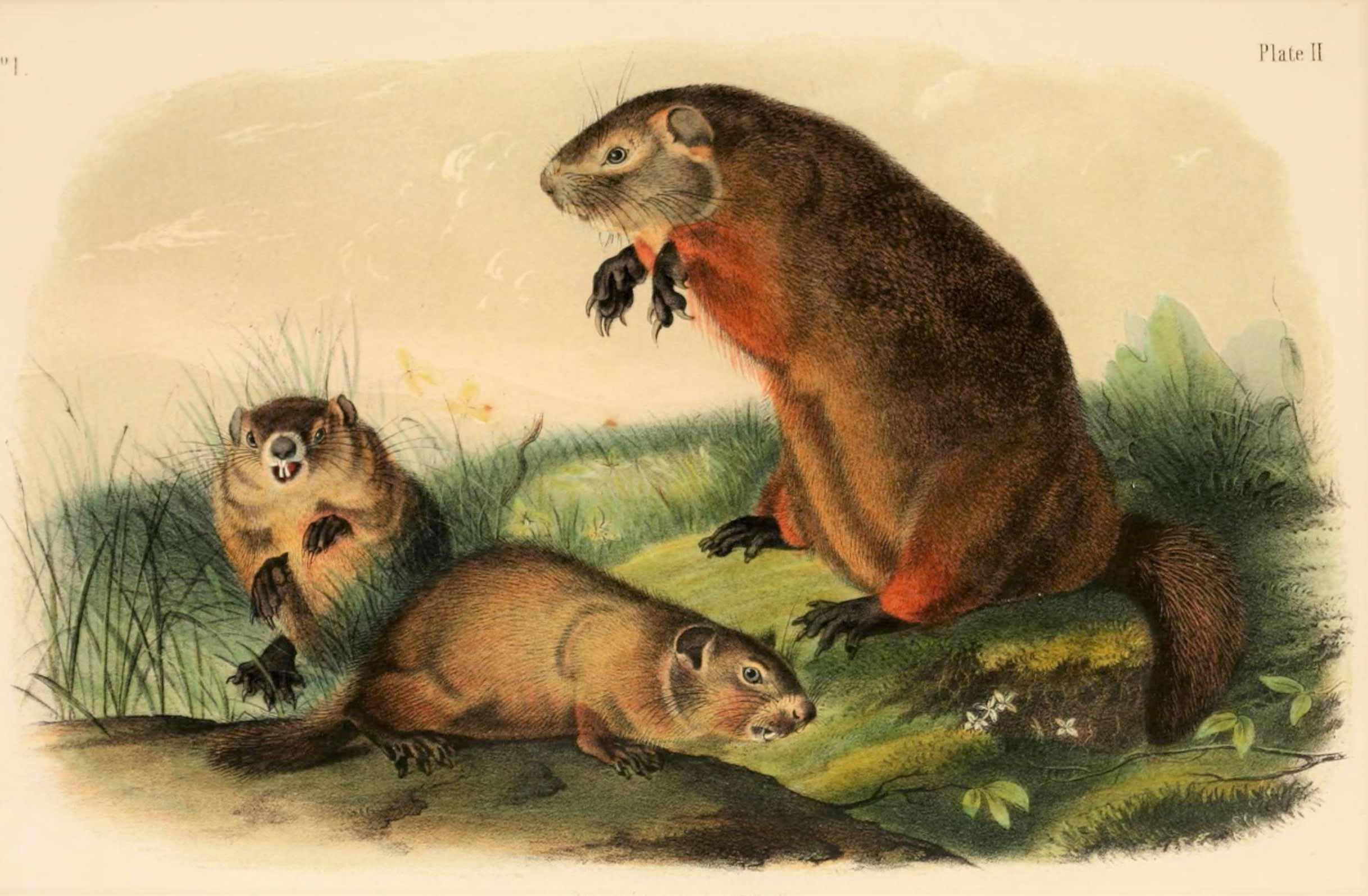
the waitress says her son raises groundhogs
I don’t know what to say
maybe she’s fucking with me
I look deep in the hulk’s eyes this year he has forty-two groundhogs
I say, that sure is a lot of groundhogs
bessemer tunnels and carbon snow
a few towns away
my mother’s family settled in the 1850’s
dropping the A and E
dropping the family crest
marrying into a family with a township named after them
a yellow sign juts from the snow in surrender I miss the america I grew up in
I want to believe this is a statement
on a widening gap in equality
on the erosion of class
on the working persons giving everything away
on the ways we allow government to fail
in not mandating social responsibility
instead, it’s another absurd conservative screed
about the good old days that never were
times when people went to church
family values happened and abortions didn’t
the stop signs have addendums
one says stop touching me
another stop, hump me
the last stop and dance
these winter messages so conflicted
I hunt frozen snakes along the kiskiminetas
here in the bleak of february
I fill myself with enough gray
to crush the restlessness that grows each snow
punxsutawney
ten hours after the groundhog
he saw his shadow
so did this town
there is no evidence this civilization
still tries to understand weather
through the eyes of animals
.
.
About the Author: Jason Baldinger is from Pittsburgh and looks forward to roaming the country writing poems again. His newest books are A Threadbare Universe (Kung Fu Treachery Press) and The Afterlife is a Hangover (Stubborn Mule Press). A History of Backroads Misplaced: Selected Poems 2010- 2020 (Kung Fu Treachery) is forthcoming later this year. His work has been published widely across print journals and online. You can hear him read his work on Bandcamp and on lp’s by The Gotobeds and Theremonster.





 As It Ought To Be
