Ace Boggess “Rock Garden”


Rock Garden

Stacked in awkward symmetry, 
fenced to keep the lot in place
like cattle. Grays, browns, 
opalescent pearls—monolith to pebble, 
they ride backs of one another
like children at play in the schoolyard mud.
Not even faded orange of a cigarette butt
has landed on this isle to blight it.
Old earth reclaimed by eminent domain:
what the city loses, we regain.


About the Author: Ace Boggess is author of five books of poetry—MisadventureI Have Lost the Art of Dreaming It SoUltra Deep Field, The Prisoners, and The Beautiful Girl Whose Wish Was Not Fulfilled—and the novels States of Mercy and A Song Without a Melody. His writing has appeared in Harvard Review, Notre Dame Review, Mid-American Review, Rattle, River Styx, and many other journals. He received a fellowship from the West Virginia Commission on the Arts and spent five years in a West Virginia prison. He lives in Charleston, West Virginia. His sixth collection, Escape Envy, is forthcoming from Brick Road Poetry Press in 2021.


More By Ace Boggess:

“And Why Am I a Free Man?”

“Why Did You Try to Sober Up?”

“Are Your Emotions More Or Less Intense?”


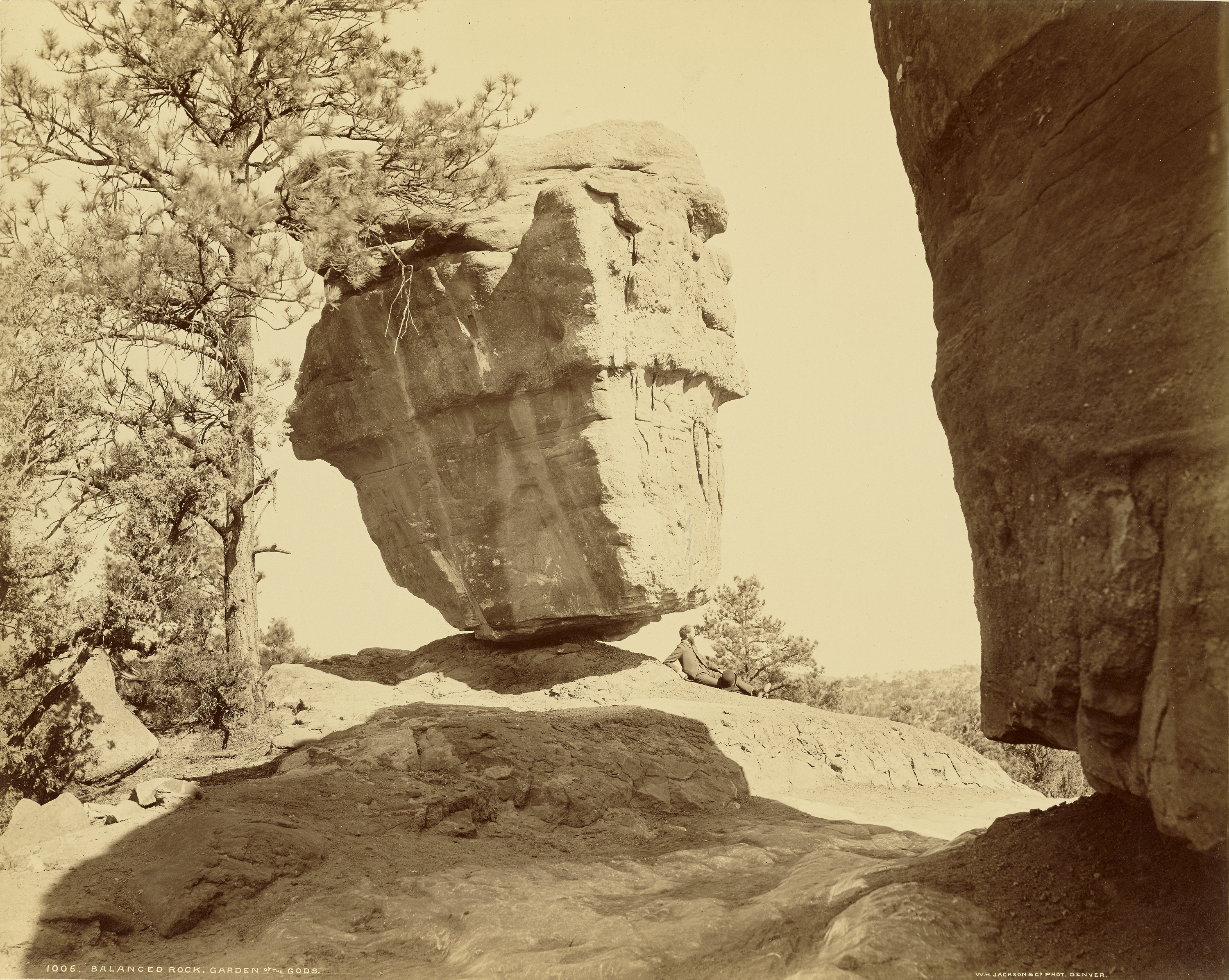
Image Credit: William Henry Jackson “Balanced Rock, Garden of the Gods” (1880) Digital image courtesy of the Getty’s Open Content Program.
Jason Baldinger: “another monochrome day”


another monochrome day

at the dog leg light
with the ghost
house, memories
of prohibition era
bathtub gin leaking
fumes into an ever
darkening sky

pillsbury sign
skirmish of endless rain
noise spills out of
the horoscope lounge
another soulful strut
drunk takes wings
glides past george aiken’s
while corner horns
street lights blow
along to a four beat

the coffee shop
clings to a revolving
door of hangovers
it seems every soul
is wider this morning

saucers of the moon
lost in the iris
of this old neighborhood
song, I swear
I’m breathing again
fingers tap on steering
wheel, light blinks green
hand spun turns
chooglin’
another split atom
another monochrome day


About the Author: Jason Baldinger is a poet from Pittsburgh, Pennsylvania.  He was recently a Writer in Residence at Osage Arts Community, and is founder and co-director of The Bridge Series. He has multiple books available including the soon to be released The Better Angels of our Nature (Kung Fu Treachery) and the split books The Ugly Side of the Lake with John Dorsey (Night Ballet Press) as well as Little Fires Hiding with James Benger (Kung Fu Treachery Press). His work has been published widely in print journals and online. You can listen to him read his work on Bandcamp on lps by the bands Theremonster and The Gotobeds.


More by Jason Baldinger:

“I forgot the earth and heaven”

“When Cancer Come to Evansville, Indiana”

“blind into leaving”


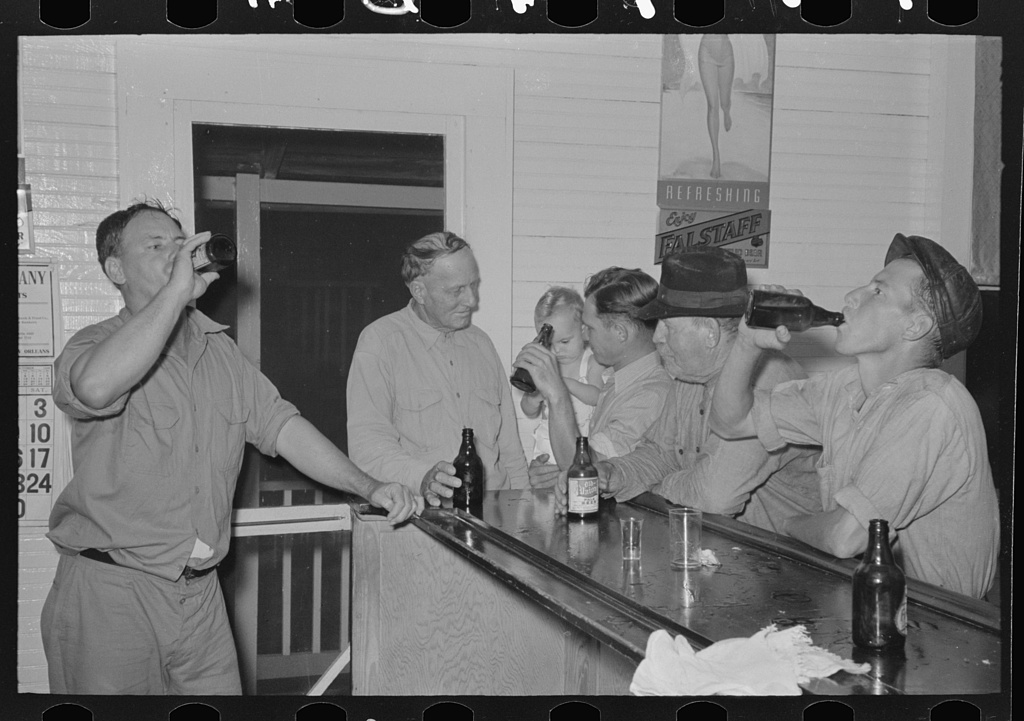
Photo Credit: Russell Lee “Drinking at the bar in Pilottown, Louisiana” (1938) The Library of Congress

Jenny Bates: “Patience not Panic”


Patience not Panic

Grandfather on the farm in Michigan
was a dowser, he’d raise his willow rods
their pendulum swing and shudder
always found water.
Back and forth, twisting down toward
underground flow.
Patience not panic, he’d say as his
body shivered with water witching.

I’d watch him suspend power 
in quivering air like the

           soothing trill of grey tree frogs
           at morning pond
           the rustle of wild turkey
           leaves a call to prayer

I’d watch the rods bend with grace like the

          prowl of feline
          shares a ritual hour
          vibrates stones and sometimes,
          the moon
          vain and vacillating as opal or rose
          a reservoir of temples and ditches
          lit by tapers,
          extinguished altar candles

I’d drink the cold stream cupped in hands like
they were a chalice of divination.


About the Author: Jenny Bates is a poet from the foothills of North Carolina. A member of Winston-Salem Writers, NC Poetry Society, NC Writers Network. She has two published books, Opening Doors: an equilog of poetry about Donkeys (Lulu Publishing, Raleigh, NC); and Coyote with Coffee, a single poem fine craft volume (Catbird on the Yadkin Press, Tobaccoville, NC). Her work has been published in Flying South, Wild Goose Poetry Review, and Old Mountain Press, and Hermit Feathers Review. She is a consecutive contributing poet in Poetry in Plain Sight and in 2017 she was a top 10 Finalist in the Press 53 Single Poem Contest. Jenny’s poetry has appeared in laJoie 2017- 2019a quarterly publication of Animals’ Peace Garden, dedicated to promoting appreciation for all beings. In 2019 her poem “Fame Looks Both Ways” was included in the Walt Whitman Bicentennial Celebration for publication in Poets to Come.  Her new book, Visitations has been published 2019 by (Hermit Feathers Press). Jenny currently volunteers as animal whisperer and helping hand at Plum Granny Farm. An organic local farm in Stokes County, North Carolina.


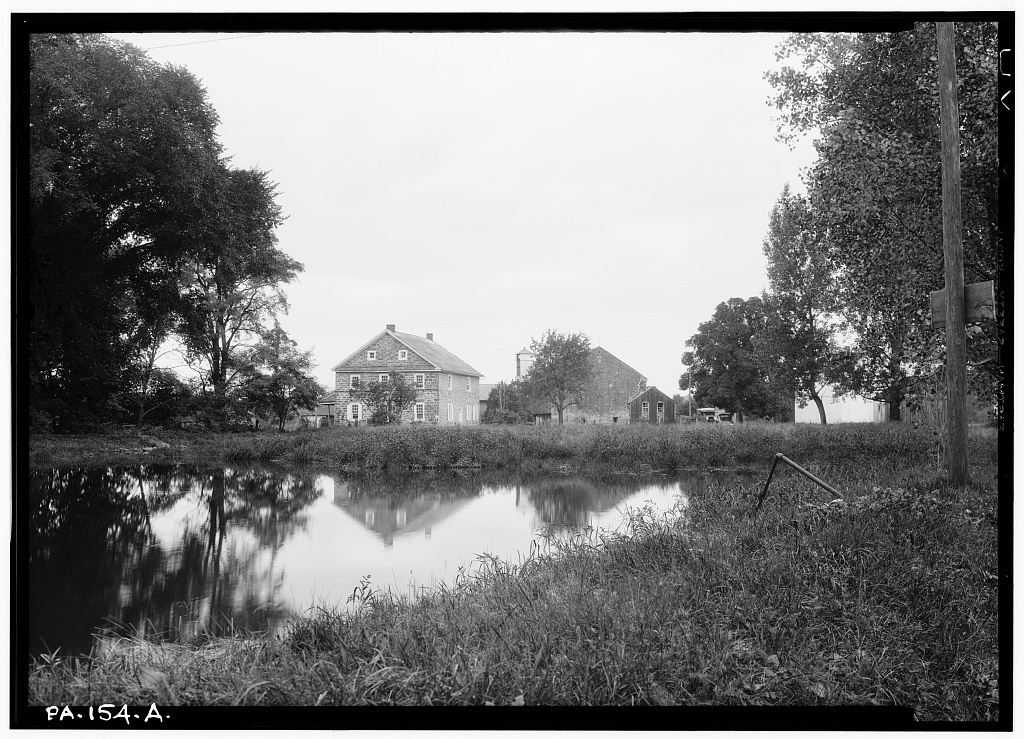
Image Credit:  Historic American Buildings Survey, Stanley P. Mixon, Photographer September 11, 1940 EXTERIOR VIEW OF FARMHOUSE & BARN STONE GROUP, SEEN ACROSS MILL POND. – Farm Group & Mill Pond, Cocalico, Lancaster County, PA. The Library of Congress

R.T. Castleberry: “July, Roadhouse Dinner”


JULY, ROADHOUSE DINNER

No leg level, no 2 chairs bent alike,
café tables bear an Aztec mosaic top.
Blue neon of a “Family Service” sign 
blocks the windows view.
After early over-service,
office clerks stumble to SUV and sedan.
High chatter of children at their coloring
clip a drinking mother’s flirtation.
Plastic menu pages flap to flutter open.
Date night dinner decisions split
between barbecue and buffalo wings,
Jamaican beer, California merlot.
I top Bacardi dark with Mexican soda,
offer an excuse no one wants,
no one expects to hear.
A rockabilly band rumbles
at a Junior Parker melody,
chords fat as a freight train.
Phone cameras flash, texting screens 
vivid as a predator’s smile.
A table of wits withers the air.

The band breaks.
I take a bottle from the car,
leave my watch in its bag,
find a bench on the smoker’s patio. 
The skin of the sky is a wind of ocher sand,
the fracture of stars beyond, behind
the desert’s slivered moon.
There are county-wide flames to the west.
With a shift in direction,
fire breaks at the highway line won’t hold.
Ocatillo rattle against wrought iron posts.
Through the talk, no one is listening.


About the Author: R.T. Castleberry is a widely published poet and critic. His work has appeared in Roanoke Review, Trajectory, Blue Collar Review, White Wall Review, The Alembic and Visitant. Internationally, Castleberry’s work has been published in Canada, Wales, Ireland, Scotland, New Zealand and Antarctica. Mr. Castleberry’s work has been featured in the anthologies, Travois-An Anthology of Texas Poetry, The Weight of Addition, Anthem: A Tribute to Leonard Cohen and You Can Hear the Ocean: An Anthology of Classic and Current Poetry.


More By R.T. Castleberry:

Down Cold Lanes


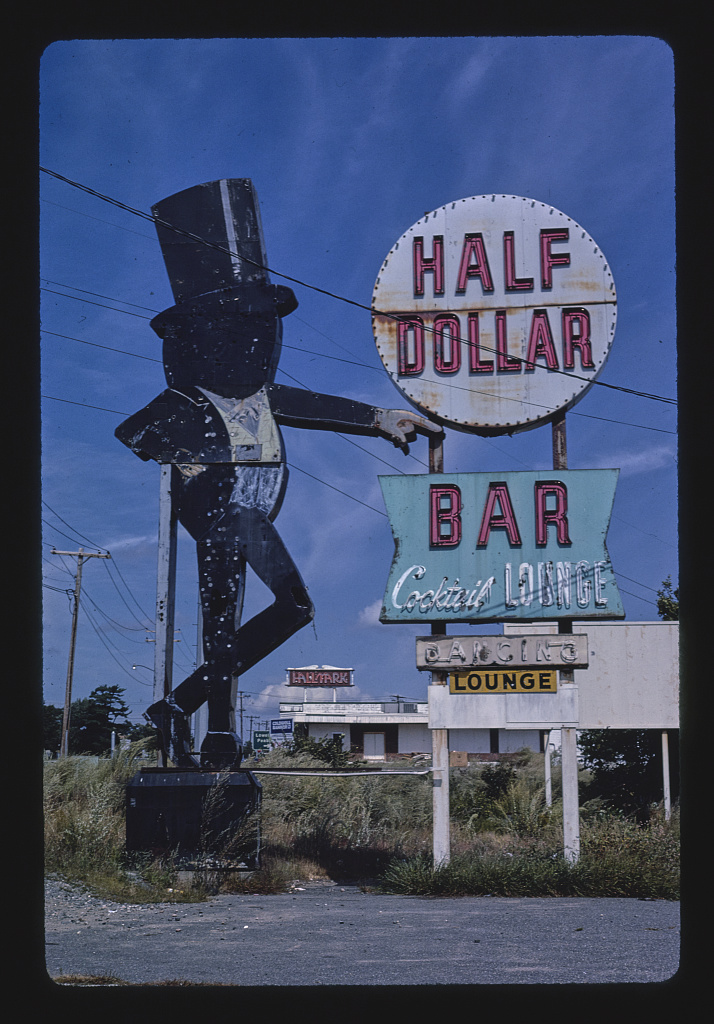
Image Credit: John Margolies “Mr. Peanut sign, (Half Dollar Bar sign), Route 1, Peabody, Massachusetts” Courtesy of the John Margolies Roadside America photograph archive (1972-2008), Library of Congress, Prints and Photographs Division.


M.J. Arcangelini: “Ten Movies”


TEN MOVIES
   (after Tim Dlugos)


Niagara (1953)

Marilyn sings along, breathlessly, with a record.
Can’t remember why she married Joseph Cotton.
Jean Peters studies the way she moves.


The Ten Commandments (1956)

Everything pales before the parting of the Red Sea,
its walls collapsing onto Pharaoh’s charioteers.
Piety and the wisdom of masculine flesh.


Cries and Whispers (1972)

Sisters gather for the death of the spinster.
The nursemaid gives the dying woman her breast.
The husbands are oblivious.


Barb Wire (1996)

Pamela playing Bogie playing Rick
in a gender role bending dystopia.
“Don’t call me babe.”


Island of Lost Souls (1932)

Family values moralist encounters mad
scientist who only wants to be left alone.
We may not all be men after all.


The Cooler (2003)

Limping schlub falls in love with waitress
in the casino where they both work.
Everyone gets just what they deserve.


The Monolith Monsters (1957)

Space crystals multiply, grow gigantic,
collapse onto buildings, turn people to stone.
Just add water.


The Conversation (1974)

Somebody is listening to everything.
Gene Hackman playing saxophone in
the twilit apartment he’s just torn apart.


Quintet (1979)

Everybody’s breath is visible.
Dogs eat corpses in a frozen city.
Paul Newman’s ice blue eyes.


The Letter (1940)

Bette being a bad girl on a rubber plantation
while subjugated natives huddle in huts
waiting for the white men to kill each other.


About the Author: M.J. (Michael Joseph) Arcangelini was born 1952 in western Pennsylvania, grew up there & in Cleveland, Ohio.  He’s resided in northern California since 1979. He began writing poetry at age 11. His work has been published in magazines, online journals, over a dozen anthologies, & four books: “With Fingers at the Tips of My Words” 2002, Beautiful Dreamer Press; the chapbooks “Room Enough” 2016, and “Waiting for the Wind to Rise” 2018, both from NightBallet Press; & “What the Night Keeps” 2019, Stubborn Mule Press. In 2018 he was nominated for a Pushcart Prize.


More by M.J. Arcangelini:

A Few Random Thoughts


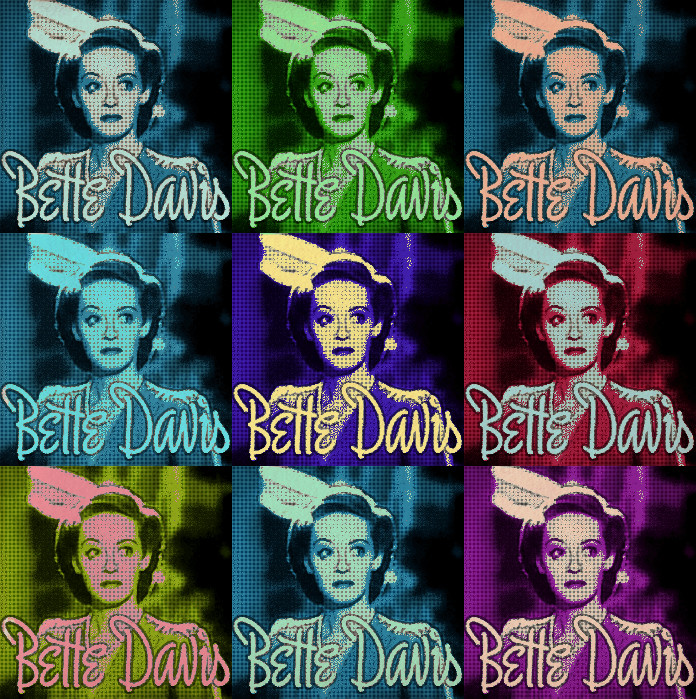
Image Credit: Public Domain still from “The Letter” turned into digital art.

Thomas M. McDade: “Christo’s Bridge”


Christo’s Bridge

The bookstalls have opened
A woman, a copy of Catherine Deneuve
Holds a paper that will find an apartment
Christo’s work on the Pont Neuf is progressing
Imagine a bridge wearing a jacket
He wants to strip away detail 
With his fabric, reveal basic form
The guide on the boat tour
Describes sites in French
A young American translates
A worker sandblasts graffiti on a quoi
A group of children, observe Christo’s art
People waiting at a bus stop gaze 
At us perhaps with envy or disdain
The Concorde Bridge built
Of stones from the Bastille
Is where the boat turns
No mention of the strike
By the bargemen 
Their crafts decorated with mums
And geraniums who are blocking
The Seine over
Christo’s shenanigans
Homeless beneath the Louis Philippe
Sit on sleeping bags and smoke
A couple of them fish with long pipes
One is reading a book
Others wave weakly
Some passengers might wish
The artist would bag them too
I can’t see Catherine Deneuve
Or her lookalike concurring
I hope the latter has found an address
We pass a film barge
The marquee is blank
So much for coincidence


About the Author: Thomas M. McDade is a 74-year-old resident of Fredericksburg, VA, previously CT & RI. He is a graduate of Fairfield University, Fairfield, CT. McDade is twice a U.S. Navy Veteran serving ashore at the Fleet Anti-Air Warfare Training Center, Virginia Beach, VA and at sea aboard the USS Mullinnix (DD-944) and USS Miller (DE / FF 1091).


More By Thomas M. McDade:

Puff of Eternal Hot Air


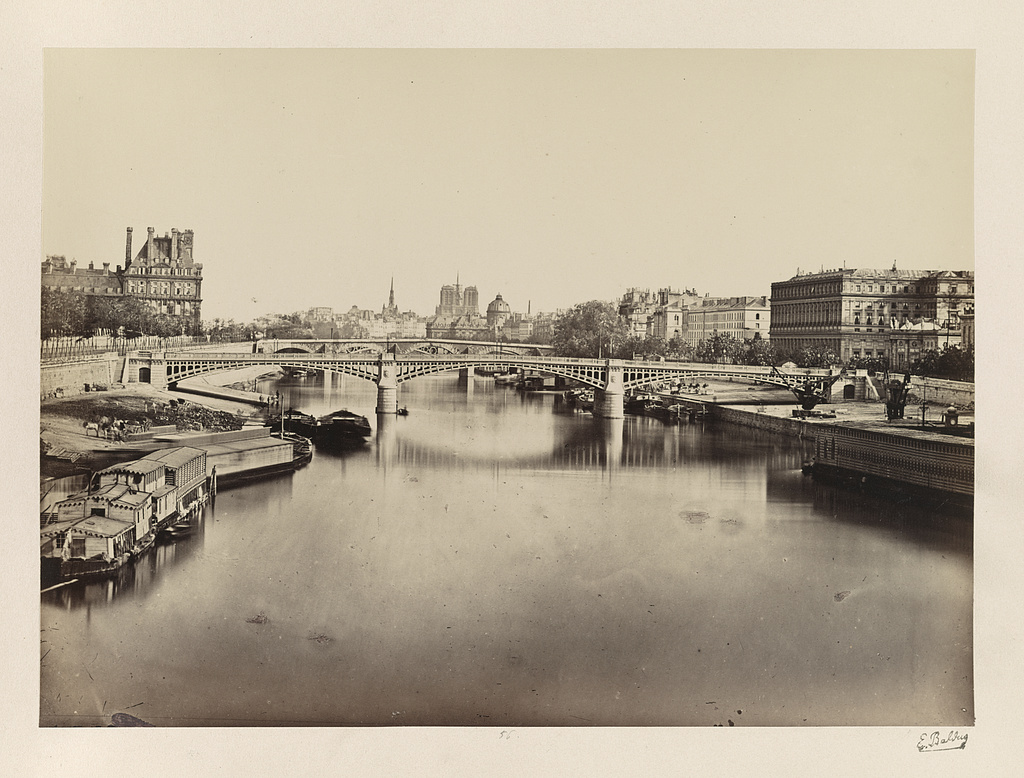
Image Credit: Edouard Baldus “View of Seine River, looking toward Notre-Dame” [between 1851 and 1870] The Library of Congress

Sue Blaustein: “A Song for Noise”


A Song for Noise

Time has been called God’s way of making sure everything doesn’t happen at once. In the same spirit, noise is Nature’s way of making sure we don’t find out everything that happens.

– Hans Christian Von Baeyer (in Information, The New Language of Science)


I was there – passing by –
             on an April day
when industrial gases arrived.
A long truck parked on Holton Street –
Advance Diecasting – their new home.

I saw tanks secured on the flatbed.
Primary colors on Hazmat signs.
Warnings in triangles – yellows
and reds. The delivery was almost over.  

It was something that happened –
an event – so I marked it. Goodbye
welding gases I said. Cordial, to cylinders
in my rear-view mirror. Visit again sometime soon! 

I could’ve said goodbye
            to the driver too. 
Said goodbye, unloaders and signs.
Goodbye tires, goodbye pebbles
caught in the tread, rolling 

            away to where? 
When to leave off? To wrap it up –
when nothing’s really “over”?
It’s a never-ending, all-at-once
            overlapping onrush –

Something happened…What 
             happened?
            What’s next?


About the Author: Sue Blaustein is the author of “In the Field, Autobiography of an Inspector”. Her publication credits and bio can be found at www.sueblaustein.com. Sue retired from the Milwaukee Health Department in 2016, and is an active volunteer. She blogs for ExFabula (“Connecting Milwaukee Through Real Stories”), serves as an interviewer/writer for the “My Life My Story” program at the Zablocki VA Medical Center, and chases insects at the Milwaukee Urban Ecology Center.


More by Sue Blaustein:

A Song for Harvest Spiders


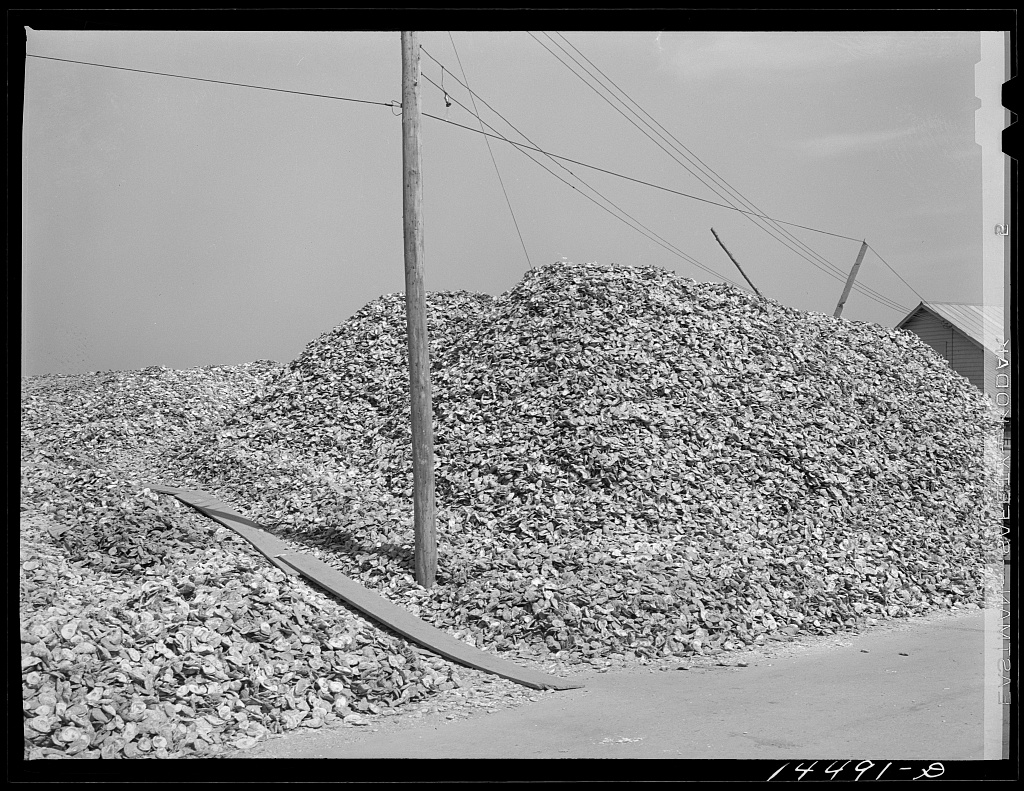
Image Credit: Reginald Hotchkiss “Shuck pile. Rock Point, Maryland. These shells are returned to river to start new beds” (1941) The Library of Congress

Ryan Quinn Flanagan: “You’d Think the Mafia Would Take the Year of the Rat More Seriously”


You’d Think the Mafia Would Take the Year of the Rat More Seriously

Close ranks, clean house.
Vacation for most of the year.
One behind the ear for good luck.

But it’s business as usual.
These wise guys don’t seem so wise to me.
You’d think the Mafia would take the year of the rat more seriously.
Look for wires in more than the backs of their televisions.

Old friends you haven’t seen in a while suddenly show up
wanting to get chatty.

To reminisce about old times
that are still open cases.

Leaning in close, so attentive.
But what do I know?

Some solitary Mick.
With no paid informants
of my own.

I’m sure the made men think they
got it made.

Down at the Mediterranean social club
where the old timers play dominoes.
Behind dark roaming sunglasses so thick
they could be a pound of butter.


About the Author: Ryan Quinn Flanagan is a Canadian-born author residing in Elliot Lake, Ontario, Canada with his wife and many mounds of snow.  His work can be found both in print and online in such places as: Evergreen Review, As It Ought To Be Magazine The New York Quarterly, Cultural Weekly, In Between Hangovers, Red Fez, and The Oklahoma Review.


More By Ryan Quinn Flanagan:

“Robbie the Owl”

“He Brought His Canvases Over”

“Before Evening Med Pass”

“It’s a girl I can tell, we’ve had nothing but trouble”

“Why Answers are Never the Answer”


Image Credit: From “Faune des vertébrés de la Suisse” Public Domain. Image courtesy of The Biodiversity Heritage Library

Jonathan K. Rice: “Seagull”

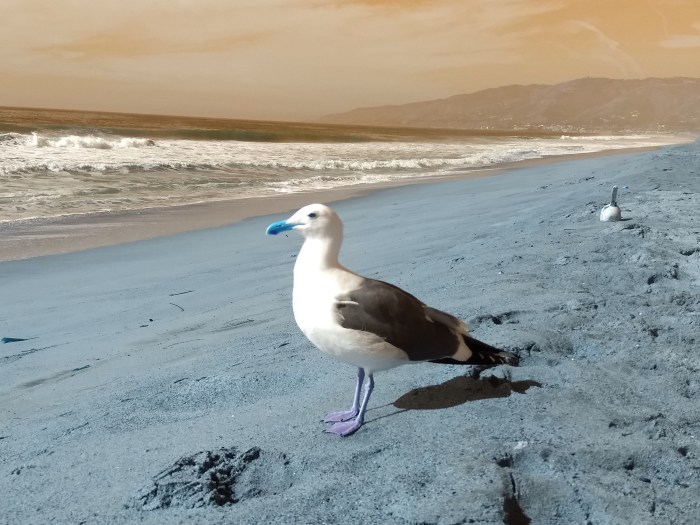
IMG_20200127_122554127


Seagull

Seagull perches 
on a chaise lounge

stoic, 
pensive

overlooking ducks,
a lone coot on a small lake.

I’ve heard they’re
intelligent and long-living,

that they’ll eat 
almost anything.

They can drink saltwater,
excrete the salt

through their nostrils,
shake it from their bill.

I think of Chekhov, 
Richard Bach, Hitchcock.

Years ago I read about 
a girl who was stranded 

on a small island
with no food or fresh water.

She survived on seagulls.
Wrung their necks,

ate them raw,
drank their blood.

This seagull preens,
mournfully squawks.

Gray and white plumage
rustles in the breeze

as it gauges distance, 
spots its mate, takes off 

beyond restaurants,
dumpsters and parking lots,

flying further inland
looking for another shore.


About the Author: Jonathan K. Rice edited Iodine Poetry Journal for seventeen years. He is the author of two full-length poetry collections, Killing Time (2015), Ukulele and Other Poems (2006) and a chapbook, Shooting Pool with a Cellist (2003), all published by Main Street Rag Publishing. He is also a visual artist. His poetry and art have appeared in numerous publications, including Cold Mountain Review, Comstock Review, Diaphanous, Empty Mirror, Gargoyle, Inflectionist Review, Levure Litteraire, The Main Street Rag, Wild Goose Poetry Review and the anthologies, Hand in Hand: Poets Respond to Race and The Southern Poetry Anthology VII: North Carolina.


More by Jonathan K. Rice

“Springmaid Pier”

“Cards”

“Stravinsky in the Shower”


Image Credit: Chase Dimock “The Seagull Who Stole My Taco” (2020)

Larry Smith: “At the Country Store”


At the Country Store

Outside of the town’s country store
stand two girls in high school jackets,
their sports names scrawled across the back.
Laughing at the greeting of cats,
they enter, sidling their way back—
past stacks of canned goods and chips,
pastas, plates, and mugs, bottles of Coke
and maple syrup, stacks of hometown t-shirts.
Rich aromas of fresh baked bread and flowers,
coffee aroma mixed with fresh cut cheese, all of it
pulling them to the meat counter.
The tall one stops, leans towards her sister,
says, “Remember now, she’s just lost her son 
in Afghanistan.” The younger one nods, 
looks up into the face of the older woman,
“Oh, Mrs, Murphy, we’ve come for Mom’s chickens.”
The older woman smiles, “Oh, if it isn’t Sherill…
and Marie. So good to see you girls.”
Names form a sacred bond here. 
“How’s your sister Margaret?” Sherill asks.
“Oh, she’s okay,” the woman lies, not wanting
to spoil their day, like that fish someone left out.
“Well, I’ve got your chickens already wrapped,”
she says, eyeing their fresh faces.
At the counter she touches each girl’s hand.
“You two be careful out there,” she says softly
into their eyes. “You know how we need you.”
A bell chimes as they exit the door.


About the Author: Larry Smith is a poet, fiction writer, and editor-publisher of Bottom Dog Press in Ohio where they feature a Working Lives and an Appalachian Writing Series. He is also the biographer of Kenneth Patchen and Lawrence Ferlinghetti. He lives in Huron, Ohio, along the shores of Lake Erie.


More By Larry Smith:

Union Town

No Walls

Wages


Image Credit: Marion Post Wolcott, “Selling drugs and medicines in doctor’s office in rear of country store. Faulkner County, Arkansas” (1940) The Library of Congress