SATURDAY POETRY SERIES PRESENTS: ADAM EAGLIN

HEAT
by Adam Eaglin

It wasn’t a dream, more like a vision,
if vision meant steam rising from
a body, meant heat from the living—

I became the eye of a round-stomached cobbler.
I became a word in a fable. I became
the tongue in the mouth

of a girl. I became limbs like those of trees stripped of bark.
I became a shade of vacant white, like light
lifting from the skin of the sun.

Once I was attractive, once, you could smell it on me
like kerosene, that kind of thing, about to catch fire.

I never used the word beauty except when it was required,
ironically, but then I became the word, a creature transforming
in the moonlight.

Something strange happened then.

A man becomes frightened,
not at what he has done, but what he is about to do;

The wet of grass on skin,
the cold of the night
when you lay your body down.

Once I was attractive, once—

and then I became the night,
and then I became the air.

(“Heat” was originally published in Prick of the Spindle and is reprinted here today with permission from the poet.)

Adam Eaglin was raised in Summerfield, North Carolina, and has degrees from Duke University and Boston University. His poetry and reviews have appeared in Gulf Coast, Publishers Weekly, and the Harvard Review. A recipient of the Robert Pinsky Global Fellowship, he works in publishing in New York City.

Editor’s Note: Adam Eaglin is a master of metaphor. He effortlessly manipulates images to create an Alice in Wonderland-esque world for his readers to slip into as if a rabbit hole. With moments like “if vision meant steam rising from a body, meant heat from the living,” and “The wet of grass on skin, the cold of the night when you lay your body down,” we the readers are taken on a journey into a man’s inner thoughts and experience and into the relationship he inhabits and the transformations that ensue as a result thereof.

Want to read more by and about Adam Eaglin?
The Atlantic
Duke University Libraries
Vanity Fair
Words Without Borders

Erlking

[The following translation was originally published in Per Contra.]

Erlking

by Johann Wolfgang von Goethe

(translation by Okla Elliott)

Who rides so late through windy night?
A father holding his child tight.
He has the youngster well in his arm,
He keeps him safe. He keeps him warm.

“My son, what twists your face with bother?”
“Don’t you see the Erlking, father?
The Erlking with crown and shroud?”
“My son, it’s but a sliver of cloud.”

Lovely, lovely child, come with me.
Such wondrous games you will see.
What bright flowers there are by the shore,
What royal clothes my mother has in store.

“Father, my father, are you listening
To what the Erlking is promising?”
“Child, calm yourself, be calm, please.
It’s just the wind rustling dried leaves.”

Sweet boy, don’t make such a fuss;
My daughters are waiting on us.
My daughters sing the nightly tunes
to cradle you beneath the moon. READ MORE

Andreas Economakis

Yiayia and Boy George (photo by Andreas Economakis)

“Perfect Makeup”

by Andreas Economakis

My grandmother Anastasia, or yiayia as I called her, must have studied Zen. She could spend hours seated motionless in her jewelry store in the Nile Hilton, a geriatric Greek sphinx staring blankly ahead. Overwhelmed by the utter tranquility in her shop, I would escape as often as I could whenever I visited her in the summers, wandering around the dusty and chaotic streets of Cairo for as long as I could stand. I would beat a hasty retreat to the cool sanctuary of the air-conditioned Hilton, with its refreshing “Asir Lemoon” lemonades and overwhelmed pink tourists, only when my feet could carry me no longer through the blazing Saharan heat and pungent city smells.

Cairo has a peculiar odor. Anyone who’s ever visited this ancient bustling city of 17 million or so souls will attest to this. You become aware of the city’s pungency from the very moment the airplane doors crack open on the sizzling tarmac of Cairo International Airport. I’m not a smell specialist, but if you put me in a headlock I guess I’d equate the city’s smells to a batch of ripe tropical fruit fermenting in old petrol smog. The Hilton was a natural haven from all this, a controlled oasis of sorts. Like any desert wanderer, I would invariably end up at the oasis when on the verge of heat stroke. In fact, I think the Hilton’s café was named The Oasis, if my memory serves me right.

There was a bookstore next to my grandmother’s shop and I started buying and feverishly reading anything I could lay my hands on. I would sit in this red and white vinyl chair behind the spotless glass of the jewelry store’s front door for hours, my head buried in Hemingway and Kazantzakis and London and Marquez. Occasionally, I would peak out at the crowds of sweaty tourists that drifted by, chuckling to myself, knowing full well what state the poor sods were in. I’ve never been good at playing salesman and I generally ignored my grandmother’s pleas to help with the odd customers who walked in, preferring my role as family bookworm. My grandmother would yell at me for reading so much, telling me that it was bad for me.

One day, I looked up into the Hilton lobby and saw Boy George walk by. I couldn’t believe my eyes. There he was, in his black robe, jewels, long hair, bangles, make up and signature bowler hat. “Dirty, filthy hippie!” my grandmother blared out, shifting uncomfortably her seat. “I bet he sleeps with dogs!” she added. I stared at my grandmother with wide eyes, not so much surprised at her comment but at the fact that she had moved in her seat. I explained that he was a famous musician, a very rich, dirty filthy hippie. “Really?” she asked all bright-eyed and bushy tailed. My grandmother might have been conservative, but a fool she was not. Visibly excited, she asked me to bring him into the store so she could meet him.

I ran out into the lobby and caught up with Boy right before he went into The Oasis. “You’re Boy George!” I said, eyelashes batting up and down over the big stupid grin that was plastered all over my face. Boy stopped and turned toward me, smiling. A pleasant smell overtook my nostrils. 150 degrees outside but the man smelled like a bouquet of freshly cut flowers. I told him that my grandmother wanted to meet him and pointed to our shop. He courteously followed me in and I made the introductions. Boy’s presence seemed to overwhelm my grandmother. It was as if an alien from planet Zork had stepped into her inner sanctuary. She totally forgot that she wanted to sell him some jewels. The only thing she could think of to say to Boy was that his make-up was perfect. Her own was always too heavy, gooped on as if with a builder’s spatula.

Perhaps feeling awkward at all the silence, Boy smiled and excused himself. My grandmother sprang back to life and asked me to ask him if I could take a photo of the two of them together. Boy said of course and I trained my pocket Hanimex on them, snapping what was to be my first “celebrity” photograph. Boy kissed my breathless grandmother on the cheek and exited with his invisible bouquet of sweet flowers. I ran up to Boy in the lobby to thank him. Right then another member of Culture Club walked up and looked at me with a mischievous look. Then Boy asked me if I wanted to join him and the band for a drink up in his room. They all giggled flirtatiously. I kindly declined and wandered back to my grandmother’s store as Boy and the band headed to the elevators.

“A nice man,” my grandmother said, “even though he dresses and smells like a girl.”

“Yeah,” I replied, my eyes trained on a white poodle that was being led through the lobby toward the elevators by a tiny bellhop in a silly outfit. The bellhop and the poodle followed a giggling Boy and the band into the elevator.

“But you can’t judge a book by its cover,” I added, just as the elevator’s doors closed with a ding.

–Andreas Economakis

This piece is part of a collection of stories on blindness entitled: The Blindness of Life.

Copyright © 2011, Andreas Economakis. All rights reserved.

For more stories by Andreas Economakis click on the author’s name below.

SATURDAY POETRY SERIES PRESENTS: KEITH WILSON

HOW LIKE A POTATO
by Keith Wilson

How potato of you,
noticing with your many eyes
the hunched and gloveless scraping of frost
from the windshield of my car. Omniscient
of you. Or perceived from your closet
window. Maybe the crack of your door.

And then to bring me a pair
of your own—worn, leather and for the garden.
How warm and hearty,
how rich and filled with starch.

Or Summer in your lawn chair.

My arms filled with groceries
or school books, how you tilt yourself
so your skin appears the most rough and brown,
bruised from the heavy handling
since before you were pulled from the unforgiving earth
by Jesus—who must, from the sounds of it,
live in the apartment
on the other side of you.

How you vegetate so,
arms like vines lifting to light
despite the dark knots
in your stomach, how you manage
to forget the heavy smell
of warm coffee soil,
down here where I live.
Below.

How like a potato,
to sit away from the birds, smiling,
all ready to fry.


(“How Like a Potato” was originally published in Poetry Bay and is reprinted here today with permission from the poet.)


Keith Wilson Keith S. Wilson is an Affrilachian poet and Cave Canem Fellow currently living in Kentucky. A graduate of Northern Kentucky University, Keith’s work has appeared in Appalachian Heritage, Mobius, Evergreen Review, The Driftwood Review, Breadcrumb Scabs, Kudzu, and in the anthology Spaces Between Us. Keith is an editor for the multilingual online journal Public-Republic and co-editor for the culture blog We Who Are About To Die.

Editor’s Note: How clever of Mr. Wilson to compare a person to a potato in such a skillful manner. To create layers of meaning – the potato-like characteristics of a person with their many eyes watching and their tendency to act as if they are “rich and filled with starch” – spread on top of deeper, more meaningful discussions that relate to religion and socioeconomic divides. In addition to his clever wordsmithing and ability to relay deeper meaning, Mr. Wilson’s poetry appealed to me first and foremost for his deft ability to manipulate language and create beautiful verse with moments like “how you tilt yourself / so your skin appears the most rough and brown, / bruised from the heavy handling / since before you were pulled from the unforgiving earth.” Given the layers of this poem, I suggest giving it a second and even a third read in order to fully extrapolate meaning as if pulling roots from the soil.

Want to read more by and about Keith Wilson?
Keith Wilson’s Official Blog

Blindfold

Blindfold

by Al Maginnes

Maybe the blindfold is not meant
as kindness for the condemned
like the choice of a final meal
or the last cigarette, a pleasure
meant to block awareness
of what’s coming. Instead it keeps
the living from seeing how
the eyes throttle with light
or glaze at the moment of impact
before the body empties into death.
In this age of performance, even an autopsy,
final audition of the body’s efficiency,
is theater. A TV doctor explains
how the flanges of the famous chest
are opened like curtains, the routines
of the reliable duo, systole and diastole,
the shuttle cocking of artery and vein,
the blood’s drifting clouds of toxins
all are measured and named,
no chance for curtain call
or final bow. In the film
I found on the internet and watched
because I started and could not stop,
the killers, not the condemned, wore masks.
He knelt before them as they read
their proclamations in a language
he was captive long enough to know
in fragments. His face a blank
of pure misery, glossed with sweat,
his hair twisted and on end,
some composure kept him still.
Perhaps he’d seen enough movies,
American enough to believe
in last-second rescues, the hero
who kicks in the door, guns blazing.
Maybe he believed this moment
a routine humiliation between
tea and afternoon prayers,
a ritual meant to be so frightening
that when water was thrown on him
or he was kicked, their laughter
let him breathe once more.
But the reading ended and one
of the masked men produced a long knife.
There was nothing swift nor spectacular
about what followed. Bodies wrestled
across the floor. Deep inside the scrum
started noise too high-pitched to be a scream,
noise I’d never heard a human make.
When the head was displayed,
it was no longer human, but something
molded from plastic and left too long
in the back seat of a car on a hot day.
If you watch this once, you will not
watch it again. In this world,
beauty and terror coax the same tears,
the voice of fear has no words,
the victim’s face, a trophy.
But morning still happens.
I get up, make coffee, walk the dog, things
I can do with my eyes closed.
Not until I read the paper or listen
to the news does the world take shape.
Some refuse the blindfold,
but most are grateful for a darkness
granted by a cloth so ordinary
it might have dried last night’s dishes,
then wiped the empty table free
of crumbs and ashes.


Al Maginnes is the author of four full length collections of poetry and four chapbooks, most recently Ghost Alphabet, which won the 2007 White Pine poetry prize and two chapbooks, Between States (Main Street Rag Press) and Greatest Hits 1987-2010 (Pudding House), which were published in 2010. Recent poems appear or are forthcoming in Southern Review, Georgia Review, Asheville Poetry Review, Cloudbank, Salamander, and Solo. He lives in Raleigh, NC with his wife and daughter and teaches at Wake Technical Community College. The above poem was originally published in Southern Poetry Review and is reprinted here with permission of the author.

SATURDAY POETRY SERIES PRESENTS: LYN LIFSHIN

WHEN I WAS NO LONGER MY LEATHER JACKET
by Lyn Lifshin

Something he’d picked up
and gently carried to the
closet. When I was no
longer something he half
wanted to wear, held so
delicately, smiled at like
when he came in later to
the reading, said he would
have brought the Margarita
but he didn’t know if I
liked it on the rocks, how I
felt about salt. Before I
was no longer my jacket,
darkly mysterious, soft but
with a musky smell, flexible
enough to do what he
wanted with. Before that I
was all animal, wild. I was prey
he was on a safari for, caught
in his crosshairs. He could
taste my hair thru e mail.
Once he tracked me as far as
San Antonio, couldn’t
find me. This time I was the
lure, the flash of a few verbs and
he canceled classes, took off
work. I was something he
couldn’t stroke like the leather.
He was used to things being
fatal, leaps and cracks. He was
a journalist, wanted no
emotion to get in the way
of the facts.

(“When I Was No Longer My Leather Jacket” was originally published in Poetry Bay and Lyn Lyfshin’s book Persephone printed by Red Hen Press and is reprinted here today with permission from the poet.)

Lyn Lifshin has written more than 125 books and edited 4 anthologies of women writers. Her poems have appeared in most poetry and literary magazines in the U.S.A, and her work has been included in virtually every major anthology of recent writing by women. Lyn Lifshin has also taught poetry and prose writing for many years at universities, colleges and high schools, and has been Poet in Residence at the University of Rochester, Antioch, and Colorado Mountain College. Winner of numerous awards including the Jack Kerouac Award for her book Kiss The Skin Off, Lyn is the subject of the documentary film Lyn Lifshin: Not Made of Glass. For her absolute dedication to the small presses which first published her, and for managing to survive on her own apart from any major publishing house or academic institution, Lifshin has earned the distinction “Queen of the Small Presses.” She has been praised by Robert Frost, Ken Kesey and Richard Eberhart, and Ed Sanders has seen her as “a modern Emily Dickinson.” Her prizewinning book (Paterson Poetry Award) Before It’s Light was published Winter 1999-2000 by Black Sparrow Press.

Editor’s Note: It is an honor to share with you the work of Lyn Lifshin today. A renowned poet, Lifshin has earned her reputation as a true wordsmith. With moments like “how I felt about salt” and “flexible enough to do what he wanted with, ” today’s poem at once delves effortlessly into a vignette of a relationship and simultaneously tells the story behind the scenes.

Want to read more by and about Lyn Lifshin?
Lyn Lifshin’s official website

SATURDAY POETRY SERIES PRESENTS: ANDREA KNEELAND

By Andrea Kneeland:

UNTITLED

When you put your arms around me and I close my eyes, everything except your body disappears. I press my face against your chest, my eyes all wet, and sometimes I pull away and see that I have left satisfying evidence of tears on your shirt. I will admire the evidence covertly. It looks like a Rorschach blot or a foodstain. When I close my eyes, you could be anyone. Sometimes I forget your name. I can even forget who you are while you are speaking to me, if I want to, if I keep my eyes shut, if I try hard enough. It’s not just you who disappears when I shut my eyes. The ones before you disappeared too. All of your arms, your t-shirts, your reluctant acts of comfort, all of you feel exactly the same and it doesn’t matter to me anymore who any of you are.


HOME MOVIES

the way flesh swarms like ants the stuttering thumps embedded
like morse in our bones forever a history of fingers glistening
like butter the way memory is sort of a stain
in the cloth

like grease or like blood forever there you are unbleached
how you let them touch you forever your breasts fleshed guppyfish
eyes straining toward opposite points in the air forever the arch
of your skin

and the slip of a fisted hand tanned like leather forever the wormy
brown nylon of twisted rug the way it holds the imprint
of swarmed bodies forever the muscle of thighs
the baby

soft skin of the wolves forever the circling throb of impatience
the impermanence of movement the impermanence of face
of the bodies of ten white socked men forever the clutch
like a balled baby

fist forever the way you pressed your self down into the love
ly brown floor forever how your face bleeds forever into the white
round white lights

forever how I wondered if anyone would ever love
you how I wondered how
you would make them


(“UNTITLED” was originally published in PANK Magazine, and “Home Movies” originally appeared in Tarpaulin Sky Press. Both poems are reprinted here today with permission from the poet.)


Andrea Kneeland is the author of The Birds & The Beasts (Cow Heavy 2011) and a web editor for Hobart. Her work has appeared or is forthcoming in a number of journals and anthologies, including Annalemma, DIAGRAM, Barrelhouse, Caketrain, American Letters & Commentary, Wigleaf, The Collagist, 580 Split and elimae.

Editor’s Note: Don’t let it be said that I don’t know how to ring the new year in with a bang! I must admit today’s poems are some of my favorites that I’ve had the pleasure to publish on this series. If you’re an avid reader it should be clear to you why these poems are right up my alley. Working strongly within the theme of relationships with an overtly sexual drive, these poems are a one-two-punch to the gut of America’s Puritanical backdrop. With moments and killer end lines like “And this will be proof that I know who you are and I mean it when I say that I love you,” “All of your arms, your t-shirts, your reluctant acts of comfort, all of you feel exactly the same and it doesn’t matter to me anymore who any of you are,” and “forever how I wondered if anyone would ever love / you how I wondered how / you would make them,” Andrea Kneeland is a poet after my own heart, and the perfect start to a new year of poetry!

Want to read more by and about Andrea Kneeland?
Hobart Literary Journal
PANK Magazine
Tarpaulin Sky Press

Art Lessons

Image from the Tom Corbett television series in the early 1950s. Command cadet Tom Corbett is flanked by Martian astrogator Roger Manning and Venusian rocket specialist Astro. Photo source: IMDb.

Art Lessons
By John Unger Zussman

One day in fourth grade, our art teacher passed out crayons and asked us to draw a picture of the most beautiful thing we could imagine.

I started with a verdant forest beside a lush green meadow. Above it I added a blue sky, wispy white clouds, and a yellow sun. And in the middle of the meadow, I placed a sleek, gleaming, silver rocket ship, pointed skyward and bearing an American flag.

It was 1960.  The space race was in high gear. The Russians had launched two Sputnik satellites in 1957 and the U.S. was trying desperately to catch up. Both countries were rushing to put astronauts in orbit. The excitement captured my nine-year-old imagination. I had even abandoned my beloved Hardy Boys books to pursue Tom Corbett, Space Cadet.

Only now does the sheer phallic audacity of that picture make me chuckle.

The art teacher, roaming the classroom, finally stopped behind my desk. “Is that really the most beautiful thing you can think of?” she sniffed.

I got the message. Since that day my artistic endeavors have been limited to doodles and scribbles. And my brilliant career as a rocket artist was snuffed out before it began.

Copyright © 2010, John Unger Zussman. All rights reserved.

An abridged version of this essay was published in The Sun Magazine in June 2004.

Anna Baltzer

STL-PSC Flash Mob: Boycott Israeli Apartheid in Palestine!

POPULAR BOYCOTT ISRAEL

ST. LOUIS FLASH MOB VIDEO

REMOVED BY YOUTUBE

Prompts Questions about Selective and possibly Unlawful Shut-Down

FOR IMMEDIATE RELEASE

December 23, 2010

Contact Person: Colleen Kelly, 314-761-7428

Who: Members and friends of the St. Louis Palestine Solidarity Committee

Where to view Flash Mobhttp://www.stl-psc.org/?p=149

Removed video: http://www.youtube.com/watch?v=OGAdfvGQ-xg

Dancing and singing to a parody of Lady Gaga and Beyoncé’s “Telephone,” more than forty members and friends of the St Louis Palestine Solidarity Committee (STL-PSC) serenaded holiday shoppers at Best Buy and AT&T stores in Brentwood, MO.  They urged patrons to join the boycott of Motorola due to the company’s involvement in Israel’s unlawful military occupation of the West Bank and Gaza.  A video of the flash mob was posted on YouTube December 13th, quickly going viral, with coverage in media around the world including Israel’s Ynet News. It acquired more than 35,000 hits in less than a week.

Shortly after the count hit 35,000, YouTube removed the video in apparent response to a notice of claimed copyright infringement from “WMG.”  The STL-PSC is firmly convinced, as advised by legal representation, that the flash mob video does not infringe Warner Music Group’s copyright, as it constitutes a “fair use” of the song and parodies of songs are protected under a U.S. Supreme Court decision in Campbell v. Acuff-Rose.

Furthermore, the song copyright appears to be owned by a subsidiary of UMG Recordings, not WMG at all. The WMG seemingly has no claim to the song; on the other hand, WMG’s relationship with Motorola is well known.

STL-PSC believes that this is an infringement on freedom of expression and plans to challenge the take-down.

Author and national organizer, Anna Baltzer, on the removal of the video:  “There are more than 1,000 Lady Gaga flash mob videos on YouTube. None of them has been shut down by WMG.  What does WMG not want the world to know about Motorola’s connection to Israeli apartheid and war crimes? The targeting of our video shows that we are doing something right and the companies are feeling the pressure. Now more ever we need to keep the pressure up! Please continue circulating and click here to send a letter to Motorola and sign a pledge.

Washington University graduate, Banan Ead, explained why she participated in the flash mob: “I’ve lived in the West Bank for a few years and visited several times, and every time I go back, with every airport interrogation or checkpoint I get stopped at, I feel only a sliver of the degradation of what the Palestinians permanently living there have to go through.  It was also important for us to show that there are ways to non-violently resist that occupation. Plus, I like to sing and dance!”

86-year-old Holocaust survivor, Hedy Epstein, also participated, saying: “During my five visits since 2003, to the Israeli Occupied Territories, I was repeatedly asked by Palestinians I met as follows:  When you return home to the U.S., please tell people there what you have seen and experienced on the ground, because the media does not convey that. I have tried to honor that commitment.”

To interview Flash Mob participants, call the contact above. To find out more about the St. Louis Palestine Solidarity Committee, visit: www.stl-psc.org

Motorola provides equipment to the Israeli military used to maintain the occupation and illegal settlements. More on Moto here…

####


Anna Baltzer
National Organizer, US Campaign to End the Israeli Occupation
Local Organizer
, St Louis Palestine Solidarity Committee
Homepage: www.AnnaInTheMiddleEast.com
Facebook: http://tinyurl.com/fbanna
Twitter: http://twitter.com/anna_baltzer

ART REVIEW

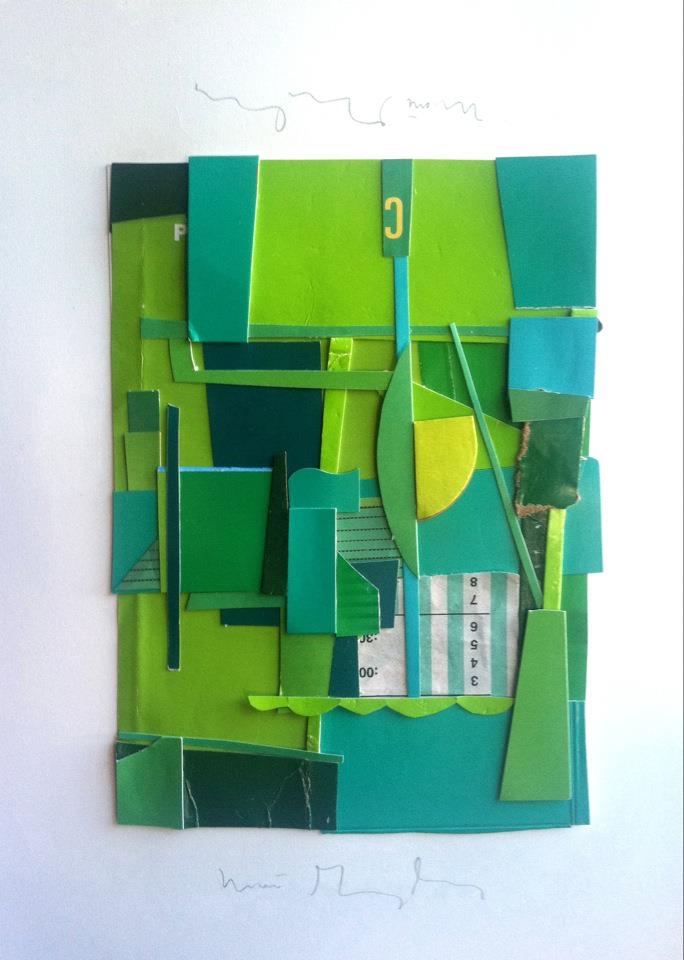
 Paper collage (11 x 14 inches) made with found materials by Matt Gonzalez.

MATT GONZALEZ AT TRIPLE BASE GALLERY

by Paul Occam

Triple Base Gallery on 24th Street recently unveiled its new artists in a flat file project that allows a standing exhibit of hundreds of works on paper from 16 artists.  The show ended on December 19, but the pieces are still at the gallery in files.

Among some of the most interesting work presented was that of Matt Gonzalez, the progressive leader who shaped much of the political landscape in San Francisco from 2000 to 2004.

What has always been striking about Gonzalez, politically, socially and otherwise, has been his staunch refusal to separate art from life. As a small but significant measure of this impact, Gonzalez was the first elected official in San Francisco to open his office for artists to put on monthly art shows.

The practice he initiated of opening city hall to art and artists—merging art and politics—has become so popular that it is common for many officials to host art shows in their offices. This victory of non-separation represents a reappraisal of the political landscape that needs to grow.

With relatively little attention and a host of small successful gallery showings at Adobe Books, Lincart and Johansson Projects, Gonzalez has produced more than 500 intimate small-scale collages over the last six years.  Many are done in the spirit of Kurt Schwitters, using only found materials collected on his walks through the city or poached from invitations he receives by mail.

The works can be found on the walls of other artists including Bay Area figurative legend Theophilus Brown and the well-known Mexican painter Gustavo Ramos Rivera.

Gonzalez’s primary palette is stuff other people throw away. The works themselves are meditations on value, meaning and social norms. As a body, the work recalls the Phillip K. Dick saying, “divinity is found in the trash substratum.”

The visual impact and gravity of his work is such that Gonzalez should not be denied a second career as an artist and may be remembered someday more in that vein, than as a politician.

The work is composed of images and discarded packaging, the disambiguation of old meanings through minor resurrections of color, compositions and forays into textures and curiosity.

The innocence of many of the pieces is striking and noticeable, inviting the spectator to see something with new eyes—similar to the way a child might be fascinated by a color or an object it instinctively reaches out for on the sidewalk, only to have an adult quickly shoo it away to enforce the conceptual reality of what is “allowed”.

Gonzalez’s work re-invigorates this moment, but stops the hand of authority before it can get a complete stranglehold on our innate sense of wonder.

Gonzalez’s reappraisal of this moment and his willingness to pick up the forgotten, unseen and rejected is a meditation on compassion. It displays an intimacy with things other people don’t want to be reminded of, as if to say “But look how great this is if you only get rid of your idea about it!” In this way the pieces are balanced by a sense of humor and the inherent questions that they pose about late capitalism, status and prescribed values.

Some of the pieces belong in the philosophical company of Asger Jorn and Guy Debord, two of the most famous members of the situationist international, and possibly as a continuation of their famous critique “The Society of the Spectacle.”

The pieces are a playful critique of modern society and throwaway culture. Gonzalez pays attention to ideas and things left in the margins and rescues them from oblivion and unconsciousness in such a way as to show us the ghost of modern living that lurks outside our doors.

Gonzalez goes further than Asger Jorn and Guy Debord when he appropriates the situationist concept of the “Drift”—a deliberately poetic and uncalculated exploration of the city—and catalogues it by creating artifacts of experience, an archaeology of everyday life created from discarded images and messages that he juxtaposes into small works of art.

The perspective is one that might be welcomed in a zen tea house—getting rid of the concepts of the past by presenting them without the garbage of conditioned thinking.

One notes that Gonzalez’s work in every field has always retained a trace of the outsider. In some sense he has made a career in representing people without a voice.

–Paul Occam

Paul Occam is the pen name of a San Francisco writer.

This review was first published at Mission Loc@l.