After I die,
let it be said
that my pussy tasted
of children’s unspoiled dreams.
May eunuchs charcoal sketch
me and Miles smoking
brown cigarettes and drunk-swaying, broadcast
all night, all over Barcelona TV.
After I am scattered,
let it be said
that I ate joy.
May the universe not regret me:
clumsy, tip-toeing, gripping, self-involved, now stumbling
with thick-treaded boots and wide steps through
the constellations and laughing, knowing
I knew nothing.
Kat White is an MFA in Creative Writing candidate and Instructor at the University of Memphis. Her creative nonfiction has been published in Phoebe Journal and Photosynthesis Magazine. Her poetry has been published in Blue Collar Review, Axe Factory, Lullwater Review, and Stone Highway Review; she has an upcoming poem in Fade Poetry Journal. Kat is currently at work in Memphis on her nonfiction novel, A Personal Cartography. Contact her at paris_anais@yahoo.com.
Editor’s Note: Kat White is forward-thinking in both her poetic maneuvers and her contemplation. Taking us on a journey from the physical and sexual to the enlightened, she is neither afraid to admit her human flaws nor to laugh at how little one knows in this life. She shines the light of optimism on the way she will be remembered, “After I am scattered, / let it be said / that I ate joy.”
“let’s get together and get some land
raise our food like the man
save our money like the mob
put up the fight, own the job”
–James Brown
Last February, World Bank President Robert Zoellick noted that the inability of poor people to feed themselves and their families contributed greatly to the civil unrest that swept across Egypt, Tunisia, and Yemen. And even as food prices have eased slightly since their record highs last January, newly appointed Food and Agriculture Organization director, General Jose Graziano da Silva, has already indicated that food prices and their volatility will remain high for the year.
Since 2008, the geopolitics of food, both on the production and consumption side, has become a growing crisis on the one hand, and a call for social revolution on the other. What Lester Brown called the “21st-century Food War” is the inflationary and supply-side unraveling of food prices for many developing nations.
Sharp increases in the four main food staples—wheat, rice, corn, and soybeans—have managed to push many of the 2 billion poorest people on the planet, who already spend between 50 to 70 percent of their income on food, into an even more perilous state of hunger and malnutrition. Arguably the largest player in the Arab Spring revolutions, Egypt alone imported roughly 70% of its wheat in 2010; making Egypt and its 86 million citizens the largest wheat importer in the world.
It should come as no surprise that in the spring of last year, the Egyptian interim government outlined a multistage strategy for improving domestic wheat production by increasing financial incentives to local farmers.
More than just an attempt to undo years of agricultural neglect during President Hosni Mubarak’s rule, the actions of the interim government show its keen awareness of the relationship between food prices and civil unrest. The Egypt government witnessed this during the 1977 “Bread Riots,” when the government attempted to end subsidies of oil, wheat, and other grains, and more recently during the 2008 food riots. Agricultural self-sufficiency seems to be a new attempt by the current government to curb future uprisings.
In December of 2011, head of the International Food Policy Research Institute, Shenngun Fan, commented that high food prices were a contributing factor in fueling the Arab Spring. And while David Biello of Scientific American was careful to note that the Egyptian revolution was the result of a number of factors, the inability of the government to rein in spiraling food costs with government subsidies only “added fuel to an already combustible mix.”
Along with macroeconomic shifts in food prices, the relationship between these global movements and food is steeped in symbolic gestures. Take for example the iconic image of a Yemeni man during the protests in Sana’a with two loaves of baguettes plastic-wrapped to his head. Or Mohamed Bouazizi, the 26 year old Tunisian street vendor—scraping out a living selling produce on the streets of Sidi Bouzid—and de-facto martyr of the Arab Spring, who after being spat upon and humiliated by municipal officer Faida Hamdi for not having a proper vendor permit, promptly obtained a can of petroleum and immolated himself in front of the governor’s office.
Out of the Arab Spring revolutions, the importance of food has not only lent credence to realities of inequality, corruption, and desperation, but has also provided an emblematic demarcation for what kinds of abuse people will no longer endure. For author Anna Badken, the attaching to one’s head of breads, tin-pot cervellieres, and frying-pan basinets during street protests in Yemen, Tunisia, and Egypt, was an attempt by protesters to form solidarity through the belief that “food in the Middle East is the most elemental expression of humanity.” It wasn’t, as Badken explained, the idea that these kitchen utensils would protect against the shelling of tear gas canisters, but instead the acknowledgment of food’s central role in Arab culture.
As then-President Jacques Edouard Alexis and the Haitian government learned, after it was overthrown during the 2007-2008 food riots, the inability of a country to manage its food prices will undoubtedly lead to its undoing. When your own population of 9 million, more than half of whom live on a dollar a day, liken their condition of food insecurity to “Clorox hunger”—the feeling that one’s stomach is literally being eaten away by bleach—it is clear that the state has failed to provide its citizens with the most basic needs.
Of course, providing these needs is easier said than done, as the Egyptian government found out. Even after increasing the subsidy for the wheat used in the mandatory production of affordable baladi—the food stamp-like bread program for the poorest of Egyptians—Mubarak was still ousted from power after eighteen days of demonstrations. This is not to mention the 175,000 tons of wheat that the Egyptian government bought from the United States and Australia in the beginning of 2011. Even a six-month wheat reserve did very little to quell dissent.
Our increasingly globalized food system has only magnified the degree to which food crises, though often experienced asymmetrically among countries, have made us even more interconnected. The adoption of neoliberal trade policies during the 1990s—the “development ladder” experiment that was ostensibly supposed to turn peasants into high-tech, highly educated factory laborers—worked instead to eviscerate domestic crop production throughout the developing world.
It is no wonder that last summer, former President Bill Clinton apologized to the Haitian government for the role that his administration—specifically the importing of subsidized US rice—had on their economy. This wasn’t an attempt by Clinton to revise his place in history, but a reflective awareness on the limitations of free trade policies.
The 21st-century Food War that we are now facing is one of increased bifurcation between the meat-centered, high calorie, packaged food diets of highly developed nations and the volatility of staple crop prices in the developing world.
When the price of wheat hit a record high of $346 a ton in February of 2011, the cost of bread in the United States only ticked up by a few nickels. While people in the developing world are largely purchasing the raw food staple items themselves, the majority of our food costs come from the packaging, advertising, and transportation of the food product—the wheat that goes into making a loaf of bread is a small fraction of the total cost.
From effects of climate change on food production to concerns over the impact of glyphosate-laden corn on the honey bee population, our current global food system has tethered itself almost exclusively to the problematic principles of unbridled market capitalism: cost-cutting mechanization, ruthless efficiency, and ethical hollowness.
We need look no further than the reckless impunity involved in the recent practice of “land grabbing” in many African countries. In 2009 alone, deals for 110 million acres of farmland were sought by wealthy foreign investors, an increase of 100 million acres from the previous year. This has been dubbed the “neo-colonization” of Africa, as foreign nations see these investments as a means of limiting exposure to future price volatility.
Still, when food is talked about in the context of social revolution, it is too often folded into a general discussion of grievances against the state. It is problematic, and, as we’ve seen over the last couple years, false to assume that lowering food prices, along with addressing other basic needs, will be enough to assuage unrest. Undoubtedly, the inability of people to afford daily meals will always be an immediate concern, but food represents more than just fluctuating nickel and dime prices on the Chicago Board of Trade. Food isn’t merely the canary in the coal mine for testing civil unrest, but a proverbial Rubicon, the place where the existential question “can I go on living another day under these conditions?” is finally asked.
What we are now facing seems to represent the beginning of a permanent food crisis. While dipping slightly from 2011 highs, the prices of most major food staples are well above 2005 levels—and nowhere close to costs before 2001. There seems to be no returning to the days of cheap food and invisible hunger disguised in a ruse of free trade and neo-liberal economic growth. Remarkably, from the United States to the Middle East, the importance of food seems to remain at the center of these struggles.
The Occupy Wall Street movement is by no means oblivious to concerns over our current food system. Among calls for ending corporate welfare and reducing the mounting wealth disparity between top earners and the 99%, concerns over our “big Ag” food system lie at the heart of the movement.
On September 29th, 2011, 12 days into the occupation of Zuccotti Park, the General Assembly of OWS published a “Declaration of the Occupation of New York City.” Along with a number of grievances, members of the NYC General Assembly declared, “they have poisoned the food supply through negligence, and undermined the farming system through monopolization.”
How then can these movements take back a dysfunctional and unjust food system?
In the 1969 pamphlet, To Feed Our Children, the Black Panther Party wrote, “hunger is one of the means of oppression and it must be halted.” Out of these conditions of inequity and rampant food insecurity, the Black Panthers even declared the last point of their ten-point plan to include the rights of “land” and “bread” ownership.
Across the country, various Occupy movements have latched onto this notion of food oppression and begun forming relationships with farmers and the sustainable food movement. Occupy Memphis and the Black Farmers and Agriculturalists Association have recently partnered to protest implied practices of discrimination by the U.S. Department of Agriculture. In occupied Frank Ogawa Plaza, attendees of the 15th Annual Community Food Security Conference gave “soapbox” speeches to Occupy Oakland about our current food system. And last December, food activists and farmers alike organized the highly publicized Occupy Wall Street Farmers’ March from the La Plaza Cultural Community Garden to Zuccotti Park.
Started last October, the OWS Food Justice group has emerged as a powerful voice within the alternative food movement. Meeting every Friday night in the heart of New York’s financial district, OWS Food Justice sees coalition building and organized marches as a way of raising awareness for food rights and inequality.
“The struggle for food justice,” Corbin Laedlein, a member of OWS Food Justice, says, “is about dismantling oppressive institutions, policies, and practices while simultaneously creating a new food system that is based upon the principles of justice and sustainability.”
Here in the United States, a presumptive myth continues to be that our only food problems are that we spend too little and eat too much. As a nation of people who take in, on average, a little less than 3,800 calories per day and, as reported by the USDA, spend 10% of our income on food, the myth has some degree of merit. But this overlooks many of the root problems, and furthermore, oversimplifies the corrosive effect that poverty, overwork, and cheap calories have on our communities and waistlines.
As argued last year by conservative think-tank the Heritage Foundation, the fact that the obesity rate has increased over the last thirty years is evidence enough to them that food insecurity is no longer a problem in the United States. Even if we disregard the fact that recipients of the Supplemental Nutritional Assistance Program (SNAP), still referred to by many as food stamps, have increased by 64% since 2008, what we’re now facing is a caloric race to the bottom. As we continue to grow poorer, we are forced to stretch our dollars toward the most calories at the cheapest prices.
This isn’t simply a question of personal responsibility, but the frank realities of poverty—something we continue to feel uncomfortable talking about in this country. Since the beginning of the Great Recession, the poverty rate has sharply risen to a record high of 15.1% of all Americans. As Bryan Walsh reported in a 2009 article for Time, a study in the American Journal of Clinical Nutrition showed thata dollar could buy 950 more calories of chips than vegetables. A year prior to the onset of the recession, researchers out of the University of Washington found that it costs $3.52 a day to eat 2000 calories of junk food as opposed to $36.32 for more nutritious foods. Healthcare costs for obesity already total over $190 billion a year, and feckless statements like “let them eat less” or “have them grow more” are not going to make these problems go away.
In solving these food problems, what we don’t need is platitudes or unrealistic expectations, as another OWS Food Justice member, Lakshman Kalasapudi, explains, “I don’t think OWS will bring on the revolution. Realistically, I think it’s just a platform for like-minded people and people of all different backgrounds to come together and work on issues.”
Just the idea that food truly matters, on some level, might be what helps to bring us all together in the end.
Food must remain at the center of any struggle for social and economic justice. More than just a means for building coalitions, food—whether it is through rising prices, loss of farmland and rural communities, or unlabeled GMO food—provides people with a shared experience for understanding oppression and injustice.
While the severity of hunger and food insecurity is undeniably unequal among nations and people, the reaches of an erratic and all-consuming food system affects us all. Charges of elitism volleyed against this nascent movement are beginning to seem desperate, as people become more aware of our industrialized food system’s failings. If we are to believe that the future of food is not one of constant sickness, scarcity and crisis, then an edible revolution is not only needed, but inevitable.
1
I didn’t find what I expected, musk or ostrich plumes or ivory, only a room in a forlorn mansion where I paced and muttered through curiously long nights, caravans of the lost forming beneath the windows and a flesh-covered dictionary open on my desk.
2
Somewhere there’s a picture of me with a different face. Why force a giraffe into a flower pot? I keep thinking. I pass a sixth day in bed gnawing my side, but otherwise alone. The gods respond to questions only in the summer when all the windows are open.
3
Along the dark riverbank, moans and shrieks, and nobody with whom to exchange heartbroken glances.
Howie Good, a journalism professor at SUNY New Paltz, is the author of the new poetry collection, Dreaming in Red, from Right Hand Pointing. All proceeds from the sale of the book go to a crisis center, which you can read about here.
Editor’s Note: Today’s poem is an exploration of the human animal. Of what it is to be civilized, to be domesticated, to be caged. And of the loneliness and singularity inherent in the human condition. The consequences of awareness that other animals do not grapple with. The advanced intelligence that causes one to contemplate the idea that “Somewhere there’s a picture of me with a different face.”
Editor’s Note: I recently heard Emily Pettit read at the Readings at Milk&Roses reading series, a PeopleHerd Poetry Cabaret. She read selections from her newly released Goat in the Snow (Birds LLC, 2011) to the clear delight of the audience. When she read the title poem from her book there was audible appreciation of a higher poetic power. Murmurs could be heard, comprised of oohs and ahs and mumblings to neighbors about how very impressed everyone was with Pettit’s work. For her part, Pettit told the tale of how the book was named before the title poem came into existence, and the poem was created as an afterthought. If you have seen Emily read this piece or have read the book, you are probably thinking something to the tune of “Thank god for afterthoughts.” An exceptionally talented up-and-coming poet, Emily Pettit is someone to look out for, and if you know what’s good for you, you’ll buy a copy of Goat in the Snow before its first printing inevitably sells out.
Brookgreen Gardens is situated on the Waccamaw River, a slow-moving blackwater river passable only in shallow-draft watercraft. The river gets its name from a little-known Native American tribe that still exists today, albeit in very small numbers (at present, about 400 Waccamaw live in South Carolina). Despite their ties to the land and continuous presence on it, the Waccamaw have, for the most part, been forgotten. One website claims “Nothing is known of their language, and very little else concerning them, as they were never prominent in history.”
When European settlers first came to North America, diseases and brute force had their way with the Waccamaw. Many were enslaved and put to work on the newly established plantations or shipped to plantations in Spain, where it was harder for them to reestablish tribal bonds. In North America the tribe often fought back against this aggression, and once even went to war with the South Carolina colony (a rebellion that was quickly put down by local militia).
In the 18th century, King George II, weary of reports of constant Indian uprisings, ordered all Indian slaves to be freed from colonial plantations. In response to this order, South Carolina’s plantation owners began calling the Waccamaw “African” and kept them in bondage.
As little of their heritage and none of their language has been preserved, today, the meaning of Waccamaw is unknown even to members of the tribe. But Waccamaw nevertheless is the name of a river that runs past Brookgreen Gardens. In the spring and fall migrating snowbirds can be seen up and down its banks. Black bears and sunfish are not an uncommon sight at any time of year. Flowing through pine forests that feature an occasional White Cedar, the river is lined by sandy banks and old plantation homes, and has a legacy as a navigation channel that “was once of particular importance to various indigenous cultures.”
II. Joshua John Ward
At the top of Brookgreen Gardens’ promotional brochure is a quote (attributed to no one) that claims as you walk the Brookgreen property “You Realize You Are Not Just Touring A Garden…You Are Reliving History.” At the bottom of the brochure a quote from the Charlotte Observer, printed in large font, states that Brookgreen Gardens is “One Of The Seven Wonders Of The Carolinas.” In between these two quotes is a block text that describes various features of the property and the property’s history. The text makes one reference to slavery, which occurs in a section titled “The Lowcountry Trail”:
“Interpretive panels provide insights of the lives of the plantation owner, the overseer, and the enslaved Africans.”
What is not in the brochure is the fact that one of Brookgreen Plantation’s most prominent figures was Joshua John Ward, a man once known as “King of the Rice Planters.” Ward was born on Brookgreen Plantation in 1800, and by the early 1850s held over one thousand slaves (while serving as Lieutenant Governor of South Carolina). Eventually Ward became owner of the plantation, and he would live there his entire life.
Today most of the property’s maintenance is carried out by volunteer laborers, many of whom are retirees. The land Ward once ruled over is now less economically viable but better groomed, made opulent by aesthetically-pleasing foliage such as False Indigo, Bloodroots, Spider Lilies, and Swamp Sunflowers.
III. Founders
Gold rush merchant and railroad magnate Collis P. Huntington is referred to on the Brookgreen Gardens website as “a forceful man, sometimes known as a ‘Robber Baron,’ but exemplifying the nation’s leadership in this period of rapid growth and expansion.” He first experienced success selling supplies to miners in Northern California during the gold rush. Later on he would help build America’s first transcontinental railroad. Known as one of the “Big Four” railroad magnates, Collis’ investments in the enterprise of railroad construction would make him rich.
Toward the end of his life Collis spent much of his fortune on art and was thought to have one of the greatest collections in the country. When he died, his widow, a woman named Arabella, would become known for a time as the richest woman in America and accumulated her own vast collection of art. Arabella had a son from a previous marriage named Archer Milton. Arabella fostered in Archer her love of art; years later, Archer himself would gain a reputation as one of America’s foremost patrons of the arts.
In 1923 Archer, at the age of 53, married a woman named Anna Hyatt, who at the time was one of the most prominent sculptors in America. She continues to be regarded as such: at present her sculptures adorn not only the grounds of Brookgreen Gardens but museums, university campuses and public squares from New York City to Gloucester, Massachusetts to Clois, France to Washington D.C. to San Diego to Madrid. Anna excelled in large sculptures of historical figures; some of her most famous works are portraits of Joan of Arc, Andrew Jackson, a young Abraham Lincoln, and Don Quixote.
In the late 1920s, Anna became infected with tuberculosis and sought to establish a winter residence in a warmer climate. This illness, plus her success as a sculptor, Archer’s wealth, and a mutual appreciation of the arts would collectively transform the dilapidated Brookgreen Plantation (which had fallen into disrepair after the Civil War) into Brookgreen Gardens. Under their direction the estate was refurbished and converted into a winter retreat, as well as a vast outdoor portfolio for Anna’s work.
Archer and Anna would live at Brookgreen Gardens off and on from the 1930s until their deaths. Today Anna’s statues – and thousands of others – are set up throughout the estate, available for public viewing year-round.
IV. Brookgreen
Brookgreen Gardens is built on four former rice plantations (one of which, of course, is Brookgreen Plantation). It is known at present as a statuary, the former home of Archer and Anna, America’s first public sculpture garden, a wildlife preserve, an aviary, a state park, a historical landmark, a botanical garden, a popular tourist attraction subsidized by philanthropy, tax dollars, admission fees, weddings, tours (both walking and boat), gift shops, and restaurants. Most of Brookgreen Gardens lies entirely on Brookgreen Plantation. As for the other three plantations, one, The Oaks, is the burial place of Governor James Alston; another, Laurel Hill, features a nonoperational rice mill that serves as the only surviving structure from the early days, and the fourth, Springfield, is home to endangered species, protected trees, sometimes migrating waterfowls. Not much information is available on Springfield Plantation, but its website does refer to the property as the product of “people from various cultures and time periods” who “sought ways to optimize the economic use of land, while preserving its natural beauty.”
Brookgreen Gardens is populated with many natural, transplanted, and man-made things, like swamps, beachfronts, Longleaf Pines, Live Oaks, American Beautyberries, Star Magnolias, Flowering Apricots, Winter Jasmine, Ginger Lilies, Virginia Sweetspires, a refuge for wild turkeys and red foxes, and another for barred owls and bald eagles that sits on the estate’s eastern end, as does a butterfly house that is open to visitors for most of the year. This past year, one refuge adopted a sick sea otter.
V. South Carolina
The plantation system has been called a microcosm of the South, an assemblage of productive agrarian institutions, the economic backbone of a region that rebelled against government aggression, a critique of industrial capitalism, productive entities submissive to an industrialized master (essentially, a system populated entirely by slaves from top to bottom). These debates, and the issue of slavery, from the evolution of the plantation system to a war that existed at least in part to preserve it, to modern day tributes to that war, will never cease to boil the blood of many for many different reasons, and all the while, Brookgreen Gardens benefits from a legacy of transnational subsidy, American art, a marriage built on companionship more so than romance, Flowering Dogwoods, Northwind Switchgrass, turtles, swans, and contorted metal, all of which is housed as a dual tribute to pastoral history and bucolic servitude – though bucolic might be too ugly a word to use.
VI. Epilogue
During the Civil War, Brookgreen’s inhabitants set up barricades to deter invading soldiers, primarily on the beachfronts. Later, the place would be more welcoming to Northerners.
***
Works Cited
Hall, Joseph. “The Great Indian Slave Caper” review of The Indian Slave Trade: The
Rise of the English Empire in the American South, 1670-1717 by Alan Gallay. New Haven: Yale University Press, 2002.
Lerch, Patricia. Waccamaw Legacy: Contemporary Indians Fight for Survival. 2004,
University of Alabama Press.
Pargas, Damian Alan. “Boundaries and Opportunities: Comparing Slave Family
Formation in the Antebellum South.” Journal of Family History. 33. 2008. 316-345.
This is all true, though it happened over a decade ago, a couple years after Nine Inch Nails came out with Pretty Hate Machine. I was thinking, “Yes, I am a pretty hate machine.” Whatever that meant. It sounded fierce, ironic, like a bittersweet love-struck college-girl in the late eighties and early nineties. I was coloring my hair back then: jet black, almost blue. I had an aesthetic, a code; it involved self-destruction and a sad kind of exotic, erotic, and alienated beauty. Though I was unhappy all the time, life seemed heightened. It was like I was on drugs, but I wasn’t.
This story begins in a Buick.
We’re not talking about a cool car. Rather, it’s an inherited one. The music makes the vehicle throb. It crawls all over you like a violation, like it’s raping you. I’m with a guy people call Jest. Jest rhymes with blessed, with rest, with test. Jest is nineteen, one year older than I. He’s prematurely balding, so he’s got thin wisps of blonde hair over a skull of baby soft skin. I’ve never touched his head, nor do I really want to, but that’s how I imagine it: soft. He has an aesthetic, as well. Despite the fact we live in the desert, he never wears shorts. This is weird because college students in Tucson, Arizona practically live in boxers and tees. Pants are hated. Everywhere Jest goes, he wears dress pants and dress shirts with the sleeves rolled up. His hands are always in his pockets too—not in some perv way, but rather like a suave undercover spy or a slick millionaire. He loves Sade because she’s so damn sensual and otherworldly; he keeps his dorm room lights off with candles burning. He cooks his own meals in the dorm kitchen; he runs a full bar from under his sink. Plus, he whispers. His whispering makes me think he knows something I don’t, like maybe he’s in touch with God.
So, I’m with Jest in a Buick and the music is positively earsplitting. This is all part of Operation Get Mickey.
Mickey Rourke, that is.
From my dorm room, I got a phone call about an hour ago, around nine p.m. on this November night in Tucson. “Mickey’s downtown,” Jest whispered. “They’re shooting a scene. Get ready. I’m picking you up.”
Jest understands desperation. In a nutshell, this is his story:
Jest’s brother committed suicide when Jest was thirteen. He discovered the body in the bathtub when he came home from school. Wandering from the kitchen towards the back of the house and carrying one of those orange juice Popsicles that kids make with toothpicks and ice trays, he called out the names of his brother, his mother, his sister. At the bathroom door, he stopped, noticing it was half-open, noticing the light was on. He stood there, licking his orange juice Popsicle. He knocked, calling out, “Phil? You in there? Phil?” Pushing the door open, he discovered the body.
There were several long minutes of mad struggle as Jest tried to pull the lifeless body from the room temperature, blood-red water. The dead body fell through his arms like a slippery fish, slapping the surface of the water and, Jest, a boy, clasped onto limbs, pulled on torso, and screamed out. The anguish and the wetness and the heaviness and the horribleness overwhelmed him so thoroughly that he sunk to the side of the tub, his own clothes wet and pink, his own limbs gently skimming the surface of deceptively calm waters. As the struggle to alter the past subsided, Jest’s fight gave way to weeping; he knew that this quieter, more thoughtful, sobbing would make an indelible mark on his person.
The streets are closed; police patrol. We park near the courthouse. Bright lights, cameras, crewmembers, and Don Johnson claim an entire intersection. While we’re staking out the shoot, Mickey Rourke arrives on a Harley.
I gasp. He looks like—like I don’t know what. A biker. A bad boy. A problem child. He’s dressed in leather; he’s got multiple earrings. I see stubble. I can’t keep my eyes off his jawbone, his minute waist. My God, I think. He looks like scum and I‘m deathly attracted to him.
Jest doesn’t turn to me while he talks, nor does he seem to move his lips. It’s as if he were some kind of ventriloquist. Film people do film things. It’s all a great mystery to us. Jest, staring ahead with his hands in his pockets, whispers, “Do it.”
I take a deep breath. I’m wearing my special Operation Get Mickey outfit: denim short shorts, a tight black top which creates the illusion of cleavage, and the leather jacket I’ve owned since high school. Staring at Mickey and speaking a good octave lower than my normal voice, I croon, “I’m going to seduce him. I’m going to make him beg, and then I’m going to tell him no. That, Jest, is all.” I squint my glam rock eyes in his direction.
“Okay,” he spins towards me, slowly. “Go.”
Ten-fifteen at night. The intersection is cluttered with equipment. Spotlights crisscross the pavement. I shadow Mickey, walking with him, preparing to approach, wondering if anyone will stop me. He smirks. He smokes. He leans against things. He poses, swaggers, wears his leather pants in a serious way.
I step forward. Mickey lights up a cigg and turns in my direction. I let my jacket fall open. I summon all the magic an eighteen-year old girl possesses on a good day. He takes a long, unhealthy, sexually-charged drag of his cigarette. He casts it to the ground while holding his breath, and shifts his eyes to roll over the sideline crowd. He glances my way. He moves on to other spectators. And then, then—as fate would have it—he returns to me, the way eyes naturally return to disaster. He sees ruin, and I have him. For a moment, it’s power, the kind of power I associate with Mickey Rourke: it’s crushing. We look at one another through scars, mascara tracks, red puckered lips, and filmic props. Electric lights drown out stars. We absorb each other on this street corner in a desert college town over a decade ago when I was capable of romantic, whimsical feats. This is a possession, an out-of-body experience. It’s mine.
Mickey Rourke and I have rock-your-world eye contact. Mickey Rourke stares at me.
He walks forward and, even though I’m scared to death, I walk forward too. No one stops me. No one gets in my way. Film crew, security guards, gaffers and best boys—these people are supposed to hold me back. I arrive and I don’t know what to do. I walk this distance between us, this blocked-off road. I bury my hands in leather jacket pockets, finding and clutching a wadded-up napkin from Domino’s Pizza in the left. I walk deliberately, strongly, confidently like this is a Milan fashion show. Right in front of me, like a divinely rejected angel, Mickey Rourke stands, anticipating my very presence.
His raw sexuality is somewhat disarming, and I work to pull myself together. I don’t know what to say, how to act. I’m an honors student; I’m dark, sardonic, witty, a staff reporter for the school paper—Arts and Culture, my beat. Okay, I’ll interview him—I’ll interview Mickey Rourke for the Arizona Daily Wildcat! Operation Get Mickey? Oh, that’s still on, of course, but I have to talk to him first, find out what’s going on with that Nine and a Half Weeks shit. Ask him if he’s psychotic or if it’s just a facade.
Let’s be very honest about all this playacting: I’m a coward and I have no real way of approaching this man.
“Mr. Rourke,” I say, all breathy and sexy. “You’re in town till December?”
He pretends to try to remember. As if one could forget how long one’s supposed to be in Tucson.
To myself, I calculate our age difference. “I’m a reporter,” I blurt out.
Bad move: a sudden flash of disinterest spreads across Mickey Rourke’s face. He seems to have met a few of these before. I’ve blown it. My God, I’ve blown my chance to have Mickey Rourke undress me so that I can say no to him! Oh, if only I had said something else. I’m a gymnast, a body double, a jazz singer, a voodoo princess. I dance on tables. I’m a good-time girl. I play craps, poker, the xylophone. But no. “I’m a reporter.”
Mickey doesn’t let me get any further. “If I have time.” He turns to a large, effeminate, flamboyant man standing next to him, saying, “This is the person you should talk to. She’ll take care of you.”
She’s a he. Well over six feet tall with a clean-shaven face and jowl-like cheeks, he’s a Christmas tree in a green sweater and white pants, a red scarf thrown dramatically around his neck. He looks at me with big I’m your girl eyes.
I have that hideous, you’re-a-loser feeling. “Hi.”
“Hi, Hon.” He flips over a Kleenex box. “Let me get your phone number.” One uses Kleenex to blow one’s nose. We complete the transaction.
Oh, but I’m not done. Mickey stands nearby. He speaks to someone with a clipboard. Gently, like adults I’ve seen often do, I reach out and touch his shoulder. With my eyes a-glow, I say, “It was a pleasure watching you.”
“Thanks.” Mickey smiles at me.
It was a pleasure watching you???
I turn around and join Jest who’s waiting for me behind the sawhorses used for crowd-control.
Operation Get Mickey has its roots.
There’s this guy; let’s call him Keifer—or how about Trey? A brooding megalomaniac type, he thoroughly convinced me upon arrival my freshman year (I’m a young sophomore) that he’s brilliant, he’s sexy, he’s capable of penetrating the heart of many of the world’s great mysteries, and he understands me like no other man ever has or ever will.
To prepare for essay exams, he’d write essays and memorize them word for word. This impressed the hell out of me. They were on things like Chinese history and the Russian humanities.
On a dare, he walked naked to the showers for a month in our co-ed dorm, using shampoo bottles as post-Edenic fig leaves. Girls would sit and watch. I did too.
He was into the problem of evil, the end of the Cold War, and the selling out of U2. This struck me as especially profound.
He’d kiss my lips and it was like he was reading my palm. Those are kisses you don’t forget.
Trey was a good reason to stay in school. In short, I believed in this guy.
In 1986, before our history began, he saw Nine and a Half Weeks. This was when Trey had longish hair and occasionally wore eyeliner. “Mickey’s a god,” he declared decisively from then on.
I never even saw the movie—I wasn’t allowed to.
Trey fixed this—we rented it at Blockbuster and watched it on a Friday night in the spaghetti sauce-scented dorm TV room. As we watched, Trey leaned forward the whole time, glued to the screen, whispering the score in my ear. He talked me through it, explaining things, laying the groundwork for our own future devastation. “Listen to what Mickey says,” Trey instructed, “and how he says it.” Trey got excited as if we were at a football game. “Watch his body language, note where he puts his hands.” Mickey, looking trampled upon but lovely, became a sick model for Trey, who was—after all—just a smart boy with a good CD collection.
Trey did weird Mickey Rourke things. He never tied me up; he never made me crawl. He posed dramatically in dark places on campus—I distinctly remember watching him smoke outside the dorm at midnight, leaning over the rusty green rail, looking very lonely despite the fact I waited inside to take him into my arms and weave him into my being till our organs and sinews were indistinguishable. I remember this.
Once, in my room, we made out/kissed apocalyptically/locked lips/mashed, and it involved food—just like Mickey and Kim Basinger did in the movie. It wasn’t very sexy, though, because I only had a six-pack of Diet Coke and a bottle of papaya juice in my knee-high fridge. We dumped soda and juice all over each other and kissed like we were in a Manhattan skyscraper and we were absolutely desperate for one another. Unfortunately, he had just eaten a hot dog, and I could taste it on the roof of his mouth. For months afterwards, I had ants.
Besides that, he regularly said enigmatic things that sounded slightly warped and twisted. At night, he’d speak softly. “I love you, but I know if I showed you the extent of my love, you’d run like hell.”
This would cause me to respond in kind with similarly enigmatic things that also sounded slightly warped and twisted. Before slipping into my room for the night where a retainer for the teeth awaited, I’d whisper back, “Show me. See if I run.”
Well, it ended rather badly after eight months of unbeatable melodrama. I mean, who can maintain clever conversation for that long? Who can be sexy every minute of every day? We had homework to do, classes to take, college philanthropies and fun-runs in which to participate. Much of our disintegration had to do with the inability to reconcile our creepy charade with rituals ranging from taking prerequisites to watching re-runs of “Cheers.” When all was said and done, the Mickey Rourke routine proved to be rather, well, insubstantial.
Rourke was the other woman.
Had Trey and I bonded without eccentricity and false pretense, had we eaten pizza and frozen yogurt, had we held hands in movie theaters and played miniature golf, we may’ve been happy. I’ll never know. Certain trappings got in the way.
But I do know this: a capricious rejection of Mickey Rourke will be a small victory for true love. If I do it quickly and suddenly, like murder, its symbolic value will resonate over the course of my entire life. I’ll be conquering flimsy erotic nonsense; then I’ll get on with things. I’ll get on with love.
When Mickey Rourke and Don Johnson come to town to make their movie, it’s a god-sent. And I believe in God.
Things happen at night. For two weeks, Jest and I are nocturnal. I had no clue Tucson is so activeafter dark. Mickey doesn’t call, so Jest and I try to keep track of the film. This nighttime world is like Blade Runner, like a John Sayles’ film, like a Lou Reed song. We go downtown where tiny little cafes stay open till four a.m. We hit empty bars where lone figures drink dry martinis. We go to diners, the bus station, Hotel Congress, Café Quebec. I drink Mexican coffee and wait for Mickey to show up. I walk over railroad tracks to Dunkin’ Donuts where Jest buys me powdered sugar munchkins.
He says, “We’ll find him. Tomorrow.”
My elbows propped on the Dunkin’ Donuts’ counter and my lips dusted in white, I say, “What makes you think so?”
Jest, whispering, only mumbles one word. “Fate.”
Of course I believe him.
Jest finds out they’re shooting at the Tucson Convention Center. Arriving around nine at night, we park in back. Two trailers parallel a huge stage door. One is for Don Johnson, the other for Mickey Rourke.
I’ve changed outfits. This time I wear a dress. Also made of denim: acid-washed, backless, a dog-collar neck.
Jest is quiet. Sitting in the front seat with the lights from the Convention Center bouncing off the Buick’s windshield, we stare at the trailers.
“I’m going in,” I say.
Jest puts his hands on the steering wheel, peering out. “Show some leg.”
I open the car door and put a foot on the ground. “Thanks. I will.”
It’s important to know that, in all this, I never have a plan. I walk to the trailer. Its door is open, and chatter emanates from within. Rourke’s name is written on the side. I slowly climb the four steps to the entrance.
Sucking sharp air into my nostrils, I reach my fist inside and knock.
Scampering, shuffling, and arranging sounds emerge. A voice says, “Come in.”
So I go.
I walk into Mickey Rourke’s trailer, ready to interview, seduce, and reject. Billy Squier sings in my head. I can do this; I can carry this off.
I head inside the trailer. The Christmas Tree with the Kleenex box meets me before I get very far. Over his shoulder, I see Mickey drinking Evian with a white towel hanging around his neck. “Oh no you don’t,” Christmas Tree says.
“I thought I heard someone say, ‘Come in.’” My eyes plead; my shoulders sink.
He looks at me with pity. “You did. Sorry, our mistake.”
I gulp and try to make it look coy. “I just wanted to talk to Mr. Rourke.”
He checks me out. I feel undone, see-through. “Aren’t you the reporter?”
I back up. I step onto the stairs. “I’m sorry. Really. I’m sorry.”
And that’s that.
Rejected by a sex symbol, I return to Jest in the Buick. The whole thing took five minutes max. Jest puts his hand on mine. We sit like that for ten minutes.
Jest breaks the silence. “I need to do something. When I leave, I want you to slide over and start the ignition, okay?”
I’m a little emotional, having been discarded by Mickey Rourke on top of the travesty that is my life. “Fine,” I say. Not only has Trey forsaken me, but so has Mickey Rourke.
Jest gets out; I slide over. When the motor’s running, I lower the windows and blast the radio. I flip through stations, vacillating between Dexy’s Midnight Runners and Modern English.
I figure Jest is getting me an autograph. I figure we’ll have to settle for our range of possibilities. I guess we’ll have to get real.
I sing “Come On, Eileen” at the top of my lungs, accepting harsh reality. I hit the steering wheel and shake my fake black hair all over the place.
Then I see him.
Jest, running like he’s in Chariots of Fire, like he’s Indiana Jones and there’s a boulder chasing him, like he’s trying to outrun a raging Dorothy-in-Kansas tornado, dashes for the car. I swear to God, the guy, dress pants and all, can really run. I watch him, not completely grasping the situation. He opens the car door, hops in, slams it, breathes heavily, and gasps, “Drive!”
A two-second delay ensues. My mind isn’t digesting the events. Something is in his arms. Jest shouts, “Drive!”
I shift the car and do just that. Though I have to slowly brake over a few Convention Center speed bumps, I race away. Jest has, in his hands, a leather bomber jacket. I look at Jest; I look at the road; I look at the jacket. “What’s going on?”
Jest breathes heavily. “I got you something.”
Again, I look at Jest, at the road, at the jacket. “What do you mean?”
“I got you this, so you’re not empty-handed.”
It takes a minute; I’m extraordinarily dense. “You stole that?” I furrow my brow. “You stole that jacket?” I was once a girl scout; I went to private Christian schools.
He holds it up. “It’s Mickey’s Harley Davidson jacket in the movie.” I look at it out of the corner of my eyes. First of all, it smells like leather, like warm bovine. I can almost taste the open highway in my mouth. Second, it’s got presence. It’s beaten-up black and orange in color. The words Harley Davidson are written on the front, on the sleeve, and sprawled across the back. A deck of cards revealing a full house fans out over the right breast. Under the full house, a skull with R.I.P. and the word Evolution are written. A pack of cigarettes and a Zippo lighter are in its pockets. I feel like I’m Dennis Hopper and I’m riding a motorcycle to Venice Beach.
“You stole a prop?” I’m utterly confused.
“It’s a one-of-a-kind,” he nods.
I look in the rearview mirror. No one’s behind us. I gave Mickey my phone number. I am suspect number one. Pulling into a university parking lot, I tremble.
With lowered heads, we walk past the front desk to my dorm room. Jest carries Mickey’s jacket. Inside, he sits on my pink bedspread. James Dean, Depeche Mode, and Gunther Gable Williams from the Ringling Brothers and Barnum & Bailey Circus look down on us from their smug places on my wall.
I cross my arms over my chest and pace. I’ve got stolen merchandise in my room and I left my phone number with the victim. “I’m calling my dad.”
My father picks up after three rings. I tell him what happened.
“You’re an accomplice,” he declares, sternly. “Probably to a felony.” His volume rises. “Where’s the damn jacket right now?” He’s really angry. “Where’d you put it?”
“It’s here.” I whimper. I’m near tears. “In my room.”
“And you gave that joker your phone number?” he shouts into the phone.
“Yeah,” I admit.
“I don’t believe you—I don’t believe you did this. And that ‘Jest’ character—doesn’t that idiot have a real name? You give him the jacket. You make him take it. You tell him to return it. Tell him to go back and return what he stole. Do you understand? I don’t want you keeping stolen property in your room. Do you understand me?”
I sniffle. “Yeah.”
When I get off the phone, I push Mickey Rourke’s Harley Davidson jacket into Jest’s arms. I tell him I can’t keep it. I tell him I can’t keep stolen property.
Later, he lets me know how it was, how the film medic took it back unknowingly, how Jest made it look like an oversight, something missed in the scuffle.
Two years pass.
Trey lives off-campus. We rarely see each other, but I think of him often.
I don’t like to hang out with Jest anymore because he scares me, but occasionally we’ll have Mickey Rourke Film Festivals in my room. We’ll rent Wild Orchid and Desperate Hours, I’ll make microwave popcorn, and Jest will sneak in beer. We’re serious critics of Mickey’s performances; we understand method acting and Mickey’s many, many moods.
Right before graduation, Jest takes me to Mina’s Red Pepper Kitchen for lemongrass chicken and Pad Thai.
“I have something for you back at my apartment,” Jest whispers over coconut-scented drops of soup. Jest, too, has left the dorm; we are separated, all of us.
“What?” I ask, picturing his apartment. He has silly black sheets he stole from Sears and a shrine to foreign-born women.
“It’s a surprise.”
“I hate surprises.” My tone is dry and indifferent; by twenty, I’m morose and apathetic.
“You’ll like this one.”
I have grown to hate Jest. That voice triggers something ruthless in me. If there’s a reason for war, it’s that voice. It makes me want to point my finger at him and assault him with enemy words. When I hear him speak, I know magic is just a sleight of hand.
Back at his apartment, I sit on his bed, the one with the stolen sheets. “Well?”
“Will you do something for me?” he asks.
“What?” I jiggle my leg up and down.
“I want to blindfold you,” he whispers.
He’s serious. He’s completely serious.
“Why?” I ask.
“It’ll add to the surprise.”
“Okay.” I pause. “Blindfold me.” One wonders why I allow it. Besides unrelenting curiosity, it’s part of being a girl: at some point in your life, a man’s going to want to blindfold you and, rather than risk false accusations, you’ll let him do it.
“Stand up,” he demands. It’s part of a plan he’s concocted in the wee hours of the night. I can tell. I see it in his face.
I stand up.
“Turn around.” His tone hasn’t changed, but I sense strategy.
I turn around. I hear him move behind me. A tie swings in front of my face, bringing darkness, and he carefully arranges it over my eyes, smoothing the silk over the bridge of my nose. He presses my eyelids lightly, making sure that my blindfold is comfortable. “Is that too tight?”
“It’s okay,” I say.
“I want you to be comfortable.”
“I know you do, Jest.”
I hear sounds like jars opening and flames flickering. Jest passes things under my nose. “Smell this.”
“What is it?” I ask, hiding fear.
“Just smell it.”
I do. Flowers not in season.
I hear the sizzle of a match and know he’s passing it by my face. “Don’t move.”
“What are you doing, Jest?” I whisper.
He doesn’t answer me.
I feel a chill against my skin, metal on my arm. He traces a cold wire along my shoulder. “Raise your arms,” he says.
“Like this?” I lift them above my head, the way kids do when they can’t stop coughing.
“No. Straight out.”
“Like Jesus on the Cross?”
“Yes.”
The cold wire moves over my wrist, past my elbow, across my shoulders, and down the other arm till it touches my fingertip and disappears.
“Do you know what that was?” he asks.
“No.”
“Guess.”
“I can’t.”
“Guess.”
“A hanger,” I moan, feigning detachment. My mind is reeling.
“You’re right.” He presses leather against my skin. “And this?”
“It’s leather,” I answer.
Jest drapes his surprise over my shoulders and I feel heavy leather cover me.
“You’re a madman, Jest.”
“Let me take off your blinders,” he declares.
Jest unties me in front of a mirror. I’m wearing Mickey Rourke’s Harley Davidson jacket. “Why did you do this?” I address his image in the mirror.
“You can forget Mickey,” he says, standing behind me while we look at ourselves. “But I want you to remember me.”
And this is our final hoax; this is how we say goodbye. We use props and call it quits.
Over ten years have passed, and the Statute of Limitations has expired. I keep the jacket in a closet, dragging it out sporadically at parties, bridal showers. My dad likes to wear it for pictures. He poses like he’s the Fonz.
Years ago, I went back to my natural hair color, a forgettable brown. Divorced and childless, I’m still at a loss when it comes to the company of men.
Jest and I barely keep in touch, but I know he’s in the Peace Corps. When he writes, he tells me about the llama jerky he makes in Bolivia while the people wait for revolution. I’m not sure whether or not he continues to wear dress pants. He’s still trying to save his brother’s life.
Trey is lost. I don’t know what happened to him.
Three years ago, though, we met in a hotel room near LAX when our business meetings converged. The room smelled like maple syrup and the carpet was a disturbing shade of gray. We met and, this time, Mickey was neither here nor there. We were alone. Undressing one another and approaching each other’s naked bodies, we searched for that old passion, that melancholic obsession that used to make us feel so alive. We stopped having sex right in the middle, because it seemed ridiculous, as if we were strangers and not strangers at the same time. Instead of the excitement of unfamiliarity or the comfort of the beloved, we found only disgust and drudgery. When we parted, we kissed like cousins. I haven’t seen him since.
I rent Mickey Rourke films rather than seeing them in movie theaters, not wanting to pay for a ticket. I can’t figure out that plastic surgery business either. He’s like an old friend, like Jest—someone I care for but really don’t want to talk to.
Finally.
This, too, is true: Like Kim Basinger in the movie, I would crawl for love. I would get down on my hands and knees and inch across hardwood floors. I would suffer rug burn. I would crawl and crawl. I would crawl for miles. I would humble myself and let any candle flame, any fire, graze my cheek, if love were truly at stake.
***
Jennifer Spiegel‘s stories have appeared in The Gettysburg Review, Nimrod, Harpur Palate, The Seattle Review, and others. The above story originally appeared in Nimrod and will be included in Spiegel’s forthcoming collection, The Freak Chronicles (Dzanc 2012).
My grandma can’t tell you my name
but she knows I live in Chicago.
She knows I have a brother,
and he lives in Chicago too.
She adjusts her hospital gown and says,
“You tell them I’m not ready.
I’ll show them.
I’m gonna live another couple years.”
You drove me all the way there,
through washed up towns and stretches of oil refineries.
Wore a nice sweater and shiny shoes even though my family
isn’t the kind you have to impress.
I liked that.
It made me feel safe.
It made me feel like I meant something to someone.
Sitting in the waiting room reading
as strangers whispered grimly into telephones,
you said, “This is the perfect book but man,
is it miserable in here.”
When I go back, the hospital room is freezing and
the doctor stands with a clipboard,
asks her what day is her birthday.
She said she knows there is a four in there somewhere.
I know it because it’s the same birthday as Hitler.
I don’t think she knows that. I hope she doesn’t know that.
And my grandpa has never held my hand
before until today. He has tears quietly running down his
cheeks when he says, “How’s the violin, ponnie?
Still playing?”
***
Franki Elliot is a twenty-something author from Chicago. Originally self published, Piano Rats sold out of it’s first printing quickly and was soon picked up by Curbside Splendor for an October 2011 release. This is her first book. Franki’s favorite artist Shawn Stucky provided the cover art and book design.
I awake suddenly from a deep and catatonic sleep. In a dream that quickly flutters away, I am pinned underneath a bulky red Lancia, desperately trying to lift it off of me. At the wheel is a gel-haired dude, smiling and oblivious to my predicament. Every time I manage to lift the car a bit, Gel-dude honks and the Lancia gets heavier. To make matters worse, the car horn sounds like a new age Vangelis ditty. Panic seizes me. That’s when the ground starts shaking, like there’s an earthquake.
Trumpets are blaring in my head and a tremendous pressure is weighing me down. It feels as if someone is sitting on me, blasting air-horns and juggling anvils. What the…? I open my eyes and notice that my cat Rufus is busy cleaning himself on my chest. That explains the juggling anvil earthquake. With his wet paw smoothing his forehead, he looks a little like the Gel-dude.
The horns continue blasting outside. What in tarnation is going on? Has Panathinaikos just won a match against Olympiakos? I live so close to Panathinaikos’ football stadium that riot-police often park their blue steel-cage buses on my side street when there’s a game. Bewildered, I look at the clock. 7:45AM. It can’t be a soccer match. Besides, I don’t hear any tear-gas canisters clanking against the pavement or bricks thumping on riot policemen’s plastic shields.
The honking continues. I shoo the cat off, ready to tackle the day like a bona fide Athenian. First on my list of things to do is find the cretin who’s honking the car horn and give him five fingers. No, ten! I peel the covers away, ready for battle. Bad mistake. I am greeted by an unbelievable blast of cold air, the kind of polar cold that frostbites all your extremities and freezes your lips together into a pucker. I gasp for breath, the wind literally knocked out of me. A notorious bareback sleeper, I quickly scurry into my clothes, layering them on like an attack-dog dummy. The horns outside keep sounding like there’s an air raid at hand. I cringe and waddle over to the radiator. Ice cold. Just then I remember that my apartment doesn’t have autonomous heating. This is true of most pre-‘90’s apartments in Athens. There is one boiler for everyone in the building and it is turned on whenever the building manager sees fit, which is generally for a couple of hours in the evening. Mornings are radiator free, the philosophy here that people will either sleep in late or bolt for work fast. It doesn’t matter if it is colder than Minsk outside, rules are rules. My apartment building is no different, with one slight exception. Strangely, the heat also goes on between 1 and 2 PM. I soon find out that this is the magical hour in my building when the young folk wake up and the old folk take their afternoon nap.
I pull my ski cap over my bedhead and turn on the thermosifonas (hot-water heater) to take a shower. At my dad’s place I learned that you must turn it on only when you intend to use it. The thermosifonas consumes egregious amounts of electricity and electricity does not come cheap in Greece. I’ll always remember my dad’s expression of horror when he got the electric bill after I’d spent a month at his place a couple of years back. I had left the thermosifonas running the whole time, accustomed like a good American to taking a hot shower whenever I damn well pleased. Only after seeing this bill did it finally make sense why the power switch to the hot water heater is clearly labeled in every Athenian apartment. And I thought it was because the pansies were worried about getting electrocuted while showering.
Highly irked by the honking, I step out onto my balcony and peer over the edge to the tiny street below. A middle-aged man in a suit looks up at me. He’s standing next to his blocked Nissan Micra, his right hand jabbing the horn trough an open window. His face is a portrait of anger, frustration and righteousness. It’s the car-honking cretin.
“Ela re malaka! Vgale to aftokinito sou apo edo gia na figo. Kornaro 10 lepta, gamo ton Christo mou!” (“Come on you masturbator! (sic. asshole). Move your car so I can get out. I’ve been honking for 10 minutes, fuck my Christ!”) he yells up at me, waving a hand that’s holding a cigarette. (A note to the readers: calling someone a masturbator or asshole in Greece isn’t necessarily an insult. It falls in the same category as “dude” if properly intoned. This guy however definitely just called me an asshole. And it isn’t even 8AM.)
“Who are you calling a masturbator, you masturbator! It’s not mine, that stupid Lancia!” I yell back, hand poised, ready to flip him five fingers. This guy is really frazzling my geraniums.
“Ah, signomi re file! Mipos xeris pianou ine?” he responds with a goofy smile, his tone noticeably friendlier. I look around for a bucket of water.
“No, I have no idea whose it is. But Jesus, can you honk a little louder, please? They can’t hear you in Kabul.” I respond, blood boiling.
“What do you want me to do, buddy? It’s not my fault!” he yells back, leaning on his horn once more and exhaling a stream of curses and smoke into the air.
Steamed, I reenter my frozen apartment. I feel hot. Getting into a shouting match first thing in the morning does the trick. Maybe this is how the locals keep themselves warm in the winter.
While brewing coffee, I get to thinking about the Lancia incident and the chaotic car scene in Athens in general. It’s a classic Greek problem, with deep roots. See, most of modern Athens was built without an urban plan. That is to say, after the dark ages of Turkish and colonial occupation and the mass repatriation of Greek refugees fleeing the Asia Minor Catastrophe in the 1920’s, everyone and their cousin built their apartment buildings wherever they could, generally leaving nothing more than a donkey-cart path below. The government just wasn’t strong enough to control the rabidly anti-authoritarian Greeks who wanted to build wherever a shovel could strike dirt. This was particularly true in the populist second half of the 1900’s. Needless to say, throughout this crazy building boom in Athens, donkey parking spaces, garages and wide streets were never considered. No one could afford donkeys or cars anyway and living space was far more important. Besides, the small village footpath was all most people knew. Not unlike the rest of medieval Europe really. The only difference is that the Middle Ages were long gone elsewhere in Europe, replaced by the Renaissance and the 20th Century. Not so in Greece. You would think that this free-for all building mentality would change once Greeks started getting more affluent and could afford cars and garages. Wrong. Renaissance, or rebirth, is just a word in the Greek vocabulary, not an action or period of time.
Every Greek I know subscribes to the philosophy that you can fit one more straw on the camel’s back, no matter how loaded up the poor beast is. If you can’t find a parking space on the road, park it on the sidewalk. If you can’t find a spot on the sidewalk, double or triple park. Many people go a step further, illegally saving a space on the street in front of their store or house with whatever object they can find (chairs, garbage bins, flower pots or the merchandise from their store). No one worries that the cops will do anything about this, because they don’t. Even fools know that cops don’t enforce the law in Greece. And when -on the rare odd occasion- they do, then everyone has a “friend” or “relative” in public service who will make the ticket or fine “go away.” Finally, because the streets are so small, many people buy a smaller second or third car or a motorcycle just for the city. Greece has the smallest cars and greatest number of motorcycles in the world because it has the smallest streets in the world.
To confound matters -and spurred no doubt by the government’s own megalomania, corruption and mind-boggling nepotism- upwardly mobile nouveaux riche Greeks have run out in droves and bought enormous cars. Desperate to show their newfound wealth, these Armani-Exchange small penis types are content to spend hours in bumper-to-bumper traffic, polluting the air and clogging the lanes. They are also fine with squeezing their Abrams-sized vehicles down medieval alleyways, destroying all side-mirrors in their path. After all, a Land Rover is a Land Rover, even if it is scratched and has no side-mirrors. Stand back and admire my size, you poor sods!
Embarrassed by the government-toppling extent of traffic in central Athens, the authorities have tried repeatedly to solve the problem. They have done this in four ways, all without success. First, they have levied huge taxes on automobiles, especially on big, luxury cars. Instead of scaring people away, this taxation has had the opposite effect on the nouveaux riche. Almost as if excited by this rise in prices, these perfumed materialists have run out and unloaded every last penny on these overpriced cars in order to parade the fact that they have the clout. Many are the stories of families with 2 Porsches and a SUV that live in hovels and sleep on blow-up mattresses. In Greece the automobile is the undisputed heavyweight status symbol of choice, followed closely by the Rolex watch, the ring-side table at a posh night club, the summer vacation to Mykonos and the ubiquitous powerboat, moored as close to Athens as possible for everyone to see.
In its second attempt to deal with the crisis, the government has passed strict odds-evens regulations in Athens, in a ring around the center of town otherwise known as the “Daktylios.” In the Daktylios, cars ending in odd numbers can only circulate on odd days and so forth. If you are caught, get set for a hefty 200 Euro fine. Leave it to the Greeks to figure out a way around this restriction too! In fact, the government’s crafty plan has backfired horribly. What the bureaucrats didn’t count on was that everyone would rush out and buy a second car, with a different ending license plate number, of course. Now more cars than ever clog the streets of Athens and finding a parking spot is like hitting the lottery. And so the double and triple-parked cars on the streets. As if by universal accord, if a blocked car needs to get out, it honks incessantly until the occupant of the offending car hears him from whatever neighboring apartment building he is in. This can take a long time and grate one’s nerves to pulp, but people don’t seem to mind.
In its third attempt at solving the traffic and parking crisis, the government has excavated the streets and built bunches of new parking lots all over Athens. To a foreigner, this seems like a pretty darn good solution to the parking problem. Does it work? No. The reason for this is multifold. Firstly, no matter how clueless a Greek person might be, he’s definitely no sucker when it comes to money. Even the richest Greek will be a penny-pincher when it comes to certain types of spending. I’m not sure if this is a left over from the Dark Ages when my Greek forefathers had to eat fried dirt and pickled thistles to survive, but your average Greek will not drop a cent into something he thinks he can get for free. Paying for parking falls into this category. Paying for parking is for losers. (An exception to this rule is when your nouveau riche Greek goes out clubbing in his fancy car, paying dearly for parking directly in front of the club). There is simply no way in hell Dimitrakis and Fofi will park their new Yaris in a pay parking lot when they can circle the block 30 times and eventually park on the sidewalk. Even if it is illegal, it is far better to risk a possible (albeit unlikely) fine than to pay a certain parking fee. Let the pedestrians use the streets if they need to walk. They don’t matter anyway, they’re pedestrians for crying out loud!
And for those of you who suggest that law enforcement of parking regulations would help curb the sidewalk parkers, think again. The very last people in Greece who enforce the laws are the cops. They are the most visible and ironic part of the anti-authoritarian culture that keeps Greece running like a rusty Citroen 2-CV. Cops in Athens rarely ticket illegally parked vehicles. They only target specific high-profile blocks downtown, where rich politicians and well-connected ship-owners live and work.
One more thing. It is every Greek’s god-given right to park directly in front of his destination. Heaven-forbid if Efthimakis has to walk more than a few meters to where he is going. Aside from risking a certain heart attack on account of the nonstop cigarette smoking, he might throw an atrophied muscle and wear down his new Gucci loafers. And if he parks in the parking lot no one will see and admire his brand new Kompressor. I saw this happen a couple of months ago on Skoufa Street, in the posh downtown shopping district of Kolonaki. A fat man smoking a cigar and looking like he had one foot in the grave (health wise) held up traffic for 20 minutes as he tried to maneuver his big, shiny silver-blue X-5 4×4 onto a bus-loading zone sidewalk, in front of a church where a wedding was taking place. Not only did all the waiting bus passengers have to step into the street to accommodate the fat bastard, the bus itself couldn’t fit down the street when it finally arrived. Only after the bus honked incessantly did cigar-man finally exit the church, cursing and annoyed as hell at the bus driver for wrecking his cool. A 10-minute chest-pounding argument ensued between the bus driver and the fat bastard, cut short only by the symphony of car horns behind the bus and an embarrassed groom intervening. I’ve come to believe that illegal parking is as much a part of the Greek psyche as is night clubbing and chain smoking.
In its fourth and final attempt to curb the traffic problem in Athens, the government has set about creating new highways and extending the metro line. These seem like smart solutions, but they too have backfired. On the short-term, these public works have grievously exacerbated the traffic problem in the city as countless trucks and piles of dirt impede virtually everything that moves. On the long term, the beneficial effects of the metro are cancelled out, paradoxically, by the new roads. Now that Dimitrakis and Fofi can take their Yaris on the super-duper new German roads into town, they wouldn’t be caught dead in the metro. After all, the metro is for the unfortunate who cannot afford cars.
Almost as if they intended to add salt to their wounds, the incompetent government bureaucrats have encouraged the banks to provide low-interest car loans to virtually every mammal with an opposable thumb in Greece. Even more paradoxical, the government always lowers the automobile taxes right before elections, in a criminally obvious attempt to sway voters. Greece has to withstand a car-buying explosion every 4 years, further clogging the already suffocating streets. They call this progress. Truth is, the guy in the Kompressor does feel 100% more important and better off today, even if he’s spending 17 hours a day trapped in heart-stopping traffic. The paradox.
The situation is pretty hopeless. There isn’t a single Athenian who doesn’t list traffic congestion as the greatest problem afflicting Athens today. Nary a day goes by that the traffic problem isn’t the focus of every single TV channel in the evening news. My favorite is ALTER TV, a fun, yellow press station on the verge of bankruptcy that plays anthemic music over its broadcasts and has a hilarious muckraking mono-brow anchorman. Mono-brow loves to incite people, especially those trapped in their cars when they are stuck in bottleneck traffic.
Scene: Split-screen. Monobrow in the studio stares at us from one of the screens. On the other, an ALTER-TV reporter walks up to a shiny Jeep Wrangler stuck in traffic. Cameras are rolling live, with Mahler blaring in the background. The driver rolls down his window, angrily, and stares at the reporter.
Reporter: “Sir, how long have you been stuck in your car?”
Driver: “An hour and 15 minutes!”
Reporter: “And how far have you traveled in this time?”
Driver: “Three blocks!!”
Reporter: “Really? What does it feel like?”
Driver: “Grrrrrrr!!! What do you think?”
Mono-brow: “Excuse me Sotiris, allow me to intervene. Sir, Mono-brow from the studio. The question at hand, is this: Is the government to blame?”
Driver: “Of course it’s the government’s fault, the good for nothing bureaucrats in their traffic-clogging Nazi limousines!”
Mono-brow: “Does this justify the boys of November 17 or The Cells of Fire?” (homegrown terrorist groups)
Driver: “You damn right it does! After all, it’s all the Americans’ fault. Why if I had a rocket propelled grenade, I’d…”
Ahem.
–Andreas Economakis
This story is a segment from the author’s book: The Greek Paradox.
Partial installation of Images in Dialogue: Andrew Schoultz and Paul Klee. Flickr photograph by My Love For You.
ANDREW SCHOULTZ AND PAUL KLEE AT SFMOMA
by Matt Gonzalez
Today closes an important exhibition at the San Francisco Museum of Modern Art (SFMOMA) pairing two artists, born roughly one hundred years apart. Artists Andrew Schoultz and Paul Klee exhibit side-by-side in the second floor gallery normally reserved exclusively for works by Klee from the Carl Djerassi Collection, in the exhibition Images in Dialogue: Andrew Schoultz and Paul Klee.
Three Crying Horses (acrylic and ink on paper) by Andrew Schoultz, 2011. Photograph by Marx & Zavattero.
Curated by John Zarobell, who until recently was an assistant curator of collections, exhibitions, and commissions at SFMOMA, the exhibition has been an opportunity to reengage with Klee works on view by the San Francisco public over the years, with the intent to present them in a new light, through the juxtaposition with contemporary artist Andrew Schoultz. Both artists’ works contain strong narrative elements, though nondescript to the extent that they invite viewers to imagine their own storylines; so the pairing offers a chance to see the effect each has on the other.
Swiss-German Paul Klee (1879-1940) is a renowned artist within the early 20th century expressionist group The Blue Rider. Painter, draughtsman, and printmaker (working with etching, drypoint, and lithography), Klee taught at the Bauhaus, lecturing on ideas about color and abstraction.
Old Man Reckoning by Paul Klee, 1929. Photograph SFMOMA.
Andrew Schoultz (1975-) is a native of Milwaukee, Wisconsin, who has resided in San Francisco, California, for over a decade. He is an internationally-known artist, well-known in contemporary circles, whose work is rooted in political concerns. Lauded for its versatility, his work ranges from large murals (most recently at Art Basel Miami) to smaller pieces, highlighting Schoultz’s tendency toward fine detail and adroit use of ink, acrylic, and collage.
Untitled (Telephone Poles) (acrylic and ink on paper) by Andrew Schoultz, 2011.
John Zarobell, Assistant Professor and Department Chair of European Studies at the University of San Francisco, conceptualized the show. Under Zarobell’s direction, Schoultz viewed the entire Klee collection in the SFMOMA’s holdings, approximately 100 pieces, and selected twenty that particularly moved him and which he felt could inspire new works. Zarobell subsequently selected nine of the new Schoultz drawings he believed worked best in concert between the two artists, and presents them in conjunction with Schoultz’s gallery, Marx & Zavaretto, in the Djerassi Gallery.
It should first be noted that the comparisons are not literal. Schoultz did not attempt to render what Klee had already done. Rather he uses Klee’s pieces to explore his own oeuvre of images and allows them to be obliquely informed or influenced by Klee.
To be sure, the exhibit is not a conversation between artists either, as Klee cannot respond to Schoultz’s work, but it does present a re-invigoration of the Klee collection and encourages Schoultz to go in directions he might not have otherwise. Zarobell stands in for Klee, as an editor having selected nine of the fifteen works Schoultz made during this project, and in that way, while it’s not Klee himself, the artist does have an indirect say in the pairings. Ultimately, the works themselves must be the focal point.
Detail of Dark Horse Apocalypse by Andrew Schoultz, 2011. Flickr photograph by My Love For You.
Klee is primarily known for the pictorial symbolism he used in his small, idiosyncratic, and playful works. He lived during one of the most tumultuous periods in Germany, yet always seemed somewhat distanced from and aloof to surrounding political circumstances. He did participate briefly in a revolutionary art council during the fleeting German communist government of 1918, but otherwise his political activism is not generally highlighted. Even his inclusion in the famed Nazi degenerate art show of 1937, while he lived in exile, seems more a product of his adherence to modernist aesthetics than it did to any narratives professing political allegiances or ideals.
In parallel, Klee’s work reads more political standing next to Schoultz. Rather than just the playful little drawing of marionettes we are accustomed to expect, one sees an artist informed by an apocalyptic image of the world and its future. Schoultz’s adjacency enlivens Klee’s political statement, by contextualizing it among Schoultz’s more visually powerful artworks which project turmoil and chaos. Now the subtle unfinished structure with ladders seems a remnant of battle or destruction of some kind. What would have otherwise simply been a device in which to place figures, even a whimsical one, is understood by the clear messages of upheaval that Schoutz’s own work more directly conveys.
Installation photo of works by Paul Klee and Andrew Schoultz. Flickr photograph by My Love For You.
Juggler in April by Paul Klee, 1928. Flickr photograph by My Love For You.
Detail of Broken Bridge by Andrew Schoutz, 2011. Flickr photograph by My Love For You.
Andrew Schoultz’s work, on the other hand, paints a world nearly always devoid of people. Riderless war horses, carrying banners, run amidst flying arrows. Tornados and whirlwinds throw bits of money around as if it were confetti. An all-seeing eye, the Eye of Providence, is now rendered as a seer ominously letting you know that your actions are chronicled, and become historic. Broken bridges and barren telephone poles suggest an environment that is desolate and wasted, setting the stage for a post-apocalyptic moment.
Unlike Klee, Schoultz has always been seriously engaged politically, living the life of someone who comes from and chronicles the challenges of the American experience in the last quarter of the 20th century and the beginning of the 21st century. From the recent economic collapse to the death of industrial cities and the loss of jobs, Schoultz’s adult life has witnessed a nearly constant presence of undeclared American wars on various continents and growing corporate greed that has endangered human beings and the environment. His work, often masked by bright festive colors, warns of, if not directly predicts, the coming desolation.
Large Beast by Paul Klee, 1928 and Three Caged Beasts by Andrew Schoultz, 2011.
Detail of Large Beast by Paul Klee, 1928. Flickr photograph by My Love For You.
Three Caged Beasts (acrylic and ink on paper) by Andrew Schoultz, 2011.
As a result of the pairing with Klee, Schoultz’s work takes on a clearer narrative quality and broadens the historic prospective of his work. Schoultz often cites the Nuremburg Chronicle (1493) as an influence. The Chronicle was an early book that paired typography with hundreds of images retelling the story of the world, contextualized in part by the Bible. Schoultz’s canvas generally seems to be a chronicle of the future. Part warning, part prediction, that globalization will render the world people-less, although also hinting toward some future existence where Nature may persevere.
Mostly, Klee’s work has the effect of emphasizing the cyclical nature of Schoultz’s historical chronicle. Rather than give off solely a future impression, standing next to the older images, particularly the yellowing of Klee’s paper, reveals that Schoultz’s work is not just one forecasting our future, but one that has been repeated throughout history. Embedded in these images is a narrative opposed to war and Wall Street greed. But now it isn’t limited to late 20th century globalization. With Klee along-side his work, Schultz’s chronicle now begins at a much earlier moment in history and is as much about the past as it is the future.
Detail of Cloud City (acrylic and ink on paper) by Andrew Schoultz, 2011. Flickr photograph by My Love For You.
Klee, whose playful images abound, also strengthens an alternative reading of Schoultz’s work, allowing it to convey less desolation. There is a “look here” quality, as the viewer enjoys finding some occurrence: dancing tigers, or even horses in a kind of funnel of energy that might otherwise intuit more ominous. Something about sharing space with Klee allows war horses to be reinterpreted as horses on a carousel; the broken bridge to be an invitation to work or build something anew without necessarily revealing what caused the devastation. Also, the absence of humans depicted in Schoultz’s work is now populated by Klee’s people, who can easily walk, in this small gallery, from one canvas to another. Klee, it can be said, emphasizes Schoultz’s playfulness, which is doubtless already present in the work.
Ultimately, this pairing works, not because of a conversation between artists or because of commentary by one artist, but because the viewer sees each artist anew. The show is a way for Schoultz to showcase his vision, and when juxtaposed against Klee’s, the world he paints comes into focus and the breadth of his chronicle becomes apparent.
Just as the SFMOMA show reaches its end, Schoultz has embarked on his next public project “the Boneyard Project” organized by Eric Firestone in Tucson, Arizona. A select number of artists, Schoultz included, are currently painting air planes and exploring their cultural significance while applying their graffiti and mural practice to this uncommon canvas. The show opens at the Pima Air & Space Museum on January 28, 2012. Specifically, Schoultz’s assignment is to paint an old spy plane. Coincidentally, Klee too once painted war planes during World War I. He camouflaged them.
Images in Dialogue: Andrew Schoultz and Paul Klee, curated by John Zarobell.Exhibition runs: August 13, 2011 to January 8, 2012.SFMOMA, 151 Third Street, San Francisco, CA.
NOTE:Curator John Zarobell says that the idea to pair Klee’s work with a contemporary artist is not an original idea: “Six years ago, then-Curatorial Associate Tara McDowell worked with Simon Evans, who selected a show of Klee works from our holdings and added a piece of his own. In 2007 Apsara DiQuinzio paired drawings by Klee with those of Devendra Banhart, who had a long-standing fascination with the modern artist.”


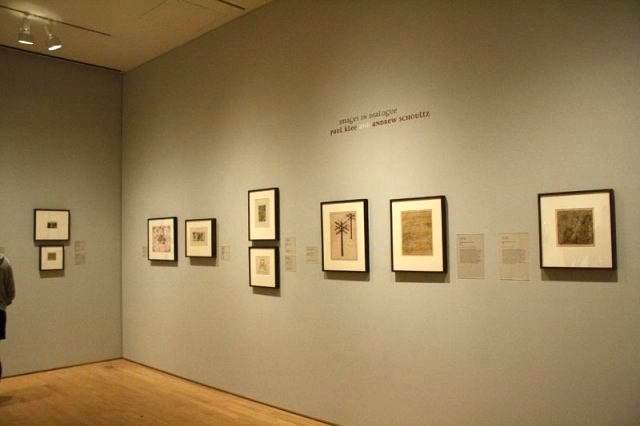


 As It Ought To Be