Mr. Frost (an excerpt from the novella Life After Sleep)

Mr. Frost (an excerpt from Life After Sleep)

by Mark R. Brand

“This frigging thing.”

Frost knew without looking that Mary had gotten blood on the hemocrit analyzer lens again. She started pulling out drawers at the nurse’s station looking for a box of individually-wrapped alcohol pads. This wasn’t as easy as it sounded. Some of the other nurses, and especially the medical assistants, loved stealing them and hiding them. The stock room guy was a blatant slacker and he just nodded like a bobblehead at the office manager’s suggestion that they only keep on hand the supplies they’d need at any given moment.

This of course meant that there were never enough of three-dozen random things at all times. Some days there’d be disposable gowns but no needles, other days there’d be five times as many bottles of peroxide as they could use, and if he wanted sterile gauze he’d need to barter half a box of iodine swabs for it with one of his associate’s staff members.

The supply black market was an unforgiving quagmire of ugliness and the instant a shipment of replacements came in, they’d vanish to wherever everyone was squirreling them away. They hadn’t had enough alcohol pads to go around for about a week and a half and nobody had extras to beg, borrow, or steal.

The hemocrit analyzer had a lens on the inside that was meant to read a little plastic disposable slide with a drop of blood on it. The chief flaw of this was that if jiggled even the slightest bit while inserting the slide, the blood droplet would contact the convex lens and smudge, rendering the machine useless.

“We going to get that reading?” he asked, just trying to light a fire under her a little. She pursed her lips but didn’t frown.

Three drawers later, Mary began hauling shit out and tossing it onto the desktop. Old versions of intake forms and script pads with one or two sheets left on them, loose drug samples on their cardboard blister cards, the caps for eighteen disposable pens that patients had wandered off with in their pockets and purses, and a seemingly bottomless pile of high-quality marketing materials shoved at them endlessly by the drug reps that haunted their office during clinic hours. After un-bending the last of these, Mary thrust out her hand silently in triumph. Behind all of this detritus she had found a dusty, forgotten box of alcohol wipes. An entire box! They were rich.

“Got it,” she said, busy using a slide to push the alcohol pad into the tiny space beneath the lens and swab it clean. Minutes passed. Finally it was ready. She grabbed her tackle box, took out another lancet and a fresh slide, and set off down the hall. Frost could hear her voice come muted from the other room. “Okay, Mrs. Healy, we’re going to have to jab you again, sorry about that.”

Mrs. Healy was a good sport, hopefully. He heard a beep and the analyzer flashed up her hemoglobin count. Frost hadn’t seen Mary return with the blood. He glanced up. There were still lights on in the rooms, but all was silent.

“Mary?” he called. No response. He walked back toward the rooms at the far end of the hall and found them empty.

He picked up the phone and dialed the office manager’s extension, thought twice, hung up, and dialed the extension for Greenstein’s nurse.

“DiLeccio,” she answered.

“Kelly?”

“Mmm hmm…is this…?”

“Doctor Frost.”

“Oh, hey Dr. Frost. I didn’t know you were still here.”

“Hey. Listen, do you know where Mary went?”

“Pretty sure she hit the road.”

“Really?”

Silence. He glanced at his watch. It was an hour past their last scheduled patient.

“Umm…”

“Right, sorry,” he said, choking on the awkwardness. “Have a good one.” He hung up.

*

X-ray machines consist of a large power generator that converts wall current to high-voltage output, a stabilizing arm, and a cylinder shaped like a large beer can. This cylinder contains an electrical anode and a rotating tungsten cone inside an airtight bath of coolant oil. This is the “tube.” The tube is encased in lead, except for the small aperture where the x-rays escape and travel at physics-class speeds through flesh, organs, and bone, finally striking a photosensitive crystal screen that imprints a negative image of the patient’s anatomy on a piece of multi-layered emulsive plastic. The rooms are generally lined with a layer of lead sandwiched in the walls to contain the photoelectric ionizing radiation that occurs when various milliamps per second course from the anode to the tungsten cone, creating a God-like arc inside the tube. All this happens in darkness, as most feats that harness the power of the building blocks of the universe do.

The doctor bounced a golf ball off of the tube in the x-ray room while the radiographer scoured the table beneath it with a disinfectant so strong it came in a glass bottle rather than a plastic one. The room smelled vaguely of feces.

“Do you get much Sleep?”

“About three hours, usually,” Andy replied. Andy had a kid at home, he knew, and another on the way. A girl named Stephanie and an unborn fetus named I Will Never Again Own a New Car. “Sometimes I get two and a half, but I don’t like cutting it quite that close. If I don’t get the full three hours, I just don’t feel right. Pretty soon I’m going to have to start Sleeping here because of the baby.”

“That sucks. You ever take naps?”

“Shit,” he said, looking sideways at the doctor. He stacked up x-ray films on a desk and started marking left and right on the corners with a black Sharpie.

“What?”

“You’re a lazy motherfucker.” He could always count on Andy for the truth. “Just turn up your Bed. Try maybe three and a half hours. You won’t be able to sit still after that much Sleep. You’ll be bouncing off the walls.” The golf ball continued to bounce off the x-ray tube.

The doctor wanted to tell him that he’d already thought of that, but didn’t. He picked this little strategy up at some conference or another in Arizona in the middle of the winter. A study was done by some focus group of vicious, slobbering medical office managers who had been let out of their cages long enough to compare notes about squeezing the last ounce of productivity out of their underpaid drones. They discovered that if the support staff think the boss is ignorant or empty-headed, they tend to work harder, a motivating force not unlike that of a child overcompensating for their well-meaning but chronically helpless parent.

He missed a catch and his golf ball rolled under the generator. He didn’t go after it. He had an entire bag of miscellaneous golf-related shit in his locker that his patients had brought him. Someone even gave him a putter shaped like a foot with a laser pointer attached to it. He didn’t know what was more insulting, his patients assuming he had time to play golf or the fact that they thought he was a bad enough player to need a laser-guided putter.

*

At some point, he realized he was in the middle of surgery on what used to be a young woman who had been dragged on a chain behind a sport utility vehicle over a mile and a half of gravel back-road.

“I think I’m hallucinating,” he said to no one in particular.

“That’s what she said,” came a reply from someone in a mask and scrubs. He gestured to the woman, whose anesthesia had sunk in enough that she could barely manage a whimper.

“Fuck you, I’m serious,” he said. His face shield fogged slightly when he exhaled.

“So is she, apparently.”

The unfortunate ingénue of that evening’s tragedy let out a “huhnnn” that was less than heroic as he scrubbed flecks of gravel out of her rectus abdominis muscle, which was open to the air given that the flesh of her torso above it had been taken off as if by a belt-sander. Cleanliness, right next to Godliness.

“What’s the time loss threshold for narcolepsy?”

“Huh?”

“It can’t be that, though. No cataplexy…”

“Focus, man.”

Frost wheeled on him, snake-like and covered in blood from sternum to knees. Whenever challenged, escalate.

“What the fuck did you just say?”

“Hey,” Dr. Nobody said, hands coming up, “I’m just here to help.”

“What are the risk factors for hallucination?” He had forgotten the patient on the table entirely. He picked up an emesis basin full of flesh and blood, intending to fling it at the resident if he flinched. Evidently the kid had been in operating rooms full of flying metal before, though, and held his ground.

“Uh… psychoactive drug therapy, alcohol and drug withdrawal, dementia, sleep deprivation, head trauma…”

Frost glared at him for another moment and the corners of his eyes flickered. Something like minutes went by. “That’s what I thought,” he said at last. He handed the resident the emesis basin and headed for the door, pulling off his mask as he went. Blood sloshed onto the floor, but he ignored it.

“Where are you going?”

“I need a nap,” he said over his shoulder to no one. As he hit the door he looked up to see another door. He opened this one into an identical hallway with another door at the end. And another, and another.

*

“Hi – this is Sandy at St. Augustine’s. We’re calling to make sure everything’s okay with our favorite doctor! Call us back when you get a minute. I’ve got a few messages for you.”

He thought he had turned the phone off, but he didn’t really remember. He had a vague vision of putting the key into his condo door and hearing it grind loudly as he turned it, and then soft blackness. Apparently he’d been unconscious for hours. The inside of his mouth felt like indoor/outdoor carpeting, and he had urinated on himself while he slept.

He hadn’t missed a day of work in seven years, twelve if you counted residency. He thought they’d be a lot angrier than they sounded. Sandy seemed nice. He made the call to the hospital and told them he’d be in later.

“Oh, that’s fine. Dr. Greenstein covered for you. He did leave a message that you should try the office Bed next time, whatever that means.”

“I know what it means.”

“You feeling okay?” she asked.

“Sandy…”

“Lisa.”

“…you’ve been more than helpful.”

He hung up. For all his lack of good taste in music, Greenstein didn’t miss much.

Every nerve cell in the human body consists of a long cable with a synapse at each end. The cable part of the cell is made up of fatty membranes that conduct electricity in the form of tiny, single-electron currents called action potentials that occur between sodium and potassium. When the current reaches the end of the cable, it jumps to the next strand by secreting a chemical that helps the current flicker across the gap. These chemicals have familiar names like serotonin, dopamine, epinephrine, and acetylcholine. When these currents jump to muscle fibers, you get a contraction. When they jump to a gland you get secretion. When they jump to your brain cells you get a boner, and so forth.

In the end, he thought, that’s all we are. Just electricity sizzling down cables made of fat and squirting across a little space between. This was another of those cases where knowing things didn’t improve on an otherwise blissfully ignorant life.

Tony Barker had this thought well in hand when he positioned the first TMS patient’s pre-frontal brain directly between the poles of an MRI electromagnet. Barker was doing this in the ’80s, so he was very progressive that way, but not so far removed from the old days that he flatly dismissed the gains made by psychiatrists in the ’50s and ’60s, when similar treatment modalities involved plugging people right into the wall current and putting a rubber block between their teeth so they didn’t snap them off. This was a kinder, gentler era. MRI was safe, as far as anyone knew. TMS was just a little current change. Hardly noticeable. The first two letters of MRI stood for Magnetic Resonance, and that’s exactly what TMS did. It caused the electrons on a molecular level to resonate. Instead of blowing the fuse entirely, the TMS just flipped the breaker on and off, on and off, thousands of times per second.

All Dr. Sid Merriweather did was discover the frequency, the note played across what amounted to a two-million-dollar electric guitar string, that reset the right sequence of synapses. Do Not Pass Go – head directly to Stage-4 REM sleep.

*

“There were a few pieces of ferrite dust on the magnet’s face, but not enough to throw off the cycle.”

“What is it, do you think?” Frost asked the repairman on the phone. He disliked people being in his apartment when he was not, but this could not be avoided.

“Hard to tell. You may want to just try another Bed if you have access to one.”

This bit of diagnostic wisdom was becoming tiresome, he thought while hanging up. He considered that it might be a while still before he went all the way over the high side, but he could feel it coming. Mary, prescient soul that she was, had started hiding his car keys. “Where the hell are they?” he asked her.

“What, doctor?”

“My keys.”

“Haven’t seen them.” As she walked away, the pocket over her left tit jangled.

“Mary,” he said, rubbing the blur out of his eyes, “I believe in the sanctity of the workplace and all that high-minded bullshit, but there’s only so much a professional can take.”

She shot him a look that pretended she had no idea what he was talking about.

He grabbed a random chart off of the wall and headed into the adjacent room. “That lung has to come out,” he announced firmly while walking in. There was no point being wishy-washy with these people. He gave them the straight news. The ten-year-old boy on the exam table looked up at him in terror over the cast on his leg. His mother, a woman who inexplicably wore yellow eyeliner, looked up from last April’s issue of TIME and gave him a shitty look.

“Excuse me for just a moment,” he said. “Mary!”

A medical assistant that he was firmly against hiring from the start looked up from a handful of used needles as the doctor passed him. He tried to scurry out of the way, but was too slow. The doctor grabbed the front of the assistant’s white coat and shoved him into the nearest room. The sound of hard muffled scrabbling against the shallow carpet was the only sound the kid made, as he attempted to keep his feet and failed. The doctor didn’t as much as look back. If you can’t stay out of your own way, at least stay out of mine.

The hallway overhead fluorescents started to pulse with his heartbeat. “Mary,” he bellowed down the hall, “the doctor needs you!”

She rounded the corner in a pretty flourish of professional crispness. The clean lines of her uniform threw her figure into maddening shapelessness. Only he knew that she had not taken her scrubs home to wash in over two weeks. Her filthiness was mildly arousing.

“I wonder about those armpits of yours,” he said.

She gave him a smile that said he was one charming dog. “Is there something you need?”

“I need my lung. Where did he go?”

“She.”

“Where did she go?”

“Room ten.”

“No,” he said, putting an arm around her shoulder. They walked toward room ten and on the way she walked him straight into a wall. He backpedaled awkwardly. It was a long hallway suddenly. “I was just in room ten, and my lung was definitely not in there.”

“Try again,” she suggested, helpfully. It was hard not to notice how round she was in her scrubs. Even with a lab coat on top. She made him think of a mesh bag of oranges shifting around in a big white grocery bag. She had enough smoke scent on her to keep her from ever smelling clean, but freshness wasn’t everything.

He took a deep breath and pulled down the lever-action door handle. Hospital door handles are regularly cited as the filthiest surfaces in the building. “That lung will have to come ou…” Sitting at a card table were three large greyhounds counting a stack of money. They peered up at him with lively, suspicious eyes. The one on the far left gave him a look like he might owe the dog a favor.

“Pardon me,” he said, closing the door quickly. Mary arched her eyebrows and her hair seemed to straighten and re-curl in front of his eyes. “Did you do something different with your hair?”

“Room ten is at the end of the hall.” Mary motioned with a seven-inch index finger. Lids with an unbecomingly cheap brand of eyeliner flicked up slightly.

“We’re going to have to have a talk about your bedside manner,” he told her as he proceeded onward. Suddenly, the medical assistant sprung on him like a trapdoor spider.

“Sorry doctor, I have Dr. Neely on the phone for you…”

“TELL HIM TO GO FUCK HIMSELF!” he screamed, buffeting the little bastard about the head and neck with a clipboard. He smiled as he walked away, secure in the effectiveness of his intuition. The escalation principle had once again steered him clear of time-consuming negotiation.

***

Mark R. Brand is a Chicago-based science-fiction author and the online short fiction editor of Silverthought Press. He is the author of three novels, The Damnation of Memory (2011), Life After Sleep (2011), and Red Ivy Afternoon (2006), and he is the editor of the collection Thank You Death Robot (2009), named a Chicago Author favorite by the Chicago Tribune and recipient of the Silver medal 2009 Independent Publisher Book Award (IPPY) in the category of Science Fiction and Fantasy. He is the producer and host of Breakfast With the Author and lives in Evanston, IL with his wife and son.

SATURDAY POETRY SERIES PRESENTS: JOHN REPP

Photo by Katherine Knupp


THE LETTER
By John Repp

In the letter,
             she says she doesn’t

want to end
             the letter so I’ll

never stop reading
             this scrap light

as ash in the pit
             where I’ve sworn

for thirty years to burn it


Today’s poem originally appeared in diode and appears here today with permission from the poet.


John Repp is a widely published poet, fiction writer, essayist, and book critic. Since 1978, he has taught writing and literature at various colleges, universities, schools, and social service agencies. A native of southern New Jersey, he has lived for many years in northwestern Pennsylvania with his wife, the visual artist Katherine Knupp, and their son, Dylan.

Editor’s Note: Today’s poem contains the joy of the unsaid. It enables the reader to invent a world—a relationship—from a few fragments of speech. There is so much joy in the power of the small poem, and in language that teases, that alludes to something larger than it shares and enables us to choose our own adventure.

Want to see more by John Repp?
John Repp’s Official Website
Buy John Repp’s Books

Rolling Stone

Rolling Stone

by Steve Davenport

Takes a flood to turn a bottom, make hell
of the houses on stilts and the ones squat
as toads hugging shore dirt. Tree-float and sop’s
the least of it. Takes more than a boat line
to drag a failing body from that noise,
the sucking into the long pull. River’s

anything but solidity of things,
no riprap of rocky words for footing.
River brings flow, flood, and alluvium.
Bottom was never saved by a song. Levee’s what

a river makes of it.

***

Steve Davenport is the author of Uncontainable Noise, which won Pavement Saw Press’s 2006 Transcontinental Poetry Prize. His New American Press chapbook Murder on Gasoline Lake is listed as Notable in Best American Essays 2007, and a story of his, published in The Southern Review, received a Special Mention in Pushcart Prize Anthology 2011. His second book of poems, Overpass, is published by Arsenic Lobster/Misty Publications. The above poem is reprinted from this book by permission of the author.

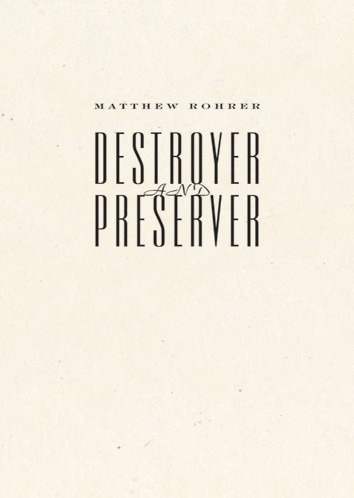
Review of Destroyer and Preserver by Matthew Rohrer

Review of Destroyer and Preserver by Matthew Rohrer

by Letitia Trent

I had a professor during my undergraduate years (one those old-fashioned liberal arts professors who believed that intimately knowing Milton’s Satan or Shakespeare’s Lear was a prerequisite for being a fully-functioning citizen of earth) that defined a great book as a book that shows you what it means to be human. He meant the great, big (and, unfortunately, primarily European or American) books, like War and Peace or Middlemarch, in which an enormous cast of characters weave in and out of each other’s lives, figuring out what it means to be a citizen, part of a family, a soldier, an artist, a lover, or a parent. I appreciate these kinds of books, too, books that are willing to explicitly wrestle with questions about how a person should be in the world and do not fear the explicitly political or philosophical. I don’t know how anyone writes books like this anymore. As Matthew Rohrer writes in the first poem from his book Destroyer and Preserver:

The oldest songs are
breaking apart
like a puzzle in a basement

What kind of writer has the gall to tell people how to live now, when there are no fixed certainties and no unassailable truths? This is not an original question, but one that I find myself bumping into over and over again as I read contemporary literature and poetry that dares to directly touch on the political as Destroyer and Preserver does. While I’ve read many contemporary poetry books that comment on the paranoia and rise of some fervid, defensive American identity that happened post 9-11 (Christian Hawkey’s Citizen Of comes to mind in particular), I don’t see many poets writing in what comes close to straightforward confessional lyric touching the issue of politics aside from Rohrer. Sometimes, when writing about war from the distance of a relatively safe place, the lyric, personal “I” can seem limited, small, stupid, unable to fully grasp anything important from the perspective comfort. Perhaps this is why many poets who are fairly privileged (I know that I am one of them) and who have never seen battle try not to tackle something as large as “the war”.

Destroyer and Preserver tries to show us something about what it means to be a middle-class, materially comfortable human in this particular time in the United States, one in which foreign wars and news of slaughter in countries in which we are linked by politics and war filter in and out of our consciousness through reports from Twitter feeds and Facebook updates, seeming both incredibly important and completely divorced from our everyday lives. I specify that the book is about middle-class life because it differs from many other overtly political books from the standpoint it takes: the speaker is comfortable, white, male, and a father. This is not a book that howls from the edges or speaks as a witness to political and social turmoil. I don’t mention this to belittle the book, but to make it clear from what perspective the book addresses the political. In Carolyn Forche’s introduction to The Poetry of Witness, she writes about the privilege of being a North American in the 20th and 21st centuries: “Wars for us (provided we are not combatants) are fought elsewhere, in other countries. The cities bombed are other people’s cities. The houses destroyed are other people’s houses.” This space is where Destroyer and Preserver comes from.

Part of the book is about the dance between enjoying the privilege we have as North Americans to live our lives relatively unscathed by war and the responsibility to acknowledge that our privileged lives are partly built on the backs of the suffering of other people. Rohrer’s book differs from those big books about morality in that it’s a product of its time, and therefore the poems don’t tell us anything definitive about how to balance joy and responsibility: the subject is not knowing, of feeling guilty for running away to poetry or family life or dreams (the book is full of dreams), and of being politically engaged but not politically engaged enough to leave what is comfortable behind. The speaker in these poems spends his days taking care of small children, recovering from hangovers, and walking around a city as news of what’s happening in the Middle East filters in and out of the central consciousness of the poems. For example, in the poem “Casualties,” the poet’s small son asks “are soldiers good or bad?”, and the speaker meets his son’s confusion with his own:

I see his face, his eyes
right in front of mine.
We are drowning together

in the hold of the ship.
He looks just like me.

The poem leaves us with an image of the plane, having just dropped a bomb on the house and desert, gliding through the sky and being returned to the United States, “to be washed and put away”. Throughout the book, images of war are and desperation are washed and put away and then continually taken out again to be examined, as with the speaker of “Poets With History/Poems Without History”:

… and the melting icebergs crumple

like the prisoners shot in the side

I move through the days remarkably sinuously

and spinning inside

I washed the dishes two or three times a day

with hot water on and on

like a dream behind the yellow gloves

from which I too cannot awaken

though my son is done with school

and holds my hand on the walk home

the feeling of falling backwards

into the bed at night fills me

each time

with sweet content

all the people rounded up in camps

have a look in their eyes

that can’t reach us now

Rohrer is at his best when the speaker of the poems sees this point of tension between a comfortable life and the knowledge that so many other people are not able to have that comfort: the poems are electric when the speaker is both conflicted and ultimately a failure at keeping the high moral ground. They falter, though, when the speaker seems to imply a particular stance is the “good” one: in “For Which I Love You,” the speaker congratulates a lover for a fairly standard, simplistic affirmation against “hate” which reads a little bit like self-congratulation for having the “right” political point of view.

It would be unfair to say that this is only a political book: several short, lyric poems punctuate the book, ranging from records of sad, contradictory moments to poems that seem like sheer celebrations of everyday life, such as “The Smell of Frying Fish.” It’s the context of these poems that makes them political: images of war surface throughout the book in poems that at first seem to be about something completely outside of war, and so these moments of domestic bliss mean something more: is the speaker giving in to forgetfulness or resisting despair by living in the moment (as cliché as that can’t help but sound) by fully embracing the given world around him?

Rohrer’s poems are largely dreamy, personal lyrics that roll from matter-of-fact observation to gentle surrealism, creating poems that seem casually tossed-off yet completely controlled within one lyric event, world, or emotional/narrative moment. You could call it domestic surrealism, but Rohrer’s observations are more about finding the literal strange in the familiar than in creating strangeness. Still yet, reading the book felt too easy: the poems are easy to read and pleasing because Rohrer is good at this kind of poetry and knows what he is doing. I couldn’t help but feel that Rohrer was coasting and that these poems are a slightly toned-down, less boisterous versions of ground he’d already covered in his first book, A Hummock in the Malookas, and his subsequent books. Only in the long poems of the book (“Believe” and “The Terrorists”) does Rohrer seem to stretch beyond his familiar gently joking, gently serious tone.

I can’t say that Destroyer and Preserver left me with anything definitive about how to be a conscientious person in a complex world, but it left me with a useful confusion and the realization of how often I, too, retreat into what’s comfortable in order to forget my own great fortune. I’m not the soldier who crumples, the face behind the cage, or the person whose home has been bulldozed. I have the privilege of forgetfulness, and I exercise it far too often.

***

Letitia Trent‘s work has appeared in the Denver Quarterly, The Black Warrior Review, Fence, and Folio, among others. Her chapbooks are Splice (Blue Hour Press) and The Medical Diaries (Scantily Clad Press). Her first full-length poetry collection, One Perfect Bird, was published by Sundress Press in early 2012. She was the 2010 winner of the Alumni Flash Writing Award from the Ohio State University’s The Journal and has been awarded fellowships from The Vermont Studio Center and the MacDowell Colony.

SATURDAY POETRY SERIES PRESENTS: TERRI KIRBY ERICKSON

DEPRESSION
By Terri Kirby Erickson

Her knees nearly buckle with the weight of a new star,
but oh the sweet relief when one of them falls or when
the sun pulls up its rays like rope ladders because light,
even light is too heavy for her to carry now. And look

at her loose grip on the baby’s stroller, as if any minute
she might let go. Other mothers’ eyes follow their children,
glisten like the wet clay of a newly fashioned Madonna,
but her expression never changes. She sees nothing but

the dull, brown jar where she spends her days alone, its
walls slick and impossible to climb, the lid screwed shut—
feels nothing but cold glass against her back, the tightening
in her chest when she tries to breathe what little air is left.


Today’s poem originally appeared in Tryst, is included in the poet’s latest collection of poetry, In the Palms of Angels (Press 53), and appears here today with permission from the poet.


Terri Kirby Erickson is the award-winning author of three collections of poetry, including her latest book, In the Palms of Angels (Press 53), winner of a 2012 Nautilus Silver Award in Poetry and the Gold Medal for Poetry in the 2012 Next Generation Indie Book Awards. Her work has appeared or is forthcoming in the 2013 Poet’s Market, Ted Kooser’s American Life in Poetry, JAMA, The Christian Science Monitor, storySouth, and many other publications. She lives in North Carolina.

Editor’s Note: Terri Kirby Erickson has a way with direct, straightforward narrative poetry. You are at once within the scene she is painting, carried along by her skill with the lyric and the image, amidst a palpable world where you feel you could actually pluck the fruit from the trees of her invention. Today’s poem captures the inner workings of a sometimes secret condition, yet Erickson’s words bridge the shame gap by giving rise to empathy in the reader.

Want to see more by Terri Kirby Erickson?
Terri Kirby Erickson’s Official Website
Press 53 Author Page
Buy In the Palms of Angels on Amazon
Buy Telling Tales of Dusk on Amazon
Buy Thread Count on Amazon

SATURDAY POETRY SERIES PRESENTS: JOHN PAUL DAVIS

MYSELF, WITH THE NIGHT ON MY FACE
By John Paul Davis

For an angel went down at a certain season into the pool, and troubled the water: whosoever then first after the troubling of the water stepped in was made whole of whatsoever disease he had.    – The Gospel of John 5:4

If I had known more grace. Heartwinter,
& all the locks frozen over. The songs
I should have been able to sing. I no
longer want to know the answers
to any of the questions. My body
less reliable now that I’m older,
& the doctor tells me I’m fit
for my age. Healthy, but not whole.
Like how I have forgotten
how to pray, the muscle that yearns
for God gone slack in my mind
after all these years. I have stopped
expecting the world to deliver magic
to me, yet it continues. Like the clouds
over Brooklyn the morning after I face
the difficult thing & deliver the bad news,
the perfect play they make with the light.
Like being awakened after midnight
by the memory of the song,
only when I listen in the bedroom’s cavedark,
the music is sweeter
than I had recalled, it is a deeper
taste. The music inside the music.
I tell you, I have been granted
the more costly victory. Like love, again.
Like a lame man on crutches to the water
expecting to beg for the day’s provisions
& what waits for him terrifies
him most: unseen,
fingers armed with heartbreak,
about to trouble the pool, the angel.


Today’s poem appears here today with permission from the poet.


John Paul Davis writes poems. Learn more about him here: www.johnpauldavis.org.

Editor’s Note: John Paul Davis is a badass wordsmith with a real knack for blank verse, which is no easy craft to master. I have had the pleasure of seeing Mr. Davis read several times at NYC’s louderArts, and am often moved—if not breathtaken—by his poetry. Today’s selection confronts the human condition as Davis often does, with words that aim straight for the soul of the reader and do not fail to find their target. From the micro of the inner workings of one man to the macro of humanity’s relationship with God, Davis is the poet taking one small step for man and one giant leap for mankind: “Like how I have forgotten / how to pray, the muscle that yearns / for God gone slack in my mind / after all these years.”

Want to see more by John Paul Davis?
John Paul Davis Official Website

Basket

Basket

by Angie DeCola

Once held a pile
of biscuits. Since then sits
still in the corner, a tabby
watching marbles roll
and sound across the floor.

Next to the table now not on it,
basket’s useless as ripped pages
of a tablet, an unchewed chiclet,
a glass of sweet muscat when the meal
needs something dry and viscous.
Basket’s as mistaken as a misread cue card—
muskrat instead of whisker, mascara for mosquito.

Basket feels as much a quitter
as the secondhand guitar—two unused
props in their corners, gritty and tired
on the grained pine planks.

Basket needs purpose—to fall like Niagara, to topple
the notion of blending the way Fallingwater house does.
Basket wants to go back to the prairie, to belong
there with the prairie dogs, who might be prey
for cliques of birds and cats but still
prove themselves daily, digging hole after hole,
rising out of them to scan the grasses and,
in the nick of time, going under again.

Basket doesn’t know what it’s here for.

***

Angie DeCola’s poems have most recently appeared in Crazyhorse and Copper Nickel. Assistant poetry editor at storySouth, mother, and freelance pastry chef, Angie currently resides in the tiniest little town she’s ever lived in, in southern Michigan. Her poem “Basket” was first published, in a slightly different version, in The Greensboro Review, and is in the process of reinventing itself as a children’s picture book.

SATURDAY POETRY SERIES PRESENTS: WILLIAM REICHARD

PALIMPSEST
By William Reichard

The dead call to say they’re not dead, or they are, but in any case, would I please stop writing about them? All of my old lovers call to say they prefer their privacy, so maybe I should stop writing about them. My brothers and my sisters call, then my mother, then my partner, all to ask, would I please stop writing about them? All right. But what then? This morning I sat in an office surrounded by a sea of papers. They all had to be put in order. So I put them in order, in neat little piles, then larger groups, then into the folders and the files where they belong. This is what I’m good at when I’m not writing about the lives of those I love, have loved, may love; when I’m not borrowing heavily from the lessons they’ve learned through pleasure and pain. This afternoon I stopped for the things we need to keep our house running: cleansers, cat food, laundry detergent. I pick them up week by week, we use them up week by week and then I go and get more. This is what I’m good at when I’m not remembering the fields of my youth, the evenly spaced rows of green and black, plant and soil, the odd sunflowers that sprang up because hungry birds carried the seeds from feeder to nest and dropped a few along the way; the sudden tall yellowness of such flowers in the cultivated order of things. This is what I’m good at when I’m not recalling a former love, the bend of his back, shoulders sculpted by afternoon light. This evening I made dinner, something not too good but edible. This is what I do when I’m not reliving the scenes of a childhood I remember more from stories than experience. I feed things: my partner, my cats, the strays in the garage. This is what I’m good at: taking care of people and things that need taking care of. This, when I’m not thinking of my parents, their lives intersecting at just the wrong time in order to make each of us, my brothers and sisters and me. When I’m not dwelling on this then I’m washing the dishes, washing the clothes, taking out the garbage. This is what I’m good for: running my little life, when I’m not locked away in my room, trying to write about all of the things I’m told I shouldn’t, yet must, and do.


Today’s poem originally appeared in Midway Journal, and appears here today with permission from the poet.


William Reichard is the author of four collections of poetry, including Sin Eater (2010) and This Brightness (2007), both published by Mid-List Press. He is the editor of the anthology American Tensions: Literature of Identity and the Search for Social Justice (New Village Press, 2011). He lives in Saint Paul, MN.


Editor’s Note: Today’s poem contemplates what it is to be a writer, and William Reichard obviously gets it. If you are being asked to stop writing about the ones you know and love, you are probably doing something right. If you are not writing, there is plenty to do to comprise a life—chores, errands—but what kind of a life is it when you are merely surviving, as opposed to living? Amidst the clarity and logic of today’s prose Reichard breaks into beautiful lyric imagery. In so doing, he lets the reader know what always lies beneath the surface—even of the mundane—when one is a writer.


Want to see more by William Reichard?
William Reichard’s Official Website
Mid-List Press
New Village Press
Knox Writers House
Interview in Literary Magpie

Diving For Dear Life

“Diving For Dear Life”

by Ashley Browne


Thirty years ago I sat on a battered Royal Navy destroyer somewhere off the Falkland Islands, listening to the BBC World Service announce that the Argentine forces on the Falkland Islands had just surrendered.  It was traditional for the BBC to tell us (and the Argentines) things before our own command did, simply because the U.K. Government usually told the BBC first.

Some three months earlier, my friends and I had been merrily drinking our way around the bars of Gibraltar, celebrating the end of a long and fairly tedious naval exercise in the Atlantic.  There had been glimpses in the news of the forthcoming trouble in the South Atlantic but when the story finally broke of the Argentine invasion of the Falkland Islands, our initial reaction was one of ‘where?’  In all honesty, the majority of us had no idea where the place was, there was a rumor that the navigation officer may have known but even that couldn’t be verified.

As we parted company with friends on other ships (a couple of whom, sadly, we would never see again), none of us could really imagine where this journey would take us.  Being as heavily trained as we were, the extra exercises had little impact on us mentally and the accompanying soundtrack of the ongoing negotiations had the misleading but comforting effect that it would all be sorted out before any fighting broke out.  The chilling reality dawned on me when I had to donate two pints of my own blood to be held in the sick-bay chillers “just in case”; nothing hits your 18 year old sense of invulnerability more than watching your own life-force being stored to possibly save your life at a later date.

Fast forward four weeks and we now found ourselves in a truly frightening shooting war and the ship was now very much in the front line and remained so throughout the rest of the conflict. During a series of hard fought air-sea battles against the very useful Argentine air force, this same ship sustained heavy damage and a number of my ship-mates were wounded.  Two of those ships that had been with us in Gibraltar were now at the bottom of the South Atlantic with some of our friends in them.

As might be expected, those dramatic events are still sharply etched in my memory and even after thirty years I can still capture the feelings and sharp emotions that surged through me at the time; the clenched, controlled fear of doing your job under fire, the deafening and intensely metallic sound of battle and the odd sense of almost zombie-like detachment that comes after the adrenalin surge of combat winds down to be followed by twitchy, nervous exhaustion and a few hours of comatose sleep if you were lucky enough that the watch system was in your favor when stood down from action. The general sense of enduring was always there; constant fatigue, cold, damp weather and short rations are my abiding memories of the time but always sweetened by the constant piss-taking humor which can still make me laugh today looking back.  We knew we were far from being an invincible war machine but just had to tough it out, the Royal Navy’s overbearing tradition of not giving up saw to that, rarely mentioned but tangible just the same.

With hindsight, our sound training (the end result of the Royal Navy’s torrid experience during the Second World War) and an ingrained sense of (at times black) humor saw us through physically and mentally. Petty differences were put aside for the duration.  Of a crew of near five hundred, only two men were taken off the ship as a result of what could be considered to be nervous breakdowns.

The Falklands are back in the news here in U.K. and the recent coverage of veterans’ issues combined with a long talk I had with a younger friend who has completed several tours of Iraq and Afghanistan, got me thinking about the effects of the high level of exposure to active service and direct combat on British service personnel and their families and associates in recent years.

Like the United States, the United Kingdom has had one arm or other of its armed forces engaged in active service on a more or less permanent basis since the end of the Second World War, from Korea to Afghanistan, in conflicts ranging from full-blown conflict to policing and peace-keeping operations, some as a result of savage civil wars, such as Bosnia in the mid-nineties.  Putting the politics and rights and wrongs of these conflicts aside, this has resulted in worrying levels of mental disorders among the young men and women involved and has directly impacted families, friends and colleagues who have to pick up the pieces, often with very little help from official channels in the shape of the Ministry of Defence (MoD) and the National Health Service.

All modern armed forces train their personnel to a point where they can cope physically and mentally to be able to carry out their allotted tasks while under extreme conditions that mirror as closely as possible combat situations .  Men and women will be exposed to harsh physical conditions, tiredness, limited rations and repetitive exercises. All of which are designed in quasi-Darwinian way to filter out those incapable of “making the grade” and expanding the concept of what is possible for those that do.

While this induced mental and physical hardening is an obvious prerequisite for men and (more frequently) women engaged in combat, the enforced bottling up of natural emotions and the subsuming of personal feeling into that of the team is almost certainly one of the main root causes of later mental problems including PTSD.  Modern military training is targeted at helping men (and increasingly) women in combat (and other dangerous military situations), overcome the immediate and natural reactions of a human being when faced with a danger.  Programs such as the U.S. military’s “Battlemind” initiative and similar programs in other NATO forces, have been highly successful in preparing troops for a shooting war but are not geared for helping those same troops wind down and rehabilitate into society, when their services on the battlefield are no longer required.  Although the U.S. has recently updated “Battlemind” to take into account post-deployment rehabilitation and help for spouses.

It is probably fair to say that although every major conflict throughout the 20th and 21st centuries has produced casualties with wounded minds, the Vietnam War was the one which really focused the Western world on the potential for long term mental harm to troops involved in modern warfare.  The shameful treatment of “shell-shock” sufferers in the First World War is indicative of how poorly the subject was understood at the time, although some effective pioneering work was carried out during that war, particularly by W.H. Rivers and others at Craiglockhart in Scotland (as readers of Pat Barker’s Regeneration trilogy will be aware).  Although the condition was recognized at the time, little or no follow-up research was done on those men that returned from the trenches of France or the Middle East and many of these men lived the remainder of their lives alone with their condition unable or unwilling to share what they had seen with their families.

By the time of the Second World War, advances in clinical psychiatry and the large scale involvement of psychiatrists with the armed forces, had bought about some recognition that men in combat had a limited “shelf-life” if they were not going to suffer long-term mental harm.  This thinking was borne out by later analysis, the fighting effectiveness of troops that had been in combat for 30, 40 and 50 days fell away exponentially, until at 60 days they were effectively incapable of continuing to fight.   Units had to be rotated out of the front line as regularly as could be allowed, in order to recover, both physically and mentally. These men often recovered quickly and one of the key factors in this was that unit integrity was maintained. Surrounded by friends and colleagues of a similar mindset and experience, they were able to reconcile their experiences and recognise that their unit provided a support mechanism, effectively a surrogate family.  I can remember conversations with my own grandfather (a veteran of France, Dunkirk and the Western Desert) on the subject and recognizing from my own experience, the importance of the bonds of those friendships to our well-being. Nothing describes it better than Shakespeare’s ‘Band of Brothers’ speech from Henry V, at that moment in time it is genuinely a form of love.

The Vietnam War produced its own set of special problems for the troops involved.  After the early phases of the war, men were drafted into units piecemeal with little acclimatisation time, the unit integrity and support mechanisms of the Second World War were often lacking and the war ultimately became unpopular at home, leading those doing the fighting feeling that they were lacking in true purpose.  Added to this (and this is true of present day Afghanistan) the fractured nature of the fighting and the lack of a clearly defined front-line, meant that even when out of combat, true relaxation was never easy.

Perhaps because these issues were so widely known combined with the sense that a generation of America’s male youth had been badly let down by the system and the later high level of interest shown by the media, writers and film-makers (some of whom had served in the war), the Vietnam War is now viewed as something of a turning point in the recognition and treatment of war related mental disorders.

The term Post Traumatic Stress Disorder was created by the American Psychiatric Association (APA) in the 1970’s and listed in their (then current) Diagnostic and Statistical Manual of Mental Disorders 3 (DSM-III) at the behest and prompting of the Vietnam Veterans Against The War organization and their supporters.  PTSD is part of a larger categorization of mental disorders and while being far from exclusive to war veterans, it has provided psychiatrists, clinicians and general practitioners with a set of clearly defined set of symptoms that can be identified and possible cause can tracked against the patient’s history of traumatic events.  This has been of particular use when dealing with combat veterans.

The key factor in this is recognition of the symptoms and early treatment; a rape or assault victim may receive counseling as part of any criminal investigation and subsequent assistance program, in essence they will rightfully be expected to have been traumatized by their experience and hopefully any symptoms of PTSD will be picked up quickly and can be treated sympathetically. This kind of counseling, unfortunately, is rarely the case with returning combat troops in the U.K. at present.

The U.K. has lagged badly behind other Western countries in its approach to identifying PTSD symptoms amongst servicemen and women, there are no longer dedicated military hospitals in the U.K. and the facilities at Selly Oak Hospital in Birmingham are effectively (and rightly) dedicated to the treatment and initial rehabilitation of those physically wounded.  This means the onus falls on an often overworked chain of command and chaplaincy to recognize when servicemen and women are displaying any of the classic symptoms of PTSD. Turn around times between deployments is often rapid and those same men and women cannot easily be monitored when on leave.

Recognition of any potential problem becomes even more difficult upon a man or woman leaving the armed forces and the loss of security and new stresses and strains may often act as a trigger for any latent problems.  Unrecognized and untreated the outcome for PTSD sufferers and their families can be tragic; by 2007 more Falklands veterans had committed suicide than had been killed in the actual conflict. Divorce rates are higher than the national average for the same group and the high level of ex-servicemen amongst the homeless in the U.K. is perhaps indicative of the level of untreated mental illness.

Fortunately, there are charities in the U.K. which are leading the way in dealing with combat related PTSD for ex-servicemen and women, chief among them being Combat Stress.  These organizations provide assistance to PTSD sufferers, advice to general practitioners and support to partners and families.  Diagnosis and some basic Cognitive Behavioral Therapy (CBT) is often all it takes to help someone. Recognition that what they are experiencing in civilian life is not necessarily a result of their combat experiences is often the first step to stability for most.

As a result of a rising profile of combat related PTSD in the U.K. due in main to campaigning by ex-service groups and the likes of Combat Stress, some research into the condition is now being carried out at St Thomas’ Hospital in London.

In 2004, after some 17 years of keeping a lid on my own symptoms post-Navy, I finally sought out some counseling.  At the time, I doubt many people would have thought I had a problem but I was starting to recognize in myself some of the odd and at times, disturbing behavior I’d seen in some of my old Navy friends whenever we met up.  I was one of the lucky ones, my symptoms were (and occasionally are) pretty mild and I had the financial wherewithal to address the problems. Others aren’t so lucky.

I don’t think anyone comes through war unchanged, some less than others but providing help for those most affected by the wars, that our politicians send us to, is a lesson that this country and specifically its government needs to learn quickly.

The Gift of the Wise Man

The Gift of a Wise Man

by Janet L. Factor

myrrh  n.  An aromatic gum resin obtained from trees and shrubs of the genus Commiphora, valued in the ancient world as a perfume and as an embalming agent. Traditionally, gift of the Magi to the infant Jesus.

This set down / This: were we led all that way for / Birth or Death? -T.S. Eliot, “Journey of the Magi”

Not so long ago I found myself an inadvertent party to a conversation at my health club. A woman was complaining about a video she had recently rented for her daughter. The movie was Old Yeller, and she had rented it because it had been recommended to her as a classic, something that every child should one day see. Her daughter had been very upset by the story, and the mother was indignant.

This movie is the tale of a stray yellow dog that is first rejected and then adopted by a farm boy on the frontier. The two grow to love one another and become inseparable. Then one day the boy’s family is attacked by a rabid wolf. The dog successfully defends them, but is badly bitten by the wolf. The boy’s mother warns her son that the dog is doomed and must be put down, but the boy cannot accept this verdict. He quarantines Old Yeller until one day, the virus wins and the maddened dog turns on him. Then he recognizes his mother’s wisdom, and reluctantly he carries out the now clearly merciful sentence.

The angry woman summed up this plot scornfully: “A boy loves his dog and then he has to kill him! What kind of lesson is that for a child to learn?” At the time, I had no ready answer, although I felt a passionate desire to defend the movie. I had seen Old Yeller when I was perhaps 8 years old, and had anyone asked, I should have said that it was one of my favorite movies. Yet I was just as upset then as her daughter was now. Although it has been decades since the one and only time I saw the movie, I can still vividly see the climactic scene and feel the bitter anguish I felt then. But I loved the story and have always valued my experience of it. What profound lesson had it taught me, that I should even now feel so strongly about it?

After much discussion and soul-searching, I have come to the conclusion that the lesson of this story is a stark and yet a very necessary one. What I learned from Old Yeller without ever consciously realizing it was this: the price of love is loss. No matter how happy, no matter how perfect and true the love, it will one day end in tears, for we cannot escape our own mortality. It is a lesson about the fundamental nature of the human condition that we all must master to become truly adult. In the movie, it is the mother, mature, who foresees death, and the young boy who seeks to deny it. In accepting at last its inevitability and indeed necessity, he takes a step forward into adulthood. And I, watching, took that painful step with him.

Why, then, did this modern mother object so strenuously to her daughter’s experience? Perhaps she was like the other parents of whom I recently heard, who, when it was time for the old family dog to be put out of his pain, told their children instead that they were taking him to live with a family on a farm, where he would have lots of room to run and other dogs to play with, a place where he would live happily ever after. Love can sometimes lead our hearts astray. For while it is natural to wish to spare our children pain, in doing so too assiduously, we deny them indispensable knowledge.

I believe that acceptance of one’s own mortality is the root of all wisdom. In both Eastern and Western cultures, the precious gem symbolic of wisdom is the pearl, for in converting the grain of sand within its shell into a pearl, the oyster takes inescapable pain and uses it to create a shining beauty. Likewise, it is only because our time is short that anything we do in our lives truly matters. If we do not see an end to life, we remain always children, living in an eternal world of make-believe where nothing makes any real difference because the play will go on and on, and can always be re-imagined another time.

Without the understanding that we are mortal, we cannot appropriately value our own lives. Unless we know that life is fragile, and brief even in its luckiest prolongation, we will not treasure each moment of joy that comes our way; we will not hasten to seize precious opportunities before they pass beyond our grasp. We may not always cleave to those we love, not thinking how our time with them is limited. Until we understand that we must die, we cannot begin to live.

Many times I have turned these thoughts over in my mind, for on July 20th of the summer of 2000, my father died. As I sat upright in the front pew at his funeral and listened to my older brother tell the tale of Dad’s life, I thought to myself that if the pain then in my heart was the price I had to pay for this man’s love, I would gladly pay it again, a thousand times over.

My father was not a rich man, he was not a famous man, he was not especially handsome nor at all proud. Yet there was a greatness in him, for Dad was wise as few men are ever wise. Of all the people I have known in my life, and I have had many beloved teachers, he is the only one I would honor with the ancient title of Sage. Thoreau says, “To be a philosopher is not merely to have subtle thoughts, nor even to found a school, but so to love wisdom as to live according to its dictates, a life of simplicity, independence, magnanimity, and trust. It is to solve some of the problems of life, not only theoretically, but practically.” This my father did, from childhood through the moment he died, suddenly, unexpectedly, but as befitted such a wise man, not unpreparedly. For what is death but the greatest problem of life?

Dad was born into rural poverty in South Dakota in 1919, the youngest of three illegitimate children at a time when that status was still a curse. At the age of two, already scarred by his drunken father’s abuse, he was abandoned along with his siblings at the grim State Public School in Owatonna, Minnesota; his desperate mother had found a man willing to marry her but unwilling to support another man’s children. The searing experience filled Dad not with bitterness, but sweet compassion. “Kindness is the most important thing in the world,” he told us. “I learned that at a very early age.” He resolved to be a better man than those his mother knew. He had no patience with macho posturings: a real man to him was one who had the fortitude to stand by his wife and support their children. Correspondingly, he was a vocal supporter of feminism and of reproductive choice.

At five he was taken from the orphanage to live with a farm couple; when he was nine they adopted him. He was forever grateful for and returned the love they gave him. Later when Grandma, aged and long widowed, was no longer able to live on a farm, it was Dad who took her in.

Growing up in that tiny town, conscious of his outsider status, Dad set to work to discover who he was and what he could make of his life. Long before he finished high school, where he was a star athlete, he had read and re-read every book in the local library, seeking a broader view of life’s possibilities than could be had from the dirt roads that converged there. “There is no such thing as a good role model,” Dad told me. “I knew as a boy that we are all unique individuals and there is no reason to try to be like anybody else. I only wanted to be the best me that I possibly could.”

After graduation, in the midst of the Depression, he joined the farm crews that migrated from South to North and back again, working the plowing and the harvest, earning money to help keep the farm, which was saved only by FDR’s moratorium on farm foreclosures. (That made Dad a lifelong Democrat.) When World War II came, he joined the Navy, wanting to serve but also seeing it as a passport to the wider world. His intelligence, skill, and cool head-when mental maturity tests were given in training, the results caused officers to exclaim “God! Factor was born old!”, which made Dad laugh-earned him a position as pilot for those trickiest of airborne vehicles, the blimps that ran escort missions with convoys off the coasts, spotting U-boats from on high.

After the war the GI Bill offered opportunity, and Dad seized it with both hands. He attended the University of Minnesota, earning a degree in chemical engineering with such distinction that his professors urged him to stay on and attend graduate school. But Dad refused, for he had met and married my mother. “Life is short, and I am already over 30,” he told his teachers. “I want to have time to raise a family.” Raise us he and Mom did, sending all four of their children not only through college but on to graduate school. Dad also continued his own education, for he remained an inveterate reader, with a special fondness for history, which he studied for the light it threw on human nature. Books were the only material possessions he cherished.

Throughout his adult life Dad worked for his community. He served on the school board, sat on the city council, headed campaigns to pass school tax levies, led the United Way fund drive. One of his last acts at the PPG factory where he worked was to plant the seeds of a project that has since reclaimed to nature large areas previously laid waste by the industry’s by-products, while simultaneously cleverly recycling the city’s treated sewage.

Always Dad loved jokes, especially puns, and was known for his good humor and joie de vivre. “It’s a great life!” he frequently exclaimed. Yes, it was, we agreed, and well-lived; and we made that the theme for his funeral.

As my family rallied to cope with his death, almost everywhere we went, we found that Dad had been there before us. It began even before he was officially dead. As we sat in the dim waiting area of an unfamiliar tourist-town hospital, the emergency room physician came to ask our permission to cease efforts at resuscitation. There was still some small amount of electrical activity in Dad’s heart, he told us, but it had been more than half an hour since he had had a heartbeat, and there was certain to be major brain damage even in the unlikely event that they should succeed in their attempts to restart the beat. Did we still want him to go on? My mother, my oldest sister, and I all said with one voice, “No! He would never want that. Stop! Let him go.” We could speak then without hesitation or guilt because Dad had made sure we knew how he felt. He had foreseen, and smoothed our way.

Once we were home and the dreadful duty of making phone calls to my brother, other sister, family friends and relatives was over, we turned to the more prosaic problems and found most of the work already done. His important papers were gathered together. His will was there, though he had taken care to arrange that his financial assets would pass automatically to Mom. All information my mother needed to claim pension and other benefits at his death was placed in an envelope labelled in large letters “Louise-Important.” His grave and marker, and one for my mother beside him, were long since bought and paid for.

The only omission, which at first I found puzzling, was any expression of wishes about the conduct of his funeral. It seemed a strange lapse. Mom struggled with the decision, then chose to have a traditional funeral at the church, with family selecting the music, and anyone welcome to speak in Dad’s memory. As my siblings and I scattered to find Dad’s favorite books, then settled down to peruse them for appropriate quotations, we found that there too he had gone ahead of us, trusting that we would follow.

In all the books, appropriate passages were carefully marked. In the anthology of poetry that my mother had given him at their marriage in 1949, he had inserted two bookmarks with the name and page number of the poems also written on them (they might have fallen out, you see, and in important matters Dad was always careful to prepare for any eventuality). One piece was Edwin Markham’s great elegy for Abraham Lincoln, Dad’s hero, which I read at the funeral. The other was a love poem, a last farewell left for my mother. Late the night before the service, I found that in Walt Whitman’s Leaves of Grass, he had highlighted the ode to Death that occurs in the midst of “When Lilacs Last in the Dooryard Bloomed,” and written clearly beside it “A perfect eulogy.”

Whitman’s ode is perhaps the most eloquent expression in the English language of the adult attitude toward death: understanding that this is the price for the beauty of life, and willingness to pay it. As my husband stood at the lectern and read the lines that Dad had chosen, my heart was torn with the beauty of it and the irony. We sat in the church where my father had been a member for some 50 years, where he had taught Sunday school in the prime of his life and served on the church council into his late 70’s. The pews were full of friends and members of the congregation who had grown old sitting there beside him. Yet almost none of them knew what both the struggling speaker and I knew, knew what depths of Dad’s soul were being expressed in these lines of poetry about accepting mortality, for Dad, devoted family man, staunch friend, amiable co-worker, pillar of the church, and scrupulously ethical public servant, was a lifelong atheist.

I do not mean for a moment that he was a man devoid of reverence; no, he was filled with it. But Dad revered the real world, the one in which we all live and die, this place that is relentless and terrible even as it is beautiful beyond all hope of expression. Humble indeed he was, but when Dad bowed down it was not before some omnipotent autocrat, but before the powerful wonder of this world. He was what is sometimes termed a modern pantheist, one who believes that the Universe and God are but one and the same thing, that life and non-life are united in this overarching order, and that anthropomorphic conceptions of a personal divinity are but primitive and petty imaginings compared to the sublime glory of the real.

         I knew these were the beliefs that shaped Dad’s life, because I shared them. I came to this view through my scientific training, even as Dad came to it through the application of his own meticulous intellect to his vast knowledge and experience. He spoke frankly to me about his philosophy many times. But he confided in very few, only those that he could be certain were spiritually akin to him. It was not until his funeral that I finally understood why.

As I followed the formal ritual of the service and listened to the pastor’s predictable homily about the gift of eternal life, what struck me most about these mythological trappings that I well knew my father had never believed was just their childishness. What a transparent fantasy! How was saying that Dad had gone to heaven where we would all rejoin him someday (provided we were good) any different from telling a child “Rover’s gone to live out in the country. Maybe someday we’ll be able to go visit him, but not right now?” It seemed to me insulting that I should be offered this juvenile fare, like a lollipop, to assuage so deep a pain, as though the death of one’s father were a mere pinprick.

There is no pain like the pain of grief, for its cause can have no remedy. Death is final. It must simply be borne. Sitting there on the unforgiving wood, I thought “There is no consolation possible for this.” Yet many in the church seemed to feel consoled. How could this be?

I saw then what I had never seen before, understood the appeal that religion holds in a new way. For this minister was not, as I had thought, offering us a patently inadequate anodyne for our mortal agony. No, he was inviting us instead to turn our heads away, to deliberately spare ourselves the fearful prospect of the coffin that stood before us, and so avoid suffering altogether. “Let’s pretend,” he was saying. “Let’s all pretend that Don isn’t really dead, that nobody ever really dies. Then we will never have to pay the full price for the love we have enjoyed.” His words were but denial writ large: if it seems unbearable, refuse to bear it. Don’t look; turn your face away.

But closing his eyes to the truth, however fierce its aspect, was the one thing that my father would never do. The sage will always look straight into the tiger’s maw. Dad loved a passage from Olive Schreiner’s Story of an African Farm, one of the books that shaped him as a youth: “All things on earth have their price; and for truth we pay the dearest.” The road to honor is paved with thorns; but on the path to truth, at every step you set your foot down on your own heart.”

Yet he was never hard-hearted nor cynical. To live such a life, a life spent with open heart as well as open eyes, requires courage of the first order, a courage that many of us find hard to summon when pleasanter prospects are dangled before us. It is so much easier to remain as children, playing only in the sunshine, afraid to face the dark.

That in itself, I finally realized, was a truth to which Dad did not close his eyes. That was why he had confided his views only to those who already shared them. Dad knew, because he knew his fellow humans, that not everyone, not even all of those who loved him, would be willing or able to follow where he led. Because he loved them too, he would not cruelly force them there. Dad would never deny to those who loved him, and whom he loved, the comfort they derived from their religious beliefs. Having himself walked through fire, he grudged no one any wellspring.

That was why he had made no requests as to the conduct of his funeral. Eight decades of experience had taught Dad well that funerals are for the living, not for the dead. A man so brimming with compassion would have seen it as selfish to insist on a simple, secular service, and Dad would never have his last act be a selfish one. Instead he refrained from saying what he wanted, so that those who mourned him could have what they needed.

But those of us for whom this was not what was required had to find the means to answer our own needs, even as Dad had always done. So to that hallowed platform where so many nativity scenes and passion plays had been staged, we brought our own. For those with eyes to see and ears to hear, we stood up, one by one, and spoke our simple truth.

My brother told Dad’s story: This was a great man, he said. I read Markham’s poem: Great men are born of the Earth, I said. My eldest sister read the final passage from Edgar Pangborn’s A Mirror for Observers, a lyrical homage to our planet: He will return to the Earth with love, she said. And last my husband rose, coming before us in my father’s stead to read Whitman’s glorious ode: We are mortal, we are mortal, we are mortal, he said. We are all mortal, but be not afraid.

Be not afraid, for behold! this knowledge is a precious gift. It is that myrrh borne by the wise man to the cradle of the infant he adores. Sweetly it perfumes the sheets of lovers; gently it secures the shrouds of the dead. The joys of life and the pains of death are not two things, but one, and can only be wholly grasped together, even as the full glory of Spring can only be known to those who choose to endure Winter.

We are mortal, and Dad did not fear the fact. Instead it inspired him to live his life with vigor and joy, to make what difference he could while he could. “Birth is a death sentence,” he often said philosophically. He needed no divine disciplinarian, no fear of hell nor hope of heaven, to keep his feet on the narrow path of righteousness. Dad was virtuous because he loved virtue, and for no other, no lesser, reason.

We all face a choice. We can go on being children all our lives, even after our parents are gone. We can even pretend that there is an eternal and perfect father, an omnipotent father, up there somewhere where we can’t see him, and that he will always take care of us and tell us what to do. Or, mature, we can accept this difficult gift, though our fingers tremble in the opening. We can willingly anoint ourselves with this essence that unites us with all those who have gone before, and will come after. We can carry it in our turn.

I do not wish to think of Dad as residing in a far-off heaven when he is alive inside me here and now. I do not need to pretend that there is an ideal Father hidden somewhere above the clouds when I have a wise and loving father within my very heart. Knowing that he could not stay, Dad deliberately gave to me everything I would need to face life without him. He showed me how the perils of this world are part and parcel with its loveliness.

Wisdom is indeed a pearl of great price, for the truth of our mortality is the hardest truth of all. But can we not choose to make this understanding the seed for our own pearls, each of us wrapping it about with the shimmering substance of our own lives, so that when we come to die, it will be a thing of beauty that we leave to our loved ones in the treasure house of their memories? Such was the gift that my father left to me.

***

Janet L. Factor is a Contributing Editor for Secular Humanist Bulletin, where she delights in exploring the unity of opposites in her column, Heart & Mind. A student of biology and history, Janet believes that the epic of evolution frames the short stories of our lives. She is Founder and Organizer of the Springfield Area Freethinkers.