Art Lessons

Image from the Tom Corbett television series in the early 1950s. Command cadet Tom Corbett is flanked by Martian astrogator Roger Manning and Venusian rocket specialist Astro. Photo source: IMDb.

Art Lessons
By John Unger Zussman

One day in fourth grade, our art teacher passed out crayons and asked us to draw a picture of the most beautiful thing we could imagine.

I started with a verdant forest beside a lush green meadow. Above it I added a blue sky, wispy white clouds, and a yellow sun. And in the middle of the meadow, I placed a sleek, gleaming, silver rocket ship, pointed skyward and bearing an American flag.

It was 1960.  The space race was in high gear. The Russians had launched two Sputnik satellites in 1957 and the U.S. was trying desperately to catch up. Both countries were rushing to put astronauts in orbit. The excitement captured my nine-year-old imagination. I had even abandoned my beloved Hardy Boys books to pursue Tom Corbett, Space Cadet.

Only now does the sheer phallic audacity of that picture make me chuckle.

The art teacher, roaming the classroom, finally stopped behind my desk. “Is that really the most beautiful thing you can think of?” she sniffed.

I got the message. Since that day my artistic endeavors have been limited to doodles and scribbles. And my brilliant career as a rocket artist was snuffed out before it began.

Copyright © 2010, John Unger Zussman. All rights reserved.

An abridged version of this essay was published in The Sun Magazine in June 2004.

Anna Baltzer

STL-PSC Flash Mob: Boycott Israeli Apartheid in Palestine!

POPULAR BOYCOTT ISRAEL

ST. LOUIS FLASH MOB VIDEO

REMOVED BY YOUTUBE

Prompts Questions about Selective and possibly Unlawful Shut-Down

FOR IMMEDIATE RELEASE

December 23, 2010

Contact Person: Colleen Kelly, 314-761-7428

Who: Members and friends of the St. Louis Palestine Solidarity Committee

Where to view Flash Mobhttp://www.stl-psc.org/?p=149

Removed video: http://www.youtube.com/watch?v=OGAdfvGQ-xg

Dancing and singing to a parody of Lady Gaga and Beyoncé’s “Telephone,” more than forty members and friends of the St Louis Palestine Solidarity Committee (STL-PSC) serenaded holiday shoppers at Best Buy and AT&T stores in Brentwood, MO.  They urged patrons to join the boycott of Motorola due to the company’s involvement in Israel’s unlawful military occupation of the West Bank and Gaza.  A video of the flash mob was posted on YouTube December 13th, quickly going viral, with coverage in media around the world including Israel’s Ynet News. It acquired more than 35,000 hits in less than a week.

Shortly after the count hit 35,000, YouTube removed the video in apparent response to a notice of claimed copyright infringement from “WMG.”  The STL-PSC is firmly convinced, as advised by legal representation, that the flash mob video does not infringe Warner Music Group’s copyright, as it constitutes a “fair use” of the song and parodies of songs are protected under a U.S. Supreme Court decision in Campbell v. Acuff-Rose.

Furthermore, the song copyright appears to be owned by a subsidiary of UMG Recordings, not WMG at all. The WMG seemingly has no claim to the song; on the other hand, WMG’s relationship with Motorola is well known.

STL-PSC believes that this is an infringement on freedom of expression and plans to challenge the take-down.

Author and national organizer, Anna Baltzer, on the removal of the video:  “There are more than 1,000 Lady Gaga flash mob videos on YouTube. None of them has been shut down by WMG.  What does WMG not want the world to know about Motorola’s connection to Israeli apartheid and war crimes? The targeting of our video shows that we are doing something right and the companies are feeling the pressure. Now more ever we need to keep the pressure up! Please continue circulating and click here to send a letter to Motorola and sign a pledge.

Washington University graduate, Banan Ead, explained why she participated in the flash mob: “I’ve lived in the West Bank for a few years and visited several times, and every time I go back, with every airport interrogation or checkpoint I get stopped at, I feel only a sliver of the degradation of what the Palestinians permanently living there have to go through.  It was also important for us to show that there are ways to non-violently resist that occupation. Plus, I like to sing and dance!”

86-year-old Holocaust survivor, Hedy Epstein, also participated, saying: “During my five visits since 2003, to the Israeli Occupied Territories, I was repeatedly asked by Palestinians I met as follows:  When you return home to the U.S., please tell people there what you have seen and experienced on the ground, because the media does not convey that. I have tried to honor that commitment.”

To interview Flash Mob participants, call the contact above. To find out more about the St. Louis Palestine Solidarity Committee, visit: www.stl-psc.org

Motorola provides equipment to the Israeli military used to maintain the occupation and illegal settlements. More on Moto here…

####


Anna Baltzer
National Organizer, US Campaign to End the Israeli Occupation
Local Organizer
, St Louis Palestine Solidarity Committee
Homepage: www.AnnaInTheMiddleEast.com
Facebook: http://tinyurl.com/fbanna
Twitter: http://twitter.com/anna_baltzer

ART REVIEW

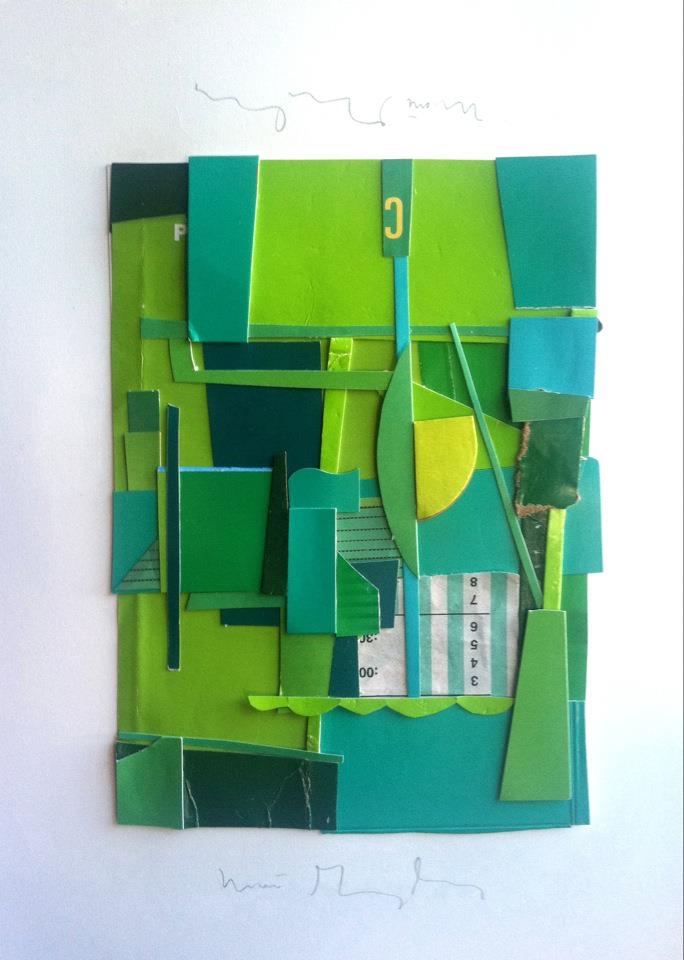
 Paper collage (11 x 14 inches) made with found materials by Matt Gonzalez.

MATT GONZALEZ AT TRIPLE BASE GALLERY

by Paul Occam

Triple Base Gallery on 24th Street recently unveiled its new artists in a flat file project that allows a standing exhibit of hundreds of works on paper from 16 artists.  The show ended on December 19, but the pieces are still at the gallery in files.

Among some of the most interesting work presented was that of Matt Gonzalez, the progressive leader who shaped much of the political landscape in San Francisco from 2000 to 2004.

What has always been striking about Gonzalez, politically, socially and otherwise, has been his staunch refusal to separate art from life. As a small but significant measure of this impact, Gonzalez was the first elected official in San Francisco to open his office for artists to put on monthly art shows.

The practice he initiated of opening city hall to art and artists—merging art and politics—has become so popular that it is common for many officials to host art shows in their offices. This victory of non-separation represents a reappraisal of the political landscape that needs to grow.

With relatively little attention and a host of small successful gallery showings at Adobe Books, Lincart and Johansson Projects, Gonzalez has produced more than 500 intimate small-scale collages over the last six years.  Many are done in the spirit of Kurt Schwitters, using only found materials collected on his walks through the city or poached from invitations he receives by mail.

The works can be found on the walls of other artists including Bay Area figurative legend Theophilus Brown and the well-known Mexican painter Gustavo Ramos Rivera.

Gonzalez’s primary palette is stuff other people throw away. The works themselves are meditations on value, meaning and social norms. As a body, the work recalls the Phillip K. Dick saying, “divinity is found in the trash substratum.”

The visual impact and gravity of his work is such that Gonzalez should not be denied a second career as an artist and may be remembered someday more in that vein, than as a politician.

The work is composed of images and discarded packaging, the disambiguation of old meanings through minor resurrections of color, compositions and forays into textures and curiosity.

The innocence of many of the pieces is striking and noticeable, inviting the spectator to see something with new eyes—similar to the way a child might be fascinated by a color or an object it instinctively reaches out for on the sidewalk, only to have an adult quickly shoo it away to enforce the conceptual reality of what is “allowed”.

Gonzalez’s work re-invigorates this moment, but stops the hand of authority before it can get a complete stranglehold on our innate sense of wonder.

Gonzalez’s reappraisal of this moment and his willingness to pick up the forgotten, unseen and rejected is a meditation on compassion. It displays an intimacy with things other people don’t want to be reminded of, as if to say “But look how great this is if you only get rid of your idea about it!” In this way the pieces are balanced by a sense of humor and the inherent questions that they pose about late capitalism, status and prescribed values.

Some of the pieces belong in the philosophical company of Asger Jorn and Guy Debord, two of the most famous members of the situationist international, and possibly as a continuation of their famous critique “The Society of the Spectacle.”

The pieces are a playful critique of modern society and throwaway culture. Gonzalez pays attention to ideas and things left in the margins and rescues them from oblivion and unconsciousness in such a way as to show us the ghost of modern living that lurks outside our doors.

Gonzalez goes further than Asger Jorn and Guy Debord when he appropriates the situationist concept of the “Drift”—a deliberately poetic and uncalculated exploration of the city—and catalogues it by creating artifacts of experience, an archaeology of everyday life created from discarded images and messages that he juxtaposes into small works of art.

The perspective is one that might be welcomed in a zen tea house—getting rid of the concepts of the past by presenting them without the garbage of conditioned thinking.

One notes that Gonzalez’s work in every field has always retained a trace of the outsider. In some sense he has made a career in representing people without a voice.

–Paul Occam

Paul Occam is the pen name of a San Francisco writer.

This review was first published at Mission Loc@l.

The Sestina Has Been Sinking, by Steve Davenport

The Sestina Has Been Sinking

for EMW

Sestina, tonight’s the night I push you off the overpass.
I’m done with your six kinds of hell. Your demanding sky,
your French complications, your clouds in my happy wagon,
your forty-two words for rain, your pearl-handled gun,
this concrete and asphalt that leap-frogs the low ground
locals call the Bottom, dirt cursed with industry and blood.

I’m done with your sixes and sevens, the pressure of blood
at the thirty-nine sutures pinning us to this long overpass
you keep calling me to, far above the patchy ground
that only we who grew up here could think deserves a sky,
any sky, even this one with its petro stink. I too have a gun,
this twelve-gauge I’m pulling loaded from my buckshot wagon.

May your pieces make a smart pattern. May the dead wagon
carry a vacuum and glue. If there are forty-two words for hell,
I expect thirty-nine of them to be you. You need a real gun,
Sestina, my dirt under your nails, the rough of this overpass
for texture, the heft of a gunite hose shooting two-up at the sky
to make a holy road for rich pilgrims heading for better ground,

which means rolling or manicured or ode-worthy, any ground
but this petro dirt you call me back to with talk of the wagon
that will save you. I’d do the Crazy Wing through a bad sky
if I thought I had anything new for you and your stale blood,
your long form, the way your returns wrap this overpass,
Sestina, in the same old sixes and sevens. Better someone gun

you down than endure one more round of blanks from the gun
you pull from your obvious garter. Better the hard ground
meet you falling than I waste my love from this overpass
on your history, the stretch marks you earned on the art wagon.
Bottom needs steel, slaughterhouses, freight trains bringing blood
and thump of flesh on flesh to make its rough song, one part sky

to five parts slag and spill, glorious smokestacks praising the sky,
canals, and river, a round of voices joining as I lift my shotgun
and new ashes settle all over this Bottom I love like blood.
Time for us to go, Sestina, double-pumped to sky and ground,
me to open fields, where I’ll whistle past the dead wagon,
and you to your forty-two words for life after overpass.

We promise to curse the sky. We deliver our ends to the ground.
We’re loaded on the meat wagon. We love the noise of the gun.
Here is the blood we love. Here is where we leave the overpass.


Steve Davenport is the author of Uncontainable Noise (2006), which won Pavement Saw Press’s Transcontinental Poetry Prize. His “Murder on Gasoline Lake,” listed as Notable in Best American Essays 2007, is available as a New American Press chapbook. Recent publications include a lyrical essay in Northwest Review, poetry and fiction in The Southern Review, and a scholarly essay about Richard Hugo’s poetry in All Our Stories Are Here: Critical Perspectives on Montana Literature (University of Nebraska Press, 2009).

SATURDAY POETRY SERIES PRESENTS: KENDRA GRANT MALONE


A PLACE WHERE YOU CAN BE ALONE
by Kendra Grant Malone

WHEN I GOT OFF THE TRAIN TONIGHT
I WANTED TO BE
BACK IN THE MIDWEST
THERE WAS NO REAL PROMPT
FOR IT
MY BRAIN WAS SUDDENLY
FLOODED WITH IDEAS
OF LAYING IN FIELDS
AT NIGHT ALONE
AND BEING ABLE TO SEE VERY FAR
A PLACE WITH NO HILLS
I WANTED TO BE
IN A PLACE
WHERE YOU COULD BE
ALONE AT NIGHT
AND HEAR THE INSECTS
SWARMING ABOVE YOU
AROUND YOU
A PLACE
WHERE YOU CAN SEE
THE WHOLE MILKY WAY
I DIDN’T WANT TO BE
IN NEW YORK
THE SMELL
IS AWFUL HERE
AND SO IS
THE CROWDING
I WANTED TO BE ALONE
LIKE YOU ONLY KNOW
WHEN YOU ARE FROM THE MIDWEST
WHERE IT IS POSSIBLE
TO DRIVE TWENTY MINUTES AWAY
AND BE THE ONLY HUMAN BEING
FOR MILES AND MILES
I WANT TO SPOON
THE CORN STALKS
TO SLEEP TONIGHT

(“A PLACE WHERE YOU CAN BE ALONE” was originally published in The Offending Adam and is reprinted here today with permission from the poet.)

Kendra Grant Malone lives with her cat Delores Grant Malone. Her first collection of poetry, Everything Is Quiet, is available at scrambler books. You can also visit her website to read more about her work and her cat at kendralovely.blogspot.com.

Editor’s Note: Today’s poem is dedicated to all of my Midwestern friends, particularly those of you who hail from the quiet sparse spaces. While so many of you have been eager to leave the stillness of that life behind for more urban pastures, I think you know what this poem is speaking to. How one might, in a moment overwhelmed by the hustle and bustle of city life, long “to drive twety minutes away and be the only human being for miles and miles,” “to spoon the corn stalks to sleep,” “to be alone like you only know when you are from the Midwest.” Perhaps you’re back in your Midwestern home today for the holiday, and perhaps this poem will help you to better appreciate your return.

Want to read more by and about Kendra Grant Malone?
Buy her book!
Kendra’s Blog
The Offending Adam

The Coming Crisis of Op-Ed Food: What Class Says About Food (or the Poverty of Food Theory)

By Liam Hysjulien

It’s hard to get behind any food movement (if they can even be categorized as such) these days.   While I tend to eat healthy—spending roughly a third of my income (which as a graduate student isn’t very hard) on organic, local foodstuff (mostly bulk grains, vegetables, and fruit)—I can’t buy into any movement that freely throws around—without a hint of irony—terms like “locavore” or “foodie.”

Still, I feel lambasting a movement that I respect, albeit not always linguistically, so dearly is counterproductive to fostering a united front.  If we are going to recreate our food system, both locally and globally, it is imperative that both the food intelligentsia (Pollan, Allen, Patel, Berry) and rank-and-file, food-minded citizens are not cannibalizing each other during this very important moment in time.

Decades from now, the early 2000s may be seen as a watershed moment for the alternative-food movement.  Sociologically speaking, food consciousness, akin to the increase in human-rights consciousness during the 80s, has entered full-force into mainstream American society.

Evidence of this collective food consciousness is everywhere, and unless McDonald’s begins injecting a brain-altering serum into their McRibs, it is here to stay. We can look at the popularity of movies like Food Inc. (Oscar-nominated) and Fresh and Pollan’s book, The Omnivore’s Dilemma, as good indicators that mainstream America is awake and mobilized toward the problems of our incredibly destructive food system.

But being awake about an issue doesn’t always mean you truly understand it.  And this is not to say that there aren’t smart people spending serious amounts of time looking at the issue of food, but personal experience, no matter how scientific we try to be, invariably leads to some degree of bias.  The problem is not the bias, but the fact that we seem to be ignoring glaring contradictions in favor of a more comfortable narrative.  The food movements seems to be content with the idea that since poor food choices got us into this mess, changing these choices will in turn solve the problem.

When Michael Pollan says that “[e]ight dollars for a dozen eggs sounds outrageous, but when you think that you can make a delicious meal from two eggs, that’s $1.50. It’s really not that much when we think of how we waste money in our lives” (Worthen 2010), there seems to be some strange, out-of-touch daftness in his line of thinking.  Is the problem simply that we haven’t understood the message of the food vanguards?  Perhaps, but I think there’s more to it than that.

I’d like to propose something a little more critical—fully aware that it will be perceived as both polemic and hyperbolic.  The problem of food is just another example of a systemic assault that has been waged against the poor and working-class in this country over the last thirty-odd years.  As wages have remained stagnant, the price of foodstuffs—with the exception of soda—has steadily risen.  We have the saturation of commercials focused almost exclusively on promoting heavy, processed, food-cum-chemically-enhanced meals to children—with fruits and vegetables rarely making an appearance.

We have people with limited access to personal transportation, coupled with working multiple jobs and longer hours, living in food-dead zones, where the nearest grocery store might be miles away.  We have basically created an economy running so fast and unequally that the logic of this system is predicated on people also eating as quickly and cheaply as possible.  This isn’t about people just not wanting to eat healthy food.  Or not knowing some ridiculous cost-balance equation about how spending X amount of money on nutritious food today will save Y dollars on health bills in the future.  Or the platitudes that if people stopped wasting so much money on material junk they’d have more money left to buy $4.00 organic peaches.  It’s about a system in which food, which should be the most basic of rights, is now some repackaged, commodified afterthought.

The problem of consumer-based movements is that they tend to focus all the strategies on personal choice, disregarding structural inequalities that are at the root of our food problems.  And even when they acknowledge these structures, they think that civil-society-promoted social movements can somehow operate successfully within the system.  When thinking of food, the question should not be why people don’t eat well, but why we have created a system that reinforces—at a cost to mental health, financial security, and physical well-being—a food plutocracy where food has become increasingly fetishized at the top and placed out of the reach at the bottom.

As citizens we need to break the Ag Business-political accord.  This can be done by voting into office people who are not wedded to the interests of Big AG, supporting your local food movements, and pressuring at all levels of government a need for healthy and safe food alternatives.  But without widening government support toward locally grown food, current food solutions will remain largely on the periphery—eating around the edges instead of tackling the middle of our increasing food crisis.

If the 2050 food disasters narratives are even half true, it’s not a matter of making better personal food choices, following rules of eating, or becoming awakened to a foodie manifesto, it’s about addressing a coming global food disaster the world has never seen.  I think the food movement needs to push even further and leave no options off the table.   As Raj Patel once said, “why are there markets of food at all?”  If we are going to buy into the idea, as proposed by the likes of Graham Riches and Patricia Allen, that access to healthy and safe food is a fundamental human right, how then that right becomes realized is an essential question.

How about a government program that tiers the prices of food—through EBT-type cards—by income bracket?  Or government refund checks to individuals who buy fruits and vegetables.   This isn’t about accepting a future of “eight-dollar eggs” which will only exacerbate the division—mostly along class lines— between the well fed haves and the well fed have-nots, but about realizing that gravity of our food future requires a range of solutions.

Andreas Economakis

Paul Simonon and Joe Strummer (Rock in Athens, July 27, 1985)

“Do You Really Want To Hurt Me?”

by Andreas Economakis

July 27, 1985. Day 2 of the big Rock in Athens concert. S. and I squeeze our way through the excited crowd and sit down on the white marble seats. We look around the open-air Kallimarmaro Stadium, home to the 1896 Olympics. The Clash are playing tonight and the place is packed to the gills. I mention to S. that I finished the marathon in this stadium when I was twelve years old. I remember being so very upset that the local newspaper misspelled my last name in the article the next day. My mom, feeling bad, whited-out the mistake and carefully wrote in my name. It was nice of her but it didn’t take the bitterness away.

I pull out a can of smuggled Amstel beer and crack it open. I hand the can to S. and she takes a swing. She hands the can back to me, her eyes smiling, flirting. Things are finally warming up between us. The mythical woman on the pedestal is finally becoming human, approachable. I’m so infatuated with her.

The lights dim. The crowd starts whistling in anticipation. Suddenly, S. takes my hand in hers. My heart skips a beat. My mind travels to the night before. There we are, seated in the same marble seats, but things are so very different. No smiling, flirting eyes, no heart-skipping looks or touches. Almost like an anti-climax, Boy George of Culture Club steps on stage. His hair is gelled high over an overly made-up face, the eyeliner around his glazed eyes giving him an almost macabre look. He’s wearing a strange and not too flattering green training outfit with shiny reflector strips and he’s sweating buckets in the hot Athenian air. Like gasoline tossed on fire, the crowd up front, mostly punks, start heckling and jeering. Before long they start throwing pebbles and water bottles at Boy George. He leaves the stage in a fit of disappointment. After several rollicking minutes of uncertainty, an announcer comes on stage and chides the crowd. A few more awkward minutes pass by and Boy George steps back on stage, inflamed eyes scanning with crowd nervously. He walks up to the microphone, takes a deep breath, and starts singing “Do you really want to hurt me?” The crowd roars “YES!!!” in unison and pelts him with more pebbles and bottles and insults. Remarkably, Boy braves his way through the song, hips dancing and swaying melifluously around the flying detritus and hurled invectives. When the song ends and the mayhem and impending carnage becomes fully apparent, Culture Club decides to flee the stage. My last image of Boy is a frightened flurry of green fabric and black face make-up, the stage’s probing spotlights making him look a like a fugitive zombie from Michael Jackson’s “Thriller.” Outside the stadium, petrol smoke, black as night, billows up to the darkening orange-blue sky. Word gets around that punks outside the stadium have set fire to Boy’s tour-bus. In reality, several concert crashers have set a car on fire as they are upset at being kept out of the stadium by a beefed-up police force. The stadium is rolling in confusion and smoke, everyone unsure if the concert’s going to be cancelled.

The lights dim and then, suddenly, Joe Strummer walks on stage. Back to today. The crowd explodes in applause. A hero’s welcome. “Should I Stay or Should I Go?” he bellows. “STAY!!!” the Greek crowd roars. I swear, I’m so happy to see Joe that tears well up in my eyes. A smiling S. turns toward me and kisses me on the lips. Joe finishes the song and dives into the crowd. He’s hoisted up, swirled around over people’s heads and thrown back on stage. He grabs the mic for the next song. That night S. and I become boyfriend and girlfriend. I owe it all to the Clash. Thank you, Joe Strummer. Thank you.

–Andreas Economakis

This piece is part of a collection of stories on blindness entitled: The Blindness of Life.

Copyright © 2010, Andreas Economakis. All rights reserved.

For more stories by Andreas Economakis click on the author’s name below.

SATURDAY POETRY SERIES PRESENTS: OKLA ELLIOTT

By Okla Elliott:

THE IDIOT’S FAITH

Three lanterns floated in the dream she told him, but he didn’t want to hear about lanterns. He wanted factories unbuilt, windows smashed open. He wanted libertine wailings. She denied being a builder of factories, but he knew her reputation. A wind blew in from Montreal, or she said it was from Montreal, said she could smell the bars of Rue St Laurent. He was skeptical but didn’t want to argue. What good are arguments on a Saturday night? What good are arguments at all? She told him again about her love of the French language, and he thought maybe they were getting somewhere. The modern sunset outside her window was spilled wine tinged with pollution. They went down the mountain to town, found the trouble she had decided they wanted. She called a homeless man a fallen Chinese god, and they mourned his sad descent, forgetting (almost) their own. That is the power of generosity, one use of our idiot faith in human love.


THE LIGHT HERE

It sets a mood
of clownish tragedy,
of ecstatic failure waiting to happen.

It is not a static blue light
nor the throb of a strobe.

It is not a light to read by
nor to be naked in,
unless you are desperate
or barbarously horny.

I would use it to look for you
in a cave or catacomb
or an ossuary crowded by the famous dead–
that is, if you were in such a place,
I would use this light to find you.

It is a light that yellows the periphery.
It is not a light that brightens the center.

It is mixed from an overcast morning
and the electric urban dusk.

It is a light I could live in
if I came to terms with certain failings
in my character
and the character of others.

I know you have light where you are,
better light even,
but I wanted you to know
about the light here.

 
Okla Elliott is currently the Illinois Distinguished Fellow at the University of Illinois, where he studies comparative literature and cultural theory. He also holds an MFA from Ohio State University. For the academic year 2008-09, he was a visiting assistant professor at Ohio Wesleyan University. His drama, non-fiction, poetry, short fiction, and translations have appeared or are forthcoming in Another Chicago Magazine, Indiana Review, The Literary Review, Natural Bridge, New Letters, North Dakota Quarterly, A Public Space, and The Southeast Review, among others. He is the author of two poetry chapbooks–The Mutable Wheel and Lucid Bodies and Other Poems–and he co-edited (with Kyle Minor) The Other Chekhov.

Editor’s Note: Today I am honored to present to you the work of As It Ought To Be‘s managing editor. His work speaks for itself, as does the significant body of publications in which his work has appeared. Okla is an impressive scholar, a fearless leader, and a wonderful person to know in the writing world. He believes strongly in the idea of building and sustaining a community of writers, and I am honored to be a member of that community. Regarding today’s pieces I will say that Mr. Elliott effortlessly combines vignettes of straightforward narrative with crisp images and moments of simple yet brilliant language such as “What good are arguments on a Saturday night? What good are arguments at all,” “if you were in such a place, I would use this light to find you,” and this kicker of an ending, “It is a light I could live in / if I came to terms with certain failings / in my character / and the character of others. / I know you have light where you are, / better light even, / but I wanted you to know / about the light here.” Simple. Elegant. Stunning.

Buy Okla Elliott’s new book, A Vulgar Geography.

Felix Macnee

Wayne Thiebaud, Cake Slices, 1963. From the Allan Stone Gallery.

HAPPY BIRTHDAY, DUMMY

by Felix Macnee

Alysia loved my family, and loved visiting New Orleans. It was always nice having her around because of her enthusiasm for everything, the details of life, the little things that made each new moment different from those that had come before.

She and I were walking to the French Quarter one crisp, chilly day in January, and she was picking out the details of architecture that fascinated her, under-radar beauties such as the Water Department logo of a crescent moon that adorned the worn metal discs in the sidewalk.

She and I passed a bakery and on a whim she suggested we get a cake.

“That’s brilliant,” I said. “Why not just get a cake for no reason?”

“Yeah,” she said, “for no reason!”

This was what I loved about her. An adherence to spontaneity.

“Why do we always have to have some special occasion for a cake?” I said, belaboring the point.

“What kind should we get?”

“How about German chocolate?” I said. “Nothing like the classic chocolate cake!”

We were about to pay for it, but Alysia stopped me:

“Hey,” she said, “why not have them write something on it? I mean, why not? How about a joke?”

“Yeah, that’s good …” I said.

“How about ‘Happy Birthday, Dummy’?”

“That’s great!” I said. “Brilliant! A cake for no reason, and a stupid inscription!”

“Right!” she said.

We brought it home, and later that evening I remembered it was my birthday.

–Felix Macnee

Open Letter: A Pre-Post-Mortem

OPEN LETTER: A PRE-POST-MORTEM

by John Halle

As of this writing, the “Open Letter to the Left Establishment” is inching towards its goal of 5,000 signatures. It has not “gone viral” compared to certain dancing parrots and singing dogs, though it should be kept in mind that this response was achieved without very much exposure on the web from large “gatekeeper” sites.

In particular, while we did, of course, send it to them, none of the high traffic progressive sites, alternet, commondreams, or truthdig made any mention of it. Nor was it placed on high traffic blogs such as firedoglake or openleft, to say nothing of the so-called access blogs Daily Kos or Huffington Post.

Of those medium traffic left sites which did run it, Znet allowed it on its front page briefly and then removed it within less than a day-displacing it with a response by Bill Fletcher now front-paged on the site for three days. In comments attached to it, Znet editor Michael Albert claims to have signed the letter “by mistake”-failing to mention that he didn’t merely sign it but posted it on his own website.

Counterpunch ran it on its weekend edition-albeit far down on the page-just below a story about the unveiling of a new organ in Ithaca.

Truthout ran it on its front page, and it continues to maintain its place there four days after as the most read story on the site.

The mostly hands-off reaction might have come as a surprise given that the letter included the signatures of a cross section of left luminaries, many of whom are routinely featured in these same outlets- Chris Hedges, Noam Chomsky, Cindy Sheehan, Cornel West among others. Novelist Russell Banks and non-fiction author Mark Kurlansky also signed on. Also coming in over the transom, as it were, were unsolicited signatures from Emmanuel Wallerstein, Frances Fox Piven, Jean Bricmont, Nell Painter, Steven Zunes, Paul Buehl and even Michael Lerner.

But for those with a sufficiently skeptical view of such matters the blackout from the great majority of the establishment left media was predictable.

For as a basic rule, no institution or individual takes kindly to its authority being challenged-and that includes those which claim, as many leftists do, to be anti-authoritarian.

I should stress that challenging the authority of left individuals and the media which provided outlets for them was not the main purpose of the letter, which was, as we make clear, to advocate for the support of the kinds of protest actions against the Obama administration which are now desperately necessary. Nor, speaking for myself, was it pleasant to do so given that some of these were key figures in my own intellectual and political development. Furthermore, in the main, I think these outlets, including those sites mentioned above, generally do a good job, and so it does not serve the interests of the left to have their authority undermined.

Unfortunately, when it comes to the Obama campaign and the first two years of his administration, a near complete collapse of objectivity raised serious questions with respect to the credibility of numerous high profile figures and media organs of the left. Challenging some of them therefore, became a regrettable necessity. More seriously, it has also been necessary due to the fact that many of these figures continue to refuse to do what the letter urges them to do: namely to actively support protests against the Obama administration”.

This has been demonstrated by the two responses to the letter which have been received since its posting by Bill Fletcher and Tom Hayden. For rather than refute the charge that both remain incapable of offering strong and unqualified support to demonstrations of the size and intensity required, they confirm it. Thus, Hayden describes the civil disobedience action at the White House scheduled for Dec. 16 as “somewhat justifiable” although questioning whether “it was a smart idea to begin with.” Nothing could better typify the kinds of half-hearted, tepid and qualified response which has played a major role in the demobilization of protest for all to many years. Fletcher’s response, however, goes one better: failing even to offer any endorsement or mention the protest at all! Furthermore, almost the entirety of the response is based on misreading, either careless or deliberate, in which the letter is claimed to “call(s) upon those named in the first paragraph to criticize the policies of the Obama administration.” It does nothing of the kind, of course. The first sentence of is “a call for active support of protest” not criticism of which there is always more than enough to go around.

Nothing could better demonstrate the necessity for challenging the authority of these two as leading voices of the left. It it s therefore convenient that when it comes to Fletcher and Hayden and the remainder of the recipients of the letter, this task was easily accomplished by simply noting some (though by no means all) of the most destructive aspects of the Obama presidency and addressing the recipients as “supporters”. That they were supporters is, of course, the undeniable fact of the matter though it should be kept in mind that their support was to a greater or lesser degree “critical” lying along a spectrum of which the following two quotations can be seen as indicating the two extremes.

“Barack Obama is clearly a reform president committed to improvement of peoples’ lives and the renewal and reconstruction of America.” (Katrina van den Heuvel)

“Putting Obama in the White House would not by any means ensure progressive change, but under his presidency the grassroots would have an opportunity to create it.” (Norman Solomon)

The first of these was typical of much that was written at the time. It is obviously absurd on its face, and the less said about it the better-though mention should probably be made that it gives the lie to the pretentious and corrosive claim that the left constitutes a “reality based community.”

The second encapsulates the positions of the more sober and rational Obama supporters, most notably those associated with the Progressive Democrats of America. Here the claim was at least superficially reasonable, but by now has shown by events to have been almost completely false. As should be obvious, protest is only now starting to develop, and compared to the peak of millions on the streets in March of 2003 remains virtually non-existent.

The reason for this vacuum has to do with a virtually unbreakable law of left organizing which operates roughly as follows: when a Democratic President enters office, those membership organizations which had been on the outside now see themselves as having a seat at the table. This is achieved through movement leadership being offered positions-albeit low to midlevel positions-in the administration. When they are not actually invited into the administration, elite levels of the left establishment see themselves as having “access” to some these figures, with the result that organizations, media outlets and high profile figures which would otherwise be organizing grassroots protests are now counseling patience, tolerance and, at the very least, “critical” support.

The Obama administration is, in fact, somewhat striking, no doubt to the displeasure of the left establishment, for the weakness with which it implemented this well-worn co-optation strategy. That said, there were at least some within it who could be pointed to as “our friends”. Hilda Solis as Secretary of Labor remains a favorite of organized labor as does Jared Bernstein. Steven Chu was initially seen by environmentalists as likely to function as a strong advocate for a sane policy on Global Warming, as was Science Advisor Steven Holdren. Human rights icon Samantha Power, now signing off on predator drone attacks in Pakistan on the National Security Council, is another. These and others (even including the exiled Van Jones) continue an unending flow of apologetics for the administration, some fraction of which are still taken seriously by some of the recipients and which have been sufficient, it would seem, to maintain the illusions among labor, environmental, and human rights organizations of access to the administration.

All this is directly relevant to purpose of the letter in that the perception of access to “friends” on the inside ensures that the organizational infrastructure which is necessary to organize protest withers, leaving it to outside marginal groups the necessity to build this infrastructure from scratch.

As noted, all this should have been obvious to those who lived through, or at least read about, the Carter and Clinton administrations where the dynamic of co-optation was refined to something close to a science. So when we confronted it anew under Obama, we should have seen it, and the events which followed, for the inevitabilities which they were and be prepared to confront them. We did not because those who should have been warning us had an investment in the Obama campaign and Obama brand, and what they felt it represented, and were thereby unwilling or unable to do so. The legacy of false claims and unrealistic expectations lives on in the continuing failure of many of these figures to advocate for protest on the scale and intensity which is required.

An awareness of this fact, as indicated by the 4000 signatories, is slowly percolating through the rank and file left. But since the left establishment gatekeepers will not allow expressions of it to surface on those high traffic sites which they control, it will need to develop further before it reaches a breaking point. When this occurs institutional leadership personified by figures such as Hayden and Fletcher is correctly seen as a major obstacle to the progress of the protest movement. At this point the rank and file will begin to develop their own institutions independent of what have become, for all practical purposes, fatally compromised institutions and spokepersons.

Or, a more happy development, would be if those left establishment figures we address, and others we do not, were to do as signatory Doug Henwood does gracefully in his statement in support of our letter. They should own up to their past mistakes, and show by their words and actions that they are now committed not to support, critical or otherwise of the Obama administration, but to active and militant opposition to its policies.

There is no good reason, it seems to us, why they could, or should, not do precisely that.

And should they do so, we will welcome them with open arms.

–John Halle

John Halle is a former Green Party Alderman for the city of New Haven, Connecticut, and is on the faculty at Bard College in New York State where he teaches music theory and is active as a composer. His political writings can be found at his website johnhalle.com.